
Understanding the intuitive vs sensing personality distinction is the most critical step in mastering the Myers-Briggs Type Indicator (MBTI). While many users focus on whether they are introverted or extroverted, the way you perceive information fundamentally shapes your reality, decision-making style, and communication patterns. If you take only one conclusion from this article, let it be this: relying solely on the four-letter code without understanding the underlying cognitive functions will lead to superficial insights and potential mistypes. True type confirmation requires observing how you process data, not just how you behave socially.
The MBTI is a tool for understanding preferences, not a label that defines the whole person. It helps individuals identify their natural strengths, potential blind spots, and pathways for growth. However, the debate between intuition and sensing is often clouded by stereotypes. Sensing types are not uncreative, and intuitive types are not impractical. To navigate this complexity, we must return to the Jungian roots of the theory. This article provides a comprehensive analysis of the intuitive vs sensing personality dynamic, offering practical frameworks for career, relationships, and personal development while emphasizing the importance of cognitive functions over simple letter binaries.
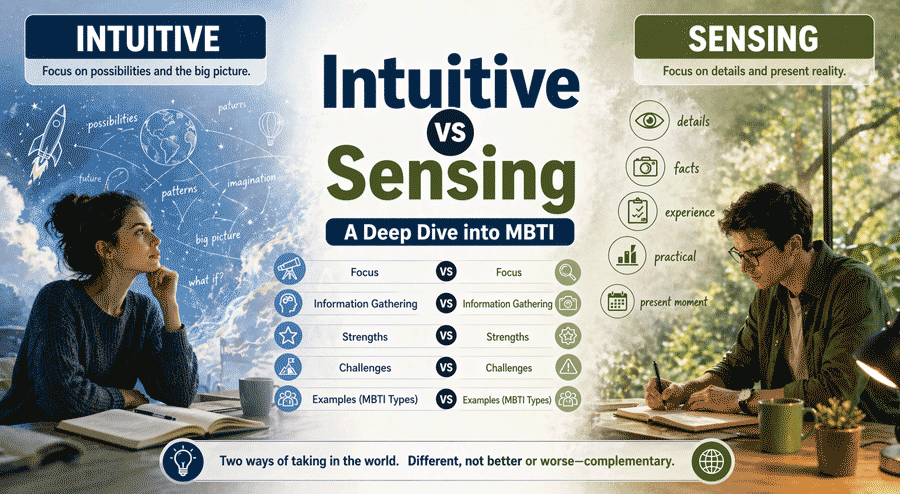
The Framework and Mechanism of Perception
To understand the intuitive vs sensing personality difference, we must look beyond the surface-level dichotomies and examine the Jungian roots of MBTI. Carl Jung proposed that humans have distinct psychological preferences in how they perceive the world and make decisions. The MBTI builds on this by categorizing these preferences into four dichotomies: Extraversion vs. Introversion, Sensing vs. Intuition, Thinking vs. Feeling, and Judging vs. Perceiving. While all four are important, the middle two letters (S/N and T/F) represent the core cognitive processes that drive behavior.
The Sensing (S) and Intuition (N) preference describes how you gather information. Sensing types prefer concrete, tangible data derived from the five senses. They focus on the present moment, practical realities, and established facts. Intuitive types prefer abstract patterns, possibilities, and future implications. They focus on the big picture, underlying meanings, and theoretical connections. However, this binary description is often too simplistic. The real mechanism lies in the cognitive function stack.
Cognitive Function Stack
Every personality type operates using a stack of four cognitive functions: dominant, auxiliary, tertiary, and inferior. For sensing types, this involves either Extraverted Sensing (Se) or Introverted Sensing (Si). For intuitive types, it involves either Extraverted Intuition (Ne) or Introverted Intuition (Ni). Understanding which function is dominant is crucial for type confirmation. For example, an ISTJ uses Introverted Sensing (Si) as their dominant function, meaning they prioritize internal sensory impressions and past experiences. An ENFP uses Extraverted Intuition (Ne) as their dominant function, meaning they prioritize exploring external possibilities and connections.
Why does letter-based typing alone often cause mistypes? Because behavior is adaptable. A sensing type can learn to think abstractly, and an intuitive type can learn to focus on details. Under stress or in professional environments, individuals often develop their non-preferred functions to survive. This behavioral adaptation can mask their true preference. Therefore, validating your type requires self-observation of your natural energy flow. When are you most energized? When recalling specific details (Si), engaging with the physical environment (Se), brainstorming multiple options (Ne), or synthesizing a singular vision (Ni)?
Decision patterns, stress reactions, and motivation are better indicators than test scores. If you frequently feel drained after focusing on minute details for too long, you may lean towards intuition. If you feel anxious when plans are too vague without concrete steps, you may lean towards sensing. Long-term feedback from others also helps. Do people describe you as grounded and realistic, or visionary and abstract? While famous public figures are often typed for illustration, such as Albert Einstein who is widely believed to be an intuitive type, these typings should be treated as hypotheses rather than facts. Use them to understand function dynamics, not to copy identities.
Application Guidance for Daily Life
Understanding the intuitive vs sensing personality dynamic is not just theoretical; it has profound practical applications. Below are two frameworks to help you apply this knowledge to your career and relationships.
Framework 1: Career and Work-Style Fit
This framework applies when you are choosing a career path, negotiating work responsibilities, or trying to improve productivity. It relates directly to how different functions process information and solve problems.
For Sensing Types (Si/Se): You thrive in environments where there is clear structure, tangible results, and immediate application of skills. Roles in operations, logistics, healthcare, or trades often fit well. You excel at maintaining quality control and ensuring procedures are followed. To leverage this, seek projects where you can see the direct impact of your work. Break large goals into actionable steps. Your benefit is reliability and precision. The limitation is potential resistance to untested theories. To judge if this fits, ask yourself: Do I feel confident when I have a clear manual or precedent?
For Intuitive Types (Ni/Ne): You thrive in environments that allow for innovation, strategy, and conceptual development. Roles in research, marketing, entrepreneurship, or systems design often fit well. You excel at identifying future trends and solving complex, abstract problems. To leverage this, seek projects that allow you to design the framework rather than just execute it. Connect daily tasks to a larger mission. Your benefit is vision and adaptability. The limitation is potential neglect of routine details. To judge if this fits, ask yourself: Do I feel energized when solving a problem that has no existing solution?
Framework 2: Relationship and Communication Guidance
This framework applies when navigating conflicts, collaborating in teams, or building personal relationships. It addresses the common friction points between sensing and intuitive communication patterns.
Bridging the Gap: Sensing types communicate linearly, focusing on facts and chronological events. Intuitive types communicate associatively, jumping between concepts and implications. Misunderstandings occur when sensors feel intuitives are impractical, and intuitives feel sensors are pedantic. To improve communication, sensing types should try to state the "why" behind the details, providing context for the intuitive partner. Intuitive types should try to provide concrete examples and step-by-step plans to reassure the sensing partner.
Practical Action Steps: When discussing a problem, agree on whether you are brainstorming possibilities (N) or deciding on a concrete plan (S). Use visual aids for sensors and conceptual maps for intuitives. The benefit is reduced conflict and increased mutual respect. The limitation is that it requires conscious effort and may feel unnatural initially. You can judge whether this fits by monitoring your frustration levels during conversations. If you frequently feel "not heard," examine whether the mismatch is due to sensing vs intuitive processing styles.
Growth and Personal Development
Personal growth in the context of MBTI is not about changing your type but about expanding your flexibility. The core principle is to identify your dominant function first. This is your natural strength and where you should build your foundation. However, relying solely on your dominant function leads to imbalance. You must distinguish preference from skill. Just because you prefer intuition does not mean you cannot develop sensing skills, and vice versa.
A critical aspect of growth is developing the inferior function gradually. For intuitive types, the inferior function is sensing (either Se or Si). For sensing types, the inferior function is intuition (either Ne or Ni). This function is often the source of stress but also holds the key to maturity. For example, an intuitive type under stress may become hyper-focused on physical sensations or details in a unhealthy way. Recognizing this allows you to engage the inferior function consciously rather than reactively.
You must also understand loop and grip patterns. A "loop" occurs when you bypass your auxiliary function and oscillate between your dominant and tertiary functions. For example, an INTJ might loop between Ni and Fi, becoming overly introspective and detached from reality. A "grip" occurs when you are overwhelmed by your inferior function. An ESTJ in a grip might become uncharacteristically emotional or obsessed with abstract possibilities. Growth means flexibility, not identity attachment. Do not use your type as an excuse for bad behavior. Instead, use it as a map to identify where you need to stretch.
Common Mistakes and Pitfalls
To ensure you are using the MBTI effectively, avoid these eight common pitfalls. Each represents a misunderstanding of the intuitive vs sensing personality dynamic.
1. Don't stereotype based on letters alone. Assuming all intuitives are artists and all sensors are accountants limits potential. Instead, look at the specific cognitive functions involved.
2. Don't ignore context. Your behavior changes based on environment. A sensing type in a creative role may appear intuitive. Instead, observe where you recharge.
3. Don't treat tests as definitive. Online tests often measure behavior, not preference. Instead, use tests as a starting point for self-study.
4. Don't value one preference over the other. Society often prizes intuition, but sensing is equally vital for execution. Instead, appreciate the complementary strengths.
5. Don't use type to excuse weaknesses. Saying "I'm an intuitive, so I'm bad with details" is avoidance. Instead, develop systems to manage details.
6. Don't assume type determines compatibility. Any two types can have a healthy relationship. Instead, focus on communication skills and mutual respect.
7. Don't neglect the inferior function. Ignoring your weaker side leads to stress bursts. Instead, practice small doses of inferior function activities.
8. Don't treat type as static. While preferences are stable, expression evolves. Instead, allow your understanding of your type to deepen over time.
Ongoing Learning and Resources
The field of personality psychology is evolving. To maintain accuracy, encourage yourself to keep following new research and higher-quality MBTI and Jungian resources. Credible organizations such as the Myers & Briggs Foundation and the Center for Applications of Psychological Type (CAPT) provide foundational materials. Jungian educational resources also offer deeper theoretical context. Be wary of debates and newer interpretations that lack empirical backing. Learn to identify reliable information by checking if the source distinguishes between preference and skill. Avoid low-quality summaries that reduce complex functions to memes or horoscopes. Continuous learning ensures you remain grounded in the theory's intended purpose: self-awareness and development.
Frequently Asked Questions
1. What is the best entry point for beginners? Start by learning the four cognitive functions rather than the 16 types. Understanding Si, Se, Ni, and Ne clarifies the intuitive vs sensing personality distinction more effectively than reading type descriptions. This prevents confusion caused by overlapping behaviors.
2. How can I confirm my type without tests? Observe your stress reactions. When overwhelmed, do you become overly detail-oriented (Sensing grip) or overly scattered and abstract (Intuitive grip)? Also, ask trusted friends how they perceive your decision-making process over time.
3. How does this affect relationship communication? Sensing types prefer direct, factual communication, while intuitive types prefer conceptual discussions. Acknowledge this difference explicitly. Agree on when to focus on details and when to focus on the big picture to avoid frustration.
4. Can I learn cognitive functions efficiently? Yes, by journaling. Record your decisions and note which function you used. Did you rely on past experience (Si), immediate data (Se), future patterns (Ni), or external possibilities (Ne)? Reviewing these entries reveals patterns.
5. Can my personality type change? Your core preferences are generally stable throughout adulthood. However, your ability to use non-preferred functions improves with maturity. What changes is not the type, but your flexibility and integration of all functions.