
When exploring personality dynamics, many seekers look for positive indicators of healthy development. In the context of psychological typing, identifying mbti green flags is not about finding perfect traits but recognizing signs of balanced cognitive function usage. True personality growth begins when we move beyond the four-letter code and understand the underlying mental processes that drive behavior. This article provides a comprehensive guide to understanding these indicators through the lens of Jungian theory, offering practical frameworks for relationships, career, and personal evolution.
The Myers-Briggs Type Indicator (MBTI) is a widely used tool for understanding psychological preferences. It helps individuals identify how they perceive the world and make decisions. However, its utility is maximized only when users recognize that the four letters are merely shorthand for a deeper stack of cognitive functions. Whether you are trying to understand your own type more accurately, exploring compatibility, or seeking growth, the real value lies in the mechanics of the mind, not the label itself. This guide is designed for English-speaking readers who seek depth beyond stereotypes and wish to apply MBTI principles with nuance and precision.
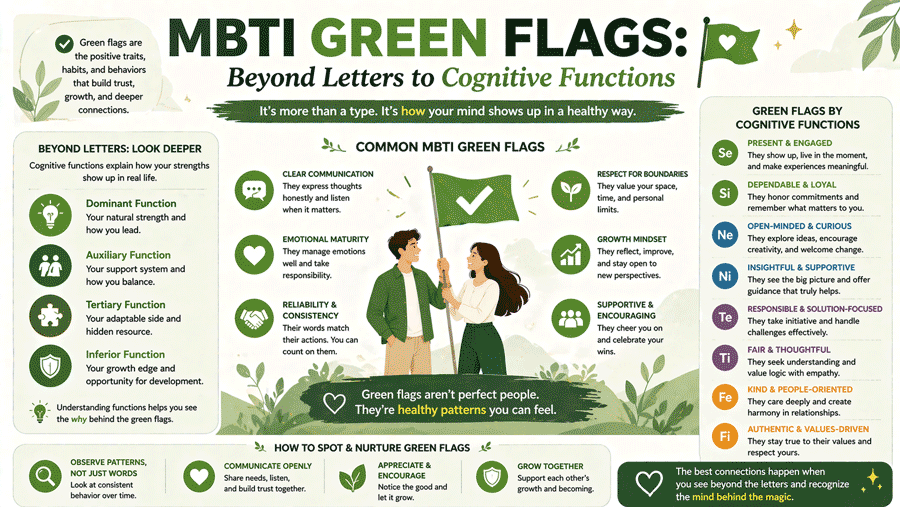
The Framework: Jungian Roots and Cognitive Mechanics
To genuinely identify healthy patterns, one must understand the engine behind the type. The MBTI is rooted in Carl Jung's theory of psychological types, which posits that human behavior is not random but follows predictable patterns based on how we process information. The four dichotomies—Extraversion/Introversion, Sensing/Intuition, Thinking/Feeling, and Judging/Perceiving—describe preferences, but they do not explain the hierarchy of mental processes.
The Cognitive Function Stack
Every type operates using a stack of four primary cognitive functions. These include the Dominant, Auxiliary, Tertiary, and Inferior functions. For example, an INTJ leads with Introverted Intuition (Ni), supported by Extraverted Thinking (Te). An ESFP leads with Extraverted Sensing (Se), supported by Introverted Feeling (Fi). Understanding this stack is crucial because mbti green flags often manifest as the healthy integration of these functions, particularly the auxiliary and tertiary, while managing the inferior.
The Dominant function is the hero archetype; it is where we are most competent and comfortable. The Auxiliary function supports the dominant, providing balance (e.g., if the dominant is perceiving, the auxiliary is judging). The Tertiary function is often less developed in youth but becomes a source of relaxation and creativity in mid-life. The Inferior function is the weakest link, often emerging under stress as a source of insecurity or overcompensation.
Why Letter-Based Typing Causes Mistypes
Relying solely on the four letters often leads to mistyping because behavior can be misleading. An individual might appear organized (Judging) due to workplace demands, even if their natural preference is flexibility (Perceiving). Similarly, someone might act logical (Thinking) in professional settings while valuing harmony (Feeling) personally. Without analyzing the cognitive functions, users may confuse social masking with genuine preference.
Validating your type requires self-observation of decision patterns, stress reactions, and motivation. Ask yourself: Where do I gain energy? What information do I trust most? How do I evaluate choices? Long-term feedback from others who know you well can also clarify blind spots. Tests are useful starting points, but they measure self-perception, which can be biased. True type confirmation comes from recognizing the consistent flow of energy through your function stack over time.
Illustrative Examples
While we must avoid labeling public figures definitively, observing widely believed typings can illustrate function dynamics. For instance, a leader often typed as ENTJ might demonstrate strong Extraverted Thinking through decisive organizational strategies, balanced by Introverted Intuition in long-term vision. Conversely, a mediator figure often associated with INFP might show deep Introverted Feeling through authentic value alignment, supported by Extraverted Intuition in exploring possibilities. These examples serve only to highlight how functions manifest, not to cement celebrity identities.
Application Guidance: Practical Frameworks for Growth
Understanding theory is only the first step. To utilize mbti green flags effectively, you need actionable frameworks. Below are two primary areas where cognitive function awareness transforms daily life: Relationship Communication and Career Fit.
Framework 1: Relationship and Communication Guidance
When it applies: This framework is essential for navigating conflicts, building intimacy, and improving teamwork. It applies whenever two individuals need to align their expectations or resolve misunderstandings.
Function Dynamics: Communication breakdowns often occur when Thinking types prioritize logic over emotional impact, or when Feeling types prioritize harmony over objective truth. Similarly, Sensing types may focus on concrete details while Intuitive types focus on abstract patterns.
Practical Action Steps:
- Identify the Value System: If your partner or colleague uses Feeling functions (Fi or Fe), acknowledge emotions before presenting solutions. If they use Thinking functions (Ti or Te), present data and logical consistency first.
- Match Information Density: For Sensing types, provide specific examples and step-by-step plans. For Intuitive types, discuss the big picture and future implications before diving into details.
- Respect Energy Sources: Allow Introverts time to process internally before expecting a response. Encourage Extraverts to brainstorm out loud without immediate judgment.
Benefits and Limitations: This approach reduces friction and increases empathy. However, it requires both parties to be willing to adapt. It does not excuse harmful behavior but explains the origin of misunderstandings.
How to Judge Fit: If communication becomes smoother and conflicts resolve faster without suppressing your own needs, the framework is working. If you feel you are constantly walking on eggshells, you may be over-accommodating rather than understanding.
Framework 2: Career and Work-Style Fit
When it applies: Use this when selecting a career path, negotiating work responsibilities, or managing burnout.
Function Dynamics: Career satisfaction often correlates with the use of Dominant and Auxiliary functions. Burnout frequently arises when a role forces constant use of the Inferior function.
Practical Action Steps:
- Leverage Strengths: If you lead with Perceiving functions (Ne, Se, Ni, Si), seek roles with flexibility and variety. If you lead with Judging functions (Te, Ti, Fe, Fi), seek roles with clear structure and defined outcomes.
- Manage Stress: Identify tasks that drain you disproportionately. If you are an Intuitive type forced into repetitive data entry (Si), schedule breaks for creative exploration (Ne/Ni).
- Development Plan: Intentionally practice using your tertiary function to build resilience. For example, a Thinking type can practice empathy exercises to strengthen Feeling capabilities.
Benefits and Limitations: Aligning work with type increases engagement and productivity. However, no job is perfect, and professional growth sometimes requires stretching beyond preferences. Use this framework to optimize, not to limit opportunities.
How to Judge Fit: Monitor your energy levels at the end of the workday. Consistent exhaustion despite adequate sleep may indicate a mismatch between role demands and cognitive preferences.
The Growth Section: Universal Principles of Development
Personal growth in the context of MBTI is not about changing your type but about expanding your capacity to use all functions healthily. There are universal principles that apply regardless of your specific four-letter code.
Identify the Dominant Function First
Growth begins with self-acceptance. You must identify what comes naturally to you. If you constantly fight your dominant function to appear different, you will experience chronic stress. Embrace your natural way of processing information as a strength, not a limitation.
Distinguish Preference from Skill
A common misconception is that preferring Thinking means you are smart, or preferring Feeling means you are kind. These are preferences, not competencies. You can be a Feeling type with excellent logical skills, and a Thinking type with deep empathy. Do not use type as an excuse to avoid developing necessary skills.
Develop the Inferior Function Gradually
The inferior function is the key to wholeness. In youth, it often manifests as insecurity. In maturity, it becomes a source of balance. For example, an ENTJ (Inferior Fi) might learn to connect with personal values rather than just external efficiency. This development happens slowly, often through life challenges, and should not be forced aggressively.
Understand Loop and Grip Patterns
Under stress, individuals may bypass their auxiliary function and enter a “loop” between their dominant and tertiary functions. For instance, an INFP might loop between Introverted Feeling (Fi) and Introverted Intuition (Ni), becoming withdrawn and overly pessimistic. Alternatively, they may fall into the “grip” of the inferior function, acting out of character (e.g., an INFP becoming unusually critical and rigid like an unhealthy Te user). Recognizing these states is a major mbti green flag for self-awareness. It allows you to step back, restore balance, and return to your auxiliary function.
Growth Means Flexibility, Not Identity Attachment
Healthy development means becoming more flexible, not more rigidly identified with a label. Use MBTI as a map, not a territory. If you find yourself saying, “I can’t do that because I’m an X type,” you are misusing the tool. The goal is to access all functions when appropriate, regardless of preference.
Mistakes and Pitfalls: What Not to Do
To maintain credibility and utility, avoid these common errors when applying MBTI concepts. Each point includes a better alternative mindset.
- Don’t stereotype based on letters. Assuming all NF types are emotional or all ST types are cold ignores individual variation. Alternative: Focus on specific function usage in context.
- Don’t use type to excuse bad behavior. Being a Perceiver does not justify chronic lateness. Alternative: Acknowledge preferences but hold yourself accountable for responsibilities.
- Don’t treat type as immutable destiny. While core preferences are stable, behavior changes with maturity. Alternative: View type as a baseline for growth, not a ceiling.
- Don’t rely solely on online tests. Free tests often lack psychometric validity. Alternative: Use tests as hints, but validate through study and reflection.
- Don’t label others without consent. Typing others can feel reductionist and intrusive. Alternative: Discuss preferences openly rather than assigning labels.
- Don’t ignore the shadow functions. Focusing only on the top four ignores the unconscious drivers of behavior. Alternative: Learn about the shadow stack to understand stress responses.
- Don’t assume compatibility is guaranteed. Two types may be theoretically compatible but personally incompatible. Alternative: Prioritize shared values and communication effort over type matching.
- Don’t neglect the context. Behavior changes across environments (work vs. home). Alternative: Observe patterns across different situations before concluding type.
Ongoing Learning: Credible Resources and Research
The field of personality psychology is evolving. To ensure you are accessing high-quality information, prioritize credible organizations and remain open to new interpretations. The Myers & Briggs Foundation offers official resources and ethical guidelines for using the indicator. The Center for Applications of Psychological Type (CAPT) provides research-based insights into type dynamics.
Additionally, explore Jungian educational resources that delve into the original theory behind the MBTI. Be wary of content that simplifies types into memes or caricatures. Look for authors who discuss cognitive functions, type development, and verification processes. Engage with debates and newer interpretations, such as the distinction between type and temperament. Learning to identify reliable information involves checking citations, avoiding absolute claims, and seeking content that emphasizes growth over categorization.
Remember that MBTI is a tool for understanding preferences, not a label that defines the whole person. It is scientifically contested in some academic circles, so maintain a measured perspective. Use it to enhance self-awareness and interpersonal understanding, not to limit potential or judge others.
Frequently Asked Questions (FAQ)
1. Where should a beginner start with MBTI?
Start by learning the four dichotomies, but quickly move to studying the eight cognitive functions. Understanding functions provides a clearer picture than letters alone. Read introductory materials from credible sources like the Myers & Briggs Foundation.
2. How can I confirm my type without relying on tests?
Observe your energy levels after different activities. Analyze your decision-making process under stress. Seek feedback from trusted friends about your blind spots. Compare your experiences with detailed function descriptions rather than brief type summaries.
3. How does MBTI help with relationship communication?
It highlights differences in information processing and value systems. Knowing whether a partner prioritizes logic or harmony helps tailor communication to reduce conflict and increase mutual understanding.
4. What is the most efficient way to learn cognitive functions?
Study one function at a time. Observe how it manifests in yourself and others. Use journals to track when you are using specific functions. Practice identifying functions in real-time conversations.
5. Can my personality type change over time?
Core preferences generally remain stable throughout adulthood. However, your ability to use non-preferred functions improves with maturity. You may appear different as you develop, but your underlying orientation typically stays consistent.
6. What if I resonate with multiple type descriptions?
This is common. Look for the underlying motivation rather than surface behavior. Consider which functions feel effortless versus which feel like work. Mistyping often occurs when people identify with their aspirational self rather than their natural self.
7. How do I judge the quality of MBTI information online?
Check if the source cites established theory or research. Avoid content that relies on stereotypes or humor at the expense of accuracy. Prefer resources that discuss growth and nuance over rigid categorization.
In conclusion, navigating mbti green flags requires a commitment to depth. By focusing on cognitive functions, validating type through observation, and applying practical frameworks, you can transform MBTI from a simple label into a powerful tool for lifelong development. Remember that the goal is not to fit perfectly into a box, but to understand the unique architecture of your mind so you can build a life that works with it, not against it.