
When exploring personality frameworks, many individuals initially view mbti types as static labels defined solely by four letters. However, this surface-level interpretation often leads to confusion, mistyping, and limited personal development. The true value of the Myers-Briggs Type Indicator lies not in the letters themselves, but in the underlying cognitive functions that drive behavior, decision-making, and information processing. To genuinely understand yourself and others, you must move beyond the dichotomies and embrace the dynamic stack of mental processes that define each type.
This article provides a comprehensive guide to interpreting personality types through the lens of Jungian cognitive functions. We will explore the mechanisms behind the types, offer practical frameworks for application, outline principles for growth, and highlight common pitfalls to avoid. By the end of this guide, you will have a deeper, more nuanced understanding of how personality preferences operate in real-world scenarios, enabling you to use this tool for genuine self-improvement rather than simple categorization.
The Jungian Framework Behind the Letters
To understand why the four-letter code is insufficient on its own, we must return to the theoretical roots of the system. The MBTI was developed by Katharine Cook Briggs and her daughter Isabel Briggs Myers, based heavily on the psychological theories of Carl Jung. Jung proposed that much of what appears as random behavior is actually quite orderly and consistent, resulting from basic differences in the way individuals prefer to use their perception and judgment.
The Four Dichotomies and Their Relationship to the 16 Types
The familiar four letters represent preferences in four distinct categories:
- Extraversion (E) vs. Introversion (I): Where you direct your energy. Extraverts generally gain energy from external interaction, while Introverts recharge through solitude and internal reflection.
- Sensing (S) vs. Intuition (N): How you perceive information. Sensors focus on concrete details, facts, and present realities, while Intuitives look for patterns, possibilities, and future implications.
- Thinking (T) vs. Feeling (F): How you make decisions. Thinkers prioritize logic, consistency, and objective criteria, while Feelers prioritize values, harmony, and person-centered concerns.
- Judging (J) vs. Perceiving (P): How you approach the outside world. Judgers prefer structure, closure, and planning, while Perceivers prefer flexibility, openness, and spontaneity.
While these dichotomies provide a useful shorthand, they do not explain the mechanism of how these preferences interact. For example, two Introverts may behave very differently because one processes information through Introverted Sensing (Si) while the other uses Introverted Intuition (Ni). This is why understanding mbti types as collections of cognitive functions is critical for accuracy.
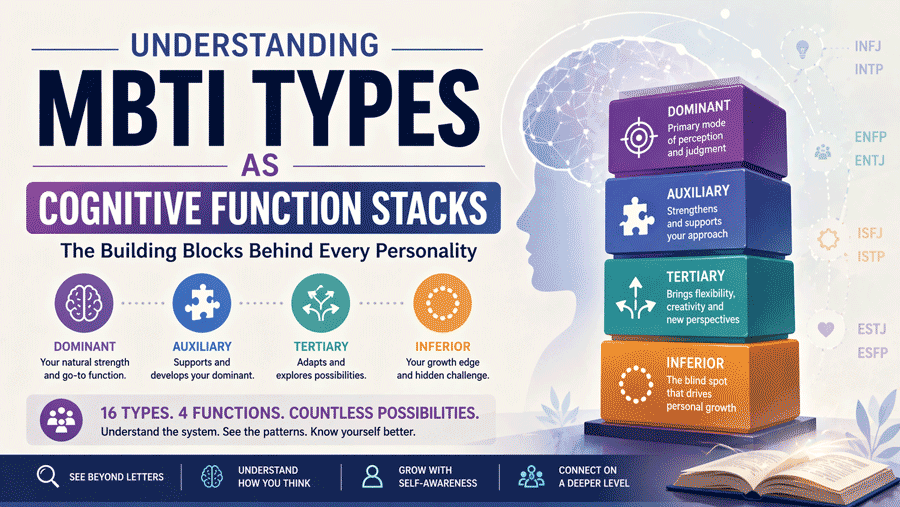
Cognitive Function Stack: Dominant, Auxiliary, Tertiary, Inferior
Each of the 16 types utilizes a stack of four cognitive functions. These functions are the actual mental processes you use to navigate the world. The stack consists of:
- Dominant Function: Your strongest, most natural process. It is your "hero" function, used consciously and confidently.
- Auxiliary Function: Supports the dominant function. It balances your perspective (e.g., if your dominant is judging, your auxiliary is perceiving).
- Tertiary Function: Less developed, often emerges in mid-life or during relaxation. It can be a source of creativity or immaturity.
- Inferior Function: Your weakest link, often unconscious. Under stress, you may "grip" into this function, behaving out of character.
For instance, an INTJ leads with Introverted Intuition (Ni), supported by Extraverted Thinking (Te). Their tertiary is Introverted Feeling (Fi), and their inferior is Extraverted Sensing (Se). Understanding this stack explains why an INTJ might be strategic and planned (Ni-Te) but occasionally impulsive or overly indulgent in sensory experiences when stressed (Se grip).
Why Letter-Based Typing Alone Often Causes Mistypes
Relying solely on questionnaires that measure dichotomies can lead to significant errors. Tests often measure behavior rather than motivation. A person might answer questions based on how they think they should act in a professional setting rather than their natural preference. Furthermore, many people develop skills in their non-preferred functions over time. An Introvert may become highly socially skilled, appearing Extraverted on a test, yet still require solitude to recharge.
Validating your type requires self-observation of decision patterns, stress reactions, and motivation. Ask yourself: What drains me? What energizes me? When I am under extreme pressure, do I become overly critical (Thinking grip) or overly emotional (Feeling grip)? Long-term feedback from trusted others who know you in various contexts is also more reliable than a single test score.
Practical Applications for Daily Life
Theory is only useful if it can be applied. Below are two practical frameworks for utilizing personality knowledge to improve your life and relationships.
Framework 1: Cognitive Function Development
When it applies: This framework is best used for personal development planning, career coaching, and identifying areas for skill acquisition.
Related Dynamics: It relates to the hierarchy of your function stack, specifically the tension between your dominant strength and your inferior weakness.
Practical Action Steps:
- Identify Your Dominant: Confirm what comes naturally. If you are a dominant Feeler, acknowledge that empathy is your superpower, not a weakness.
- Strengthen the Auxiliary: This is your growth edge. If you are an Introverted Thinker, work on expressing your logic externally (Extraverted Thinking) or gathering more data (Extraverted Intuition).
- Manage the Inferior: Recognize when you are stressed. If you are an Intuitive type, force yourself to engage with physical reality (Sensing) through exercise or cleaning to ground yourself.
Benefits and Limitations: The benefit is targeted growth without trying to change your core nature. The limitation is that developing lower functions takes significant energy and should not be forced during high-stress periods.
Judgment Fit: You know this fits if you feel a sense of relief acknowledging your strengths rather than shame about your weaknesses.
Framework 2: Communication and Relationship Dynamics
When it applies: Use this during conflicts, team collaborations, or when trying to persuade others.
Related Dynamics: This relates to MBTI compatibility and how different types process information and values.
Practical Action Steps:
- Match the Language: When speaking to a Sensor, use concrete examples and data. When speaking to an Intuitive, discuss the big picture and future possibilities.
- Respect Decision Styles: Do not pressure a Thinker to decide based on harmony, and do not pressure a Feeler to decide based solely on cold logic.
- Energy Management: Respect an Introvert's need for processing time before a meeting, and allow an Extravert to brainstorm out loud.
Benefits and Limitations: This reduces friction and misunderstandings. However, it should not be used to excuse bad behavior or avoid necessary conflict.
Judgment Fit: This fits if communication becomes smoother and conflicts are resolved faster because both parties feel understood.
Principles of Genuine Personality Growth
Growth within the MBTI framework is not about changing your type; it is about expanding your flexibility. Here are universal principles for healthy development:
Identify the Dominant Function First: You cannot grow if you do not know your starting point. Spend time observing what mental processes feel effortless versus exhausting.
Distinguish Preference from Skill: You can be skilled at something you do not prefer. An Introvert can be a great public speaker, but it will cost them more energy than an Extravert. Acknowledge the cost.
Develop the Inferior Function Gradually: The inferior function is a gateway to wholeness, but it is fragile. Engage it in low-stakes environments. For example, a Thinking type might explore art not to become an artist, but to connect with their Feeling side.
Understand Loop and Grip Patterns: When stressed, types may skip their auxiliary function and loop between their dominant and tertiary (e.g., an INFP looping between Fi and Ne, becoming overly introspective and paranoid). Recognizing this pattern allows you to re-engage the auxiliary function to break the loop.
Growth Means Flexibility, Not Identity Attachment: Do not use your type as an excuse. Saying "I am an INTJ, so I don't do emotions" is a limitation, not a truth. Mature types can access all functions when necessary.
8 Common Pitfalls to Avoid When Typing
To maintain objectivity and usefulness, avoid these common mistakes when exploring personality types:
- Don't treat type as a horoscope: Avoid vague, positive statements that apply to everyone. Focus on specific cognitive mechanisms.
- Don't assume type determines morality: No type is inherently "better" or "more ethical." Each type has unique blind spots regarding ethics.
- Don't type others without consent: Armchair typing can be intrusive and inaccurate. Use type to understand, not to label others.
- Don't ignore context: Behavior changes based on environment. A relaxed Perceiver may look like a Judger at work. Look for underlying motivation.
- Don't rely on memes and stereotypes: Internet culture often exaggerates traits for humor. Real psychology is more nuanced.
- Don't use type to avoid responsibility: "I'm late because I'm a Perceiver" is an avoidance of time management skills. Use type to find better strategies, not excuses.
- Don't assume compatibility is fixed: Any two types can have a healthy relationship with effort. Type explains friction points, not destiny.
- Don't stop learning after typing: Typing is the beginning of the journey, not the end. Continuous study of functions is required for depth.
Continuing Your MBTI Education
The field of personality psychology is evolving. To ensure you are accessing high-quality information, consider the following resources and strategies:
Follow Credible Organizations: Look for resources from the Myers & Briggs Foundation or the Center for Applications of Psychological Type (CAPT). These organizations maintain the integrity of the original instrument and research.
Explore Jungian Educational Resources: Since MBTI is rooted in Jung's work, reading introductory texts on Jungian psychology can provide deeper context for the cognitive functions.
Stay Updated on Research: Be aware that while MBTI is popular, it is one of many tools. Acknowledge debates regarding reliability and validity. Use it as a heuristic for self-reflection rather than a definitive scientific diagnosis.
Identify Reliable Information: Avoid content that claims one type is superior or that promises to "hack" your personality. Quality content emphasizes balance, growth, and understanding differences.
Frequently Asked Questions
1. Where should a beginner start with MBTI?
Start by understanding the four dichotomies, but quickly move to learning the eight cognitive functions (Ni, Ne, Si, Se, Ti, Te, Fi, Fe). Read descriptions of the function stacks rather than just the four-letter type summaries. This prevents stereotyping.
2. How can I confirm my type without taking a test?
Observe your energy levels. What activities drain you versus energize you? Analyze your stress response. Do you become overly critical, emotional, impulsive, or withdrawn? Compare these patterns against function descriptions rather than behavior checklists.
3. How does type affect relationship communication?
Type influences how you express care and resolve conflict. For example, a Thinking type may show love through problem-solving, while a Feeling type may show it through verbal affirmation. Understanding these differences prevents misinterpreting intent.
4. What is the most efficient way to learn cognitive functions?
Focus on one axis at a time (e.g., Thinking vs. Feeling). Study how Introverted Thinking differs from Extraverted Thinking. Apply this to your own recent decisions. Journaling about your thought processes can accelerate this learning.
5. Can my personality type change over time?
Your core preferences generally remain stable throughout adulthood. However, your ability to use non-preferred functions improves with maturity. You may appear to change because you have developed greater behavioral flexibility, but your underlying energy orientation typically remains consistent.
6. What if I resonate with multiple type descriptions?
This is common, especially if you have developed your auxiliary or tertiary functions well. Look for the "cost" of the behavior. Which way of processing feels effortless, and which feels like work? The effortless path usually indicates your dominant preference.
7. How do I judge the quality of MBTI information online?
High-quality information avoids absolute statements, acknowledges limitations, and focuses on cognitive processes rather than behaviors. Be wary of content that uses type to validate biases or sell unrealistic self-improvement schemes.