
Understanding how you interact with the world is crucial for personal and professional success. While many people rely on the four-letter code, true insight into mbti communication styles requires looking deeper into the underlying cognitive functions. This article concludes immediately that relying solely on letters often leads to stereotypes, whereas analyzing function stacks provides actionable clarity for relationships and growth. Whether you are trying to understand your own type more accurately or seeking to improve compatibility with colleagues and partners, moving beyond the surface level is essential.
The Myers-Briggs Type Indicator (MBTI) is a popular tool used to categorize personality preferences. It helps individuals identify their natural inclinations in processing information and making decisions. However, its utility is maximized only when users recognize that the type is a starting point, not an endpoint. For readers exploring cognitive functions, compatibility, career fit, and communication, the depth of analysis matters. This guide is designed for English-speaking readers interested in MBTI who seek depth beyond stereotypes. We will emphasize that deeper understanding requires returning to cognitive functions, not just the four letters.
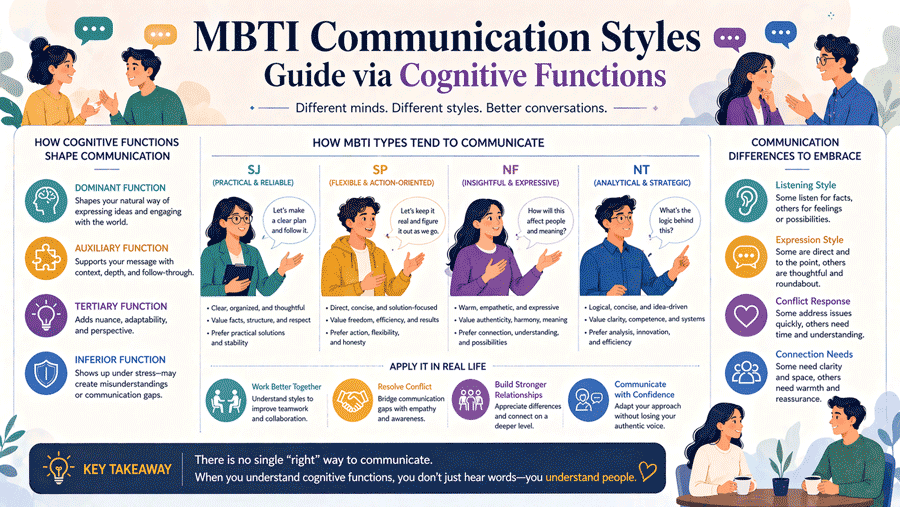
The Framework: Beyond the Four Letters
To truly grasp communication dynamics, one must understand the machinery behind the type code. The MBTI is rooted in Carl Jung’s theory of psychological types. Jung proposed that people have inherent preferences for how they perceive the world and how they make decisions. The MBTI expanded this into four dichotomies: Extraversion vs. Introversion, Sensing vs. Intuition, Thinking vs. Feeling, and Judging vs. Perceiving. These combine to form the 16 personality types.
However, the dichotomies are merely the surface expression of a deeper mechanism: the cognitive function stack. Each type operates using a hierarchy of four functions: dominant, auxiliary, tertiary, and inferior. The dominant function is the primary lens through which an individual views reality. The auxiliary supports it, providing balance. The tertiary is less developed, often emerging in mid-life, and the inferior is the weakest link, often surfacing under stress. For example, an INTJ leads with Introverted Intuition (Ni), supported by Extraverted Thinking (Te). An ENFP leads with Extraverted Intuition (Ne), supported by Introverted Feeling (Fi).
Why does letter-based typing alone often cause mistypes? Because behavior can be misleading. Two people might exhibit similar behaviors for different reasons. An ISTJ and an ESTJ might both appear organized, but the ISTJ organizes based on internal sensory consistency (Si), while the ESTJ organizes based on external logistical efficiency (Te). Without understanding the function, you might misinterpret the motivation behind the communication style. Validating type requires self-observation of decision patterns, stress reactions, motivation, and blind spots. Long-term feedback from others is also crucial. Tests are useful snapshots, but they cannot capture the nuance of function usage over time.
Consider public figures cautiously. For instance, Steve Jobs is widely believed to be an ENTJ, often typed as such due to his visionary leadership and decisive execution. However, using celebrities as definitive examples carries risk. It is better to focus on your own internal experience. Do you feel energized by exploring possibilities (Ne) or consolidating known facts (Si)? Do you prioritize harmony and values (Fi) or objective logic and efficiency (Te)? These questions reveal more than a quiz score.
Practical Application Frameworks
Understanding theory is valuable, but application transforms knowledge into results. Below are two practical frameworks to utilize mbti communication styles effectively in daily life.
Framework 1: Cognitive Function Development
This framework applies when you feel stuck in your personal growth or career progression. It relates to the dynamic between your dominant and inferior functions. The goal is to strengthen the auxiliary and tertiary functions to support the dominant, while gradually integrating the inferior function without being overwhelmed by it.
Practical Action Steps:
- Identify your dominant function. If you are an INFP, this is Introverted Feeling (Fi). Acknowledge that your primary drive is internal value alignment.
- Consciously exercise your auxiliary function. For an INFP, this is Extraverted Intuition (Ne). Make time to brainstorm externally and explore new ideas with others.
- Monitor stress signals. When you become overly critical or rigid, your inferior function (Te for INFP) might be gripping you. Recognize this as a signal to rest and return to your strengths.
- Set small goals to develop the tertiary function. For an INFP, this is Introverted Sensing (Si). Practice recalling past experiences to inform current decisions without getting stuck in nostalgia.
Benefits and Limitations: This approach fosters resilience and reduces burnout. However, it requires patience. Function development is a lifelong process, not a quick fix. Readers can judge whether it fits them by observing if they feel more balanced after intentionally using their non-dominant functions. If forcing a function causes anxiety, scale back and focus on strengthening the auxiliary first.
Framework 2: Relationship and Communication Guidance
This framework applies to interpersonal conflicts, team dynamics, and romantic partnerships. It relates to how different function stacks interact. For example, a Thinker may perceive a Feeler’s concern as irrational, while the Feeler perceives the Thinker as cold. Understanding the function behind the communication prevents personalizing the conflict.
Practical Action Steps:
- Map the function dynamics. If you are an ESTP (Se-Ti) communicating with an INFJ (Ni-Fe), recognize that you prioritize immediate action and logic, while they prioritize future vision and group harmony.
- Translate your message. When speaking to a Sensing type, provide concrete details and step-by-step plans. When speaking to an Intuitive type, focus on the big picture and underlying concepts.
- Validate the other person’s process. Even if you disagree with their conclusion, acknowledge the validity of their function. Say, “I see you are prioritizing harmony here,” rather than, “You are being too sensitive.”
- Establish shared goals. Find a common ground where both function sets can contribute. Let the Thinker handle the strategy and the Feeler handle the team morale.
Benefits and Limitations: This reduces friction and increases empathy. The limitation is that it requires both parties to be willing to understand type dynamics. If one party is resistant, focus on managing your own reactions. Readers can judge fit by noting if conflicts de-escalate faster when they adjust their communication style based on the other person’s preferences.
Pathways to Personality Growth
Growth in the context of MBTI is not about changing your type; it is about expanding your flexibility within your type. Universal principles apply across all 16 types. First, identify the dominant function. This is your superpower. Lean into it when making major life decisions. If you are a dominant Perceiver, do not force yourself into a rigidly structured role without adequate autonomy. If you are a dominant Judger, ensure you have enough closure to feel secure.
Second, distinguish preference from skill. You may prefer Thinking, but that does not mean you are good at logic. You may prefer Feeling, but that does not mean you are empathetic. Skills must be learned; preferences are just where you start. Third, develop the inferior function gradually. The inferior function is often the source of mid-life growth. For an ISTP, the inferior is Extraverted Feeling (Fe). Learning to consider group emotions can make them more effective leaders, but trying to become a "people person" overnight will lead to exhaustion.
Explain loop and grip patterns where relevant. A "loop" occurs when you bypass your auxiliary function and oscillate between your dominant and tertiary. For example, an INTJ looping between Ni and Ti may become overly theoretical and disconnected from reality. A "grip" occurs when you are under extreme stress and fall into your inferior function. An ENFJ in grip may become overly critical and isolated (inferior Ti). Recognizing these states helps you return to balance.
Finally, remember that growth means flexibility, not identity attachment. Do not say, “I am an INTP, so I cannot do emotional work.” Say, “I am an INTP, so emotional work is challenging, but I can develop it.” This mindset shift prevents the type from becoming a cage.
Common Mistakes and Pitfalls
Even well-intentioned users fall into traps when applying mbti communication styles. Avoiding these pitfalls ensures you use the tool constructively.
1. Don’t use type as an excuse for bad behavior. Saying “I’m just being honest” because you are a Thinking type is not a valid justification for rudeness. Better mindset: Use your type to understand your impulse, then choose a more constructive delivery.
2. Don’t assume compatibility is deterministic. Just because two types are theoretically compatible does not guarantee a good relationship. Better mindset: Focus on shared values and effort rather than type matching alone.
3. Don’t stereotype based on letters. Assuming all Sensors are uncreative or all Intuitives are impractical is harmful. Better mindset: Look at the individual’s function development and life experience.
4. Don’t ignore the context. Communication styles change based on environment. A professional setting may require different behaviors than a home setting. Better mindset: Adapt your style to the context while staying authentic.
5. Don’t rely solely on online tests. Free tests often lack reliability and validity. Better mindset: Use tests as a starting point, then validate through study and self-reflection.
6. Don’t dismiss other types. Believing your type is superior creates division. Better mindset: Appreciate the diverse strengths each type brings to a team or community.
7. Don’t neglect the inferior function. Ignoring your weakness limits your growth potential. Better mindset: Acknowledge the inferior function as an area for gradual development.
8. Don’t treat type as static. While preferences are stable, behavior evolves. Better mindset: Expect your expression of type to mature over time.
Ongoing Learning and Resources
The field of personality psychology is evolving. To maintain accuracy, readers should keep following new research and higher-quality MBTI or Jungian resources. Credible organizations include the Myers & Briggs Foundation and the Center for Applications of Psychological Type (CAPT). These bodies provide updated materials and ethical guidelines for using the instrument.
Engage with debates and newer interpretations. Some critics argue about the scientific validity of MBTI compared to the Big Five. It is important to keep a measured tone and understand that MBTI is a tool for understanding preferences, not a label that defines the whole person. Look for ways to identify reliable information and avoid low-quality summaries. Social media often reduces type to memes. Seek out books and articles that discuss cognitive functions in depth. By committing to ongoing learning, you ensure that your understanding of mbti communication styles remains nuanced and applicable.
Frequently Asked Questions
1. Where should a beginner start with MBTI?
Start by understanding the four dichotomies, but quickly move to cognitive functions. Read introductory materials from credible sources like the Myers & Briggs Foundation. Take a reputable test as a reference point, but do not treat the result as final. Observe your own behavior in low-stress situations to see what feels natural.
2. How can I confirm my type without tests?
Type confirmation comes from self-observation over time. Look at your decision-making style. Do you prioritize logic or values? Look at your energy source. Do you recharge alone or with people? Examine your stress reactions. Which functions emerge when you are tired? Long-term feedback from trusted friends who know you well can also provide clarity.
3. How does type affect relationship communication?
Type affects how you express care and resolve conflict. A Thinking type may show care by solving problems, while a Feeling type may show care by listening emotionally. Understanding these communication patterns helps partners avoid misunderstanding intentions. It allows you to speak the other person’s language rather than forcing them to speak yours.
4. What is the most efficient way to learn cognitive functions?
Focus on one function pair at a time. For example, study the difference between Introverted Sensing (Si) and Extraverted Sensing (Se). Compare how different types use them. Apply the concepts to real-life scenarios. Journaling about your daily interactions can help you identify which functions you are using.
5. Can my personality type change over time?
Core preferences generally remain stable throughout adulthood. However, your ability to use non-preferred functions improves with age and development. You may appear different because you have grown more flexible, not because your type has changed. Growth means integrating all functions, not switching types.
6. What if I resonate with multiple type descriptions?
Partial resonance is common because everyone uses all eight functions. Look for the type where the description of the dominant and inferior functions fits best. Consider which description explains your stress reactions most accurately. Sometimes, mistyping occurs because you are describing your ideal self rather than your natural self.
7. How do I judge the quality of MBTI information?
Check the source. Is it based on Jungian theory or just internet stereotypes? Does the author acknowledge limitations? Credible resources will discuss cognitive functions and avoid absolute claims. Avoid content that claims one type is better than another or that uses type to justify discrimination.
In conclusion, mastering mbti communication styles is a journey of self-discovery and interpersonal improvement. By focusing on cognitive functions, avoiding common pitfalls, and committing to ongoing learning, you can use this framework to build stronger relationships and achieve greater personal growth. Remember, the goal is not to label yourself, but to understand yourself well enough to transcend limitations.