
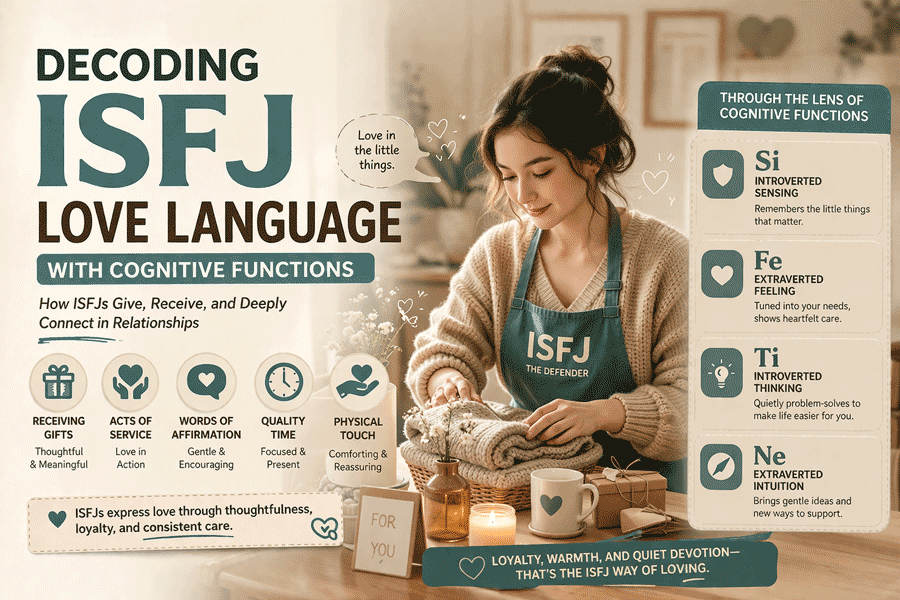
Decoding ISFJ Love Language with Cognitive Functions
Understanding the isfj love language requires moving beyond surface-level stereotypes and diving into the cognitive machinery that drives this personality type. While many assume ISFJs simply prefer Acts of Service, the reality is far more nuanced. Their expression of care is rooted in Introverted Sensing (Si) and Extraverted Feeling (Fe), creating a unique blend of stability, memory, and harmony. This article concludes upfront: to truly connect with an ISFJ, you must understand their function stack, not just their four-letter code. MBTI is a tool for understanding preferences, not a label that defines the whole person. By focusing on cognitive functions, readers can achieve deeper relationship compatibility, accurate type confirmation, and meaningful personality growth.
The Myers-Briggs Type Indicator (MBTI) is widely used to categorize personality preferences, helping individuals understand how they perceive the world and make decisions. It is useful for self-awareness, team dynamics, and relationship navigation. However, relying solely on the four letters often leads to misunderstandings. For the ISFJ, often called the "Defender" or "Protector," the key to unlocking their emotional world lies in recognizing how their dominant and auxiliary functions process love and care. This guide provides a search-intent-driven analysis for English-speaking readers interested in MBTI, offering depth beyond stereotypes for those exploring cognitive functions, compatibility, and communication.
The Jungian Framework Behind ISFJ
To grasp the isfj love language, one must return to the Jungian roots of MBTI. Carl Jung proposed that psychological types are defined by how people orient themselves (Introversion vs. Extraversion) and how they process information (Sensing vs. Intuition, Thinking vs. Feeling). The MBTI system expanded this into four dichotomies, resulting in 16 types. However, the dichotomies are merely the surface; the engine underneath is the cognitive function stack.
The ISFJ function stack consists of:
- Dominant: Introverted Sensing (Si) - Focuses on past experiences, stability, routine, and concrete details.
- Auxiliary: Extraverted Feeling (Fe) - Focuses on group harmony, external emotional values, and caring for others.
- Tertiary: Introverted Thinking (Ti) - Focuses on internal logical consistency and analyzing how things work.
- Inferior: Extraverted Intuition (Ne) - Focuses on future possibilities, patterns, and abstract connections (often a source of stress).
Why does letter-based typing alone often cause mistypes? Because two people can test as ISFJ but operate differently. One might be heavily stressed and operating in a "grip" of their inferior function, while another is mature and balanced. Validating type requires self-observation of decision patterns, stress reactions, motivation, and blind spots. For example, an ISFJ makes decisions based on how actions affect people (Fe) grounded in what has worked before (Si). If someone claims to be ISFJ but prioritizes abstract future possibilities over past stability, they may be mistyped. Long-term feedback from others is crucial; do people see you as reliable and harmonious, or erratic and detached?
Public figures are often typed cautiously. For instance, Queen Elizabeth II is widely believed to be an ISFJ due to her lifelong commitment to duty, tradition (Si), and service to the public (Fe). However, typing public figures is speculative. Use such examples only to illustrate function dynamics, not as definitive facts. The goal is to understand the mechanism, not to idolize the label.
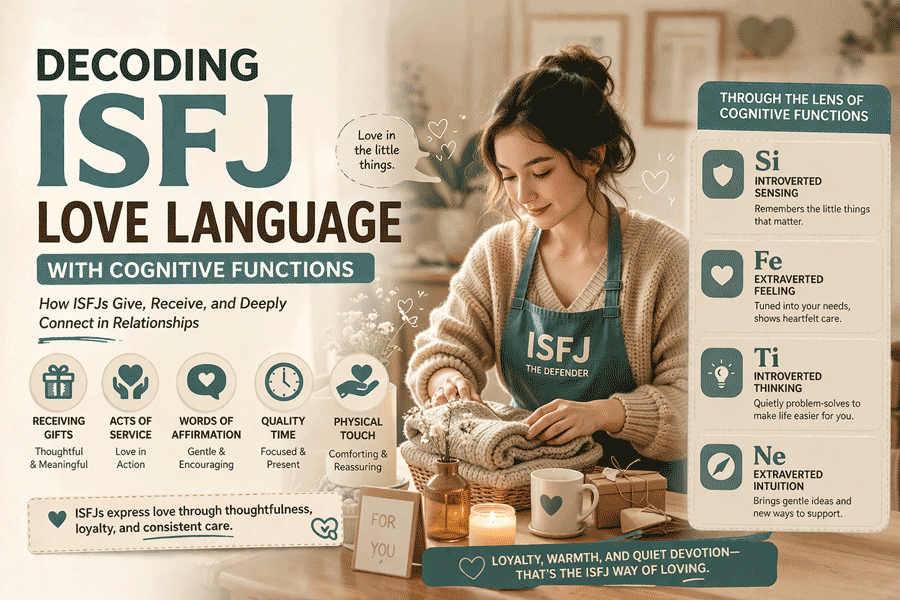
Decoding the ISFJ Love Language
When we discuss the isfj love language, we are essentially discussing how Si and Fe manifest in relationships. The popular "5 Love Languages" framework (Words of Affirmation, Acts of Service, etc.) is useful, but cognitive functions explain why certain languages resonate.
Introverted Sensing (Si): The Language of Stability
Si dominates the ISFJ psyche. In love, this translates to a desire for consistency and reliability. An ISFJ shows love by remembering details: your favorite food, important dates, or how you like your coffee. They value routine. A sudden change in plans can feel disruptive to their sense of security. For an ISFJ, love is proven over time through repeated actions, not grand, one-off gestures. They build a shared history. If you want to speak their language, honor commitments. Being late or canceling frequently signals a lack of respect for their time and the stability they crave.
Extraverted Feeling (Fe): The Language of Harmony
Fe is the auxiliary function, driving the ISFJ to maintain social harmony. In relationships, this manifests as attentiveness to the partner's emotional state. An ISFJ will often sacrifice their own needs to ensure their partner is comfortable. They read the room. If there is tension, they feel it physically. Their love language involves creating a peaceful environment. They may not always verbalize their own distress to avoid conflict. Understanding this is vital for MBTI compatibility. Partners must learn to ask explicitly how the ISFJ is feeling, as the ISFJ might not volunteer negative emotions to preserve peace.
Tertiary Introverted Thinking (Ti): The Logic of Care
As ISFJs mature, they develop Ti. This adds a layer of logical consistency to their care. They don't just want to help; they want to help effectively. They may analyze problems their partner faces and offer practical solutions. However, under stress, Ti can become critical. An immature ISFJ might nitpick logic rather than offering emotional support. Recognizing this helps in communication patterns. When an ISFJ offers advice, it is often their way of showing love, even if the partner just wanted empathy.
Inferior Extraverted Intuition (Ne): The Stress Point
Ne is the inferior function. In healthy relationships, ISFJs can enjoy brainstorming future plans with partners. However, under stress, Ne manifests as catastrophizing. An ISFJ might suddenly worry about all the things that could go wrong in the relationship. Partners should recognize this as a stress response, not a rational assessment. Reassuring them with concrete facts (appealing to Si) is more effective than abstract optimism.
Practical Frameworks for Relationships
To apply this understanding, we offer two practical frameworks. These are designed for readers seeking depth beyond stereotypes, providing actionable steps for relationship and communication guidance.
Framework 1: Cognitive Function Development in Partnerships
When it applies: This framework is best for long-term relationships where both parties are willing to grow. It relates to the dynamic between Si-Fe and the partner's functions.
Practical Action Steps:
- For the ISFJ: Practice expressing needs directly. Your Fe wants harmony, but suppressing needs leads to resentment. Use Ti to logically articulate why a specific need matters.
- For the Partner: Provide consistency. Small, repeated acts of kindness outweigh grand gestures. Acknowledge their efforts verbally (Fe craves validation).
- Joint Activity: Create shared traditions. This satisfies Si. Whether it's a weekly dinner or an annual trip, routine builds security.
Benefits and Limitations: This fosters deep security and trust. However, it requires patience. If the partner is highly spontaneous (high Ne), they may find the routine stifling. Compromise is key.
How to Judge Fit: If the ISFJ feels less anxious and the partner feels more appreciated, the framework is working. If the ISFJ feels controlled or the partner feels bored, adjust the level of routine.
Framework 2: Communication Patterns Under Stress
When it applies: During conflicts or high-pressure periods. This relates to the Si-Ne axis and Fe-Ti axis.
Practical Action Steps:
- Identify the Grip: If the ISFJ is uncharacteristically impulsive or pessimistic, they are in an Ne grip. Do not argue logic immediately.
- Grounding Techniques: Return to sensory details. Cook a meal together, walk in nature, or organize a space. This reactivates Si.
- Fe Validation: Acknowledge emotions before solving problems. Say, "I see this is hard for you," before offering solutions.
Benefits and Limitations: This de-escalates conflict quickly. The limitation is that it requires the partner to be observant. If the partner is unaware of MBTI, explain these needs calmly during non-stressful times.
How to Judge Fit: Monitor recovery time after arguments. If conflicts resolve faster and with less lingering resentment, the communication pattern is effective.
Growth and Personal Development
Personal growth for an ISFJ means flexibility, not identity attachment. MBTI type is a starting point, not an endpoint. Here are universal principles for development:
- Identify the Dominant Function First: Accept that your need for stability (Si) is a strength, not a weakness. Do not try to become someone who thrives on chaos.
- Distinguish Preference from Skill: You may prefer harmony (Fe), but you can learn to handle conflict. Skill can be developed outside of preference.
- Develop the Inferior Function Gradually: Engage with Ne in low-stakes environments. Try new hobbies without expecting mastery. This prevents burnout.
- Explain Loop and Grip Patterns: Be aware of the Si-Ti loop, where you isolate and over-analyze without external feedback (Fe). Break the loop by reaching out to trusted friends.
- Growth Means Flexibility: Do not use "I am an ISFJ" as an excuse to avoid growth. Use it as a map to know where you need to stretch.
Understanding these patterns aids in decision-making style. An ISFJ decides based on values and past data. Growth involves incorporating future possibilities (Ne) and objective logic (Ti) without losing their core self.
8 Common Mistakes to Avoid
To ensure accurate type confirmation and healthy relationships, avoid these pitfalls. Each point includes a better alternative mindset.
- Don't stereotype ISFJs as doormats. Explanation: Fe seeks harmony, but healthy ISFJs have boundaries. Alternative: View them as diplomatic guardians who choose peace strategically.
- Don't rely solely on online tests. Explanation: Tests measure behavior, not cognition. Alternative: Study cognitive functions and observe your own mental processes.
- Don't ignore stress reactions. Explanation: Typing looks different under stress. Alternative: Analyze how you behave when exhausted to confirm type.
- Don't assume love languages are static. Explanation: Needs change with maturity. Alternative: Regularly check in with your partner about their current needs.
- Don't use MBTI to justify bad behavior. Explanation: "I'm an ISFJ" is not an excuse for passive-aggressiveness. Alternative: Take responsibility for actions regardless of type.
- Don't overlook the Tertiary function. Explanation: Ti plays a big role in adult ISFJs. Alternative: Acknowledge your need for logical consistency in relationships.
- Don't force compatibility. Explanation: Not all types match well, regardless of effort. Alternative: Focus on communication tools rather than forcing a square peg into a round hole.
- Don't neglect the Inferior function. Explanation: Ignoring Ne leads to rigidity. Alternative: Embrace small changes to keep your perspective fresh.
Ongoing Learning and Resources
MBTI is a field with evolving interpretations. Readers should keep following new research and higher-quality resources. Credible organizations include the Myers & Briggs Foundation and the Center for Applications of Psychological Type (CAPT). Jungian educational resources provide depth on cognitive functions. Be wary of low-quality summaries on social media that reduce types to memes. Look for debates and newer interpretations that challenge the status quo. Ways to identify reliable information include checking author credentials and looking for citations of Jungian theory rather than pop psychology. This approach ensures you are building knowledge on a solid foundation, aiding in personality growth and accurate type confirmation.
Frequently Asked Questions (FAQ)
1. What is the best beginner entry point for understanding ISFJ?
Start with the cognitive function stack (Si-Fe-Ti-Ne) rather than the four letters. Read about how Introverted Sensing processes memory and stability. This provides a mechanical understanding rather than a descriptive one.
2. How can I confirm my type without tests?
Observe your decision-making style. Do you prioritize past experience and group harmony? Reflect on your stress reactions. Do you become catastrophic or impulsive? Seek long-term feedback from others about your consistent behaviors.
3. How does ISFJ love language affect relationship communication?
It emphasizes non-verbal care and consistency. Partners should learn to recognize acts of service and routine maintenance as expressions of love, not just words. Explicit verbal validation is also crucial for Fe.
4. How can I learn cognitive functions efficiently?
Focus on one function at a time. Compare Si vs. Ni, or Fe vs. Fi. Use real-life examples of decisions you've made. Journaling about why you made a choice can reveal your dominant function.
5. Can personality type change over time?
Your core preferences (type) generally remain stable, but your behavior and maturity change. You develop access to all functions. So, while you remain an ISFJ, you may become more comfortable using Intuition or Thinking as you age.
6. What if I only resonate with part of a type description?
This is common. Descriptions often mix stereotypes with functions. Focus on the cognitive processes. If you share the mental machinery (Si-Fe), you are likely an ISFJ, even if you don't fit every hobby or stereotype.
7. Is MBTI scientifically uncontested?
No. MBTI is a tool for understanding preferences, not a psychometric measure of ability or intelligence. It has critics in the academic community. Use it for self-reflection and communication, not for hiring or clinical diagnosis.
Conclusion
The isfj love language is a complex interplay of memory, stability, and harmony. By understanding the cognitive functions behind the type, partners and ISFJs themselves can navigate relationships with greater empathy and precision. Remember that MBTI is a starting point. True growth comes from integrating all functions, managing stress, and maintaining flexibility. Whether you are an ISFJ seeking self-understanding or a partner seeking compatibility, the key lies in observing the mind in action, not just labeling the outcome. Use these frameworks to build stronger connections, avoid common pitfalls, and continue your journey of personality growth with credible resources and an open mind.