
Introduction: Beyond the Letters
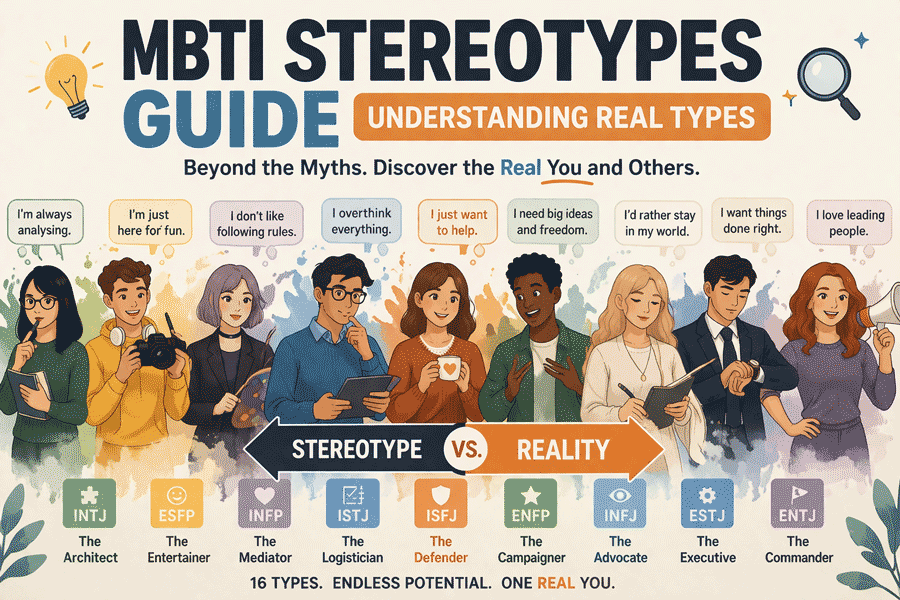
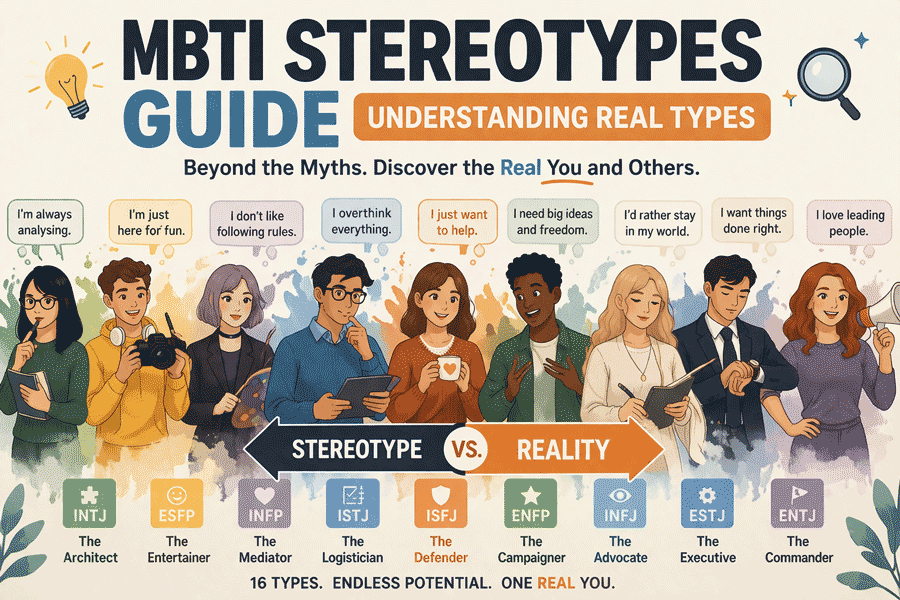
In the realm of personality psychology, few tools are as recognized yet as misunderstood as the Myers-Briggs Type Indicator. When searching for mbti stereotypes, users often encounter simplified caricatures that reduce complex human beings to four-letter codes. This guide aims to dismantle those superficial labels and provide a deep, actionable walkthrough of personality types based on cognitive functions rather than mere letters. Our goal at Persona Key is to empower you with accurate self-knowledge that serves as a starting point for growth, not a ceiling for potential.
The MBTI framework, rooted in Carl Jung’s theory of psychological types, offers a sophisticated map of how individuals perceive the world and make decisions. However, popular culture often distorts this into rigid boxes. To truly benefit from this system, one must look beyond the surface. This article serves as a comprehensive review and application guide, designed for those ready to move past internet memes and explore the nuanced mechanics of their psyche. Whether you are seeking career clarity, relationship harmony, or personal development, understanding the underlying cognitive architecture is essential.
We will explore the theoretical foundations, provide practical schemes for development, and highlight common pitfalls to avoid. By the end of this walkthrough, you will understand why “type is the start, not the end” and how to apply this knowledge ethically and effectively in real-world scenarios. Let us begin by establishing the core mechanisms that drive personality differences.
Framework and Core Mechanisms
The Jungian Roots and Four Dimensions
The MBTI instrument was developed by Katharine Cook Briggs and her daughter Isabel Briggs Myers, based largely on Carl Jung’s work. It categorizes preferences across four dichotomies: Extraversion (E) vs. Introversion (I), Sensing (S) vs. Intuition (N), Thinking (T) vs. Feeling (F), and Judging (J) vs. Perceiving (P). While these letters are useful shorthand, they often fuel mbti stereotypes when taken out of context. For instance, an ‘I’ does not necessarily mean shy, but rather that one recharges through solitude. An ‘F’ does not mean irrational, but that one prioritizes values in decision-making.
Understanding these dimensions requires nuance. The Myers & Briggs Foundation emphasizes that all preferences are valuable; none are inherently superior. The interaction between these preferences creates the 16 personality types. However, the true power lies in the dynamic relationship between them, known as the function stack. Without this depth, users risk falling into the trap of static labeling, which limits growth and understanding.
Cognitive Function Stack Explained
Every type operates using a hierarchy of eight cognitive functions: Se, Si, Ne, Ni, Te, Ti, Fe, Fi. Your type determines the order in which you access these functions. The Dominant function is your “capteen,” the Auxiliary supports it, the Tertiary offers relief, and the Inferior function is often a source of stress or growth potential. For example, an INFJ leads with Introverted Intuition (Ni) and supports it with Extraverted Feeling (Fe). This stack explains why two ‘NFs’ might behave differently if their function orders differ.
Recognizing your stack helps verify your type beyond online quizzes. Self-observation is key. Do you naturally seek patterns (Ni) or possibilities (Ne)? Do you organize the external world (Te) or internal logic (Ti)? These questions dig deeper than “Do you like parties?” which is a common stereotype trap. Accurate typing requires observing your mental processes under stress and flow, not just your social habits.
Verification and Celebrity Cases
Verifying your type should involve feedback from trusted others and reflection on long-term behaviors. Tests can be biased by mood or self-perception. When looking at public figures, caution is necessary. For instance, Elon Musk is often categorized as an INTJ or ENTJ due to his strategic vision, but this is based on external observation and widely believed typologies, not official confirmation. Similarly, Oprah Winfrey is frequently associated with the ENFJ type due to her empathetic leadership, yet these remain theoretical classifications.
Using celebrity examples helps concretize abstract functions but should not be the sole basis for self-identification. Focus on whether their described cognitive processes resonate with your internal experience. Did they lead with logic or values? Did they prefer structure or flexibility? This analytical approach reduces the risk of adopting mbti stereotypes based on fame rather than function.
Type Application and Development Schemes
Scheme 1: Cognitive Function Strengthening
To move beyond static labels, engage in active function development. This scheme focuses on exercising your weaker functions to create a more balanced psyche. For example, a dominant Thinker (T) might practice identifying and articulating emotions (F) through journaling or active listening exercises. A dominant Sensor (S) might engage in brainstorming sessions to stretch their Intuitive (N) muscles.
Actionable Steps:
- Daily Reflection: Spend 10 minutes analyzing a decision. Did you prioritize logic or harmony? Identify which function was dominant.
- Stress Testing: Deliberately put yourself in situations that require your inferior function. If you are a Judger (J), leave a day unplanned to develop Perceiving (P) flexibility.
- Feedback Loops: Ask colleagues how your decision-making lands. Do they feel heard (F) or efficient (T)? Use this data to adjust.
This approach transforms personality theory from a label into a gym for your mind. It acknowledges that while preferences are innate, skills can be developed. This is crucial for professional growth where adaptability is valued over rigid type adherence.
Scheme 2: Relationship and Communication Adaptation
MBTI relationships thrive on understanding differences rather than assuming similarity. This scheme focuses on translating your communication style to match others. If you are an Intuitive (N) speaking to a Sensor (S), avoid abstract metaphors and focus on concrete details and practical steps. Conversely, if you are a Sensor speaking to an Intuitive, connect the details to the bigger picture or future implications.
Scenario Applications:
- Workplace Collaboration: When partnering with a Thinker, present data first. When partnering with a Feeler, establish rapport and shared values before diving into tasks.
- Conflict Resolution: Recognize that a Te user’s directness is not aggression, and an Fi user’s hesitation is not weakness. Frame feedback in their preferred language.
- Team Dynamics: Build diverse teams. A group of all Ne users might generate ideas but fail to execute. Balance visionaries with implementers.
By adapting your communication, you reduce friction and increase influence. This practical application demonstrates that knowing your type is less about knowing yourself and more about knowing how to interact with the world effectively.
Function Cognition and Growth Mindset
General Principles for Development
Growth within the MBTI framework follows a natural trajectory. Priority should always be given to confirming and mastering the Dominant function first. This is your home base. Once secure, you develop the Auxiliary to support it. The Tertiary function often emerges in mid-life as a source of play and relaxation. The Inferior function is the key to long-term maturity; integrating it reduces stress responses and expands your capabilities.
For instance, an ESTP (Se-Ti-Fe-Ni) might struggle with long-term planning (Ni). Instead of forcing it immediately, they should first hone their situational awareness (Se) and logical analysis (Ti). Once confident, they can gradually introduce strategic planning exercises. Pushing the inferior function too hard too soon leads to burnout, a common issue when users misinterpret mbti stereotypes about “fixing” weaknesses.
Stress Management and Type
Under stress, types often “grip” their inferior function. An organized INTJ might become impulsive and sensory-seeking. Recognizing this pattern is vital for emotional regulation. Instead of judging the behavior, acknowledge it as a stress response. Techniques include returning to dominant function activities. An stressed INFP (Fi) might retreat to write or create art to recharge their values before re-engaging with external logic (Te).
Understanding these cycles prevents self-criticism. It frames behavioral shifts as mechanical responses to pressure rather than character flaws. This perspective is essential for mental health and sustained performance in high-pressure environments.
Common Mistakes and Pitfalls to Avoid
To ensure ethical and accurate use of personality theory, avoid these eight common traps. These errors often perpetuate mbti stereotypes and limit the utility of the framework.
- Do Not Pigeonhole Others: Never assume you know someone’s type immediately. Behavior is influenced by context, mood, and role. Labeling a colleague as “just an ESTJ” dismisses their complexity.
- Do Not Use Type as an Excuse: Saying “I’m an INFP, so I can’t do math” is self-sabotage. Type explains preference, not capability. Avoid using it to justify limitations.
- Do Not Ignore Context: A person may act differently at work than at home. An Introvert may appear Extraverted during a presentation. Observe across multiple settings.
- Do Not Value One Type Over Another: There is no “best” type. Each brings unique strengths. Valuing NTs over SFs creates toxic hierarchies in organizations.
- Do Not Rely Solely on Tests: Online quizzes are often inaccurate. They measure self-perception, not cognitive processes. Use them as a starting point, not a diagnosis.
- Do Not Force Typing on Children: Personality stabilizes over time. Labeling children can create self-fulfilling prophecies. Allow them to explore all functions.
- Do Not Stereotype Genders: Avoid assumptions like “All women are Feelers” or “All men are Thinkers.” This reinforces harmful biases unrelated to actual psychological type.
- Do Not Neglect Growth: Knowing your type is useless without action. The goal is development, not validation. Static identification leads to stagnation.
Avoiding these pitfalls ensures that the MBTI remains a tool for empowerment rather than division. It keeps the focus on human potential rather than rigid categorization.
Version Updates and Resource Tracking
The field of personality psychology is evolving. While the MBTI instrument remains stable, research into cognitive functions and neuroscience continues to refine our understanding. Readers should track updates from the Myers & Briggs Foundation and reputable psychological journals. New studies often clarify how type interacts with modern workplace dynamics and digital communication.
Stay informed about “Type Dynamics” rather than just static types. Look for resources that discuss neural correlates of cognitive functions. Be wary of pop-psychology blogs that prioritize clickbait over accuracy. Credible sources will emphasize nuance, ethical usage, and the limitations of the model. Keeping your knowledge current prevents reliance on outdated mbti stereotypes that may have been debunked by newer data.
Frequently Asked Questions
1. How do I start learning about MBTI without getting confused?
Begin with the four dichotomies but quickly move to cognitive functions. Read official manuals or guides from the Myers & Briggs Foundation. Avoid meme-heavy social media pages initially. Focus on understanding your own mental processes before trying to type others. Start with self-observation journals to track your decision-making patterns over a few weeks.
2. Can my MBTI type change over time?
Your core preferences generally remain stable, but your expression of them evolves. As you develop your function stack, you may appear different. An immature type might look very different from a mature version of the same type. This is growth, not type changing. Do not retest frequently; instead, assess your functional development.
3. How does MBTI help in relationships?
It provides a language for differences. Understanding that your partner processes information differently reduces conflict. It helps in MBTI relationships by highlighting where friction is natural and where compromise is needed. For example, knowing a partner needs processing time (I) prevents misinterpreting silence as anger.
4. What is the best way to study this efficiently?
Focus on one function pair at a time. Compare types that share functions (e.g., INFJ and INTJ share Ni). This highlights the impact of the auxiliary function. Use comparison charts but verify with real-life observation. Group study with others interested in depth rather than surface labels is highly effective.
5. How do I distinguish between reliable and unreliable information?
Check for citations. Reliable content references Jung, Myers, or Briggs directly. Unreliable content makes absolute claims (“All INTPs are geniuses”). Look for qualifiers like “often,” “may,” or “tends to.” If a source sells a definitive test without nuance, approach with caution. Prioritize educational content over entertainment content.
Conclusion
Navigating the world of personality types requires diligence and an open mind. By focusing on cognitive functions and avoiding mbti stereotypes, you unlock the true potential of this framework. Remember, type is a starting point for understanding, not a definition of your limits. Use these insights to build better relationships, optimize your career, and foster personal growth. The journey of self-discovery is continuous, and the MBTI is merely one compass on that map. Proceed with curiosity, respect, and a commitment to lifelong development.