
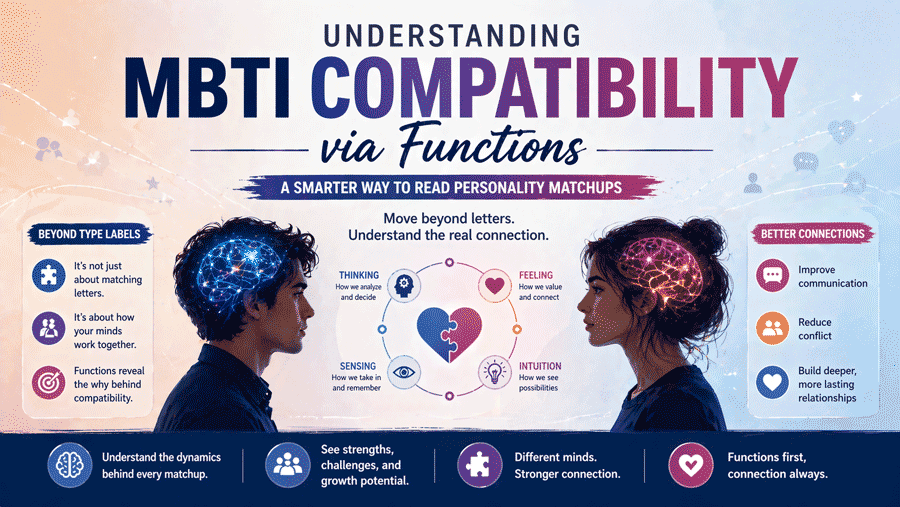
When exploring mbti compatibility, most people start by comparing four-letter codes. They look for "perfect matches" based on superficial similarities or opposite letters. However, this approach often leads to confusion and disappointment. True compatibility is not found in the letters themselves, but in the underlying cognitive functions that drive behavior. If you want to understand why some relationships thrive while others struggle, you must move beyond the surface level of E, I, N, S, T, F, J, and P. This article concludes upfront: meaningful mbti compatibility analysis requires a deep dive into cognitive function stacks, not just type labels. By understanding how information is processed and decisions are made, you can navigate relationships, career choices, and personal growth with far greater accuracy.
The Myers-Briggs Type Indicator (MBTI) is a useful tool for self-awareness, but it is frequently misunderstood as a rigid classification system. It is most useful for individuals seeking to understand their natural preferences, improve communication, and identify blind spots. However, relying solely on the four-letter result without understanding the machinery behind it limits the tool's potential. This guide is designed for English-speaking readers who want depth beyond stereotypes. Whether you are trying to confirm your own type, improve a relationship, or understand a colleague, the key lies in the cognitive functions.
The Mechanism Behind MBTI Compatibility
To grasp why mbti compatibility is complex, we must return to the Jungian roots of the system. Carl Jung proposed that human behavior is not random but follows patterns based on how we perceive information and how we make decisions. The MBTI builds on this by categorizing these preferences into four dichotomies. However, the dichotomies are merely the outward expression of the internal cognitive function stack.
The Four Dichotomies and Their Limits
The four letters represent preferences: Extraversion (E) vs. Introversion (I), Sensing (S) vs. Intuition (N), Thinking (T) vs. Feeling (F), and Judging (J) vs. Perceiving (P). While helpful, these letters can be misleading. For example, two "Thinkers" (T) may process logic completely differently. One might use Introverted Thinking (Ti), focusing on internal consistency and precision, while the other uses Extraverted Thinking (Te), focusing on external efficiency and organization. Without distinguishing between Ti and Te, a compatibility analysis is incomplete.
This is why letter-based typing alone often causes mistypes. A person might test as an INTJ but actually be an INFJ, or vice versa, because tests measure behavior rather than motivation. Behavior can be adapted; motivation is deeper. To validate your type, you must observe your decision patterns, stress reactions, and energy sources over time. Do you recharge by being alone (Introversion) or by interacting (Extraversion)? Do you trust concrete data (Sensing) or abstract patterns (Intuition)? These questions probe the function, not just the label.
The Cognitive Function Stack
Every type has a stack of four functions that operate in a specific order: Dominant, Auxiliary, Tertiary, and Inferior. This hierarchy dictates how you interact with the world.
- Dominant Function: This is your core identity, the lens through which you view life. It is highly developed and comfortable. For example, an Dominant Introverted Intuitive (Ni) focuses on future visions and underlying meanings.
- Auxiliary Function: This supports the dominant function. If the dominant is introverted, the auxiliary is extraverted, and vice versa. It provides balance. An Ni dominant might use Extraverted Thinking (Te) to execute their visions.
- Tertiary Function: Often less mature, this function emerges more in leisure or mid-life. It can be a source of creativity or relief.
- Inferior Function: This is the unconscious opposite of the dominant. Under stress, you may "grip" into this function, behaving uncharacteristically. An Inferior Extraverted Sensing (Se) type might suddenly indulge in sensory excess when overwhelmed.
Understanding these stacks is crucial for mbti compatibility. Compatibility is often about how function stacks interact. For instance, a type with dominant Fe (Extraverted Feeling) might harmonize well with a type that values group emotions, but clash with a dominant Ti (Introverted Thinking) type who prioritizes logical accuracy over social harmony. However, clash does not mean incompatibility; it means growth potential through friction.
Validating Type Through Observation
Because tests are imperfect, self-observation is vital. Look at your long-term feedback from others. Do people consistently describe you as empathetic or analytical? How do you react under extreme stress? Do you withdraw (Introverted) or seek stimulation (Extraverted)? Famous public figures are often typed by enthusiasts, but these should be treated cautiously. For example, a certain leader is widely believed to be an ENTJ, but without their direct input, this remains speculation. Use such examples only to illustrate function dynamics, not as absolute facts.
Practical Frameworks for Application
Knowing the theory is one thing; applying it is another. Below are two practical frameworks to use this knowledge for relationship dynamics and personal development.
Framework 1: Relationship and Communication Guidance
When it applies: This framework is best used when conflicts arise in personal or professional relationships, or when you want to deepen a connection.
Function Dynamics: It focuses on the interaction between Perceiving functions (how you gather info) and Judging functions (how you decide). For example, an N type (Intuition) might feel frustrated with an S type (Sensing) who focuses on details rather than the big picture. This is not a character flaw but a function difference.
Practical Action Steps:
- Identify the Friction Point: Is the conflict about facts (S vs N) or values (T vs F)?
- Translate Your Language: If you are an N type speaking to an S type, ground your ideas in concrete examples. If you are a T type speaking to an F type, acknowledge emotions before presenting logic.
- Respect Energy Needs: Understand if your partner needs solitude (I) or interaction (E) to recharge. Do not take their need for space as rejection.
Benefits and Limitations: This approach reduces personalization of conflict. You stop seeing differences as attacks. However, it does not excuse poor behavior. Understanding a function does not mean tolerating disrespect.
How to Judge Fit: If applying these steps reduces tension and increases mutual understanding, the framework fits. If conflicts remain entrenched despite function awareness, other factors like values or life goals may be the issue.
Framework 2: Stress Management and Personal Growth
When it applies: Use this when you feel burned out, stuck, or unusually reactive.
Function Dynamics: This relates to the "Grip" stress response. When the dominant function is overwhelmed, the inferior function takes over negatively. An INTJ (Dominant Ni) under stress might overindulge in sensory pleasures (Inferior Se), such as binge eating or impulsive spending.
Practical Action Steps:
- Recognize the Grip: Notice when you are acting out of character. Are you being uncharacteristically emotional or impulsive?
- Restore the Dominant: Engage activities that strengthen your dominant function. An Ni dominant should spend time planning or reflecting. An Se dominant should engage in physical activity.
- Develop the Auxiliary: Lean on your secondary strength. If you are stressed, don't try to fix everything with your weak spot. Use your auxiliary function to stabilize.
Benefits and Limitations: This helps prevent burnout and promotes resilience. The limitation is that it requires high self-awareness, which takes time to develop.
How to Judge Fit: If recognizing your stress pattern helps you recover faster, this framework is effective. If you find yourself unable to step back, professional support may be needed alongside type work.
Principles for Personality Growth
Growth in the context of MBTI is not about changing your type. It is about expanding your flexibility while honoring your preferences. Here are universal principles for healthy development.
Identify the Dominant Function First
Before trying to fix weaknesses, know your strength. Your dominant function is your superpower. An dominant Extraverted Intuitive (Ne) thrives on brainstorming and possibilities. Suppressing this to be more "serious" leads to dissatisfaction. Growth starts with leveraging this strength confidently.
Distinguish Preference from Skill
You can prefer Thinking (T) but be skilled at Feeling (F) tasks, or vice versa. Preference is about energy and comfort; skill is about capability. Do not confuse the two. You might prefer introversion but have excellent public speaking skills. Acknowledge the effort it costs you.
Develop the Inferior Function Gradually
The inferior function is a source of growth but also vulnerability. Do not try to force it. An inferior Fe type (who struggles with group harmony) should not force themselves to be the life of the party. Instead, practice small acts of connection. Gradual exposure builds capacity without causing burnout.
Explain Loop and Grip Patterns
A "loop" occurs when you bypass your auxiliary function and oscillate between your dominant and tertiary. For example, an INFP might loop between Fi (values) and Ne (possibilities), ignoring Te (action), leading to endless planning without execution. Recognizing loops helps you re-engage the auxiliary function to get back on track.
Growth Means Flexibility, Not Identity Attachment
Do not use your type as an excuse. Saying "I'm an INTP, so I can't be emotional" is a trap. Type describes preferences, not limitations. True growth means being able to access all functions when needed, even if some cost more energy. Flexibility is the goal, not rigid identity attachment.
Common Mistakes and Pitfalls
Even well-intentioned users fall into traps when discussing mbti compatibility and type dynamics. Avoid these eight common mistakes to maintain a healthy perspective.
- 1. Don't stereotype types: Avoid assuming all members of a type act the same. Better mindset: View type as a tendency, not a rule.
- 2. Don't ignore context: Behavior changes based on environment. Better mindset: Consider situational factors before labeling behavior as "type-typical."
- 3. Don't use type to justify bad behavior: Being blunt is not a valid excuse for being hurtful. Better mindset: Take responsibility for impact regardless of intent.
- 4. Don't obsess over mistyping: Constantly doubting your type hinders growth. Better mindset: Work with your current best understanding and adjust later if needed.
- 5. Don't treat compatibility as destiny: Any two types can work with effort. Better mindset: Focus on communication skills rather than type matching.
- 6. Don't neglect the inferior function: Ignoring your weak spots limits potential. Better mindset: Respect the inferior function as a area for gradual development.
- 7. Don't rely solely on online tests: Free tests are often inaccurate. Better mindset: Use tests as a starting point for self-reflection, not a final diagnosis.
- 8. Don't isolate based on type: Avoiding certain types limits your world. Better mindset: Seek diversity in relationships to challenge and grow your functions.
Ongoing Learning and Resources
The field of personality psychology is evolving. To maintain accuracy and depth, readers should commit to ongoing learning. Do not rely on social media memes or simplified summaries. Seek out higher-quality MBTI and Jungian resources. Credible organizations such as the Myers & Briggs Foundation and the Center for Applications of Psychological Type (CAPT) provide research-based materials. Jungian educational resources also offer deeper theoretical context.
Stay open to debates and newer interpretations. The understanding of cognitive functions has refined over decades. Learn to identify reliable information by checking citations and avoiding absolute claims. Remember that MBTI is a tool for understanding preferences, not a label that defines the whole person. It is scientifically contested in some academic circles, so maintain a measured perspective. Use it as a map, not the territory.
Frequently Asked Questions
1. Where should a beginner start with MBTI?
Start by learning the four dichotomies, but quickly move to cognitive functions. Read descriptions of the functions (Ti, Te, Fi, Fe, Ni, Ne, Si, Se) rather than just the 16 types. This provides a clearer picture of how your mind works.
2. How can I confirm my type without tests?
Observe your energy levels. What drains you? What energizes you? Look at your decision-making style. Do you prioritize logic or values? Ask trusted friends for feedback on your blind spots. Long-term self-observation is more reliable than a single test result.
3. Does mbti compatibility guarantee a good relationship?
No. Compatibility indicates potential areas of ease or friction, but it does not guarantee success. Communication, shared values, and effort are far more important than type matching. Any combination can work with mutual respect.
4. How do I learn cognitive functions efficiently?
Focus on one function at a time. Study how it manifests in an extraverted vs. introverted attitude. Compare examples of Ti vs Te or Ni vs Ne. Apply the concepts to your own daily decisions to see which resonates.
5. Can my personality type change over time?
Your core preferences generally remain stable, but your expression of them matures. You may develop your non-preferred functions, making you appear different. This is growth, not a change in type. However, significant trauma or life changes can sometimes shift how preferences are expressed.
6. What if I resonate with multiple type descriptions?
This is common. Look at the "why" behind the behavior. Two types might act similarly but for different reasons. Dig into the cognitive function stack to find the root motivation. Often, one stack will explain your stress reactions better than the other.
7. How do I judge the quality of MBTI information?
Check if the source distinguishes between type and behavior. Avoid content that stereotypes or claims one type is "better." Credible sources acknowledge limitations and emphasize growth over labeling. Look for references to Jungian theory or established foundations.
In conclusion, mbti compatibility is a rich field when approached with depth. By focusing on cognitive functions, validating type through observation, and applying practical frameworks, you can transform this tool from a simple label into a roadmap for meaningful connection and personal evolution. Remember, the goal is not to box yourself in, but to understand yourself well enough to break out of limitations when necessary.