
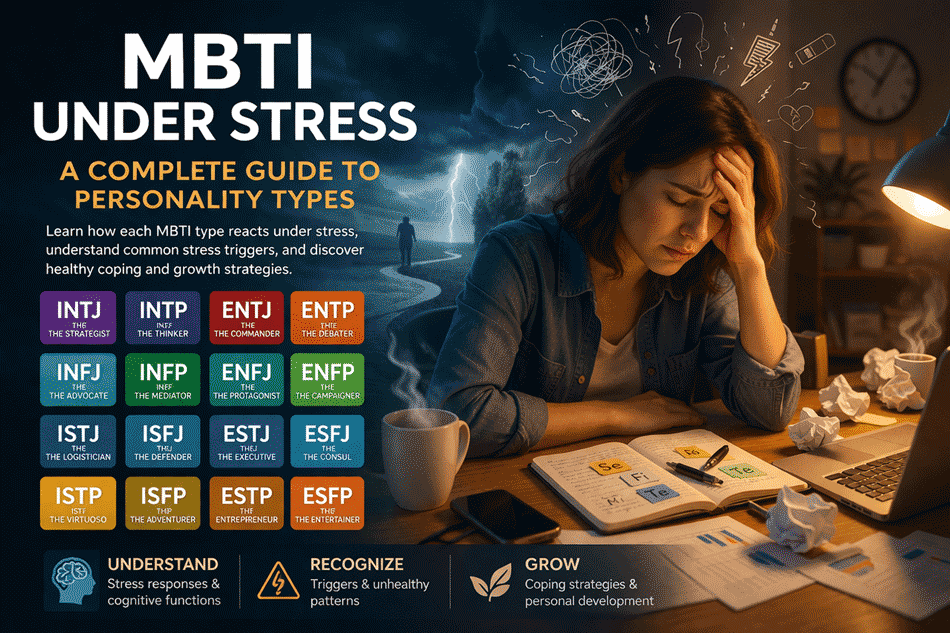
MBTI Under Stress: Complete Guide to All 16 Personality Types
Understanding MBTI under stress can help you make sense of your reactions during conflict, pressure, burnout, and emotional overload. Many people know their MBTI type in calm situations, but stress often reveals a very different side of personality. This is where the framework becomes especially useful. Instead of only describing your strengths, MBTI can also help you recognize your blind spots, unhealthy coping patterns, and growth areas.
This guide explains how 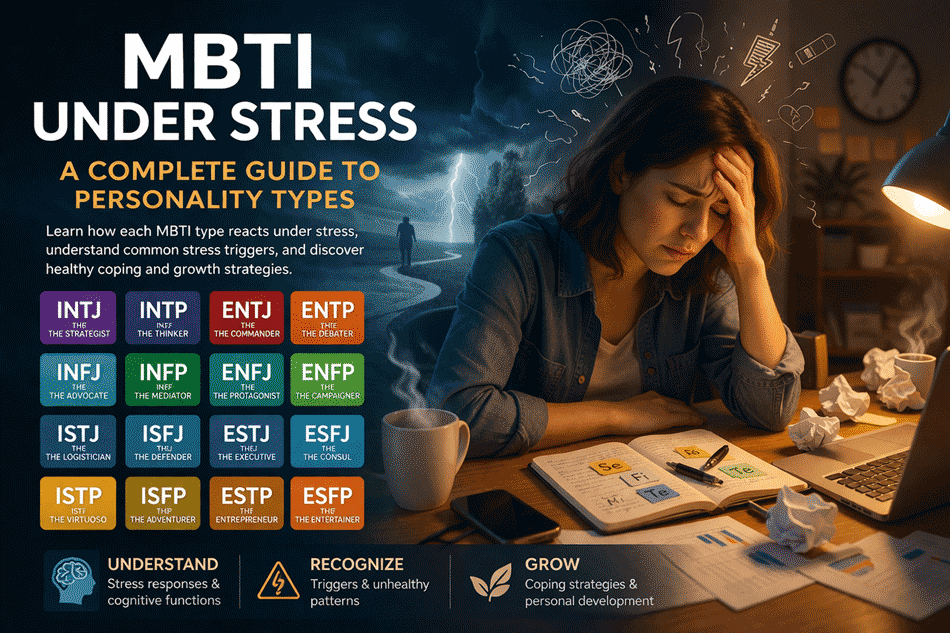 works, why different personality types react differently under pressure, and how cognitive functions shape those reactions. Whether you are dealing with work pressure, relationship conflict, or internal exhaustion, understanding your stress patterns can help you respond with more awareness and less self-judgment.
What Does MBTI Under Stress Mean?
MBTI under stress refers to the way personality patterns change when a person feels overwhelmed, emotionally overloaded, or mentally exhausted. In normal conditions, people tend to rely on their strongest and most natural cognitive functions. Under stress, however, they may lose access to those strengths and start acting in unfamiliar or unhealthy ways.
This is one reason MBTI can be helpful. It does not just describe who you are at your best. It can also help explain what happens when you feel off-balance, reactive, withdrawn, impulsive, overly emotional, or mentally stuck. Stress does not change your personality type, but it can distort how that type shows up in daily life.
The MBTI Model Behind Stress Responses
To understand MBTI under stress, it helps to look beyond the four letters and focus on cognitive functions. The Myers-Briggs system is based on Carl Jung’s theory of psychological types and organizes personality around preferences in how people gather information and make decisions.
The four basic MBTI dimensions are:
- Extraversion (E) vs. Introversion (I)
- Sensing (S) vs. Intuition (N)
- Thinking (T) vs. Feeling (F)
- Judging (J) vs. Perceiving (P)
These dimensions create 16 personality types, but the deeper structure comes from the cognitive function stack. Each type has four main functions:
- Dominant
- Auxiliary
- Tertiary
- Inferior
The dominant and auxiliary functions usually support healthy thinking and behavior. The inferior function is weaker and often becomes more visible under pressure. That is why stress can make people seem unlike themselves.
Cognitive Functions and the Grip Experience
One of the most important ideas in MBTI under stress is the “grip” experience. This happens when the dominant function becomes overwhelmed and the inferior function starts taking over in a reactive way. The result can feel confusing, intense, and out of character.
For example, an INTJ usually relies on Introverted Intuition (Ni) and Extraverted Thinking (Te). Under heavy stress, that same person may fall into inferior Extraverted Sensing (Se), becoming unusually impulsive, overstimulated, or obsessed with immediate details.
This helps explain why stress responses often feel extreme. A person is not becoming a different type. They are reacting through a less developed part of their personality. Recognizing this pattern is often the first step toward recovery.
MBTI Under Stress: Common Patterns by Type Group
Different MBTI groups often show different stress patterns. These are not fixed rules, but they can offer a helpful starting point.
NF Types Under Stress
INFJs and ENFJs may become unusually critical, cynical, or emotionally drained. INFPs and ENFPs may become rigid, detail-obsessed, or overwhelmed by negativity.
NT Types Under Stress
INTJs and ENTJs may become impulsive, overstimulated, or overly focused on physical details. INTPs and ENTPs may become unexpectedly emotional, reactive, or sensitive to criticism.
SJ Types Under Stress
ISTJs and ESTJs may feel overwhelmed by disorder and become withdrawn or harsh. ISFJs and ESFJs may become detached, coldly logical, or less responsive to emotional needs.
SP Types Under Stress
ISTPs and ESTPs may become anxious about future possibilities or stuck in overanalysis. ISFPs and ESFPs may become more judgmental, self-critical, or rigid than usual.
These patterns are useful because they show that stress often pushes people away from their natural strengths and into less balanced behavior.
How to Recognize Your Stress Response
If you want to understand MBTI under stress in a practical way, start by observing your real reactions over time. Ask yourself:
- What usually triggers me?
- Do I withdraw, lash out, overthink, or become impulsive?
- Do I become more emotional, more critical, or more controlling?
- What feels different from my normal personality?
- What helps me return to balance?
You do not need a perfect answer right away. The goal is to notice recurring patterns. Stress responses often become easier to identify once you stop judging them and start observing them with curiosity.
How to Verify Your Type Without Relying Only on Tests
Many people explore MBTI under stress because they are still unsure of their type. Online tests can be a useful starting point, but they often miss nuance, especially if you answer based on stress, aspiration, or recent life pressure.
A better way to verify your type includes:
Observe your energy patterns
Do you recover best through solitude or interaction? Do you feel more grounded in facts or in possibilities?
Look at your decision-making style
Do you naturally prioritize logic, structure, harmony, personal values, or long-term meaning?
Compare your calm self to your stressed self
Your type is usually easier to spot in your normal state, while your inferior function often shows up more strongly under pressure.
Ask for feedback
Trusted friends may notice long-term patterns that you miss in yourself.
Tests can help, but long-term self-observation is usually more accurate.
MBTI Under Stress in Work and Career
Understanding MBTI under stress can be especially useful at work. Career pressure often triggers unhealthy patterns because it combines deadlines, expectations, conflict, and fatigue.
For example:
- A structured type may become overly rigid or controlling.
- A flexible type may become scattered or avoidant.
- A thinking type may become unusually blunt or detached.
- A feeling type may become emotionally overwhelmed or highly sensitive.
- An intuitive type may get lost in worry or abstraction.
- A sensing type may become fixated on immediate problems and lose the bigger picture.
Knowing these patterns can help you respond earlier. Instead of waiting for full burnout, you can recognize the warning signs and reset before stress takes over completely.
MBTI Under Stress in Relationships
Stress does not only affect work. It also affects communication, patience, empathy, and conflict in relationships. Understanding MBTI under stress can help couples, friends, and families avoid misreading each other.
For example:
- A stressed introvert may seem distant, but may simply need recovery time.
- A stressed extravert may talk more, vent more, or seek reassurance through interaction.
- A stressed thinking type may sound cold when they are actually overloaded.
- A stressed feeling type may become unusually reactive when they feel emotionally unseen.
These differences matter. In many cases, the problem is not lack of care, but different stress languages. MBTI can help people interpret these differences more accurately and communicate with more empathy.
Practical Strategies for Managing MBTI Under Stress
Understanding your pattern is only the first step. The next step is knowing what to do with it.
Strengthen your auxiliary function
Your auxiliary function often helps restore balance. If stress pushes you into an unhealthy grip state, reconnecting with your second function can help stabilize you.
Reduce overload before major decisions
Many bad decisions happen in the middle of stress. If possible, delay important conversations or choices until you are more regulated.
Watch for out-of-character behavior
If you suddenly feel unusually impulsive, rigid, cynical, emotional, or controlling, that may be a sign that stress is affecting your function stack.
Build recovery habits
Rest, sleep, reflection, movement, journaling, and quiet space can all help, depending on your type and needs.
Use MBTI as a tool, not an excuse
Stress responses may explain behavior, but they do not remove responsibility. Awareness should lead to better choices, not self-justification.
Growth Through Stress Awareness
A healthy approach to MBTI under stress is growth-oriented. The goal is not to avoid all stress forever. The goal is to recognize what stress reveals and use that knowledge to become more balanced.
Growth often includes:
- understanding your dominant and inferior functions
- spotting your early warning signs
- reducing shame around stress reactions
- practicing healthier coping habits
- learning how to return to your natural strengths more quickly
Over time, this creates resilience. You may still get stressed, but you become less controlled by it. That is one of the most practical benefits of MBTI when used well.
Common Mistakes to Avoid
When learning about MBTI under stress, people often fall into a few common traps.
Treating MBTI like a fixed label
Your type describes preferences, not permanent limits.
Using stress patterns as excuses
“I was stressed” explains behavior, but it does not replace accountability.
Relying only on online tests
Tests can be inconsistent, especially when mood and stress distort self-perception.
Ignoring context
Stress responses can be influenced by health, burnout, environment, and life stage.
Typing others too quickly
Public behavior or isolated reactions are not enough to define someone’s full type.
Assuming one type handles stress best
Every type has strengths and vulnerabilities. No type is immune to pressure.
Avoiding these mistakes makes MBTI more accurate and more useful in real life.
Frequently Asked Questions
What does MBTI under stress mean?
It refers to how each MBTI type reacts when overwhelmed, pressured, or emotionally overloaded, especially when the inferior function becomes more active.
Can stress make you seem like a different type?
Yes. Stress can make people behave in unfamiliar ways, especially during a grip experience, but it does not usually mean their core type has changed.
How do I know my stress response pattern?
Look for repeated reactions during conflict, burnout, or overload. Notice what feels out of character and what keeps showing up under pressure.
Can MBTI help with relationships under stress?
Yes. It can improve empathy by helping people understand different communication needs, coping habits, and emotional responses.
Should I trust online MBTI tests?
They can be useful as a starting point, but they should not be your only source. Long-term observation is more reliable.
What is the best way to recover from stress?
That depends on the person, but recovery usually starts with rest, reduced overload, emotional awareness, and reconnecting with healthier cognitive patterns.
Final Thoughts
Understanding MBTI under stress can help you respond to challenges with more clarity, compassion, and self-control. Instead of seeing stress reactions as random or shameful, you can start seeing them as patterns that reveal where you feel overloaded and what you need to restore balance.
Used wisely, MBTI is not a cage. It is a framework for awareness. It helps you understand how pressure affects your personality, how your weaker functions show up under strain, and how you can grow into a healthier version of yourself over time.