
Understanding how each mbti shows love is often the first step partners take to bridge communication gaps and deepen emotional intimacy. However, relying solely on the four-letter type code can lead to stereotypes that obscure the nuanced reality of human connection. To truly grasp relationship dynamics, one must look beyond the letters and explore the underlying cognitive functions that drive behavior. This article provides a comprehensive, function-based analysis of love languages across the 16 personality types, offering practical frameworks for growth and compatibility.
While MBTI is a valuable tool for understanding preferences, it is not a definitive label. Deeper application requires returning to cognitive functions. Whether you are seeking to understand your partner or refine your own self-awareness, recognizing the mechanical drivers of affection allows for more accurate type confirmation and healthier communication patterns.
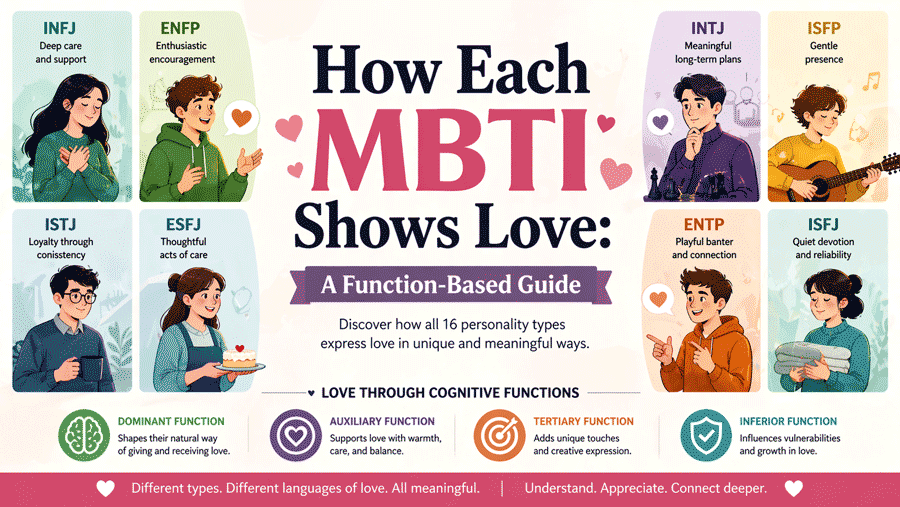
The Mechanism: Beyond the Four Letters
To understand relationships deeply, we must revisit the Jungian roots of the MBTI system. Carl Jung proposed that people perceive the world and make decisions using specific mental processes, known as cognitive functions. The MBTI four dichotomies (Extraversion/Introversion, Sensing/Intuition, Thinking/Feeling, Judging/Perceiving) are merely indicators of which functions a person prefers to use.
The Cognitive Function Stack
Each of the 16 types operates using a stack of four primary functions: Dominant, Auxiliary, Tertiary, and Inferior. The Dominant function is the core lens through which a person views the world. The Auxiliary supports it. The Tertiary and Inferior functions are less developed and often emerge under stress or during periods of significant personality growth.
For example, an INFJ leads with Introverted Intuition (Ni) but shows love primarily through their auxiliary Extraverted Feeling (Fe). An INTP leads with Introverted Thinking (Ti) but may show care through their tertiary Introverted Sensing (Si) or inferior Extraverted Feeling (Fe). Ignoring this stack leads to mistyping. Many people identify with their aspirational functions rather than their natural defaults. Validating your type requires self-observation of decision patterns, stress reactions, and long-term feedback from others, rather than relying only on online tests.
Why Letter-Based Typing Causes Mistypes
Letter-based typing often fails because it conflates behavior with motivation. Two people may exhibit the same loving behavior (e.g., planning a date) but for different functional reasons. One may do it to ensure efficiency (Te), while another does it to create emotional harmony (Fe). Understanding how each mbti shows love requires distinguishing these motivations. If you resonate partially with a type description, examine which functions are driving that resonance. Is it a natural flow, or is it a learned coping mechanism?
How Each MBTI Shows Love: A Functional Breakdown
Rather than listing types alphabetically, we group them by their dominant cognitive function. This reveals the core engine of their affectionate expression.
Dominant Introverted Feeling (Fi): INFP, ISFP
Types with dominant Fi prioritize authenticity and internal value alignment. For them, love is an intense, private experience that must be genuine.
INFP: An INFP shows love by sharing their inner world. They write deeply personal messages, remember obscure details about your dreams, and offer unconditional acceptance. They seek a soulmate connection where vulnerabilities are safe. However, they may struggle to express needs directly, expecting partners to intuitively understand their emotional state.
ISFP: An ISFP demonstrates love through aesthetic experiences and physical presence. They create beautiful environments, cook meaningful meals, or engage in shared sensory activities. Their love is in the moment. They may withdraw if they feel controlled, as autonomy is crucial for their Fi to function. To connect with them, respect their need for space and appreciate their tangible gestures.
Dominant Extraverted Feeling (Fe): ENFJ, ESFJ
Fe dominants are attuned to the emotional atmosphere of the group. Their love is outward-facing, focused on harmony and care.
ENFJ: An ENFJ shows love by investing in your growth. They mentor, encourage, and organize support systems for you. They want to see you become your best self. Their shadow side may involve becoming overly intrusive or sacrificing their own needs to maintain harmony. They thrive on verbal affirmation and shared social experiences.
ESFJ: An ESFJ expresses love through practical care and tradition. They remember birthdays, ensure you are fed, and maintain family rituals. Their love is reliable and tangible. They may feel unloved if their efforts are not acknowledged or if traditions are dismissed. Reciprocity in social obligations is key to their sense of security.
Dominant Introverted Thinking (Ti): INTP, ISTP
Ti dominants value logical consistency and internal understanding. Love is shown through problem-solving and respecting autonomy.
INTP: An INTP shows love by sharing ideas and trusting you with their theories. They may not be emotionally expressive but will spend hours discussing concepts important to you. They show care by fixing your problems logically. They need a partner who understands their need for intellectual space and does not interpret silence as rejection.
ISTP: An ISTP demonstrates love through action and shared activities. They will fix your car, teach you a skill, or engage in adventurous outings. They value competence and independence. Emotional drama can be draining for them. They appreciate a partner who is self-sufficient and enjoys doing things side-by-side rather than constant face-to-face processing.
Dominant Extraverted Thinking (Te): ENTJ, ESTJ
Te dominants focus on efficiency, results, and external organization. Love is demonstrated through provision and protection.
ENTJ: An ENTJ shows love by including you in their long-term plans and optimizing your life. They remove obstacles for you and provide resources. They may seem demanding, but their critique is intended to help you succeed. They respect competence and direct communication. Vulnerability is private for them, so when they share it, it is a significant sign of trust.
ESTJ: An ESTJ expresses love through duty and stability. They ensure the household runs smoothly, finances are secure, and obligations are met. They are protective and loyal. They may struggle with abstract emotional expression, preferring to show care by doing things correctly. Appreciation for their hard work and reliability reinforces their bond.
Dominant Introverted Intuition (Ni): INFJ, INTJ
Ni dominants focus on future vision, patterns, and deeper meaning. Love is a strategic and spiritual union.
INFJ: An INFJ shows love through deep emotional insight and advocacy. They understand your pain before you articulate it and stand up for you. They seek a transformative connection. They may become intense or withdraw if the relationship lacks depth. They need authenticity and shared values more than social activity.
INTJ: An INTJ demonstrates love by integrating you into their vision of the future. They share their long-term goals and expect you to be a partner in achieving them. They value intellectual compatibility and independence. They may not offer frequent verbal affection but will remain steadfastly loyal. Respecting their need for solitude is essential for their recharge.
Dominant Extraverted Intuition (Ne): ENFP, ENTP
Ne dominants explore possibilities, connections, and potential. Love is an adventure and a discovery.
ENFP: An ENFP shows love through enthusiasm and encouragement. They celebrate your uniqueness and introduce you to new experiences. They want to know all your stories. They may struggle with routine and follow-through. They need a partner who can ground them while supporting their curiosity. Emotional validation is crucial for them.
ENTP: An ENTP expresses love through intellectual sparring and shared exploration. They challenge your ideas to help you refine them. They show care by including you in their schemes and adventures. They may neglect emotional niceties in favor of truth and fun. They appreciate a partner who can keep up with their wit and does not take debate personally.
Dominant Introverted Sensing (Si): ISFJ, ISTJ
Si dominants value stability, memory, and past experiences. Love is consistency and reliability.
ISFJ: An ISFJ shows love through attentive service and remembering details. They recall your favorite foods and anticipate your needs before you ask. They create a safe, comfortable home environment. They may feel taken for granted if their sacrifices are unnoticed. They value tradition and commitment highly.
ISTJ: An ISTJ demonstrates love through loyalty and responsibility. They keep their promises and maintain structure. They may not be spontaneous, but they are dependable. They show care by ensuring security and order. They appreciate a partner who respects rules and values stability over constant change.
Dominant Extraverted Sensing (Se): ESFP, ESTP
Se dominants live in the present moment, engaging with the physical world. Love is shared experience and excitement.
ESFP: An ESFP shows love by making life fun and vibrant. They plan surprises, give gifts, and ensure you are enjoying the moment. They are physically affectionate and expressive. They may avoid conflict or heavy emotional processing. They need a partner who joins them in experiencing life rather than analyzing it.
ESTP: An ESTP expresses love through action and protection. They are ready to jump into any situation to help you. They enjoy shared thrills and physical activities. They value honesty and directness. They may struggle with long-term emotional planning but are fiercely loyal in the present. They appreciate a partner who is adaptable and confident.
Practical Frameworks for Relationship Growth
Understanding types is only the beginning. Applying this knowledge requires structured frameworks to improve MBTI compatibility and personal development.
Framework 1: Cognitive Function Development
When it applies: This framework is useful when you feel stuck in repetitive relationship conflicts or personal stagnation.
Function Dynamics: It relates to balancing the Dominant and Inferior functions. Over-reliance on the Dominant can lead to rigidity, while ignoring the Inferior leads to stress.
Action Steps:
- Identify your Dominant function (e.g., Ti for INTP).
- Identify your Inferior function (e.g., Fe for INTP).
- Practice small acts of the Inferior function. If you are a Thinker, practice expressing appreciation verbally. If you are a Feeler, practice making logical decisions based on data.
- Observe how this flexibility reduces tension with partners who prefer those functions.
Benefits and Limitations: This promotes personality growth and reduces mistyping by revealing hidden capacities. However, it requires patience; the Inferior function is naturally weaker and tires easily.
Judgment: You know it fits if you feel more resilient during stress and less judgmental of partners who differ from you.
Framework 2: Communication Pattern Mapping
When it applies: Use this during conflicts or when planning major life decisions together.
Function Dynamics: This relates to Perceiving (S/N) and Judging (T/F) interactions. It highlights where information processing diverges.
Action Steps:
- Map your partner's primary information intake (Sensing vs. Intuition).
- Adjust your explanation style. For Sensors, provide concrete details and steps. For Intuitives, provide the big picture and purpose.
- Map decision criteria (Thinking vs. Feeling).
- For Thinkers, present logical pros and cons. For Feelers, discuss impact on people and values.
Benefits and Limitations: This drastically improves communication patterns and reduces misunderstanding. It does not solve value conflicts but ensures both parties understand the argument.
Judgment: It fits if conflicts resolve faster and both parties feel heard, even if disagreement remains.
Universal Growth Principles
Regardless of type, certain principles govern healthy psychological development within the MBTI framework.
Identify the Dominant Function First
Growth begins with acknowledging your natural strength. Do not try to change your core nature. An Introvert should not force themselves to be the life of the party constantly. Honor your energy source.
Distinguish Preference from Skill
You may be skilled at something you do not prefer. A Feeling type can learn logic, but it costs more energy. Recognize the energy cost to avoid burnout.
Develop the Inferior Function Gradually
The Inferior function is the gateway to growth but also the source of stress. Engage it in low-stakes environments. Do not rely on it during high-pressure crises until it is more mature.
Understand Loop and Grip Patterns
Under stress, types may bypass their Auxiliary function and enter a "loop" (e.g., INFP using only Fi and Ne, skipping Te), leading to unproductive spiraling. In severe stress, they may "grip" into their Inferior function (e.g., INTJ exploding with emotional outbursts). Recognizing these states helps partners offer appropriate support rather than taking behavior personally.
Growth Means Flexibility
MBTI is not an identity attachment. It is a map. True maturity is the ability to access all functions when appropriate, not just your preferred ones. Flexibility prevents stereotyping and fosters deeper MBTI compatibility.
8 Common Mistakes to Avoid
To maintain credibility and utility, avoid these common pitfalls when applying MBTI to relationships.
- Don't use type as an excuse for bad behavior. Explanation is not justification. Being an INTP does not grant permission to be unkind.
- Don't assume compatibility is deterministic. Any two types can work with effort. Type suggests friction points, not destiny.
- Don't rely solely on online tests. Tests measure self-perception, not cognitive machinery. Use them as a starting point for type confirmation, not the final verdict.
- Don't stereotype based on letters alone. Not all Thinkers are cold. Not all Feelers are irrational. Look at the function stack.
- Don't ignore the context. Stress, culture, and upbringing influence behavior as much as type. A stressed ESFJ may look like an unhealthy ESTP.
- Don't type others without consent. Armchair typing can feel invasive and reductionist. Discuss types openly.
- Don't treat type as static. While preferences are stable, expression evolves. Allow room for change and maturity.
- Don't neglect the Shadow functions. Understanding what you repress is as important as understanding what you embrace for holistic growth.
Continuing Your MBTI Journey
The field of personality psychology is evolving. To ensure you are accessing reliable information, prioritize credible organizations and research-based resources.
Consider exploring materials from the Myers & Briggs Foundation or the Center for Applications of Psychological Type (CAPT). These organizations uphold ethical standards and accurate representations of the theory. Jungian educational resources also provide depth on the cognitive functions that underpin the MBTI.
Stay open to debates and newer interpretations. The community is active, and understanding deepens over time. Avoid low-quality summaries that reduce complex human beings to memes. Reliable information will emphasize nuance, growth, and the limitations of the tool. By committing to ongoing learning, you ensure that MBTI remains a catalyst for understanding rather than a cage of labels.
Frequently Asked Questions
1. Where should a beginner start with MBTI?
Start by learning the four dichotomies, but quickly move to cognitive functions. Read about the function stack (Dominant, Auxiliary, Tertiary, Inferior). This prevents superficial typing and provides a mechanism for understanding behavior.
2. How can I confirm my type without tests?
Observe your energy sources and stress reactions. What drains you? What restores you? How do you behave under extreme pressure? Ask trusted friends for feedback on your blind spots. Consistency over time is a better indicator than a single quiz result.
3. Can MBTI help improve relationship communication?
Yes, by highlighting differences in information processing and decision-making. It helps partners understand that a difference in style is not a defect. It facilitates empathy by explaining the "why" behind behaviors.
4. Is it possible to resonate with multiple types?
Yes. You may be developing your tertiary function, or you may be mistyped. You might also be healthy and accessing non-preferred functions. Focus on which processes feel effortless versus which feel like work.
5. Can my personality type change?
Your core preferences are generally stable throughout adulthood. However, your ability to use all functions improves with maturity. You do not change types, but you become more flexible and balanced in how you express them.