
Understanding personality is often like trying to categorize wildlife; it requires observing behavior in natural habitats rather than just looking at labels. When people search for mbti types as animals, they are seeking a relatable, instinctual bridge to understand complex psychological preferences. However, while animal metaphors provide an engaging entry point, true type accuracy demands a deeper return to cognitive functions. This article concludes upfront: mapping MBTI types to animals is useful for visualizing energy dynamics, but validating your type requires analyzing how you process information and make decisions through the Jungian function stack.
The Myers-Briggs Type Indicator (MBTI) is a tool designed to help individuals understand their psychological preferences in how they perceive the world and make decisions. It is useful for self-awareness, career planning, and improving communication. Yet, relying solely on four-letter codes or surface-level animal comparisons can lead to mistyping. To apply the concept of mbti types as animals effectively, one must understand the underlying machinery of cognitive functions. This guide will move beyond stereotypes, offering a robust framework for type confirmation, growth, and practical application.
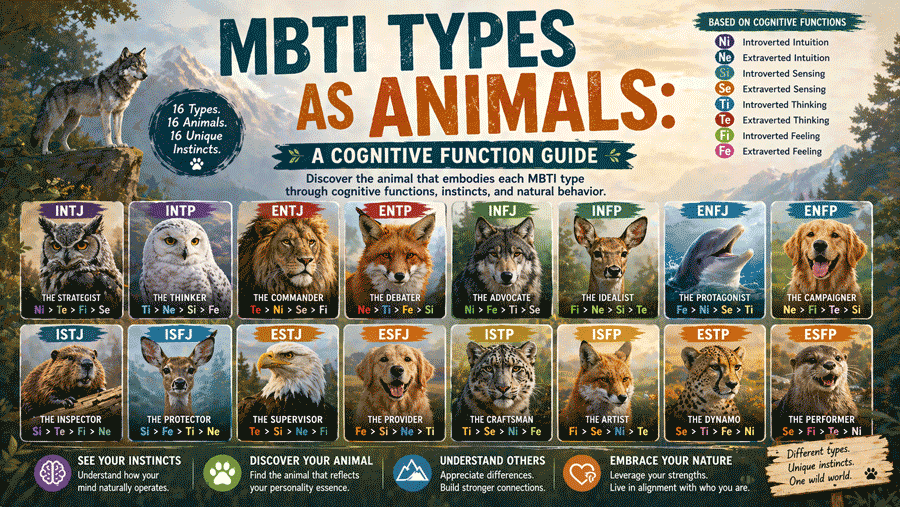
The Jungian Framework: Beyond the Four Letters
To understand why certain types resonate with specific animals, we must first look at the roots of the theory. The MBTI is based on Carl Jung's theory of psychological types. Jung proposed that people have innate preferences in how they direct their energy, take in information, make decisions, and organize their lives.
The Four Dichotomies and Their Limits
Traditionally, MBTI is presented through four dichotomies:
- Extraversion (E) vs. Introversion (I): Where you focus your attention.
- Sensing (S) vs. Intuition (N): How you take in information.
- Thinking (T) vs. Feeling (F): How you make decisions.
- Judging (J) vs. Perceiving (P): How you deal with the outer world.
While helpful, these letters often cause mistypes because they describe behavior rather than mechanism. Two people might both appear organized (J), but one uses Extraverted Thinking (Te) to structure the environment, while the other uses Introverted Sensing (Si) to maintain internal stability. This is why the concept of mbti types as animals works best when linked to functions, not just letters.
The Cognitive Function Stack
Every type operates using a stack of four cognitive functions:
- Dominant Function: The hero role. Your natural strength and primary lens.
- Auxiliary Function: The parent role. Supports the dominant and provides balance.
- Tertiary Function: The child role. Often playful but less mature.
- Inferior Function: The aspirational role. A source of stress but also growth.
Validating your type requires self-observation of these functions. Ask yourself: What is my default decision-making style? How do I react under stress? Do I prefer exploring possibilities (Ne) or narrowing down to one vision (Ni)? Relying only on tests often fails because tests measure self-perception, which can be biased. True type confirmation comes from recognizing patterns in motivation, blind spots, and long-term feedback from others.
The Animal Metaphor Mechanism
Why do we compare personalities to animals? Animals represent instinctual behavior, survival strategies, and social structures. When we say an INTJ is an owl, we are not saying they look like birds. We are saying their cognitive process mirrors the owl's strategic observation and nocturnal independence. When we say an ESFP is a dolphin, we reference their social fluidity and sensory engagement with the immediate environment.
This metaphor works because cognitive functions are essentially mental instincts. Extraverted Sensing (Se) hunts for immediate data like a predator. Introverted Intuition (Ni) synthesizes patterns like a migratory bird navigating by stars. By understanding the function, the animal comparison becomes a tool for memory and insight rather than a childish stereotype.
Deep Dive: The 16 Types as Animals
Below, we explore the 16 types grouped by their dominant cognitive function. This ensures the animal comparison reflects the core engine of the personality.
Dominant Introverted Intuition (Ni): The Owl and The Whale
Types: INTJ, INFJ
Animal Archetype: The Owl (INTJ), The Whale (INFJ)
Ni dominants focus on future implications, patterns, and singular visions. They are often solitary strategists.
INTJ (The Owl): Owls are observant, silent, and strike with precision. INTJs use Ni to foresee outcomes and Te to execute plans. Like an owl watching from a high branch, they detach to analyze systems. They value competence and long-term strategy over social harmony.
INFJ (The Whale): Whales are deep, communicative over long distances, and emotionally complex. INFJs use Ni to understand human potential and Fe to harmonize groups. They dive deep into emotional undercurrents, often feeling misunderstood by surface-level interactions. Their growth involves surfacing to engage with practical realities.
Dominant Extraverted Intuition (Ne): The Dolphin and The Fox
Types: ENTP, ENFP
Animal Archetype: The Fox (ENTP), The Dolphin (ENFP)
Ne dominants explore possibilities, connections, and what could be. They are scattered but brilliant.
ENTP (The Fox): Foxes are cunning, adaptable, and provocative. ENTPs use Ne to generate ideas and Ti to analyze their logical consistency. They enjoy debating to test boundaries. Like a fox, they are quick-witted and can talk their way out of trouble, but may struggle with follow-through.
ENFP (The Dolphin): Dolphins are social, playful, and intuitive. ENFPs use Ne to explore human potential and Fi to align with personal values. They swim through social groups easily, seeking authentic connection. Their challenge is maintaining focus amidst endless possibilities.
Dominant Introverted Sensing (Si): The Beaver and The Elephant
Types: ISTJ, ISFJ
Animal Archetype: The Beaver (ISTJ), The Elephant (ISFJ)
Si dominants value stability, tradition, and detailed recall. They are the guardians of structure.
ISTJ (The Beaver): Beavers build dams systematically and maintain them rigorously. ISTJs use Si to recall past data and Te to organize the external world. They are reliable, dutiful, and prefer proven methods. They ensure the infrastructure of society functions smoothly.
ISFJ (The Elephant): Elephants have long memories and strong herd bonds. ISFJs use Si to remember personal details and Fe to care for others. They are protective and nurturing, often putting the group's needs before their own. Their growth involves asserting their own needs without guilt.
Dominant Extraverted Sensing (Se): The Tiger and The Peacock
Types: ESTP, ESFP
Animal Archetype: The Tiger (ESTP), The Peacock (ESFP)
Se dominants live in the moment, engaging directly with the physical world.
ESTP (The Tiger): Tigers are action-oriented, bold, and reactive. ESTPs use Se to assess immediate risks and Ti to analyze mechanics. They thrive in crises and prefer learning by doing. They are pragmatic problem-solvers who dislike abstract theory without application.
ESFP (The Peacock): Peacocks are vibrant, expressive, and center-stage. ESFPs use Se to experience life fully and Fi to express authentic emotion. They bring energy to rooms and seek to make life enjoyable. Their challenge is considering long-term consequences of immediate actions.
Dominant Introverted Thinking (Ti): The Snake and The Cat
Types: INTP, ISTP
Animal Archetype: The Snake (INTP), The Cat (ISTP)
Ti dominants seek internal logical consistency and precision.
INTP (The Snake): Snakes are contemplative, shedding skin to grow. INTPs use Ti to deconstruct ideas and Ne to explore theoretical frameworks. They are detached observers who value truth over harmony. They often struggle with executing their complex internal models.
ISTP (The Cat): Cats are independent, agile, and observant. ISTPs use Ti to understand how things work and Se to interact with tools. They are master craftsmen who prefer autonomy. They show care through actions rather than words.
Dominant Extraverted Thinking (Te): The Lion and The Bear
Types: ENTJ, ESTJ
Animal Archetype: The Lion (ENTJ), The Bear (ESTJ)
Te dominants organize the external world for efficiency and results.
ENTJ (The Lion): Lions lead prides and command territory. ENTJs use Te to mobilize resources and Ni to set long-term goals. They are natural commanders who value competence and drive. They must learn to listen to emotional undercurrents they might overlook.
ESTJ (The Bear): Bears are protective, strong, and establish boundaries. ESTJs use Te to enforce standards and Si to uphold traditions. They are the pillars of community, ensuring rules are followed. Their growth involves flexibility when rules no longer serve the goal.
Dominant Introverted Feeling (Fi): The Deer and The Swan
Types: INFP, ISFP
Animal Archetype: The Deer (INFP), The Swan (ISFP)
Fi dominants prioritize internal values, authenticity, and empathy.
INFP (The Deer): Deer are sensitive, alert, and gentle. INFPs use Fi to navigate moral landscapes and Ne to imagine better worlds. They are idealists who seek meaning. They must guard against becoming too isolated in their inner values.
ISFP (The Swan): Swans are graceful, aesthetic, and quiet. ISFPs use Fi to honor personal integrity and Se to express beauty. They live in the moment and express values through art or action. They struggle with conflict that threatens their inner peace.
Dominant Extraverted Feeling (Fe): The Wolf and The Dog
Types: ENFJ, ESFJ
Animal Archetype: The Wolf (ENFJ), The Dog (ESFJ)
Fe dominants prioritize group harmony, social norms, and collective values.
ENFJ (The Wolf): Wolves lead packs with a focus on unity and direction. ENFJs use Fe to inspire groups and Ni to envision collective growth. They are charismatic mentors. They must avoid losing themselves in others' needs.
ESFJ (The Dog): Dogs are loyal, social, and attentive to owners. ESFJs use Fe to maintain social bonds and Si to remember obligations. They are the glue of social networks. Their growth involves distinguishing their own needs from the group's expectations.
Application Frameworks for Growth
Understanding your animal archetype is fun, but applying it is transformative. Here are two frameworks to use this knowledge practically.
Framework 1: Cognitive Function Development
When it applies: When you feel stuck, inefficient, or emotionally volatile.
Relation to Types: All types, specifically focusing on the Tertiary and Inferior functions.
Action Steps:
- Identify the Dominant: Confirm what you do naturally. If you are an Owl (INTJ), accept your need for strategy.
- Stretch the Inferior: If you are an Ni dom, your inferior is Se. Engage in physical activities without over-analyzing. If you are an Fe dom, your inferior is Ti. Spend time analyzing logic without worrying about feelings.
- Monitor Stress: Notice when you enter a "grip" stress reaction. An Owl under stress might binge eat or act impulsively (Se grip). Recognize this as a signal to rest, not a character flaw.
Benefits: Increases resilience and reduces burnout.
Limitations: Developing inferior functions takes years. Do not expect to become an expert in your weakness quickly.
Judgment: You know it fits when you feel more balanced and less reactive to stressors that previously overwhelmed you.
Framework 2: Relationship and Communication Guidance
When it applies: During conflicts, team collaborations, or parenting.
Relation to Types: MBTI compatibility and interaction styles.
Action Steps:
- Translate Languages: If you are a Tiger (ESTP) talking to a Whale (INFJ), realize they speak "values" while you speak "action." Translate your intent: "I am fixing this because I care," not just fixing it silently.
- Respect Energy: Introverted animals (Owl, Snake) need downtime. Extraverted animals (Lion, Dolphin) need interaction. Negotiate social batteries.
- Validate Functions: Acknowledge the other's strength. Tell the Beaver (ISTJ) you appreciate their reliability. Tell the Fox (ENTP) you value their ideas.
Benefits: Reduces misunderstanding and fosters deeper connection.
Limitations: Type does not excuse bad behavior. Maturity is still required.
Judgment: It fits if conflicts decrease in frequency and intensity, and resolution happens faster.
Growth Principles for All Types
Regardless of your animal archetype, certain universal principles apply to personality growth.
Identify the Dominant Function First
Before trying to fix weaknesses, maximize strengths. An Owl should not try to be a Dolphin all day. Schedule deep work during your peak energy times.
Distinguish Preference from Skill
You may prefer Thinking (T), but that does not mean you are smart. You may prefer Feeling (F), but that does not mean you are kind. Skill is developed; preference is innate. Do not use type as an excuse for lack of skill development.
Develop the Inferior Function Gradually
The inferior function is the key to wholeness. For an INTJ, engaging with the physical world (Se) prevents burnout. For an ENFP, organizing tasks (Si) prevents chaos. Approach this gently, like training a wild animal, not forcing it.
Explain Loop and Grip Patterns
Under stress, types may skip their auxiliary function. An INFJ might loop between Ni and Ti, becoming paranoid and overly critical. Recognizing this pattern allows you to re-engage the auxiliary (Fe) by connecting with others.
Growth Means Flexibility
Do not attach your identity to the label. You are not "just an Owl." You are a human using Owl-like strategies. Flexibility allows you to adopt other strategies when the situation demands it.
8 Mistakes and Pitfalls to Avoid
To maintain credibility and utility, avoid these common traps when exploring mbti types as animals.
- Don't treat type as destiny. Alternative: View it as a map of preferences, not a cage. You can learn new behaviors.
- Don't validate stereotypes. Alternative: Recognize that an emotional ENTJ exists. Functions manifest differently in everyone.
- Don't use type to excuse bad behavior. Alternative: "I'm an ESTP" is not a valid reason for being insensitive. Take responsibility.
- Don't rely solely on tests. Alternative: Use tests as data points, but verify with self-observation and function theory.
- Don't mistype celebrities as facts. Alternative: Use phrases like "widely believed to be." Public personas differ from private selves.
- Don't ignore cultural context. Alternative: Understand that culture influences how functions are expressed. Fe in Japan may look different than Fe in the US.
- Don't seek perfection in typing. Alternative: Accept some ambiguity. The goal is utility, not 100% certainty.
- Don't neglect the shadow. Alternative: Acknowledge that under extreme stress, you may display traits of your opposite type. This is normal.
Ongoing Learning and Credible Resources
The field of personality psychology is evolving. To deepen your understanding beyond mbti types as animals, seek high-quality resources.
Follow organizations like the Myers & Briggs Foundation or CAPT (Center for Applications of Psychological Type). These bodies maintain ethical standards and research integrity. Explore Jungian educational resources that discuss psychological types in depth.
Be wary of low-quality summaries on social media that reduce types to memes. Look for content that discusses cognitive functions, not just letters. Engage in debates and newer interpretations, but verify claims against established theory. Reliable information will emphasize nuance, while low-quality content will promise instant answers.
Frequently Asked Questions
1. Where should a beginner start with MBTI?
Start by learning the four cognitive functions (Sensing, Intuition, Thinking, Feeling) and their attitudes (Introverted, Extraverted). Do not memorize type descriptions yet. Understand the mechanism first, then apply it to yourself.
2. How can I confirm my type without tests?
Observe your stress reactions. What do you do when exhausted? Also, ask trusted friends how they perceive your decision-making. Compare their feedback with function descriptions. If you resonate with the "why" behind a function, that is a strong indicator.
3. How does type affect relationship communication?
Types differ in how they give and receive support. Thinkers may offer solutions; Feelers may offer empathy. Knowing this helps you ask for what you need. "I need advice" vs. "I need to vent."
4. What is the most efficient way to learn cognitive functions?
Study one function pair at a time. For example, compare Ti vs. Te for a week. Observe these specific dynamics in your life. This focused approach is better than trying to learn all eight functions at once.
5. Can my MBTI type change over time?
Your core preferences generally remain stable, like being right or left-handed. However, your ability to use all functions improves with age. You may look different behaviorally, but your underlying engine remains the same. Growth looks like change, but type is the foundation.
In conclusion, exploring mbti types as animals is a powerful mnemonic for remembering personality dynamics, but it must be grounded in the science of cognitive functions. By focusing on how you process information and what motivates you, you move beyond stereotypes into genuine self-understanding. Use this guide as a starting point for observation, not a final verdict on who you are. The goal is not to fit the animal, but to understand the instinct.