
Understanding the intersection of personality theory and performance art offers profound insights into human behavior. When searching for comedian mbti information, most readers seek to understand how different personality types approach humor, creativity, and audience connection. However, relying solely on the four-letter code often leads to superficial conclusions. True depth requires analyzing the underlying cognitive functions that drive decision-making and creative expression. This article moves beyond stereotypes to provide a robust framework for understanding how personality influences comedy, communication, and personal growth.
The Myers-Briggs Type Indicator (MBTI) is a tool designed to help individuals understand their psychological preferences. It is useful for self-awareness, career planning, and improving interpersonal relationships. Yet, when applied to complex fields like comedy, the four letters are merely a starting point. To truly grasp the nuances of a comedian mbti profile, one must return to the Jungian cognitive functions. These functions explain the mental processes behind why a comedian writes jokes a certain way, how they handle stage fright, and how they connect with an audience. This guide prioritizes function dynamics over static labels to offer actionable insights for performers and enthusiasts alike.
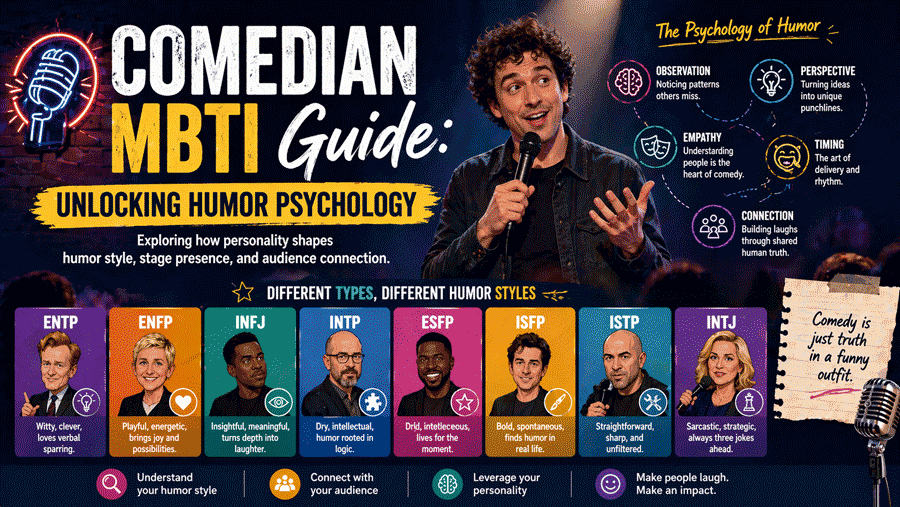
The Framework: Beyond the Four Letters
To understand why certain personalities excel in comedy, we must first establish the theoretical foundation. The MBTI is rooted in Carl Jung's theory of psychological types, which posits that people have innate preferences in how they perceive information and make decisions. The four dichotomies—Extraversion vs. Introversion, Sensing vs. Intuition, Thinking vs. Feeling, and Judging vs. Perceiving—combine to form 16 types. However, these letters are merely indicators of the underlying cognitive function stack.
The cognitive function stack consists of four roles: dominant, auxiliary, tertiary, and inferior. The dominant function is the primary lens through which an individual views the world. The auxiliary supports the dominant, providing balance. The tertiary is less developed but offers relief, while the inferior function is often a source of stress but also potential growth. For example, a comedian with dominant Extraverted Intuition (Ne) might thrive on improvisation and generating endless possibilities, while one with dominant Introverted Sensing (Si) might excel at detailed observational humor based on past experiences.
Letter-based typing alone often causes mistypes because it focuses on behavior rather than motivation. Two comedians might both appear extraverted on stage, but one may be energizing the crowd to feed their own energy (Extraverted Feeling), while the other is projecting energy to test hypotheses about audience reaction (Extraverted Thinking). Validating type requires self-observation of decision patterns, stress reactions, and motivation. Ask yourself: Do I prepare meticulously before a set, or do I prefer to wing it? Do I focus on the logical structure of the joke, or the emotional impact on the room? Long-term feedback from peers and mentors is also crucial, as they often see blind spots we miss.
While public figures are often typed by enthusiasts, these assessments should be treated cautiously. For instance, Robin Williams is widely believed to be an ENFP, showcasing rapid Ne-Fi improvisation, while Jerry Seinfeld is often typed as an ISTJ, reflecting his structured, observational Si-Te approach. These examples illustrate function dynamics but should not be taken as definitive facts. Use them as illustrative tools to understand how functions manifest in performance, not as rigid categories for comparison.
Application Guidance: Practical Frameworks
Understanding your type is useless without application. Below are two practical frameworks to leverage personality insights for career development and communication.
Framework 1: Cognitive Function Development for Performance
This framework applies to comedians seeking to refine their craft based on their natural strengths. It relates to the dominant and auxiliary functions. For instance, Perceiving types (Ne or Se users) may excel at crowd work, while Judging types (Ni or Si users) may prefer tight scripting.
When it applies: Use this when developing new material or preparing for a specific venue. If you are an Intuitive type, brainstorming sessions will yield better results than solitary writing. If you are a Sensing type, recording live sets and reviewing specific details will be more productive.
Practical Action Steps:
- Ne Users (ENFP, ENTP, INFP, INTP): Schedule improvisation workshops. Allow yourself to explore absurd connections without immediate editing. Benefit: High creativity. Limitation: Can lack focus. Judge fit by whether you feel energized by brainstorming.
- Si Users (ISTJ, ISFJ, ESTJ, ESFJ): Keep a detailed journal of daily observations. Structure jokes with clear setups and punchlines. Benefit: Relatable, precise humor. Limitation: May resist risky experimental material. Judge fit by audience consistency.
- Fe Users (ENFJ, ESFJ, INFJ, ISFJ): Focus on reading the room's energy. Adjust delivery based on audience reaction. Benefit: Strong connection. Limitation: May take heckles personally. Judge fit by comfort level with crowd interaction.
- Ti Users (INTP, ISTP, ENTP, ESTP): Deconstruct the logic of humor. Analyze why a joke works structurally. Benefit: Clever, layered jokes. Limitation: Can become too abstract. Judge fit by intellectual satisfaction.
Framework 2: Relationship and Communication Guidance
This framework is essential for writers' rooms, collaborations, or managing relationships with agents and audiences. It relates to the Thinking vs. Feeling dichotomy and how information is processed.
When it applies: Use this during collaboration conflicts or when pitching material. Understanding whether a partner values logical consistency (Thinking) or harmonic values (Feeling) can prevent misunderstandings.
Practical Action Steps:
- Communicating with Thinkers: Present the logic behind a joke. Explain the structure and the expected payoff. Avoid overly emotional appeals unless supported by data.
- Communicating with Feelers: Discuss the emotional resonance of the material. How will it make the audience feel? Ensure the tone aligns with shared values.
- Handling Feedback: If you are a Feeling type, recognize that critical feedback from a Thinking type is not a personal attack but an attempt to improve quality. If you are a Thinking type, recognize that emotional concerns from a Feeling type are valid data points about audience reception.
Benefits and Limitations: This improves collaboration efficiency but requires patience. Readers can judge fit by noting reduced conflict in creative partnerships.
Growth Section: Universal Principles
Personality growth is not about changing your type but expanding your flexibility. Regardless of your comedian mbti classification, certain universal principles apply to developing psychological maturity.
Identify the Dominant Function First: Your dominant function is your superpower. Lean into it. If you are an Introverted Intuitive (Ni), trust your insights even if you cannot fully explain them yet. If you are an Extraverted Sensor (Se), trust your ability to react in the moment. Suppressing your dominant function leads to burnout.
Distinguish Preference from Skill: Just because you prefer Thinking does not mean you are good at logic, and preferring Feeling does not guarantee empathy. Skills must be practiced. A comedian might prefer introversion but must develop the skill of public speaking. Do not use type as an excuse to avoid necessary skill development.
Develop the Inferior Function Gradually: The inferior function is your Achilles' heel but also your source of renewal. For an INTJ, the inferior function is Extraverted Sensing (Se). Engaging in physical activities or improvisation can help balance their intense planning. For an ESFP, the inferior function is Introverted Intuition (Ni). Taking time for reflection and long-term planning can prevent impulsive decisions. Growth means accessing these functions without being overwhelmed by them.
Explain Loop and Grip Patterns: Under stress, types may fall into "loops" or "grips." A loop occurs when you bypass your auxiliary function and oscillate between your dominant and tertiary. For example, an INFP might loop between Introverted Feeling (Fi) and Extraverted Intuition (Ne), becoming overly introspective and scattered. A grip occurs when the inferior function takes over. An ENTJ under stress might become overly sensitive to physical details or emotional outbursts (inferior Fi). Recognizing these patterns allows you to step back and re-engage your auxiliary function for balance.
Growth Means Flexibility: Ultimately, growth is about identity flexibility, not attachment. Do not say, "I am an ENTP, so I cannot do detailed work." Instead say, "I prefer big ideas, but I can develop systems to handle details." This mindset shift empowers you to transcend limitations.
Mistakes and Pitfalls
When exploring personality types, especially in the context of comedian mbti, several common pitfalls can hinder progress. Avoid these eight mistakes to ensure a healthy relationship with the theory.
1. Don't Stereotype Based on Letters: Assuming all Extroverts are loud or all Introverts are shy is reductive. Behavior is contextual. Better Mindset: Focus on energy sources. Does socializing drain or charge you?
2. Don't Ignore Stress Responses: Typing yourself only when happy leads to errors. Stress reveals the inferior function. Better Mindset: Observe how you act under deadline pressure or criticism.
3. Don't Use Only Online Tests: Free tests often lack validity and rely on self-reporting bias. Better Mindset: Use tests as a starting hypothesis, then validate through study and reflection.
4. Don't Ignore Context: A comedian on stage is performing a role. This may not reflect their private self. Better Mindset: Distinguish between stage persona and off-stage preferences.
5. Don't Box Yourself In: Using type as an excuse for bad behavior ("I'm just a Perceiver, I'm always late") is harmful. Better Mindset: Acknowledge preferences but take responsibility for improvements.
6. Don't Ignore Development: Assuming your type is static prevents growth. Functions develop over time. Better Mindset: View type as a map for development, not a cage.
7. Don't Confuse Skill with Type: Being good at logic doesn't make you a Thinker if you decide based on values. Better Mindset: Analyze the decision-making process, not just the outcome.
8. Don't Ignore Feedback: Others often see your type more clearly than you do. Better Mindset: Ask trusted friends how they perceive your decision-making and energy.
Ongoing Learning
The field of personality psychology is evolving. To maintain accuracy, readers should commit to ongoing learning. Follow new research regarding trait theory and type dynamics. Seek out higher-quality MBTI and Jungian resources rather than social media summaries. Credible organizations such as the Myers & Briggs Foundation and the Center for Applications of Psychological Type (CAPT) provide foundational materials. Engage with debates and newer interpretations, such as the Beebe model of functions, to deepen understanding. Learn to identify reliable information by checking citations and avoiding content that promises "hack" solutions to personality. True understanding comes from sustained study and self-reflection.
FAQ
1. Where should a beginner start with MBTI? Start by learning the four dichotomies, then move quickly to cognitive functions. Read official manuals from credible publishers rather than meme-based content. Understanding the function stack is the key to accurate typing.
2. How can I confirm my type without tests? Observe your energy levels after social interaction. Analyze your decision-making process: do you prioritize logic or harmony? Review your stress responses. Compare these observations with function descriptions rather than type labels.
3. How does type affect relationship communication? Different types process information differently. Thinkers may need space to analyze, while Feelers may need immediate emotional validation. Understanding these differences reduces conflict and improves MBTI compatibility.
4. How can I learn cognitive functions efficiently? Focus on one function at a time. Observe it in yourself and others. Keep a journal of instances where you used Te vs. Ti, or Fe vs. Fi. Practical observation is more effective than rote memorization.
5. Can my personality type change? Your core preferences are generally stable, but your behavior and function development change. You may become more balanced over time, accessing inferior functions more easily, but your underlying type remains consistent. Focus on personality growth rather than changing labels.
In conclusion, exploring comedian mbti dynamics offers a rich pathway to understanding human creativity. By focusing on cognitive functions, avoiding stereotypes, and committing to ongoing growth, performers and enthusiasts can use this tool to enhance their craft and relationships. Remember, the goal is not to label yourself but to understand yourself better.