
When exploring personality typology, the distinction between planning and spontaneity often surfaces as a primary point of confusion. Many individuals assume that being organized defines one side and being messy defines the other. However, the judging vs perceiving personality dynamic in the Myers-Briggs Type Indicator (MBTI) is far more nuanced than mere cleanliness or scheduling habits. It fundamentally describes how you orient yourself to the external world and how you prefer to process information before making decisions.
This article concludes upfront: understanding the judging vs perceiving preference requires looking beyond the four-letter code to the underlying cognitive functions. While the letters provide a shorthand, true self-knowledge comes from analyzing how your mind prioritizes structure versus openness. Whether you are seeking career guidance, relationship compatibility, or personal growth, recognizing these patterns allows for a more accurate application of typology. This guide will dismantle stereotypes, explain the Jungian mechanisms at play, and provide actionable frameworks for leveraging your natural preferences.
The Framework and Mechanism of Preference
To grasp the depth of the judging vs perceiving personality distinction, we must return to the Jungian roots of the MBTI system. Carl Jung originally proposed psychological types based on how people perceive information and how they make judgments. The MBTI expanded this into four dichotomies, but the final letter (J or P) serves a specific technical function regarding the orientation of your dominant cognitive process.
The Four Dichotomies and Their Relationship to the 16 Types
The MBTI sorts preferences into four pairs: Extraversion vs. Introversion (E/I), Sensing vs. Intuition (S/N), Thinking vs. Feeling (T/F), and Judging vs. Perceiving (J/P). The first three describe mental processes. The fourth, J/P, describes which of those processes is extraverted, or shown to the outside world. This is a critical distinction often missed in casual discussions.
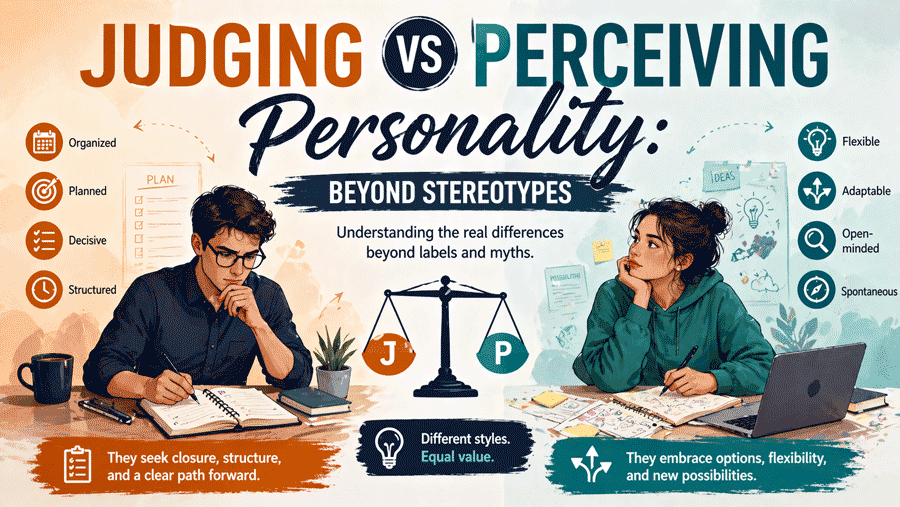
If you are a Judging type (J), your extraverted function is a Judging function (Thinking or Feeling). This means you prefer to present a structured, decided, and organized face to the world. You feel comfortable when plans are made and decisions are settled. If you are a Perceiving type (P), your extraverted function is a Perceiving function (Sensing or Intuition). This means you prefer to present a flexible, adaptable, and open-ended face to the world. You feel comfortable when options remain open and new information can still be gathered.
Cognitive Function Stack: Dominant, Auxiliary, Tertiary, Inferior
Every personality type operates using a stack of four cognitive functions. The J/P preference determines the order of this stack. For example, an INTJ (Introverted, Intuitive, Thinking, Judging) leads with Introverted Intuition (Ni) and supports it with Extraverted Thinking (Te). Because they are a Judging type, their extraverted function is a judging one (Te). Conversely, an INTP (Introverted, Intuitive, Thinking, Perceiving) leads with Introverted Thinking (Ti) and supports it with Extraverted Intuition (Ne). Because they are a Perceiving type, their extraverted function is a perceiving one (Ne).
This structural difference explains why two types that share three letters (like INTJ and INTP) can behave so differently. The INTJ seeks closure and implementation (Te), while the INTP seeks accuracy and exploration (Ne). Understanding this stack is essential for accurate type confirmation. Relying solely on behavior without understanding the function stack often leads to mistypes, as behavior can be adapted while cognitive preference remains constant.
Why Letter-Based Typing Alone Often Causes Mistypes
Many online tests rely on self-reported behavior rather than cognitive motivation. A person might appear organized because their job requires it, leading them to test as a Judging type, even if their natural preference is Perceiving. Similarly, a Perceiving type under stress may become rigid and controlling, mimicking Judging behaviors. Without analyzing the decision-making style and the motivation behind actions, the four letters can be misleading.
To validate your type, observe your decision patterns. Do you feel relieved when a decision is final (Judging), or do you feel constrained when options are closed (Perceiving)? Do you seek external structure to manage your energy, or do you seek internal flexibility? Stress reactions are also telling. A Judging type under extreme stress may become impulsively reckless (inferior Perceiving function), while a Perceiving type may become obsessively rigid (inferior Judging function).
Validating Type Through Self-Observation
Accurate typing requires long-term feedback from others and honest self-reflection. Consider asking trusted colleagues or friends how they perceive your work style. Do they see you as someone who drives toward deadlines early, or someone who works in bursts of energy near the end? Neither is inherently better, but they indicate different cognitive priorities. Motivation is key: a Perceiving type might organize a space to facilitate creativity, while a Judging type might organize to reduce anxiety and ensure efficiency. Recognizing the 'why' behind the behavior is the path to clarity.
Application Guidance for Daily Life
Understanding the judging vs perceiving personality dynamic is not just theoretical; it has profound implications for how you work, learn, and relate to others. Below are two practical frameworks to apply this knowledge effectively.
Framework 1: Career and Work-Style Fit
This framework applies to professional development, project management, and role selection. It relates directly to how Judging and Perceiving types manage time, deadlines, and ambiguity.
When it applies: Use this when choosing a career path, negotiating work conditions, or managing a team with mixed preferences.
Type Dynamics: Judging types (especially those with Extraverted Thinking, Te) thrive in environments with clear metrics, defined hierarchies, and actionable goals. Perceiving types (especially those with Extraverted Intuition, Ne, or Extraverted Sensing, Se) thrive in environments that allow for pivoting, brainstorming, and adapting to real-time data.
Practical Action Steps:
- For Judging Types: Create structured roadmaps for projects. Break large goals into weekly milestones. Communicate clear deadlines to collaborators to reduce anxiety. If working in a chaotic startup environment, create personal systems to maintain stability.
- For Perceiving Types: Build buffer time into schedules to allow for exploration. Seek roles that value innovation over strict adherence to protocol. Use tools that allow for flexible note-taking and idea mapping rather than rigid linear lists. Communicate your need for autonomy when deadlines are flexible.
Benefits and Limitations: Aligning work style with preference increases productivity and reduces burnout. However, over-reliance on preference can limit growth. A Judging type must learn to adapt when plans fail, and a Perceiving type must learn to commit when action is required.
How to Judge Fit: Reflect on your energy levels at the end of the week. Do you feel drained by constant changes (suggesting a Judging preference), or do you feel drained by repetitive, rigid routines (suggesting a Perceiving preference)?
Framework 2: Relationship and Communication Guidance
This framework applies to personal relationships, conflict resolution, and team dynamics. It focuses on how different preferences interpret reliability and responsiveness.
When it applies: Use this during conflicts about planning, punctuality, or decision-making speed with partners, family, or colleagues.
Type Dynamics: In MBTI compatibility, J/P conflicts are common. A Judging type may perceive a Perceiving type's flexibility as flakiness or lack of commitment. A Perceiving type may perceive a Judging type's planning as controlling or rigid. Understanding that these are different orientations to the external world reduces personalization of conflict.
Practical Action Steps:
- For Partners of Judging Types: Provide reassurance that plans will be kept. If you need to change plans, communicate early. Acknowledge their need for closure.
- For Partners of Perceiving Types: Allow room for spontaneity. Avoid micromanaging their process. Focus on the final outcome rather than the method used to get there.
- Shared Strategy: Establish 'hard' deadlines for critical items and 'soft' deadlines for exploratory items. Agree on which decisions need immediate closure and which can remain open.
Benefits and Limitations: This approach fosters empathy and reduces friction. However, it requires both parties to respect differences without trying to 'fix' the other. Compatibility is not about being the same type, but about managing differences constructively.
How to Judge Fit: Observe conflict patterns. Do arguments consistently revolve around time management or decision speed? If so, applying this framework can resolve the root cause rather than just the symptoms.
Growth and Personal Development
Personal growth in the context of MBTI is not about changing your type, but about developing flexibility within your cognitive stack. The goal is to access non-preferred functions when necessary without losing your core identity.
Identify the Dominant Function First
Growth begins with leveraging your strengths. If you are a Judging type, your strength lies in execution and closure. If you are a Perceiving type, your strength lies in adaptation and information gathering. Do not try to grow by fixing weaknesses first; grow by maximizing your natural advantages. This builds the confidence needed to tackle more difficult areas later.
Distinguish Preference from Skill
A common pitfall is confusing what you prefer with what you are good at. You may be skilled at organizing (a Judging trait) because you were forced to learn it, but it may still drain your energy. Conversely, you may be naturally spontaneous but have learned to be punctual. Personality growth involves recognizing the energy cost of these skills. Use your skills where necessary, but replenish your energy by engaging in preferred activities.
Develop the Inferior Function Gradually
The inferior function is the fourth function in your stack, often emerging under stress. For Judging types, the inferior function is a Perceiving one (either Introverted Sensing or Introverted Intuition, depending on the stack, but often manifesting as a lack of openness). For Perceiving types, the inferior is a Judging function. Growth involves integrating this function in small doses. For example, a Perceiving type might practice setting one firm deadline per week. A Judging type might practice leaving one weekend day completely unplanned.
Explain Loop and Grip Patterns
Under stress, individuals may bypass their auxiliary function and fall into a 'loop' between their dominant and tertiary functions, or fall into the 'grip' of their inferior function. A Judging type in the grip may become uncharacteristically impulsive or sensory-overloaded. A Perceiving type in the grip may become rigid, critical, and obsessed with rules. Recognizing these states allows you to step back and restore balance rather than making permanent decisions based on temporary stress responses.
Growth Means Flexibility, Not Identity Attachment
Ultimately, MBTI is a tool for understanding preferences, not a label that defines the whole person. Healthy growth means becoming more whole, not more extreme. It means a Judging type learning to flow with change, and a Perceiving type learning to commit with confidence. Avoid using your type as an excuse for behavior. Instead, use it as a map for where you need to stretch.
Mistakes and Pitfalls to Avoid
To ensure you use typology constructively, avoid these common errors. Each point includes a better alternative mindset.
- Don't equate Judging with being organized. Explanation: A Perceiving type can be very organized if their system supports flexibility. Alternative: View Judging as a preference for closure and decision.
- Don't equate Perceiving with being messy. Explanation: A Perceiving type's space may look chaotic but be organized in a way they understand. Alternative: View Perceiving as a preference for keeping options open.
- Don't use type to excuse rudeness. Explanation: Saying 'I'm a Perceiving type, so I'm late' is irresponsible. Alternative: Acknowledge the preference but manage the impact on others.
- Don't assume compatibility is impossible between J and P. Explanation: Opposite preferences can complement each other if managed well. Alternative: Focus on communication strategies rather than type matching.
- Don't rely solely on online tests. Explanation: Tests measure behavior, not cognitive motivation. Alternative: Use tests as a starting point, then study cognitive functions.
- Don't stereotype public figures. Explanation: Celebrity typings are often speculative. Alternative: Use public figures only as illustrative examples with cautious wording.
- Don't ignore the context of behavior. Explanation: Work behavior may differ from home behavior due to environmental demands. Alternative: Observe preferences in low-stress, voluntary situations.
- Don't treat type as static destiny. Explanation: People develop non-preferred functions over time. Alternative: View type as a baseline for development, not a ceiling.
Ongoing Learning and Credible Resources
The field of personality typology is evolving. To maintain accuracy and depth, readers should commit to ongoing learning. Seek out new research and higher-quality MBTI and Jungian resources. Credible organizations such as the Myers & Briggs Foundation and the Center for Applications of Psychological Type (CAPT) provide foundational materials that adhere to the original theoretical framework.
Be wary of low-quality summaries on social media that reduce complex psychological concepts to memes. Engage with debates and newer interpretations, such as the Beebe Model of cognitive functions, which offers a more granular view of type dynamics. Learn to identify reliable information by checking if the source distinguishes between behavior and cognition, and whether they acknowledge the limitations of the tool. Remember that MBTI is not scientifically uncontested; it is a useful heuristic for self-reflection, not a definitive psychometric assessment like the Big Five. Keeping a critical mind ensures you use the tool for empowerment rather than limitation.
Frequently Asked Questions
1. What is the best entry point for beginners?
Start by understanding the four dichotomies, but quickly move to cognitive functions. Reading about the function stack (Dominant, Auxiliary, Tertiary, Inferior) will clarify why types behave differently than their letters suggest. This prevents early misconceptions about the judging vs perceiving personality dynamic.
2. How can I confirm my type without tests?
Focus on energy dynamics. Which activities drain you, and which replenish you? Observe your stress responses. Do you become rigid or impulsive? Long-term self-observation and feedback from close contacts who know you in various contexts are more reliable than a single quiz.
3. How does this affect relationship communication?
Judging types often need verbal confirmation of plans to feel secure. Perceiving types often feel secure knowing plans can change if needed. Communicating these needs explicitly prevents misunderstandings about commitment and reliability.
4. How do I learn cognitive functions efficiently?
Study one function at a time. Start with the difference between Thinking and Feeling, then Sensing and Intuition. Apply these to your own decision-making processes. Keep a journal of decisions and analyze which function drove the choice.
5. Can my personality type change?
Your core preferences are generally stable, similar to handedness. However, your ability to use non-preferred functions develops with age and maturity. You may appear to change type as you become more balanced, but your underlying cognitive orientation typically remains consistent.