
Understanding the introvert vs extrovert personality dynamic is often the first step individuals take when exploring psychological typing. However, relying solely on surface-level social behaviors leads to significant mistyping and shallow self-awareness. The Myers-Briggs Type Indicator (MBTI) is not merely a label for social preference; it is a framework for understanding cognitive processing. This article concludes immediately that true type accuracy requires moving beyond the four letters to examine the underlying cognitive function stack. Whether you are seeking career alignment, relationship compatibility, or personal growth, the depth of your insight depends on recognizing how energy direction interacts with information processing and decision-making.
Many readers approach MBTI expecting a simple horoscope-like description, but the utility of the system lies in its mechanistic explanation of why people think differently. The dichotomy of introversion and extroversion is not about being shy or outgoing; it is about where you direct your energy and where you seek stimulation. To apply this effectively, one must return to the Jungian roots of the theory. This guide provides a comprehensive analysis for English-speaking readers interested in MBTI, offering practical frameworks for validation, growth, and application while avoiding common stereotypes.
The Framework and Mechanism of Type
To understand the introvert vs extrovert personality distinction accurately, we must look at the engine under the hood. The MBTI is based on Carl Jung's theory of psychological types, which posits that human consciousness operates through specific cognitive functions. These functions are the mental processes we use to perceive information and make decisions. The four letters of your MBTI type are merely a code that describes the order and orientation of these functions.
Jungian Roots and the Four Dichotomies
Jung identified two attitudes: Introversion (I) and Extroversion (E). These attitudes determine the orientation of your cognitive functions. An extroverted function engages with the external world of objects, people, and actions. An introverted function engages with the internal world of concepts, reflections, and subjective impressions. The MBTI adds four dichotomies: Energy (E/I), Information (S/N), Decisions (T/F), and Structure (J/P). While helpful for sorting, these letters can be misleading if taken as behavioral traits rather than cognitive preferences.
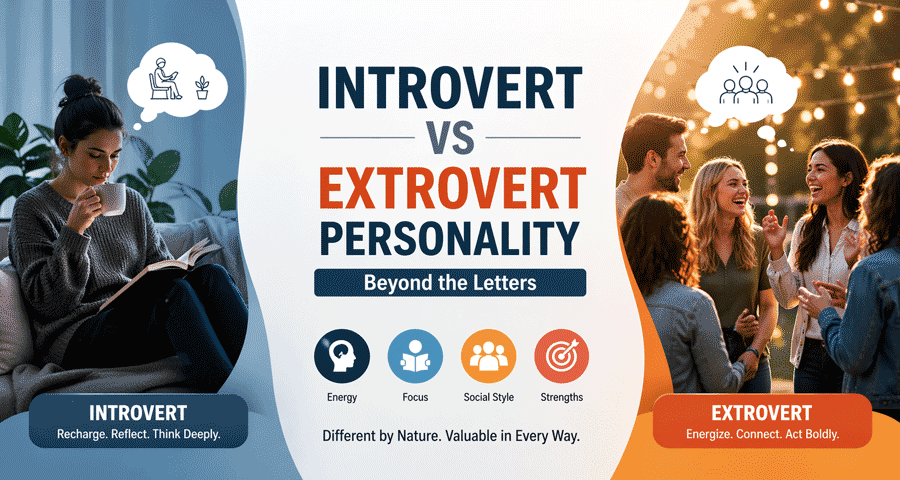
For example, an Introvert is not necessarily quiet; they are energized by internal reflection. An Extrovert is not necessarily loud; they are energized by external interaction. This distinction is crucial for type confirmation. Many people mistype because they behave according to social expectations rather than their natural energy flow. A developed Introvert may be socially skilled, but they still require solitude to recharge. A mature Extrovert may enjoy quiet focus, but they still seek external engagement to feel alive.
The Cognitive Function Stack
Every type uses four primary functions in a specific order: Dominant, Auxiliary, Tertiary, and Inferior. This stack explains why two Introverts (e.g., ISTJ and INFJ) can behave very differently. The Dominant function is the hero; it is what you do best and trust most. The Auxiliary supports the dominant. The Tertiary is less mature, and the Inferior is the aspiration and stress point.
- Perceiving Functions: Sensing (S) focuses on concrete reality, details, and experience. Intuition (N) focuses on patterns, possibilities, and future implications.
- Judging Functions: Thinking (T) focuses on logic, consistency, and objective criteria. Feeling (F) focuses on values, harmony, and human impact.
When combined with attitude (Introverted/Extroverted), we get eight functions: Te, Ti, Fe, Fi, Se, Si, Ne, Ni. Understanding these is more important than the four letters. For instance, an ENTJ and an ESTJ both lead with Extroverted Thinking (Te), but their auxiliary functions differ (Ni vs Si), leading to different decision-making styles. The ENTJ looks for strategic vision, while the ESTJ looks for proven procedures.
Why Letter-Based Typing Causes Mistypes
Online tests often rely on self-reported behavior, which is influenced by environment, culture, and stress. A person might test as an Extrovert because their job requires constant communication, even if they are cognitively Introverted. To validate your type, observe your decision patterns under stress, your natural motivation, and your blind spots. Long-term feedback from trusted others is also valuable. Ask them: "When I am tired, do I withdraw or seek people?" "Do I prioritize efficiency or harmony?" These questions reveal function use better than a quiz.
Famous public figures are often typed based on observation, but these typings should be treated cautiously. For example, Elon Musk is widely believed to be an INTJ or ENTJ, illustrating strong Te or Ti usage, but without his direct confirmation, this remains speculative. Use such examples only to illustrate function dynamics, not as definitive proof of type.
Application Guidance for Daily Life
Knowing your type is useless without application. Below are two practical frameworks to utilize your understanding of the introvert vs extrovert personality dynamic and cognitive functions.
Framework 1: Career and Work-Style Fit
This framework applies when choosing roles, negotiating work conditions, or solving productivity issues. It relates to the Judging functions (T/F) and the orientation of energy (E/I).
- When it applies: During career planning, project management, or when feeling burnt out at work.
- Type Dynamics: Extroverted Thinkers (Te) thrive in structured, outcome-oriented environments. Introverted Thinkers (Ti) thrive in autonomous, analysis-heavy roles. Extroverted Feelers (Fe) excel in team harmony and client-facing roles. Introverted Feelers (Fi) excel in roles aligned with personal values and authenticity.
- Practical Action Steps: Identify your dominant function. If you lead with Si, create detailed routines. If you lead with Ne, allow for brainstorming time. Schedule work blocks that match your energy cycle. Introverts should block "deep work" time without meetings. Extroverts should schedule collaborative sessions to maintain energy.
- Benefits and Limitations: This increases productivity and reduces burnout. However, do not use type as an excuse to avoid necessary tasks. An Introvert still needs to present; an Extrovert still needs to focus.
- Judgment: If you feel drained by your core tasks despite having the skills, your work style may conflict with your cognitive preferences.
Framework 2: Relationship and Communication Guidance
This framework applies to personal relationships, team dynamics, and conflict resolution. It relates to the Perceiving functions (S/N) and Feeling functions (F).
- When it applies: During misunderstandings, emotional conflicts, or when trying to persuade others.
- Type Dynamics: Sensors (S) communicate concretely and practically. Intuitives (N) communicate abstractly and conceptually. Thinkers (T) prioritize truth and logic. Feelers (F) prioritize tact and connection.
- Practical Action Steps: Translate your message. If speaking to an S, give examples and data. If speaking to an N, explain the big picture. If speaking to a T, be logical and direct. If speaking to an F, acknowledge feelings first. Recognize that an Introvert's silence is not rejection, and an Extrovert's venting is not aggression.
- Benefits and Limitations: This reduces friction and improves empathy. However, it requires effort to speak another's language. Do not assume compatibility is impossible based on type alone.
- Judgment: If conflicts repeatedly stem from "you don't listen" vs "you talk too much," examine the E/I and S/N dynamics.
Growth and Personal Development
Personality growth is not about changing your type; it is about developing flexibility within your type. The goal is to access all eight functions, not just your preferred four.
Identify the Dominant Function First
Growth begins with leveraging your strengths. If you are a dominant Perceiver (P), do not force rigid structure immediately. Use your flexibility to explore, then gradually introduce organization. If you are a dominant Judger (J), use your planning skills but allow room for spontaneity. Trust your natural lead function before trying to fix weaknesses.
Distinguish Preference from Skill
You can learn skills outside your preference. An Introvert can learn public speaking; an Extrovert can learn deep analysis. Do not confuse "I am not good at this" with "I do not prefer this." Skill is developed through practice; preference is about energy cost. Acknowledge that using non-preferred functions will always cost more energy, even if you are skilled at them.
Develop the Inferior Function Gradually
The inferior function is your fourth function (e.g., Fe for ISTP). It is often the source of insecurity but also holds the key to balance. Do not try to make it your dominant function. Instead, engage it in low-stakes environments. An inferior Fe user can practice small acts of kindness without expecting social validation. An inferior Ti user can practice analyzing logic without needing to win an argument.
Understand Loop and Grip Patterns
Under stress, types may skip their auxiliary function and enter a "loop" (e.g., INFP looping on Fi-Ne, becoming overly introspective and speculative) or a "grip" (e.g., ENTJ in grip of Fi, becoming overly emotional and sensitive). Recognizing these states helps you return to balance. If you are in a grip, rest and engage your dominant function gently. Do not make major decisions while in a stress response.
Growth Means Flexibility, Not Identity Attachment
Do not use MBTI as an identity cage. Saying "I am an INTP, so I cannot be emotional" is a misuse of the tool. Healthy growth means expanding your repertoire. You are a human being first, a type second. Use the framework to understand your defaults, then choose to act differently when the situation requires it.
Common Mistakes and Pitfalls
To ensure accurate understanding, avoid these eight common errors when exploring the introvert vs extrovert personality landscape.
- Don't equate Introversion with Social Anxiety. Introversion is an energy preference, not a fear of social interaction. Social anxiety is a clinical condition. An Introvert can be socially confident but still prefer solitude.
- Don't assume Extroverts are shallow. Extroverts process externally, which can look like thinking out loud. This does not mean they lack depth. They often refine ideas through conversation.
- Don't rely solely on test results. Tests measure self-perception, which can be biased. Use tests as a starting point, not a diagnosis. Validate with behavioral observation.
- Don't use type to excuse bad behavior. "I am a Thinker, so I don't care about feelings" is not an acceptable excuse for rudeness. Type explains preference, not morality.
- Don't stereotype career paths. Not all Extroverts are salespeople; not all Introverts are programmers. Focus on the function, not the job title. An Extroverted Intuitive might be an entrepreneur or a teacher.
- Don't ignore the context. Behavior changes based on environment. A person may appear Extroverted at a party but Introverted at work. Look for consistent patterns over time.
- Don't treat types as static. While preferences are stable, expression evolves. A mature type looks different from an immature type. Allow for development and change in behavior.
- Don't dismiss opposite types. Valuing only your own type creates echo chambers. The opposite type holds the skills you lack. Respect and learn from different cognitive approaches.
Ongoing Learning and Resources
MBTI is a field of ongoing study. To deepen your knowledge, follow credible organizations and research. The Myers & Briggs Foundation provides official information on the instrument. The Center for Applications of Psychological Type (CAPT) offers research-based insights. Jungian educational resources provide the theoretical backbone.
Be cautious of low-quality summaries on social media that reduce types to memes. Look for content that discusses cognitive functions rather than just stereotypes. Engage in debates and newer interpretations, but verify claims against established theory. Reliable information focuses on mechanics and development, not just labeling. Keep following new research to understand how typing interacts with modern psychology and neuroscience.
Frequently Asked Questions
1. Where should a beginner start with MBTI?
Start by understanding the four dichotomies, but quickly move to cognitive functions. Read about the eight functions (Te, Ti, Fe, Fi, Se, Si, Ne, Ni). Observe your own energy levels and decision processes. Do not stop at the four-letter code.
2. How can I confirm my type without tests?
Observe your stress reactions. What do you do when overwhelmed? Do you withdraw (Introvert) or seek support (Extrovert)? Do you focus on details (Sensing) or possibilities (Intuition)? Ask close friends how they perceive your natural state versus your work persona.
3. How does type affect relationship communication?
It affects how information is sent and received. Thinkers may need to soften their delivery for Feelers. Sensors may need to provide context for Intuitives. Understanding these communication patterns reduces conflict and increases mutual respect.
4. How do I learn cognitive functions efficiently?
Study one function at a time. Try to identify it in others before identifying it in yourself. This reduces bias. Use resources that provide concrete examples of function usage in daily scenarios.
5. Can my personality type change over time?
Your core preferences are generally stable, like handedness. However, your ability to use all functions improves with age. You may appear different as you mature, but your underlying energy orientation usually remains consistent. Focus on development rather than changing your type.
In conclusion, the introvert vs extrovert personality discussion is merely the gateway to a deeper understanding of human psychology. By focusing on cognitive functions, validating through observation, and applying practical frameworks, you can use MBTI as a powerful tool for growth. Remember that the goal is not to fit into a box, but to understand the map so you can navigate your life with greater clarity and intention.