
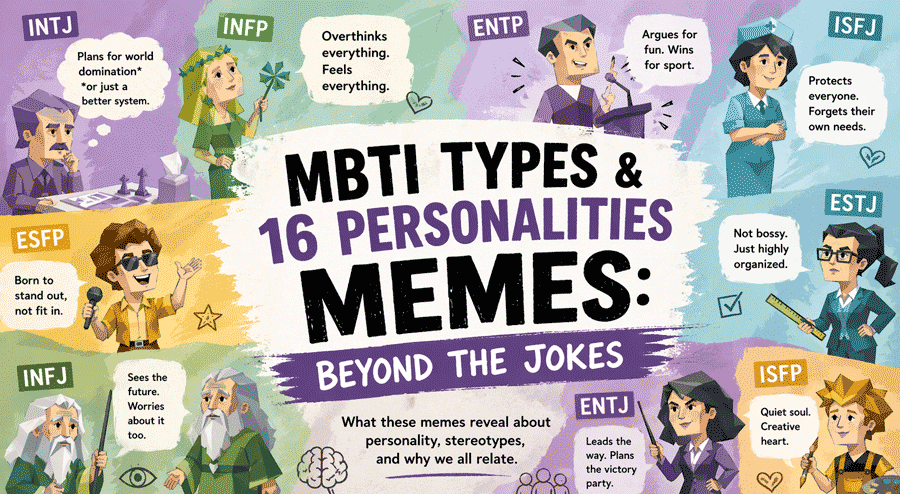
When you search for mbti types 16 personalities memes, you often find humor that simplifies complex psychological preferences into relatable caricatures. While these images offer entertainment and a sense of community, they rarely capture the nuance required for genuine self-understanding. The Myers-Briggs Type Indicator (MBTI) is a powerful tool for exploring how individuals perceive the world and make decisions, but its true value lies not in four-letter stereotypes, but in the underlying cognitive functions that drive behavior. This article moves beyond the surface-level jokes to provide a deep, actionable analysis of personality types, helping you validate your type accurately and apply these insights for personal growth.
Understanding your personality type is a starting point, not an endpoint. To truly benefit from this framework, you must return to the cognitive functions—the mental processes that define how you interact with reality. Whether you are here to confirm your type, improve relationships, or navigate career choices, this guide offers the depth often missing from viral content.
The Framework and Mechanism Behind the Types
To understand why mbti types 16 personalities memes often miss the mark, we must first examine the theoretical roots of the system. The MBTI is based on Carl Jung’s theory of psychological types, which posits that much of seemingly random behavior is actually quite orderly and consistent, resulting from basic differences in how individuals prefer to use their perception and judgment.
Jungian Roots and the Four Dichotomies
The system categorizes preferences across four dichotomies, resulting in 16 distinct personality types. These dichotomies are:
- Extraversion (E) vs. Introversion (I): Where you direct your energy. Extraverts tend to focus on the outer world of people and things, while Introverts focus on the inner world of ideas and impressions.
- Sensing (S) vs. Intuition (N): How you gather information. Sensors prefer concrete, factual data present in the moment, while Intuitives prefer patterns, possibilities, and future implications.
- Thinking (T) vs. Feeling (F): How you make decisions. Thinkers prioritize logic, consistency, and objective criteria, while Feelers prioritize values, harmony, and person-centered concerns.
- Judging (J) vs. Perceiving (P): How you approach the outside world. Judgers prefer structure, plans, and closure, while Perceivers prefer flexibility, openness, and options.
While these letters provide a shorthand, they are merely indicators of deeper cognitive processes. Relying solely on the letters often leads to mistyping because behavior can be misleading. For example, an Introvert can be socially skilled, and a Thinker can be empathetic. The letters describe preferences, not capabilities.
The Cognitive Function Stack
The core mechanism of MBTI is the cognitive function stack. Each type uses four main functions in a specific order: Dominant, Auxiliary, Tertiary, and Inferior. These functions are:
- Extraverted Thinking (Te): Organizing the external world, efficiency, logical structure.
- Introverted Thinking (Ti): Internal logical consistency, precision, analyzing principles.
- Extraverted Feeling (Fe): Group harmony, social values, external emotional atmosphere.
- Introverted Feeling (Fi): Internal values, authenticity, personal emotional depth.
- Extraverted Sensing (Se): Immediate physical experience, action, awareness of the present.
- Introverted Sensing (Si): Past experiences, stability, routine, detailed recall.
- Extraverted Intuition (Ne): Brainstorming, connecting ideas, exploring possibilities.
- Introverted Intuition (Ni): Future vision, synthesizing insights, strategic foresight.
For instance, an INTJ leads with Introverted Intuition (Ni) and supports it with Extraverted Thinking (Te). This means their primary drive is to form a long-term vision, which they then execute through logical planning. An ENFP, conversely, leads with Extraverted Intuition (Ne) and supports it with Introverted Feeling (Fi), driving them to explore possibilities that align with their personal values. Understanding this stack is crucial for accurate type confirmation because it explains why you do what you do, not just what you do.
Why Letter-Based Typing Causes Mistypes
Many online tests rely on self-reported behavior rather than cognitive processes. If you answer questions based on how you act at work versus how you feel at home, your results may vary. Furthermore, cultural conditioning often forces individuals to develop non-preferred functions. A naturally Feeling type working in a corporate law firm may develop strong Thinking skills, leading them to test as a Thinker despite their internal preference remaining unchanged. To validate your type, observe your decision-making style under stress, your natural motivations, and your energy drains rather than just your social persona.
Practical Application Frameworks
Knowing your type is useful only if applied. Below are two frameworks to help you utilize your personality insights for tangible improvement in relationships and personal development.
Framework 1: Cognitive Function Development
When it applies: This framework is best for individuals seeking long-term personal growth and those who feel stuck in repetitive behavioral patterns.
Related Dynamics: It focuses on the hierarchy of your function stack, specifically strengthening the auxiliary function and integrating the inferior function.
Practical Action Steps:
- Identify Your Dominant Function: Reflect on what activity makes you lose track of time. If you are constantly analyzing systems, it may be Ti or Te. If you are constantly empathizing with others, it may be Fi or Fe.
- Strengthen the Auxiliary: This is your balance wheel. If you are an Introverted Dominant, your auxiliary is Extraverted. Practice engaging with the outer world. For example, an INFJ (Ni-dom) should practice using Extraverted Feeling (Fe) by actively checking in on group dynamics.
- Respect the Inferior: The inferior function is often a source of stress but also growth. An ISTP (Ti-dom, Fe-inferior) might struggle with emotional expression. Instead of forcing it, acknowledge when stress triggers emotional outbursts and prepare calming strategies.
Benefits and Limitations: This approach fosters psychological maturity and reduces burnout. However, it requires patience; function development is a lifelong process, not a quick fix.
How to Judge Fit: If focusing on these functions reduces your anxiety and increases your effectiveness, the framework fits. If it feels like acting, you may have misidentified your dominant function.
Framework 2: Relationship and Communication Guidance
When it applies: Use this when navigating conflicts with partners, colleagues, or family members where communication styles clash.
Related Dynamics: This relates to MBTI compatibility and understanding differing communication patterns.
Practical Action Steps:
- Map the Difference: Identify if the conflict stems from Information Gathering (S vs. N) or Decision Making (T vs. F). An S type may feel an N type is impractical, while the N type feels the S type is boring.
- Translate Your Needs: If you are a Thinker speaking to a Feeler, preface your logic with appreciation for their values. “I value our relationship, and logically, this plan ensures our stability.”
- Adjust Delivery: Perceivers may need written deadlines to feel secure around Judgers. Judgers may need to allow brainstorming time before demanding decisions from Perceivers.
Benefits and Limitations: This reduces friction and builds empathy. However, it should not be used to excuse bad behavior. Type explains preference, not accountability.
How to Judge Fit: If conflicts decrease in intensity and resolution time shortens, the strategy is working. If you feel you are walking on eggshells, you may be over-accommodating.
Growth and Personal Development
True personality growth involves flexibility, not rigid identity attachment. Your type describes your natural path, but maturity comes from walking other paths when necessary.
Universal Principles for Growth
- Identify the Dominant Function First: You cannot grow if you do not know your starting point. Spend time observing what energizes you versus what drains you.
- Distinguish Preference from Skill: You can be skilled at something you do not prefer. Do not mistype yourself based on competence alone.
- Develop the Inferior Function Gradually: The inferior function often emerges during mid-life. Engage with it in low-stakes environments. If you are a Thinking type, try art or volunteering to engage Feeling without pressure.
- Understand Loop and Grip Patterns: Under stress, types may bypass their auxiliary function and fall into a “loop” (e.g., an INTP overusing Ti and Ne without Te action) or a “grip” (e.g., an ESTJ overwhelmed by inferior Introverted Feeling). Recognizing these states helps you return to balance.
- Growth Means Flexibility: Do not use your type as an excuse (“I’m a P, so I’m always late”). Use it as a map to know where you need to build scaffolding.
Common Mistakes and Pitfalls
When exploring mbti types 16 personalities memes and related content, avoid these common traps to ensure accurate self-understanding.
- Don’t rely solely on online tests: Tests are snapshots, not diagnoses. Use them as a starting point, not a final verdict.
- Don’t confuse behavior with preference: You may act extraverted at work but need solitude to recharge. Look at energy flow, not just social activity.
- Don’t stereotype others: Assuming all INTJs are cold or all ESFPs are shallow limits your ability to connect. Individuals vary widely within types.
- Don’t use type to excuse poor behavior: Being a Perceiver does not justify chronic unreliability. Type explains tendencies, not moral obligations.
- Don’t ignore the cognitive functions: Focusing only on letters ignores the engine of the personality. Always return to functions for depth.
- Don’t expect type to solve all problems: MBTI is a tool for understanding, not a cure for mental health issues or systemic workplace problems.
- Don’t force compatibility: Just because two types are theoretically compatible does not guarantee a healthy relationship. Effort and values matter more.
- Don’t stop learning: Personality theory evolves. Stay open to new interpretations and deeper Jungian concepts rather than sticking to static definitions.
Continuing Your Learning Journey
To maintain accuracy and depth, encourage yourself to keep following credible resources. The field of personality psychology is nuanced, and high-quality information is essential.
- Seek New Research: Look for updates in psychometrics and Jungian studies.
- Use Higher-Quality Resources: Prioritize books and articles that discuss cognitive functions over those that only list traits.
- Follow Credible Organizations: Resources like the Myers & Briggs Foundation, CAPT (Center for Applications of Psychological Type), and established Jungian educational resources provide vetted information.
- Engage in Debates: Listen to newer interpretations and discussions within the community to avoid stagnation.
- Identify Reliable Information: Avoid low-quality summaries that rely on astrology-like generalizations. Look for content that emphasizes self-observation and verification.
Frequently Asked Questions
1. Where should a beginner start with MBTI?
Start by understanding the four dichotomies and then move quickly to cognitive functions. Read basic descriptions of your potential types, but focus on the “why” behind the behavior. Take a reputable test as a reference, but do not treat it as absolute truth. Self-observation over a few weeks is more valuable than a single quiz.
2. How can I confirm my type without tests?
Focus on energy dynamics. Ask yourself: “After socializing, do I feel energized or drained?” “When making a decision, do I look for objective logic or personal impact first?” Track your stress reactions. Your type is most visible when you are tired or under pressure. Compare your internal experience with function descriptions rather than external stereotypes.
3. How does MBTI help with relationship communication?
It highlights differences in information processing and decision-making. If you know your partner prefers Sensing, provide concrete details. If they prefer Feeling, acknowledge emotions before presenting logic. This reduces misunderstandings and helps you speak a language they naturally understand, fostering better communication patterns.
4. What is the most efficient way to learn cognitive functions?
Study one function at a time. Start with your suspected dominant function. Read examples of how it manifests in both Extraverted and Introverted attitudes. Try to spot these functions in real-time conversations. Journaling about your decision-making process can also reveal which function you prioritize.
5. Can my personality type change over time?
Your core preferences generally remain stable throughout adulthood. However, your expression of them changes as you develop. You may become more balanced, using non-preferred functions more effectively. This looks like change, but it is actually growth and integration. If you feel your type has changed completely, you may have been mistyped initially.
6. What if I resonate with multiple type descriptions?
Partial resonance is common because we all use all eight functions. Look for the “best fit” rather than a perfect match. Consider which description explains your struggles and stress responses, not just your strengths. Often, the type that explains your weaknesses accurately is the correct one.
7. How do I judge the quality of MBTI information?
High-quality information emphasizes cognitive functions, acknowledges limitations, and avoids deterministic language. Be wary of sources that claim MBTI predicts success perfectly or treats types as rigid boxes. Credible sources will encourage self-discovery rather than labeling.
Conclusion
While mbti types 16 personalities memes provide a fun entry point into personality theory, they are insufficient for true self-knowledge. By diving deeper into cognitive functions, validating your type through observation, and applying practical frameworks for growth, you can transform MBTI from a label into a tool for lifelong development. Remember, the goal is not to fit neatly into a box, but to understand your unique wiring so you can navigate the world with greater clarity, empathy, and effectiveness.