
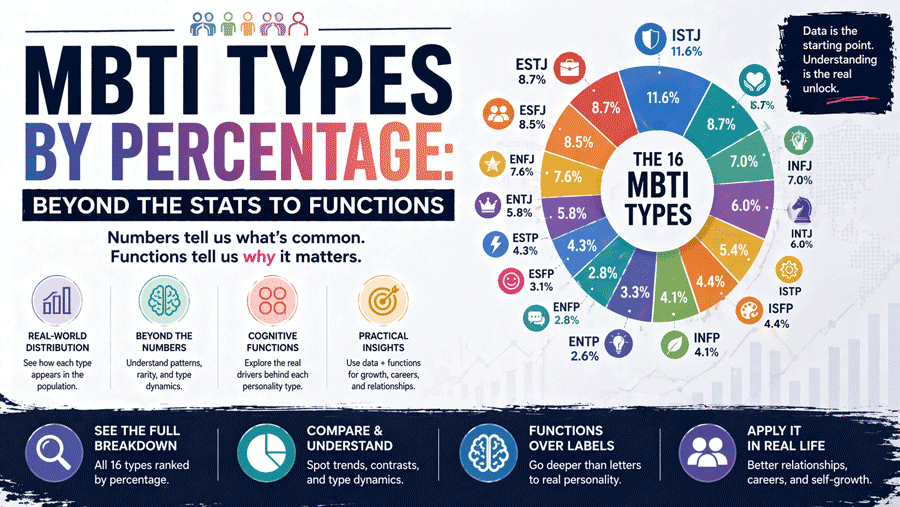
Understanding the distribution of personality types is a common starting point for many exploring psychological typology. When users search for mbti types by percentage, they often seek to know how rare their type is or to validate their identity against population norms. However, relying solely on statistical rarity can lead to misconceptions about personality structure. The true value of the Myers-Briggs Type Indicator lies not in how common a type is, but in how its underlying cognitive functions operate. This article concludes upfront: knowing the percentage of your type is less important than understanding your function stack. Accurate typing and personal growth require moving beyond four-letter codes into the mechanics of Jungian cognitive processes.
The MBTI framework helps individuals understand their preferences in energy direction, information gathering, decision-making, and lifestyle organization. It is useful for career planning, relationship navigation, and self-awareness. Yet, the surface-level letters often obscure the dynamic interplay of mental processes. To apply mbti types by percentage data meaningfully, one must return to cognitive functions. This article provides a deep dive into the mechanisms of type, practical applications for growth, and common pitfalls to avoid, ensuring readers gain a nuanced perspective rather than a static label.
The Framework and Mechanism of Type
To understand why statistics are secondary, we must examine the roots of the system. The MBTI is based on Carl Jung’s theory of psychological types, which posits that humans have innate preferences in how they perceive the world and make decisions. The four dichotomies—Extraversion/Introversion, Sensing/Intuition, Thinking/Feeling, and Judging/Perceiving—are the visible markers of these preferences. However, these letters are merely indicators of the underlying cognitive function stack.
Each of the 16 types operates using a hierarchy of four cognitive functions: dominant, auxiliary, tertiary, and inferior. The dominant function is the primary lens through which an individual engages with the world. The auxiliary supports the dominant, providing balance. The tertiary is less developed but offers relief, while the inferior function is often a source of stress or growth potential. For example, an INTJ leads with Introverted Intuition (Ni), supported by Extraverted Thinking (Te). An ISFJ leads with Introverted Sensing (Si), supported by Extraverted Feeling (Fe). Understanding this stack explains why two types might share letters but behave differently.
Why does letter-based typing cause mistypes? Tests often measure behavior rather than motivation. A person might act organized (J) due to work requirements but prefer flexibility (P) internally. Without analyzing the cognitive functions, such nuances are lost. Validation requires self-observation of decision patterns, stress reactions, and motivation. For instance, does a person recharge through solitude (Introversion) or social interaction (Extraversion)? Do they trust concrete data (Sensing) or abstract patterns (Intuition)?
Famous public figures are often typed based on observed behavior, but these should be treated as illustrative examples rather than facts. Someone like Albert Einstein is widely believed to be an INTP, illustrating dominant Ti and auxiliary Ne, but this is speculative. Use such examples to understand function dynamics, not as definitive proof of type. True type confirmation comes from long-term feedback from others and introspection regarding where you feel most energized versus drained.
The Eight Cognitive Functions
To move beyond mbti types by percentage statistics, one must understand the eight functions. Perceiving functions gather information: Se (Extraverted Sensing) focuses on immediate physical reality; Si (Introverted Sensing) compares present data to past experiences; Ne (Extraverted Intuition) explores multiple future possibilities; Ni (Introverted Intuition) converges on a single visionary insight. Judging functions make decisions: Te (Extraverted Thinking) organizes external systems for efficiency; Ti (Introverted Thinking) analyzes internal logical consistency; Fe (Extraverted Feeling) harmonizes with group values; Fi (Introverted Feeling) aligns with personal authenticity.
Each type uses four of these in a specific order. An ENFP leads with Ne, exploring possibilities, supported by Fi, ensuring alignment with values. Their tertiary Te helps execute plans, while inferior Si can manifest as neglecting physical details under stress. Recognizing these patterns allows for precise type confirmation. If you resonate with the struggle of neglecting details despite having big ideas, you might identify with ENFP dynamics regardless of population statistics.
Application Guidance for Personal Development
Understanding your function stack unlocks practical frameworks for life. We will explore two key areas: career fit and relationship communication. These applications demonstrate why function dynamics matter more than type rarity.
Framework 1: Career and Work-Style Fit
This framework applies when choosing roles or optimizing current work environments. It relates to how different functions process information and make decisions under pressure. For example, dominant Te users thrive in structured environments with clear metrics, while dominant Fi users need autonomy and alignment with personal values.
Practical Action Steps: Identify your dominant function. If it is a Perceiving function (Ne, Ni, Se, Si), ensure your role allows for information gathering without premature closure. If it is a Judging function (Te, Ti, Fe, Fi), ensure you have authority to make decisions. For auxiliary functions, seek tasks that complement your dominant style. An INTJ (Ni-Te) might lead strategy (Ni) but needs a team to handle implementation details (Te support).
Benefits and Limitations: This approach increases job satisfaction and reduces burnout. However, it does not guarantee success; skills must still be developed. A type fit provides energy, but competence requires practice. Readers can judge fit by monitoring energy levels after work tasks. Do you feel drained or energized after using specific cognitive muscles?
Framework 2: Relationship and Communication Guidance
This framework applies to interpersonal conflicts and partnership dynamics. It relates to how different types express care and process disagreement. For instance, Thinkers may offer solutions when Feelers seek empathy. Understanding these patterns prevents misinterpretation of intent.
Practical Action Steps: Identify your partner’s likely functions. If they lead with Feeling, validate emotions before offering logic. If they lead with Sensing, provide concrete examples rather than abstract theories. Practice “function translation.” When an NT type says “This is inefficient,” an SF type might hear “Your effort is worthless.” Reframe communication to bridge this gap.
Benefits and Limitations: This reduces conflict and deepens intimacy. However, it should not excuse poor behavior. Type explains preferences, not excuses for disrespect. Readers can judge effectiveness by tracking conflict resolution speed. Do misunderstandings clear up faster when you adjust your communication style?
Growth Section: Developing the Whole Self
Personal growth in the MBTI context is not about changing your type but expanding your flexibility. Universal principles guide this journey. First, identify the dominant function. This is your superpower but also your potential blind spot if overused. Second, distinguish preference from skill. You may prefer Intuition but need to develop Sensing skills for daily tasks.
Third, develop the inferior function gradually. This is the key to maturity. An inferior Te user (like an INFP) might struggle with organization. Instead of forcing rigid systems, they can adopt small, flexible planning habits. Fourth, understand loop and grip patterns. A “loop” occurs when a type bypasses their auxiliary function, leading to unbalanced behavior. An INFP in a Ni-loop might become withdrawn and overly pessimistic. A “grip” occurs under extreme stress, where the inferior function takes over explosively. An INFJ in a Se-grip might indulge in sensory excesses.
Growth means flexibility, not identity attachment. Do not say “I am an INTP, so I cannot be emotional.” Instead, say “I prefer logic, but I am developing emotional awareness.” This mindset prevents stagnation. The goal is integration, where all functions are accessible when needed, even if some remain less natural.
Mistakes and Pitfalls to Avoid
To maintain credibility and utility, avoid these common errors when exploring type dynamics.
1. Don’t rely solely on online tests. Tests measure self-perception, which can be biased. Alternative: Use tests as a starting hypothesis, then validate through function study.
2. Don’t stereotype types as rigid boxes. People are complex. Alternative: View types as preferences that manifest differently across individuals.
3. Don’t use type to excuse bad behavior. “I’m a Perceiver” is not an excuse for chronic lateness. Alternative: Acknowledge preferences but take responsibility for impact.
4. Don’t obsess over rarity. Searching for mbti types by percentage can lead to elitism about rare types. Alternative: Focus on functionality rather than exclusivity.
5. Don’t ignore cultural context. Expression of functions varies by culture. Alternative: Consider how environment shapes function expression.
6. Don’t assume compatibility is fixed. Any type can work with any type. Alternative: Focus on communication skills rather than type matching.
7. Don’t neglect the inferior function. Ignoring it leads to stress. Alternative: Engage it gently through low-stakes practice.
8. Don’t treat type as static. Functions develop over time. Alternative: Expect your expression of type to mature with age.
Ongoing Learning and Credible Resources
The field of personality psychology evolves. Readers should keep following new research and higher-quality MBTI or Jungian resources. Credible organizations include the Myers & Briggs Foundation and the Center for Applications of Psychological Type (CAPT). These bodies uphold ethical standards and research integrity. Be wary of pop-psychology sites that reduce type to memes or horoscopes.
Look for debates and newer interpretations. Some practitioners integrate Big Five traits with MBTI for a broader view. Learn to identify reliable information by checking citations and avoiding absolute claims. Reliable resources acknowledge limitations and emphasize development over labeling. Avoid low-quality summaries that promise instant typing without depth. True understanding requires study and reflection over time.
Frequently Asked Questions
1. Where should beginners start? Begin by studying the four dichotomies, then move quickly to cognitive functions. Read foundational texts rather than quick quizzes.
2. How do I confirm my type without tests? Observe your stress reactions and energy sources. Which activities drain you? Which restore you? Ask trusted friends for feedback on your blind spots.
3. How does type affect relationship communication? It influences how you express care and resolve conflict. Learn your partner’s function preferences to tailor your approach.
4. How can I learn cognitive functions efficiently? Study one function at a time. Observe it in yourself and others. Keep a journal of when you use specific functions.
5. Can my type change over time? Your core preferences likely remain stable, but your development changes. You become better at using non-preferred functions as you mature.
6. What if I resonate with multiple types? This is common. Focus on the function stack that explains your motivations, not just behaviors. Look for the “best fit” rather than a perfect match.
7. Is MBTI scientifically uncontested? No. It is a tool for understanding preferences, not a definitive scientific measure like blood type. Use it heuristically.
In conclusion, while searching for mbti types by percentage offers curiosity about rarity, true insight comes from cognitive functions. Use this framework to grow, connect, and understand yourself with depth and compassion. The letters are a map, but the functions are the terrain.