
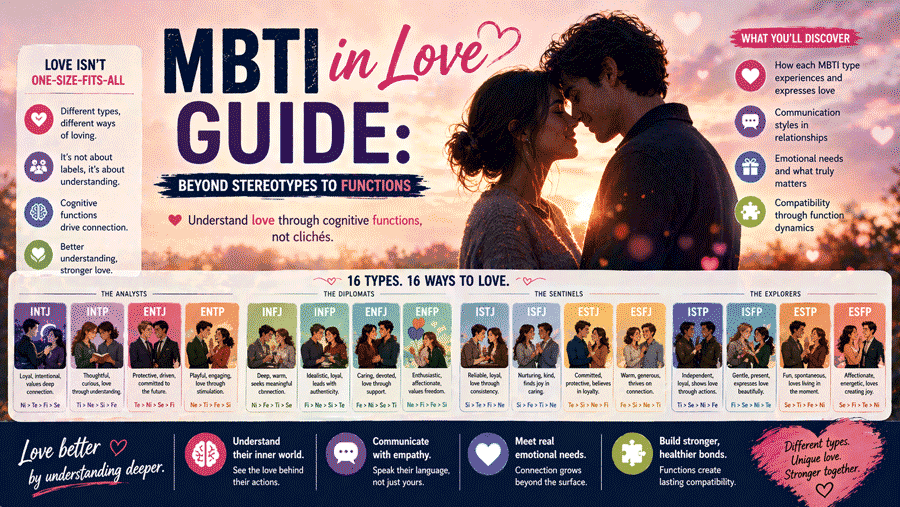
Understanding mbti in love requires moving past surface-level four-letter codes and diving into the cognitive machinery that drives human behavior. While many seekers start with compatibility charts based on types like INFJ or ENTP, true relational depth emerges only when we analyze the underlying cognitive functions. This article concludes upfront: MBTI is a tool for understanding preferences, not a deterministic label that defines your entire identity or relationship destiny. To use MBTI effectively in relationships, you must prioritize cognitive function dynamics over static type descriptions.
The Myers-Briggs Type Indicator (MBTI) is a self-report inventory designed to identify psychological preferences in how people perceive the world and make decisions. It is useful for individuals seeking self-awareness, teams aiming to improve communication, and couples wanting to navigate differences. However, its deeper application in romance must return to the Jungian cognitive functions. Without this nuance, users risk falling into stereotypes that hinder rather than help connection.
The Framework Behind MBTI in Love
To grasp why certain dynamics occur in relationships, one must understand the theoretical roots. The MBTI is built upon Carl Jung’s theory of psychological types, which posits that human behavior results from consistent patterns in how we process information.
Jungian Roots and Dichotomies
The system uses four dichotomies: Extraversion (E) vs. Introversion (I), Sensing (S) vs. Intuition (N), Thinking (T) vs. Feeling (F), and Judging (J) vs. Perceiving (P). These combine to form 16 personality types. However, in the context of mbti in love, these letters are merely shorthand for a more complex stack of cognitive functions.
For instance, an ‘F’ preference does not simply mean “emotional.” It indicates a preference for making decisions based on values and person-centered concerns rather than impersonal logic. An ‘T’ preference indicates a focus on cause-and-effect logic. In relationships, conflicts often arise not because one partner is “cold” and the other “warm,” but because their decision-making hierarchies differ.
The Cognitive Function Stack
Every type operates using a stack of four primary functions: Dominant, Auxiliary, Tertiary, and Inferior. This stack determines how a person interacts with a partner.
- Dominant Function: The core lens through which a person views life. In love, this is their default mode of operation. For example, a Dominant Feeler (like an ENFJ) prioritizes group harmony instinctively.
- Auxiliary Function: Supports the dominant function. It often emerges more clearly in close relationships where the individual feels safe. An Introverted Thinker (Ti) auxiliary might help an ENFJ analyze relationship logic internally.
- Tertiary Function: Less mature, often appearing in relaxation or play. In stress, it can become a source of indulgence.
- Inferior Function: The unconscious weak spot. Under severe stress, a person may “grip” into this function, behaving uncharacteristically. An INFJ (Dominant Ni, Inferior Se) might suddenly overindulge in sensory pleasures during a relationship crisis.
Why Letter-Based Typing Causes Mistypes
Relying solely on the four letters often leads to mistyping, which derails relationship advice. A common error is confusing behavior with preference. An introvert who works in sales may exhibit extraverted behavior, but their energy still drains from social interaction. In love, if you type your partner based on their social mask rather than their energy source, you will misunderstand their needs for recharge.
Furthermore, cultural conditioning affects how functions present. A man encouraged to suppress feelings may test as a Thinker despite having a Feeling preference. Accurate typing requires looking beyond the surface.
Validating Your Type Without Tests
Online tests are starting points, not verdicts. To confirm your type for relationship work, observe your natural patterns over time.
Self-Observation and Decision Patterns
Ask yourself: When making a major relationship decision, what is my first instinct? Do I analyze the pros and cons logically (Thinking), or do I consider how it impacts everyone’s feelings (Feeling)? Do I rely on past experiences and concrete facts (Sensing), or do I look for future possibilities and patterns (Intuition)?
Stress Reactions and Motivation
Stress reveals the inferior function. If you become unusually critical and isolated under stress, you might be an Extraverted Feeler gripping into Introverted Thinking. If you become impulsive and reckless, you might be an Introverted Intuitive gripping into Extraverted Sensing. Tracking these reactions provides clearer data than a quiz.
Long-Term Feedback
Ask trusted partners or friends how they perceive your blind spots. Sometimes others see our unconscious patterns more clearly than we do. If multiple people note that you dismiss practical details despite valuing efficiency, you might be an Intuitive type overestimating your Sensing capabilities.
Illustrative Examples
Public figures are often typed cautiously. For instance, Abraham Lincoln is widely believed to be an INTP or INTJ, illustrating how a dominant Thinking function can manifest as profound moral conviction rather than coldness. However, use such examples only as illustrations, not facts, as remote typing is speculative.
Practical Application Frameworks
Understanding theory is useless without application. Here are two frameworks to apply mbti in love practically.
Framework 1: Cognitive Function Development in Relationships
When it applies: This framework is best for long-term couples seeking growth rather than just conflict resolution. It relates to how partners can support each other’s function stacks.
Type Dynamics: Every type has functions they neglect. A partner can help develop these. For example, an ENTP (Dominant Ne, Inferior Si) might struggle with routine and stability. An ISFJ partner (Dominant Si) can gently model healthy routine without enforcing it rigidly.
Action Steps:
- Identify your partner’s inferior function.
- Create a safe space for them to practice it without judgment.
- Recognize when they are in a “grip” stress state and offer grounding rather than logic.
Benefits and Limitations: This fosters deep mutual growth. However, it requires patience. You cannot force a partner to develop their inferior function quickly; it is a lifelong process.
Judging Fit: If you feel your partner understands your stress triggers better over time, this framework is working.
Framework 2: Communication Patterns and Conflict Resolution
When it applies: Use this during active disagreements or when setting boundaries. It relates to Information Processing (S/N) and Decision Making (T/F).
Type Dynamics: Sensing types prefer concrete examples; Intuitives prefer abstract concepts. Thinkers prefer directness; Feelers prefer tact. Mismatches here cause friction.
Action Steps:
- For S-N mismatches: The Intuitive should provide concrete examples when explaining ideas. The Sensor should articulate the “big picture” implication of practical details.
- For T-F mismatches: The Thinker should validate feelings before offering solutions. The Feeler should state logical constraints clearly without apologizing.
Benefits and Limitations: This reduces immediate conflict. However, it does not solve fundamental value incompatibilities. It is a translation tool, not a fix for abuse or neglect.
Judging Fit: If arguments decrease in intensity and duration, the communication framework is effective.
Growth Principles for Personality Type
Growth in the context of MBTI means flexibility, not identity attachment. Here are universal principles for using type information wisely.
Identify the Dominant Function First
Your dominant function is your strength. In love, lean into it. If you are a Dominant Feeler, your empathy is a gift. Do not suppress it to appear “logical.” Authenticity attracts compatible partners.
Distinguish Preference from Skill
You may prefer Thinking but have highly developed Feeling skills due to upbringing. Do not confuse competence with preference. In relationships, acknowledge what drains you even if you are good at it.
Develop the Inferior Function Gradually
The inferior function is a source of growth but also vulnerability. Engage it in low-stakes environments. If you are an Introvert (Inferior Extraversion), practice socializing in short bursts rather than forcing yourself into constant partying.
Explain Loop and Grip Patterns
A “loop” occurs when you bypass your auxiliary function. An INTP might loop between Introverted Thinking and Introverted Intuition, becoming paranoid and isolated. Recognizing this allows a partner to gently encourage extraverted engagement.
Growth Means Flexibility
Do not use type as an excuse (“I’m an P, so I’m always late”). Use it as an explanation to find strategies. Growth is expanding your repertoire, not rigidly staying within your type’s box.
Common Mistakes and Pitfalls
When exploring mbti in love, avoid these eight common errors to maintain a healthy perspective.
- Don’t label your partner: Avoid saying “You’re just being an ESTJ.” This dismisses their feelings. Alternative: Discuss specific behaviors without type labels.
- Don’t ignore stress: Typing someone in stress leads to errors. Alternative: Observe them when they are relaxed and energized.
- Don’t assume compatibility: Two types are not “meant to be.” Alternative: Focus on shared values and effort.
- Don’t use type to excuse bad behavior: Abuse is not a personality trait. Alternative: Hold boundaries regardless of type.
- Don’t stereotype genders: Avoid assuming all men are Thinkers or women are Feelers. Alternative: Evaluate individuals on their own merits.
- Don’t rely on one test: Tests vary in quality. Alternative: Use multiple sources and self-reflection.
- Don’t neglect the inferior function: Ignoring it leads to burnout. Alternative: Schedule rest and care for your weak spots.
- Don’t treat type as static: People mature. Alternative: Re-evaluate preferences every few years.
Ongoing Learning and Resources
The field of personality psychology evolves. To maintain accuracy, readers should commit to ongoing learning.
Credible Organizations
Seek information from established bodies like the Myers & Briggs Foundation or the Center for Applications of Psychological Type (CAPT). These organizations uphold ethical standards and accurate theoretical representation.
Jungian Educational Resources
Deepen your knowledge through Jungian educational resources that explore the original psychological types. This provides context that modern pop-psychology often lacks.
Identifying Reliable Information
Be wary of content that promises instant fixes or deterministic outcomes. Reliable information acknowledges nuance, debates, and newer interpretations. Avoid low-quality summaries that reduce complex humans to memes.
New Research and Debates
Stay open to new research regarding personality traits. While MBTI is popular, academic psychology often discusses the Big Five. Understanding the relationship between these models can provide a more rounded view of human personality.
Frequently Asked Questions
Here are answers to common questions regarding mbti in love and type usage.
1. Where should a beginner start?
Start by reading about the four dichotomies and taking a reputable test as a baseline. Then, read detailed descriptions of the cognitive functions to see which resonate most with your internal experience.
2. How do I confirm my type without tests?
Focus on energy dynamics. What drains you? What energizes you? Observe your decision-making process under no pressure. Consistent patterns over years are more reliable than a single quiz result.
3. Can MBTI help with relationship communication?
Yes, by highlighting differences in information processing. Knowing your partner prefers direct logic over nuanced tact can prevent misunderstandings, provided both parties respect each other’s style.
4. How do I learn cognitive functions efficiently?
Study one function at a time. Start with your suspected dominant function. Look for examples of it in healthy and unhealthy states. Compare it with its opposite to understand the contrast.
5. Can my personality type change?
Your core preferences generally remain stable throughout adulthood. However, your ability to use non-preferred functions (development) increases with age. You do not change types, but you become more balanced.
Conclusion
Using mbti in love is a journey of nuance. It offers a vocabulary for differences but demands responsibility in application. By focusing on cognitive functions, validating types through observation, and avoiding stereotypes, couples can use these tools to foster empathy and growth. Remember, the goal is not to find a perfect type match, but to build a perfect understanding between two unique individuals.