
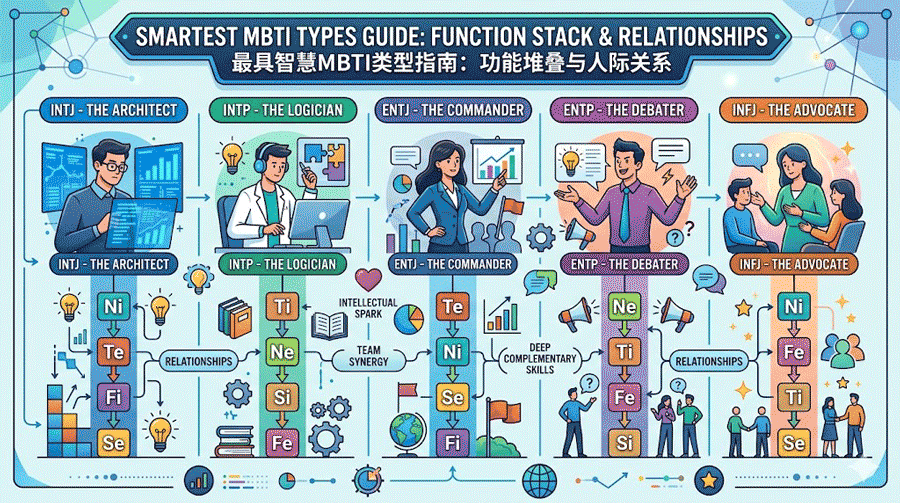
When discussing intelligence within the Myers-Briggs Type Indicator framework, the conversation often centers on the search for the smartest mbti types. However, true psychological depth requires us to move beyond simple rankings and understand how cognitive functions shape perception and decision-making. This guide explores the nuanced relationship between personality type and intelligence, emphasizing that type is a starting point, not a destination. Whether you are an INTJ seeking strategic clarity or an ENFP looking for creative breakthroughs, understanding your function stack is key to unlocking your potential in careers and relationships.
According to the Myers & Briggs Foundation, the MBTI instrument indicates preference, not ability. Therefore, labeling one type as universally "smarter" is scientifically inaccurate. Instead, we examine how different types process information. For instance, Thinking types may prioritize logical consistency, while Feeling types prioritize value-based harmony. Both are intelligent adaptations to different environmental demands. This article provides a comprehensive review of how these preferences manifest in real-world scenarios, offering actionable advice for personal growth and relational harmony.
Type Framework and Core Mechanisms
To understand intelligence across types, we must return to the theoretical roots of Carl Jung and the subsequent development by Katharine Cook Briggs and Isabel Briggs Myers. The MBTI is built on four dichotomies: Extraversion/Introversion, Sensing/Intuition, Thinking/Feeling, and Judging/Perceiving. However, the true engine of personality lies in the cognitive function stack.
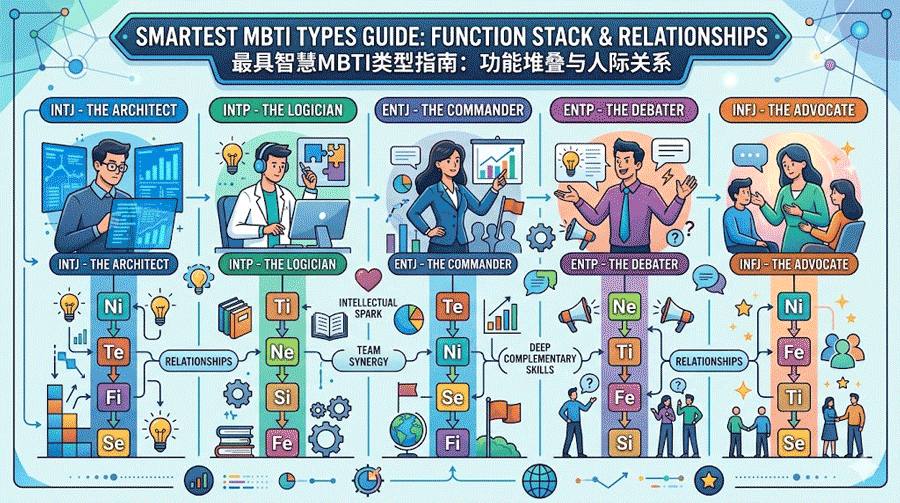
The Eight Cognitive Functions
Each of the 16 types utilizes a hierarchy of four functions: Dominant, Auxiliary, Tertiary, and Inferior. These functions determine how information is gathered (Perceiving: Sensing or Intuition) and how decisions are made (Judging: Thinking or Feeling).
- Introverted Thinking (Ti): Focuses on internal logical consistency. Often associated with types like INTP and ISTP. This function seeks precision and underlying principles.
- Extraverted Thinking (Te): Focuses on external efficiency and organization. Common in ENTJ and ESTJ. This function seeks measurable results and structured systems.
- Introverted Feeling (Fi): Focuses on internal values and authenticity. Prominent in INFP and ISFP. This function seeks alignment with personal moral compasses.
- Extraverted Feeling (Fe): Focuses on external harmony and group values. Common in ENFJ and ESFJ. This function seeks social cohesion and empathy.
- Introverted Intuition (Ni): Focuses on future insights and patterns. Key for INTJ and INFJ. This function seeks long-term vision and convergence.
- Extraverted Intuition (Ne): Focuses on possibilities and connections. Key for ENTP and ENFP. This function seeks divergence and potential outcomes.
- Introverted Sensing (Si): Focuses on past experiences and stability. Key for ISTJ and ISFJ. This function seeks reliability and detail retention.
- Extraverted Sensing (Se): Focuses on immediate reality and action. Key for ESTP and ESFP. This function seeks sensory engagement and adaptability.
Verification Beyond Testing
Online tests often yield inconsistent results. To accurately verify your type, observe your stress responses and energy sources. Do you recharge alone (Introversion) or with others (Extraversion)? When solving problems, do you rely on established data (Sensing) or conceptual models (Intuition)? Self-observation over weeks is more reliable than a single quiz. Additionally, seek feedback from trusted peers who know you well. They may notice patterns you miss, such as a tendency to prioritize logic over emotion during conflicts, indicating a Thinking preference.
Type Applications and Development Suggestions
Understanding your type allows for targeted development. Below are two structured plans to enhance cognitive flexibility and relational success.
Plan A: Cognitive Function Strengthening
This plan focuses on balancing your function stack to prevent burnout and rigidity.
- For Dominant Intuitives (NF/NT): Ground your ideas in reality. Schedule time for detailed execution (Si/Se) rather than just planning. Practice mindfulness to stay present.
- For Dominant Sensors (SJ/SP): Challenge your assumptions. Engage in brainstorming sessions that require abstract thinking (Ni/Ne). Ask "what if" questions to expand perspective.
- For Dominant Thinkers (TJ/TP): Develop emotional granularity. Practice active listening without immediately offering solutions. Validate others' feelings before analyzing the problem.
- For Dominant Feelers (FJ/FP): Strengthen objective decision-making. Use data to support your values. Practice setting boundaries based on logic rather than just comfort.
Plan B: Relationship Adaptation
Relationships often fail due to cognitive mismatches. This plan helps navigate those differences.
- Communication Style: If you are a Te user, recognize that Fe users need harmony before efficiency. If you are an Fi user, understand that Ti users need logical consistency before emotional validation.
- Conflict Resolution: Identify the trigger. Is it a violation of values (Fi/Fe) or a breach of logic (Ti/Te)? Address the root cause rather than the surface behavior.
- Growth Partnership: Partner with someone who complements your weaknesses. An ENTP might benefit from an ISTJ's attention to detail, while the ISTJ benefits from the ENTP's innovation.
Function Cognition and Growth Ideas
Personal growth within the MBTI framework is not about changing your type, but about developing all functions. The goal is "type development," moving from unconscious competence in your dominant function to conscious competence in your inferior function.
General Principles for Growth
First, prioritize confirming your dominant function. This is your natural strength. Leverage it in your career and daily tasks. For example, if you have dominant Ni, choose roles that require strategic planning. Second, gradually integrate your inferior function. This is often the source of stress but also holds the key to wholeness. For an INFJ (dominant Ni, inferior Se), engaging in physical activities or sensory experiences can reduce anxiety and ground their visions. Third, accept that development is non-linear. There will be periods of regression, especially during high stress. This is normal and part of the journey.
Contextual Intelligence
Intelligence is contextual. A type that excels in academic theory might struggle in crisis management, and vice versa. An ESTP with high Se might be the "smartest" person in a rapidly changing emergency, while an INTJ with high Ni might be the "smartest" in long-term corporate strategy. Recognizing this prevents elitism and fosters respect for diverse cognitive strengths. It also helps in team building, ensuring that all cognitive perspectives are represented for holistic problem-solving.
Common Mistakes and Pitfalls
Misunderstanding MBTI can lead to stereotyping and self-limitation. Avoid these eight common errors to maintain a healthy perspective on personality types.
1. Do Not Equate Type with IQ
Never assume a specific type is inherently more intelligent. Research shows no correlation between MBTI type and IQ scores. Intelligence is multifaceted, and every type has access to high cognitive capability.
2. Do Not Use Type as an Excuse
Avoid saying "I am an INFP, so I cannot be organized." This is self-limiting. Types describe preferences, not disabilities. You can develop skills outside your preference with effort.
3. Do Not Stereotype Others
Do not assume you know someone's behavior solely based on their type. Individual maturity, culture, and experience play larger roles than personality preference. Treat each person as an individual first.
4. Do Not Type Others Without Consent
Armchair typing can be intrusive and inaccurate. Unless someone shares their type or asks for help, avoid labeling them. It can create resistance and misunderstanding in relationships.
5. Do Not Over-Reliy on Tests
Free online tests often lack validity. They measure mood rather than stable preference. Use them as a starting point for reflection, not as a definitive diagnosis. Professional assessment is more reliable.
6. Do Not Ignore the Shadow
Under stress, types exhibit "shadow functions" which can be destructive. Ignoring this leads to confusion when you act out of character. Learn to recognize your stress responses to manage them better.
7. Do Not Confuse Behavior with Function
Two people can exhibit the same behavior for different reasons. An INTJ and an ISTJ might both be organized, but one uses Te/Ni for efficiency/vision, the other uses Si/Te for stability/procedure. Look at the motivation, not just the action.
8. Do Not Neglect Emotional Intelligence
Focus solely on cognitive functions can lead to neglecting EQ. Regardless of type, developing empathy and social skills is crucial for success. Thinking types must not dismiss feelings as irrelevant data.
Version Update Focus
The field of personality psychology is evolving. While the MBTI remains popular, new research integrates neuroscience and big data. Readers should track updates from the Myers & Briggs Foundation for official stance changes. Additionally, look for resources discussing the Big Five model alongside MBTI for a broader perspective. Academic journals often publish studies on cognitive function validation. Staying informed ensures you are using the most current and scientifically backed information. Avoid outdated forums that promote rigid typing or mystical interpretations of type dynamics. Focus on evidence-based applications in organizational psychology and counseling.
Frequently Asked Questions
1. How do I start learning MBTI as a beginner?
Start with the four dichotomies to understand the basic language. Then, move to cognitive functions for depth. Read official literature from the Myers & Briggs Foundation before exploring community forums. Practice self-reflection daily to observe your preferences in real-time.
2. Can my MBTI type change over time?
Core preferences generally remain stable throughout adulthood. However, your expression of these preferences can mature. You may develop your weaker functions, making you appear different, but your underlying orientation usually stays consistent. Significant trauma or life changes can temporarily shift behavior.
3. How does MBTI help in relationship communication?
It provides a framework to understand differences. Knowing your partner processes information differently reduces frustration. For example, understanding that a partner needs time to process internally (Introversion) prevents misinterpreting silence as disinterest. It fosters patience and tailored communication strategies.
4. What is the most efficient way to study for my type?
Align study methods with your functions. Intuitives benefit from concept maps and big-picture theories. Sensors benefit from detailed notes and practical examples. Thinkers benefit from logical structures and debate. Feelers benefit from connecting material to personal values and group discussion.
5. How do I distinguish between reliable and unreliable MBTI information?
Check the source. Reliable information cites psychological theory and avoids absolute statements. Unreliable information often uses memes, stereotypes, or claims one type is superior. Look for nuance, acknowledgment of limitations, and focus on growth rather than labeling.