
16 Personality Types: Complete Guide to Relationships and Personal Growth
Understanding the 16 personality types can help you make sense of how people think, communicate, build relationships, and grow over time. While many people first discover personality type through a quick online quiz, real insight comes from going beyond the four-letter label and understanding the deeper patterns behind it.
This guide offers a practical, user-friendly introduction to the 16 personality types, including how they work, how they affect relationships, and how each type can approach personal growth more effectively. Whether you are new to personality theory or already familiar with MBTI, this article will help you use the framework in a more meaningful and balanced way. Instead of treating type as a box, the goal is to use it as a tool for self-awareness, empathy, and development.
What Are the 16 Personality Types?
The 16 personality types come from the Myers-Briggs Type Indicator, often known as MBTI. This system describes personality using four preference pairs:
- Extraversion (E) vs. Introversion (I)
- Sensing (S) vs. Intuition (N)
- Thinking (T) vs. Feeling (F)
- Judging (J) vs. Perceiving (P)
These four dimensions combine to create 16 different types, such as INFJ, ENFP, ISTJ, and ENTJ. Each type reflects a different pattern of how a person tends to focus attention, gather information, make decisions, and approach structure in life.
At a basic level, the model helps explain why people often respond differently to the same situation. Some people want facts and details. Others focus on possibilities and future meaning. Some lead with logic, while others naturally consider values and emotional impact first. These preferences do not define everything about a person, but they can reveal useful patterns in behavior and motivation.
Why the 16 Personality Types Matter
The value of the 16 personality types is not in labeling people. The real value is in helping people understand themselves and others more clearly. When used well, personality theory can improve communication, reduce unnecessary conflict, and support personal growth.
For example, one person may need time alone to process ideas, while another thinks best through conversation. One partner may want emotional validation first, while the other immediately tries to solve the problem. One coworker may want a clear plan, while another prefers flexibility and room to explore. Understanding these differences can lead to more patience and better decisions.
That said, the 16 personality types should not be treated as fixed categories or excuses for bad habits. Personality type describes preferences, not limits. It is a starting point for growth, not a final definition of who someone is.
The Theory Behind the 16 Personality Types
To understand the 16 personality types more deeply, it helps to look at where the model comes from. The MBTI framework was influenced by Carl Jung’s theory of psychological types and later developed by Katharine Cook Briggs and Isabel Briggs Myers. Jung believed that people have natural preferences in how they perceive the world and make decisions. MBTI organizes these preferences into a more accessible structure.
However, the four letters are only the surface layer. Beneath them is a deeper system known as cognitive functions. This is where many advanced users of MBTI focus their attention, because cognitive functions explain not just what a type looks like, but how it works internally.
Understanding Cognitive Functions
Cognitive functions are the mental processes behind the 16 personality types. There are eight functions in total:
- Extraverted Thinking (Te)
- Introverted Thinking (Ti)
- Extraverted Feeling (Fe)
- Introverted Feeling (Fi)
- Extraverted Sensing (Se)
- Introverted Sensing (Si)
- Extraverted Intuition (Ne)
- Introverted Intuition (Ni)
Each personality type has a typical function stack made up of four main functions:
- Dominant
- Auxiliary
- Tertiary
- Inferior
For example, an INFJ is commonly understood to use Introverted Intuition (Ni) as the dominant function and Extraverted Feeling (Fe) as the auxiliary function. This helps explain why INFJs are often described as future-focused, reflective, and deeply aware of interpersonal dynamics.
Understanding cognitive functions is useful because behavior alone can be misleading. A person may seem quiet but still prefer extraverted mental processes. Another may look highly organized on the outside but still rely on flexible internal exploration. Cognitive functions help clarify motivation, not just appearance.
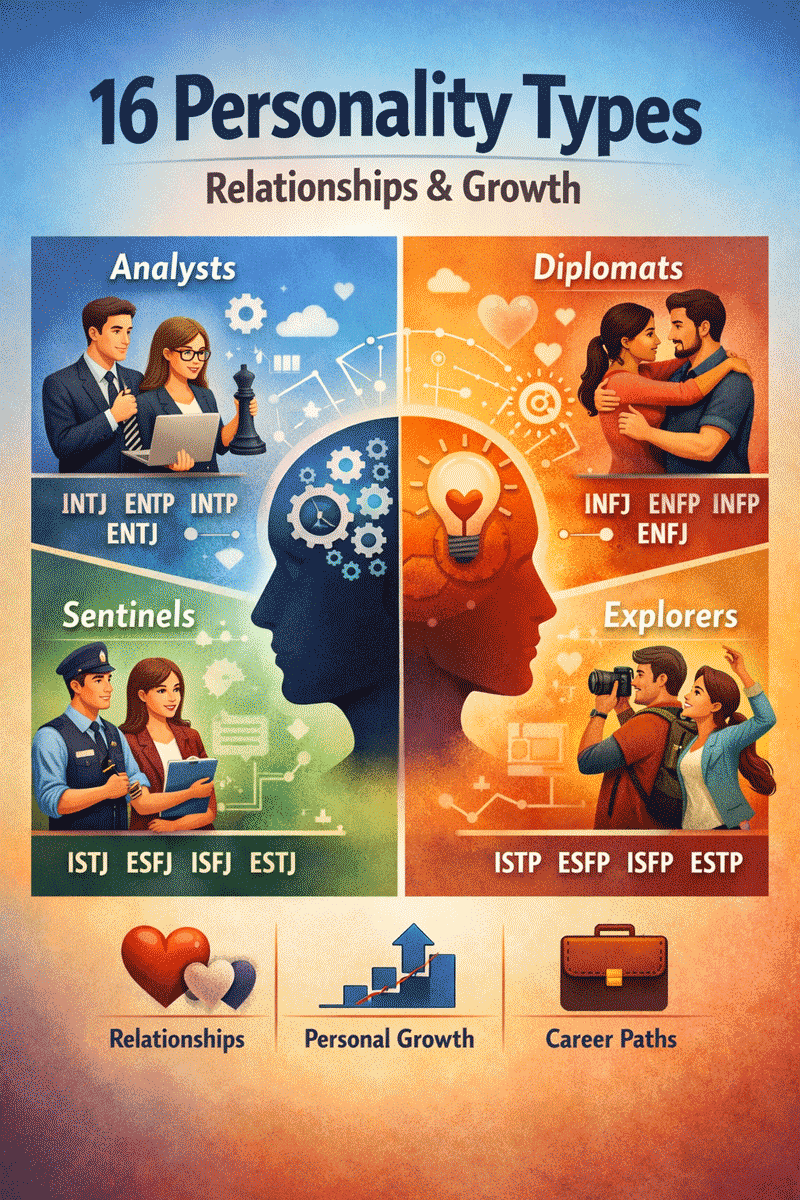
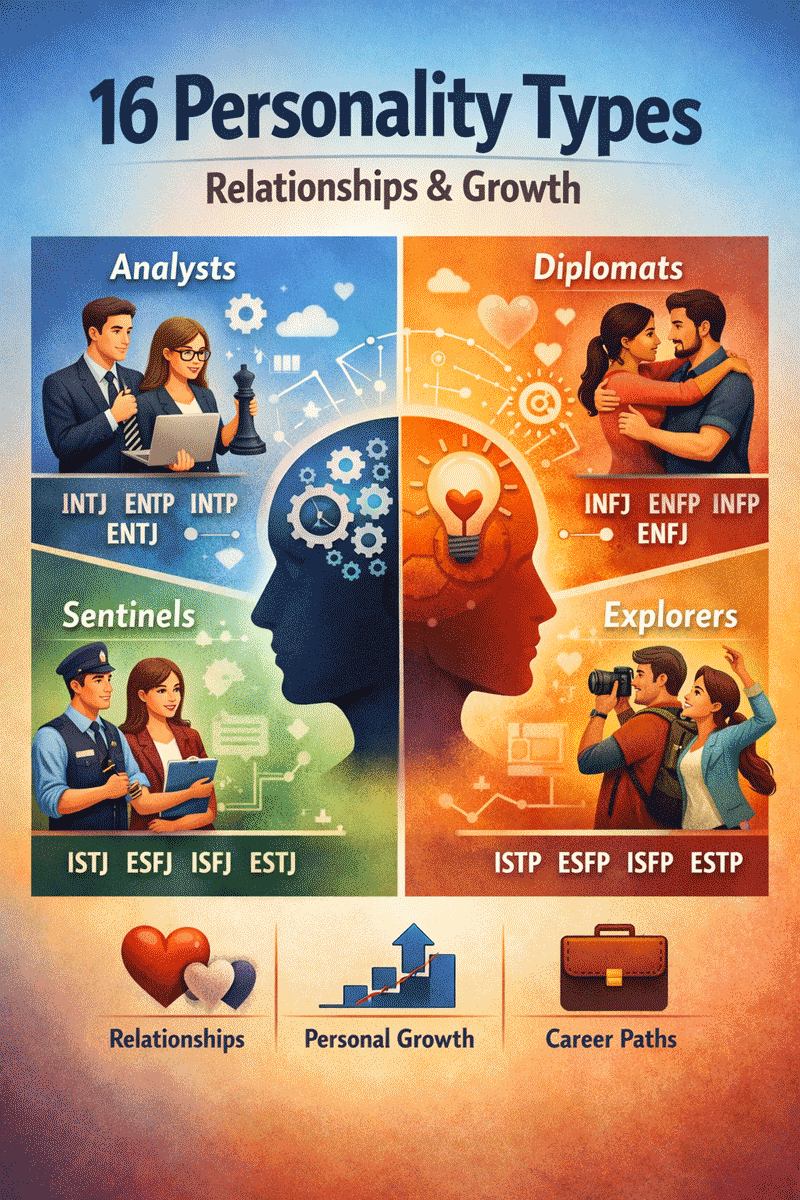
The 16 Personality Types at a Glance
The 16 personality types are often grouped into four broad categories to make them easier to understand.
Analysts
- INTJ
- INTP
- ENTJ
- ENTP
These types are often associated with strategy, analysis, systems, and innovation.
Diplomats
- INFJ
- INFP
- ENFJ
- ENFP
These types are often associated with empathy, meaning, idealism, and personal growth.
Sentinels
- ISTJ
- ISFJ
- ESTJ
- ESFJ
These types are often associated with responsibility, structure, reliability, and practical care.
Explorers
- ISTP
- ISFP
- ESTP
- ESFP
These types are often associated with adaptability, hands-on action, freedom, and responsiveness.
These groupings are helpful for a broad overview, but they should not replace individual understanding. People of the same type can still look very different depending on life stage, culture, environment, and personal development.
How to Identify Your Personality Type More Accurately
Many people first meet the 16 personality types through online tests, but tests alone are not always enough. Results can be influenced by mood, stress, life circumstances, and question wording. A more accurate approach involves reflection over time.
Study Your Preferences, Not Just Your Habits
Ask what feels natural, not just what you have learned to do well. A person can become highly skilled at planning without naturally preferring structure.
Pay Attention to Motivation
Try to understand why you make decisions the way you do. Do you seek internal logical consistency, external efficiency, personal values, or relational harmony?
Notice Your Patterns Under Stress
Stress reactions often reveal parts of your type more clearly, especially your inferior function. These moments can offer useful clues.
Compare Similar Types
If you are uncertain, compare types that seem close, such as INFP vs INFJ or ENTP vs ENTJ. The differences often become clearer when looking at functions and motivations.
Ask for Grounded Feedback
Trusted friends or mentors may notice recurring patterns that you miss in yourself.
Typing is more reliable when treated as an ongoing process rather than a one-time result.
16 Personality Types in Relationships
One of the most popular reasons people explore the 16 personality types is to better understand relationships. Personality type can help explain communication style, emotional needs, conflict patterns, and how people show care.
For example, Feeling types may naturally focus on emotional tone and relational harmony, while Thinking types may focus on fairness, logic, and solving the issue. Neither approach is wrong, but misunderstandings happen when each side assumes the other should respond in the same way.
Similarly, Introverted types may prefer more space and depth, while Extraverted types may prefer faster feedback and more direct interaction. Judging types often appreciate predictability and closure, while Perceiving types may want flexibility and openness.
Healthy relationships are not built on type matching alone. There is no perfect type pairing that guarantees success. Strong relationships depend on communication, respect, emotional maturity, and willingness to adapt. Still, the 16 personality types can provide a useful language for understanding differences instead of taking them personally.
Friendship and Social Dynamics
The 16 personality types can also help explain friendship patterns and group dynamics. Some people enjoy lively discussion and social energy, while others prefer one-on-one conversations and more meaningful depth. Some want spontaneous fun, while others prefer a clear plan.
A balanced friend group often benefits from variety. Intuitive types may bring ideas and vision, while Sensing types help keep things practical and grounded. Thinking types may add clarity and honest feedback, while Feeling types may help maintain warmth and emotional awareness.
Understanding these differences can make social planning easier and reduce friction. For example, one friend may enjoy a long debate about ideas, while another would rather connect through shared activity or practical support. Knowing this can help people feel seen rather than misunderstood.
16 Personality Types in Career and Work
The 16 personality types are also useful in the workplace. They can help explain why certain environments, tasks, and communication styles feel more natural to some people than others.
For example:
- Intuitive types may enjoy strategy, innovation, and future-focused planning
- Sensing types may excel in detail, process, and execution
- Thinking types may prefer objective decision-making and system building
- Feeling types may do well in people-centered roles and team support
- Judging types may like deadlines, order, and clear expectations
- Perceiving types may enjoy adaptability, exploration, and open-ended work
This does not mean any type can only succeed in one kind of role. People can thrive in many different careers. The point is that personality type can help explain preferred working style, common strengths, and likely stress points.
In teams, this understanding can improve collaboration. A structured type may view a spontaneous coworker as disorganized, while the spontaneous coworker may see the structured one as rigid. Recognizing these as style differences rather than personal flaws can improve trust and performance.
Personal Growth and the 16 Personality Types
A healthy approach to the 16 personality types is growth-oriented. Type should help you understand where your strengths come from and where your development edge may be.
Growth does not mean becoming a different type. It means becoming a more mature version of your own type. This usually involves:
- understanding and using your strengths more consciously
- developing your auxiliary function for balance
- learning to work with your weaker functions without forcing them
- becoming less reactive under stress
- improving communication with people who think differently
For example, a type that naturally relies on empathy may benefit from practicing more objective analysis when needed. A type that naturally focuses on systems and efficiency may benefit from slowing down to consider emotional impact. Real development expands your range without erasing your preferences.
A Practical Growth Plan
If you want to use the 16 personality types for real self-improvement, this simple plan can help.
1. Identify Your Strongest and Weakest Patterns
Look at what comes naturally to you and what tends to create stress or avoidance.
2. Build Awareness Through Reflection
Keep a journal of situations where you felt energized, frustrated, effective, or misunderstood.
3. Practice One Growth Skill at a Time
Choose one development target, such as clearer communication, better emotional regulation, stronger planning, or more flexibility.
4. Adjust Your Relationships Intentionally
Learn how the important people in your life prefer to communicate, decide, and handle conflict.
5. Revisit Your Type Over Time
As you grow, your self-understanding becomes more accurate. Review your type with fresh perspective instead of clinging to an early label.
This makes personality theory practical instead of purely theoretical.
Common Mistakes to Avoid
When exploring the 16 personality types, people often fall into a few common traps.
Treating Type Like a Horoscope
Personality theory is not meant to predict every detail of your life. It should guide reflection, not replace judgment.
Using Type as an Excuse
Saying “that’s just my type” can block growth. Type explains preferences, not permanent limitations.
Stereotyping Others
No type is always shy, cold, emotional, lazy, bossy, or deep. People are more complex than online memes suggest.
Relying on One Test Result
Tests can help, but they should not be the only source of truth.
Ignoring Context
Stress, culture, age, and environment all shape how type appears in real life.
Ranking Types as Better or Worse
There is no best type. Every personality has strengths, blind spots, and growth challenges.
Avoiding these mistakes makes the framework more accurate and more useful.
Are the 16 Personality Types Scientifically Perfect?
The 16 personality types are widely used in coaching, education, relationships, and self-development, but they are not a perfect scientific system. Many psychologists raise concerns about reliability and the limits of type-based models, especially when used for high-stakes decisions like hiring.
That does not mean the framework has no value. It means it should be used with balance. The best use of personality type is as a reflective tool that helps people understand patterns in cognition, behavior, and communication. It is most helpful when combined with humility, context, and real-life observation.
Frequently Asked Questions
What are the 16 personality types?
The 16 personality types are personality categories based on four MBTI preference pairs: Extraversion or Introversion, Sensing or Intuition, Thinking or Feeling, and Judging or Perceiving.
How do I know which personality type I am?
Start with self-reflection, study the cognitive functions, compare similar types, and use tests only as a starting point rather than a final answer.
Can your personality type change over time?
Your core preferences tend to stay relatively stable, but how you express them can change as you mature and develop.
Which of the 16 personality types is best in relationships?
No type is automatically best. Healthy relationships depend more on communication, maturity, and mutual respect than on type alone.
Are the 16 personality types useful for career choices?
They can be helpful for understanding work style, strengths, and preferred environments, but they should not be used as the only factor in career decisions.
Why are cognitive functions important?
Cognitive functions help explain the internal processes behind each type, making the model deeper and more accurate than four-letter stereotypes alone.
Final Thoughts
The 16 personality types offer a useful framework for understanding yourself and others, especially when the focus is on growth rather than labels. They can help you improve communication, navigate relationships, better understand your working style, and develop more self-awareness over time.
The most helpful way to use personality theory is with curiosity and flexibility. Learn your patterns, notice your blind spots, and use that knowledge to make wiser choices. The goal is not to fit into a category perfectly. The goal is to understand yourself more clearly, relate to others more effectively, and keep growing.