
Understanding personality is not about labeling yourself; it is about unlocking a map for growth. When readers search for all mbti types explained, they are often looking for more than just a list of four-letter codes. They want to know how these types function in real life, how to confirm their own type accurately, and how to use this knowledge for career development, relationships, and personal maturity. The core conclusion is simple: the four letters are merely a shorthand for a deeper psychological mechanism known as cognitive functions. Without understanding these functions, any explanation of MBTI types remains superficial and prone to error.
The Myers-Briggs Type Indicator (MBTI) is a useful tool for understanding preferences in how people perceive the world and make decisions. It is particularly helpful for individuals seeking to improve communication, reduce conflict, and identify environments where they can thrive. However, deeper application of all mbti types explained must return to cognitive functions. Relying solely on the letters often leads to stereotyping, whereas exploring the underlying cognitive stack provides a dynamic model for human behavior. This article moves beyond basic definitions to offer a robust framework for type confirmation, practical application, and sustainable personal growth.
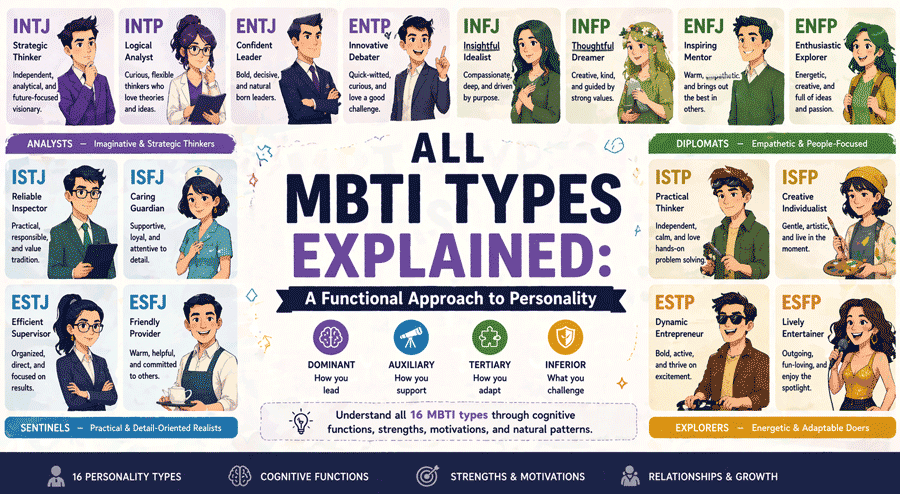
The Framework: Jungian Roots and Cognitive Functions
To truly grasp all mbti types explained, one must look back to the work of Carl Jung. The MBTI was developed by Katharine Cook Briggs and her daughter Isabel Briggs Myers, based on Jung's theory of psychological types. Jung proposed that much of what appears to be random variation in human behavior is actually quite orderly and consistent, stemming from basic differences in how individuals prefer to use their perception and judgment.
The Four Dichotomies and Their Relationship to the 16 Types
Traditionally, MBTI is introduced through four dichotomies: Extraversion (E) vs. Introversion (I), Sensing (S) vs. Intuition (N), Thinking (T) vs. Feeling (F), and Judging (J) vs. Perceiving (P). These preferences describe where you focus your energy, how you take in information, how you make decisions, and how you approach the outside world. When combined, these create the 16 personality types.
However, these letters are static. They tell you what you prefer, but not how you process information. For example, two people might both be typed as INTJ, but if one relies heavily on logical analysis while the other is deeply values-driven, the letter code obscures this nuance. This is why the concept of cognitive functions is essential when discussing all mbti types explained. The letters are the exterior; the functions are the engine.
Cognitive Function Stack: Dominant, Auxiliary, Tertiary, Inferior
Each of the 16 types operates using a stack of four cognitive functions. These functions are mental processes that determine how you interact with information. The stack consists of:
- Dominant Function: The hero or heroine of your personality. It is your natural strength, used most comfortably and frequently. It defines your core perspective.
- Auxiliary Function: The supportive parent. It balances the dominant function. If your dominant is introverted, your auxiliary is extraverted, and vice versa. It helps you engage with the world.
- Tertiary Function: The child. It is less mature and often used in leisure or stress. It can be a source of creativity or relief.
- Inferior Function: The aspirational child. It is your weakest link, often emerging under extreme stress. Integrating this function is a key goal of mid-life development.
For instance, an INFJ leads with Introverted Intuition (Ni), supported by Extraverted Feeling (Fe). Their tertiary is Introverted Thinking (Ti), and their inferior is Extraverted Sensing (Se). Understanding this stack explains why an INFJ might seem empathetic and future-oriented but struggle with immediate physical details or logical detachment under pressure.
Why Letter-Based Typing Alone Often Causes Mistypes
Many online tests rely on self-reported behavior based on the four letters. This approach is flawed because behavior is adaptable. An introvert can learn to act extraverted in a professional setting. A feeler can develop strong thinking skills for work. When you type based on behavior alone, you risk mistyping. For example, a highly logical INFP might test as an INTJ because they have developed their Thinking function for their career, even though their core decision-making framework remains values-based (Fi).
To validate type through self-observation, you must look at decision patterns, stress reactions, motivation, and blind spots. Ask yourself: When I am tired, do I withdraw to process internally (Introversion) or seek stimulation (Extraversion)? When making a hard choice, do I prioritize objective consistency (Thinking) or human impact (Feeling)? Long-term feedback from others is also crucial. Friends often see our blind spots clearer than we do. If you believe you are a Thinker but everyone describes you as deeply sensitive to harmony, you may need to re-evaluate your function stack.
Illustrative Examples of Public Figures
While we cannot know the true minds of public figures, some are widely believed to be certain types based on their public personas. For example, Albert Einstein is often typed as an INTP, illustrating the dominant Ti (logical analysis) and auxiliary Ne (exploring possibilities). Marie Curie is frequently associated with the INTJ type, demonstrating strategic vision and decisive implementation. These examples serve only as illustrative anchors to help you visualize the functions, not as definitive facts.
Application Guidance: Using Type for Real Life
Knowing all mbti types explained is useless without application. Theory must translate into action. Below are two practical frameworks for using personality type to improve your life.
Framework 1: Career and Work-Style Fit
When it applies: This framework is useful when choosing a career path, negotiating work responsibilities, or managing team dynamics. It helps align your natural cognitive strengths with your daily tasks.
Which type or function dynamics it relates to: This relates to the Dominant and Auxiliary functions. For example, types with dominant Perceiving functions (Ne, Se, Ni, Si) may prefer flexibility, while those with dominant Judging functions (Te, Ti, Fe, Fi) may prefer structure.
Practical Action Steps:
- Audit Your Tasks: List your weekly tasks. Mark which ones drain you and which energize you.
- Match Functions to Tasks: If you are an ENFP (Ne-Fi), you likely thrive on brainstorming and connecting ideas but may struggle with repetitive administrative details (Si). Negotiate to swap administrative tasks with a colleague who enjoys structure (e.g., an ISTJ).
- Environment Design: Introverts may need quiet zones for deep work, while Extraverts may benefit from collaborative open spaces. Advocate for the environment that suits your energy management.
Benefits and Limitations: The benefit is increased job satisfaction and reduced burnout. The limitation is that no job is perfect. You will always need to use non-preferred functions. The goal is not to avoid weakness but to manage energy so you can tackle necessary weaknesses when refreshed.
How to Judge Fit: If you feel constantly exhausted despite adequate sleep, or if you feel your core strengths are never utilized, your work style may be misaligned with your type. Conversely, if you feel "in flow" often, your role likely respects your cognitive preferences.
Framework 2: Relationship and Communication Guidance
When it applies: This framework applies to romantic partnerships, family dynamics, and professional collaborations. It is essential when conflicts arise from misunderstanding intentions.
Which type or function dynamics it relates to: This relates to the Thinking vs. Feeling axis and the Judging vs. Perceiving axis. Communication breakdowns often occur when one party values logical consistency (T) and the other values relational harmony (F).
Practical Action Steps:
- Identify the Conflict Source: Is the argument about facts (T) or values/feelings (F)? An INTJ might argue about the efficiency of a plan, while an ENFJ might argue about how the plan affects the team morale.
- Translate Your Message: If you are a Thinker speaking to a Feeler, preface your logic with acknowledgment of their effort. If you are a Feeler speaking to a Thinker, state your conclusion first, then explain the human context.
- Respect Processing Time: Introverts often need time to process before responding. Extraverts may think out loud. Agree on a "pause button" during heated discussions to allow the Introvert to recharge.
Benefits and Limitations: This reduces personalization of conflict. You learn to see differences as structural rather than malicious. However, type should never be used as an excuse for bad behavior. "I'm an INTP, so I'm blunt" is not a valid excuse for rudeness.
How to Judge Fit: Relationships improve when both parties feel understood. If you find yourself constantly explaining your basic needs without being heard, introduce type language as a neutral third party to facilitate understanding.
Personal Growth: From Awareness to Flexibility
The ultimate goal of studying all mbti types explained is not to cement your identity but to expand your capabilities. MBTI type is a starting point, not an endpoint. Growth means developing flexibility, not identity attachment.
Identify the Dominant Function First
Growth begins with leveraging your strengths. If you do not trust your dominant function, you will try to lead with your weaker functions, leading to instability. An INFP should trust their internal values (Fi) rather than trying to force themselves to be purely objective logicians (Te) all the time. Master your native language before learning a second one.
Distinguish Preference from Skill
You can be skilled at something you do not prefer. An Introvert can be a great public speaker; they just need more recovery time afterward. Do not confuse competence with preference. Acknowledge where you are competent but drained, and schedule recovery accordingly.
Develop the Inferior Function Gradually
The inferior function is a source of growth but also stress. For an INTJ, the inferior function is Extraverted Sensing (Se). They might indulge in excessive sensory pleasures under stress or ignore physical needs entirely. Healthy development involves engaging the inferior function in small, controlled doses. An INTJ might schedule regular physical activities or mindfulness exercises to ground themselves without becoming overwhelmed.
Explain Loop and Grip Patterns
Under stress, types may bypass their auxiliary function and fall into a "loop" between their dominant and tertiary functions. For example, an ISTP (Ti-Se) might loop between Ti and Ni (tertiary), becoming paranoid and overly theoretical, ignoring real-world data. The "grip" occurs when the inferior function takes over. An INFJ (Ni-Fe) in grip might become uncharacteristically impulsive and sensory-focused (Se). Recognizing these patterns allows you to step back, re-engage your auxiliary function, and restore balance.
Common Mistakes and Pitfalls to Avoid
When exploring all mbti types explained, readers often fall into traps that limit the utility of the framework. Here are eight critical mistakes to avoid:
- Don't Use Type as an Excuse: Saying "I'm a Perceiver, so I'm always late" reinforces bad habits. Use type to understand why you struggle with time, then build systems to manage it.
- Don't Stereotype Others: Assuming all Thinkers are cold or all Feelers are irrational ignores individual maturity. Treat people as individuals first, types second.
- Don't Ignore Context: You may act differently at work than at home. A type description that doesn't fit your professional persona might still fit your private self. Consider context when typing.
- Don't Obsess Over Accuracy: Spending years debating whether you are an ENFP or an ENFJ can hinder action. Pick the model that offers the most useful insights and move forward. Perfect accuracy is less important than utility.
- Don't Neglect the Inferior Function: Ignoring your weakness doesn't make it go away. It will emerge under stress. Proactively develop it to increase resilience.
- Don't Type Children Too Early: Personality stabilizes in adulthood. Typing children can limit their self-concept. Observe their preferences but keep labels flexible.
- Don't Assume Compatibility is Fixed: Just because two types are theoretically "compatible" doesn't guarantee a good relationship. Shared values and effort matter more than type matching.
- Don't Treat Type as Static: While preferences are stable, behavior changes. You can develop non-preferred functions. Growth looks like becoming more whole, not staying rigidly within your type box.
Ongoing Learning and Credible Resources
The field of personality psychology is evolving. To maintain a accurate understanding of all mbti types explained, readers should commit to ongoing learning. Rely on high-quality resources rather than social media memes, which often reduce complex types to caricatures.
Encourage readers to follow new research and higher-quality MBTI or Jungian resources. Credible organizations include the Myers & Briggs Foundation and the Center for Applications of Psychological Type (CAPT). These organizations maintain the integrity of the instrument and provide research-based insights. Jungian educational resources also offer depth on the cognitive functions that underpin the MBTI.
Be aware of debates and newer interpretations. Some psychologists argue for the Big Five model as more scientifically robust, while others defend the utility of MBTI for development. Understanding these debates helps you identify reliable information and avoid low-quality summaries. Look for authors who emphasize nuance, development, and cognitive functions over simple letter codes. Avoid content that promises to tell you everything about a person based solely on their type.
Frequently Asked Questions
1. What is the best entry point for beginners?
Start by understanding the four cognitive preferences (E/I, S/N, T/F, J/P) but quickly move to learning the eight cognitive functions (Ni, Ne, Si, Se, Ti, Te, Fi, Fe). Reading about functions provides a clearer picture than letters alone. Begin with self-observation of your energy drains and gains.
2. How can I confirm my type without tests?
Tests are indicators, not verdicts. Confirm your type by studying the cognitive function stacks. Observe your stress reactions (grip behavior) and your natural problem-solving style. Ask trusted friends how they perceive your decision-making process. Consistency over time is key.
3. How does type affect relationship communication?
Type influences how you express care and resolve conflict. Thinkers may offer solutions, while Feelers may offer empathy. Understanding these differences prevents misinterpretation. Use type to translate your needs, not to demand change from your partner.
4. What is the most efficient way to learn cognitive functions?
Focus on one axis at a time (e.g., Thinking vs. Feeling). Compare types that share functions but differ in order (e.g., INTJ vs. INTP). Use real-life scenarios to identify which function is driving the behavior. Practice identifying functions in others before confirming your own.
5. Can my personality type change over time?
Your core preferences generally remain stable throughout adulthood. However, your behavior and skill set can change significantly. You may become more balanced, using non-preferred functions more effectively. This is growth, not a change in type. If you feel your type has changed, you may have been mistyped initially.
Conclusion
Exploring all mbti types explained is a journey toward self-awareness and empathy. By grounding your understanding in cognitive functions rather than stereotypes, you gain a tool for lifelong development. Remember that MBTI is a tool for understanding preferences, not a label that defines the whole person. Use it to build bridges, enhance communication, and foster growth. The letters are just the beginning; the depth lies in how you apply the insights to become a more flexible, understanding, and effective human being.