
When individuals search for mbti test personality types, they are often seeking more than just a four-letter label. They want validation, clarity, and a roadmap for understanding their unique psychological landscape. The Myers-Briggs Type Indicator (MBTI) is one of the most popular personality frameworks in the world, used by millions to explore career paths, improve relationships, and understand personal strengths. However, relying solely on the surface-level letters can lead to superficial conclusions and frequent mistyping. To truly benefit from this tool, one must look beneath the dichotomies and engage with the underlying cognitive functions.
This guide is designed for English-speaking readers who are interested in MBTI but feel limited by standard test results. Whether you are trying to understand your own type more accurately, exploring cognitive functions, or seeking depth beyond stereotypes, this article provides a comprehensive framework. We will move from the basic definition of MBTI to the complex mechanics of Jungian cognitive functions, offering practical guidance on how to apply these insights to career, relationships, and personal growth. The core principle remains constant: MBTI type is a starting point, not an endpoint. Deeper understanding requires returning to cognitive functions, not just the four letters.
The Framework and Mechanism of Personality
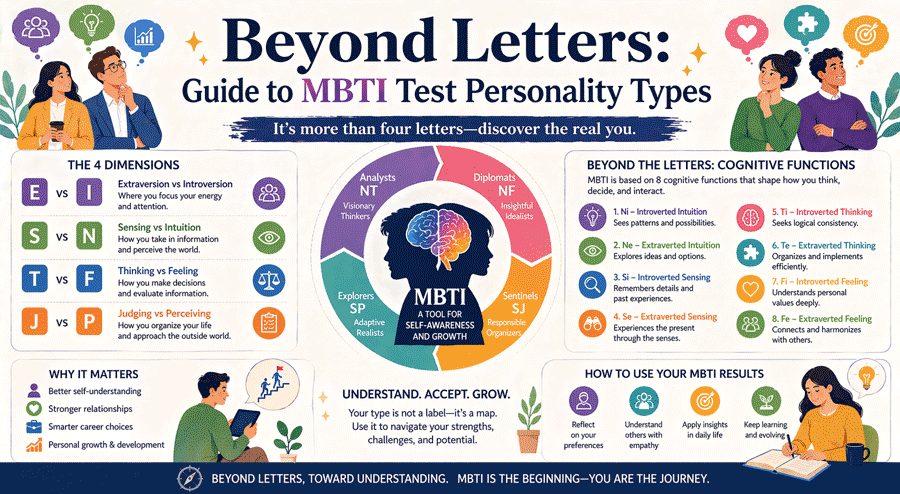
To understand mbti test personality types accurately, we must first acknowledge the Jungian roots of the system. Carl Jung proposed that people have innate preferences in how they perceive information and make decisions. The MBTI, developed by Katharine Cook Briggs and Isabel Briggs Myers, operationalized these preferences into four dichotomies: Extraversion (E) vs. Introversion (I), Sensing (S) vs. Intuition (N), Thinking (T) vs. Feeling (F), and Judging (J) vs. Perceiving (P). While these dichotomies create the 16 types, they are merely the outer shell of a deeper cognitive engine.
The Four Dichotomies and Their Limitations
The four letters describe what you prefer, but not necessarily how you process information. For example, two people might both test as “INTJ,” but one might rely heavily on logical analysis while the other is driven by a visionary sense of future possibilities. This is where the letter-based typing often causes mistypes. Tests measure self-reported behavior, which can be influenced by mood, environment, or social conditioning. A person might answer based on who they want to be rather than who they are. Therefore, validating your type requires more than a quiz score; it requires self-observation of decision patterns, stress reactions, motivation, and blind spots.
Cognitive Function Stack: The Engine of Type
The real power of MBTI lies in the cognitive function stack. Each type uses four primary functions in a specific order: dominant, auxiliary, tertiary, and inferior. These functions are the mental processes you use to interact with the world. They are divided into Perceiving functions (how you take in information) and Judging functions (how you make decisions).
Perceiving Functions:
- Se (Extraverted Sensing): Focuses on the immediate physical reality, action, and sensory experience. High Se users live in the moment.
- Si (Introverted Sensing): Focuses on past experiences, details, stability, and internal sensory impressions. High Si users value tradition and consistency.
- Ne (Extraverted Intuition): Focuses on possibilities, connections, and future potential. High Ne users brainstorm and see multiple angles.
- Ni (Introverted Intuition): Focuses on patterns, insights, and long-term vision. High Ni users synthesize information into a single cohesive outcome.
Judging Functions:
- Te (Extraverted Thinking): Focuses on external logic, efficiency, structure, and objective criteria. High Te users organize the world.
- Ti (Introverted Thinking): Focuses on internal logic, precision, and understanding how things work. High Ti users analyze systems.
- Fe (Extraverted Feeling): Focuses on group harmony, social values, and external emotional atmosphere. High Fe users maintain social cohesion.
- Fi (Introverted Feeling): Focuses on internal values, authenticity, and personal ethics. High Fi users stay true to themselves.
Understanding your function stack explains why you react to stress the way you do. For instance, an INTP (Dominant Ti, Auxiliary Ne) might struggle with execution because their inferior function is Fe (managing social harmony), whereas an ENTJ (Dominant Te, Auxiliary Ni) might struggle with empathy because their inferior function is Fi (internal values). This dynamic is crucial for type confirmation. Instead of asking “Am I an E or an I?” ask “Do I gain energy from exploring external possibilities (Ne) or refining internal insights (Ni)?”
Validating Type Through Observation
How do you validate your type without relying solely on tests? Look for long-term feedback from others and consistent behavioral patterns. Do you naturally organize your environment (Te) or organize your ideas (Ti)? When stressed, do you become overly critical (Ti grip) or overly emotional (Fi grip)? Famous public figures are often typed based on observed behavior, but caution is needed. For example, Steve Jobs is widely believed to be an ENTJ or ENTP due to his visionary drive and demanding management style, but without his personal confirmation, this remains illustrative rather than factual. Use such examples to understand function dynamics, not to copy identities.
Application Guidance: Practical Frameworks
Knowing your mbti test personality types is useless without application. Below are two practical frameworks to help you integrate this knowledge into daily life. These frameworks focus on cognitive function development and relationship communication, providing actionable steps for readers.
Framework 1: Cognitive Function Development for Career
When it applies: This framework is ideal for professionals seeking career alignment or students choosing a major. It relates to the dominant and auxiliary functions, which represent your natural strengths.
Type Dynamics: Your dominant function is your “superpower,” while your auxiliary function supports it. For example, an ISFJ (Dominant Si, Auxiliary Fe) excels in roles requiring reliability and care for others, such as healthcare or administration. An ENTP (Dominant Ne, Auxiliary Ti) thrives in roles requiring innovation and strategic analysis, such as entrepreneurship or consulting.
Practical Action Steps:
- Identify Your Dominant Function: Reflect on what activities make you lose track of time. If you love optimizing systems, it might be Te or Ti. If you love helping people feel understood, it might be Fe or Fi.
- Align Tasks with Strengths: Structure your workday to prioritize tasks that use your dominant function. If you are an intuitive type (N), schedule brainstorming sessions in the morning. If you are a sensing type (S), handle detailed execution when your energy is high.
- Manage the Inferior Function: Recognize that your inferior function is a source of stress. An INFJ (Inferior Se) might burn out from too much sensory overload. Plan downtime to recover.
Benefits and Limitations: The benefit is increased job satisfaction and reduced burnout. The limitation is that no job uses only your strengths. You must still develop weaker functions to be well-rounded. Readers can judge fit by monitoring their energy levels after specific tasks. Consistent drainage suggests a mismatch with natural preferences.
Framework 2: Relationship and Communication Guidance
When it applies: This framework applies to personal relationships, team dynamics, and conflict resolution. It relates to the Judging functions (T/F) and how different types express care and resolve disputes.
Type Dynamics: Thinking types (T) often communicate through logic and solutions, while Feeling types (F) communicate through empathy and validation. A mismatch here causes friction. For example, an ESTJ might offer a solution to a problem, while an INFP might want emotional validation first.
Practical Action Steps:
- Identify Communication Styles: Ask your partner or colleague how they prefer to receive feedback. Do they want directness (Te) or sensitivity (Fe/Fi)?
- Translate Your Message: If you are a Thinking type, add emotional context to your logical points. If you are a Feeling type, structure your emotional points with clear reasoning.
- Respect Processing Time: Introverts (I) often need time to process before responding. Extraverts (E) may process out loud. Allow space for these differences during conflicts.
Benefits and Limitations: The benefit is reduced conflict and deeper connection. The limitation is that type should not be used as an excuse for bad behavior (“I’m an INTJ, so I don’t need to apologize”). Readers can judge effectiveness by observing whether conflicts resolve faster and with less resentment over time.
Growth Section: Universal Principles for Development
Personal growth within the MBTI framework is not about changing your type, but about expanding your capacity to use all functions flexibly. Here are universal principles for personality growth.
Identify the Dominant Function First
Growth starts with mastery of your dominant function. If you neglect your strengths to work on weaknesses, you may feel ineffective. An ENFP should first hone their Ne (idea generation) before forcing themselves to become highly structured (Si). Confidence comes from leveraging natural talents.
Distinguish Preference from Skill
Just because you prefer Introversion does not mean you lack social skills. Preference is about energy drainage, not capability. You can learn to be a good public speaker even if you are an Introvert. Do not use type as a limit on skill acquisition. Growth means acquiring skills outside your preference while honoring your energy needs.
Develop the Inferior Function Gradually
The inferior function is the key to maturity. For an ISTP (Inferior Fe), learning to consider group harmony is a growth edge. However, pushing too hard too fast leads to stress. Engage the inferior function in low-stakes environments. An INTJ (Inferior Fi) might explore personal values through journaling rather than high-pressure emotional confrontations.
Understand Loop and Grip Patterns
Under stress, types may fall into “loops” or “grips.” A loop occurs when you bypass your auxiliary function and oscillate between your dominant and tertiary functions. For example, an INFJ (Ni-Fe) might loop into Ni-Ti, becoming overly abstract and critical. A grip occurs when the inferior function takes over. An ENTJ (Inferior Fi) might become unexpectedly emotional or hypersensitive. Recognizing these patterns helps you return to balance.
Growth Means Flexibility, Not Identity Attachment
Do not attach your identity to your type. You are not “an INFP”; you are a person who currently prefers INFP patterns. Clinging to type stereotypes limits growth. True maturity is the ability to access any function when the situation demands it, regardless of preference.
Mistakes and Pitfalls: What Not to Do
To ensure accurate use of mbti test personality types, avoid these common pitfalls. Each point includes a better alternative mindset.
- Don’t treat the test result as final truth. Tests are snapshots, not diagnoses. Alternative: Use tests as a hypothesis to be tested through self-observation.
- Don’t stereotype based on letters. Assuming all “F” types are emotional or all “T” types are cold is inaccurate. Alternative: Look at specific cognitive functions to understand nuance.
- Don’t use type to excuse bad behavior. Saying “I’m a Perceiver, so I’m always late” avoids responsibility. Alternative: Acknowledge the preference but commit to managing the impact on others.
- Don’t ignore the context of behavior. You might act like an Extravert at work but an Introvert at home. Alternative: Identify where you recharge, not just how you act socially.
- Don’t focus only on strengths. Ignoring weaknesses leads to blind spots. Alternative: Actively develop tertiary and inferior functions for balance.
- Don’t assume compatibility is fixed. Some types are theorized to match better, but individual maturity matters more. Alternative: Focus on communication skills and shared values rather than type matching.
- Don’t dismiss types you don’t understand. Valuing your own type over others creates bias. Alternative: Study all 16 types to appreciate diverse perspectives.
- Don’t expect type to explain everything. MBTI does not cover trauma, mental health, or intelligence. Alternative: Use MBTI alongside other psychological tools and professional advice when needed.
Ongoing Learning: Keeping Your Knowledge Accurate
The field of personality psychology is evolving. To maintain credibility and depth, readers should keep following new research and higher-quality resources. Avoid low-quality summaries that reduce MBTI to memes or horoscopes.
Credible Organizations and Resources:
- Myers & Briggs Foundation: The official body providing ethical guidelines and research on the instrument.
- CAPT (Center for Applications of Psychological Type): Offers research and publications on type dynamics.
- Jungian Educational Resources: Look for materials that discuss Carl Jung’s original work on psychological types for deeper theoretical grounding.
Identifying Reliable Information: Check if the author cites psychological theory or merely anecdotal evidence. Be wary of content that claims MBTI predicts success or dictates life choices absolutely. Engage with debates and newer interpretations, such as the distinction between MBTI and Big Five traits, to maintain a critical perspective. Credible information acknowledges limitations and emphasizes self-discovery over labeling.
Frequently Asked Questions (FAQ)
1. Where should a beginner start with MBTI?
Start by understanding the four dichotomies, but quickly move to learning the eight cognitive functions. Read descriptions of functions rather than just type profiles. This prevents stereotyping and helps you identify your actual mental processes.
2. How can I confirm my type without relying on tests?
Observe your stress reactions and energy sources. Keep a journal of decisions you make and why. Ask trusted friends for feedback on your blind spots. Compare your behavior against function descriptions, not just type labels. Type confirmation is a process of elimination over time.
3. How does MBTI help with relationship communication?
It highlights differences in information processing. Knowing your partner’s type helps you tailor your communication. For example, give Sensing types concrete details and Intuitive types the big picture. Give Thinking types logical reasons and Feeling types emotional validation.
4. What is the most efficient way to learn cognitive functions?
Study one function pair at a time (e.g., Te vs. Ti). Observe these functions in people you know well. Try to identify which function you use when you are relaxed versus when you are stressed. Practical observation is faster than theoretical memorization.
5. Can my personality type change over time?
Your core preferences are generally stable, like handedness. However, your behavior and skill development change. You may learn to act more “extraverted” with practice, but your internal energy source likely remains the same. Growth looks like flexibility, not a change in fundamental type.
6. What if I resonate with multiple type descriptions?
This is common. It may indicate you are developing your auxiliary or tertiary functions, or that you are in a stress loop. Focus on which description fits your natural, unguarded state rather than your adapted professional persona. Partial resonance often points to shared functions between types.
7. How do I judge the quality of MBTI information online?
Look for sources that mention cognitive functions and avoid those that rely solely on stereotypes or memes. Credible content emphasizes nuance, acknowledges limitations, and does not claim scientific absolute certainty. Check if the author references established organizations like the Myers & Briggs Foundation.
Conclusion
Understanding mbti test personality types is a journey of self-discovery that goes far beyond a simple quiz result. By focusing on cognitive functions, validating through observation, and applying practical frameworks for growth, you can transform MBTI from a label into a tool for genuine development. Remember that type is a starting point. The goal is not to fit neatly into a box, but to understand your unique wiring so you can navigate the world with greater awareness, empathy, and effectiveness. Continue to learn, question, and grow, using these insights to build a life that honors both your preferences and your potential.