
Many people search for celebrity mbti compatibility hoping to find a shortcut to understanding their own relationships or validating their personality type. However, the conclusion is clear: relying solely on famous pairings or four-letter codes often leads to misunderstanding. True insight comes from analyzing cognitive functions, not just matching letters. This article guides you through the deeper mechanics of personality type, moving beyond surface-level stereotypes to provide practical tools for growth and connection.
Understanding personality is not about labeling yourself based on who you admire. It is about understanding how you process information, make decisions, and interact with the world. While knowing that a certain actor is often typed as an ENFP might be fun, it does not replace the work of self-observation. In this guide, we will explore why celebrity mbti compatibility is a starting point for curiosity, but cognitive function theory is the destination for accuracy.
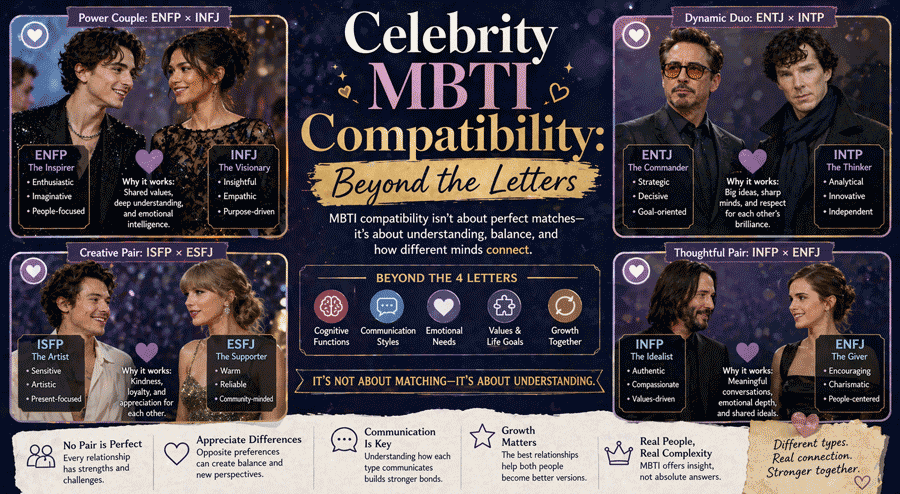
The Reality Behind Celebrity MBTI Compatibility
When users explore celebrity mbti compatibility, they are often looking for validation. If a beloved public figure shares your type, it feels affirming. If they are in a relationship with someone of a different type, it offers hope for your own partnerships. However, public typings are rarely verified by the individuals themselves. Most celebrity types are assigned by fans or pop-psychology websites based on observed behavior, which can be heavily influenced by public persona, scripting, and editing.
For example, a politician may exhibit strong Te (Extroverted Thinking) traits during a debate but rely on Fi (Introverted Feeling) for personal values. Observers might mistype them based on a single context. Therefore, using celebrities as a primary metric for MBTI compatibility is risky. It is more effective to use them as case studies for cognitive functions rather than definitive labels. When you shift your focus from “Who is this celebrity?” to “What function are they demonstrating here?”, you gain a tool for analyzing your own behavior.
Furthermore, compatibility is not determined by type matching alone. Two INFJs may clash due to unresolved inferior functions, while an INFJ and an ESTP may thrive due to complementary cognitive stacks. The letters are merely shadows cast by the underlying cognitive processes. To understand relationship dynamics, career fit, or personal growth, you must look at the engine, not the paint job. This article will dismantle the reliance on surface-level typing and rebuild your understanding on the robust framework of Jungian cognitive functions.
Understanding the Jungian Framework
The Myers-Briggs Type Indicator (MBTI) is rooted in Carl Jung’s theory of psychological types. Jung proposed that people have innate preferences for how they perceive the world and how they make decisions. The MBTI expanded this into four dichotomies: Extraversion vs. Introversion, Sensing vs. Intuition, Thinking vs. Feeling, and Judging vs. Perceiving. While these dichotomies are useful for sorting, they do not explain the mechanism of personality.
The mechanism lies in the cognitive function stack. Each of the 16 types uses a hierarchy of four functions: Dominant, Auxiliary, Tertiary, and Inferior. These functions are either introverted or extraverted versions of Sensing, Intuition, Thinking, or Feeling. For instance, an INTJ leads with Introverted Intuition (Ni) and supports it with Extroverted Thinking (Te). An ENFP leads with Extroverted Intuition (Ne) and supports it with Introverted Feeling (Fi). Understanding this stack is crucial for accurate type confirmation.
Why does letter-based typing cause mistypes? Because behavior is adaptable. A mature Introvert can act socially in public. A Feeling type can make logical decisions under pressure. If you type based solely on whether someone is “quiet” or “logical,” you will miss the motivation behind the action. An INTJ might be quiet because they are processing internal insights (Ni), while an ISTP might be quiet because they are observing sensory details (Si/Se). The behavior looks similar, but the cognitive process is different.
To validate your type, you must observe your decision patterns, stress reactions, and motivations. Do you seek closure quickly (Judging) or keep options open (Perceiving)? When stressed, do you become overly critical (Thinking grip) or emotionally overwhelmed (Feeling grip)? Long-term feedback from trusted others is also essential. They may see patterns you miss. Reliable typing requires synthesizing self-observation with theoretical knowledge of the function stack, rather than relying on a 5-minute online quiz.
Practical Framework 1: Cognitive Function Development
One of the most powerful applications of MBTI is using it for personal development. Instead of asking “What is my type?”, ask “How can I develop my functions?”. This framework applies to anyone seeking personality growth, regardless of their confirmed type. It focuses on balancing the use of your dominant strengths with the development of your weaker areas.
When it applies: This framework is useful when you feel stuck in repetitive patterns, experience burnout, or want to improve your decision-making style. It is particularly relevant for individuals who feel limited by their type description.
Function Dynamics: Every type has a dominant function that feels natural and an inferior function that is a source of stress but also growth. For example, a dominant Thinker may struggle with empathy (Feeling), while a dominant Feeler may struggle with objective analysis (Thinking). Development involves strengthening the auxiliary and tertiary functions while learning to manage the inferior function without being consumed by it.
Action Steps:
- Identify your dominant function through self-reflection on what energizes you.
- Consciously practice using your tertiary function in low-stakes environments.
- Monitor your stress levels to detect when you are falling into an “inferior grip.”
- Seek feedback on your blind spots from people who lead with your inferior function.
Benefits and Limitations: The benefit is increased psychological flexibility and resilience. You become less rigid and more adaptable. The limitation is that developing weaker functions takes time and energy. It does not change your core type, but it expands your behavioral repertoire. Readers can judge if this fits them by noticing if they feel more balanced and less reactive after practicing these steps.
Practical Framework 2: Relationship and Communication
Relationships are where personality differences become most visible. Using MBTI for relationship dynamics is not about finding a “perfect match” but about understanding communication patterns. This framework helps partners navigate conflicts by recognizing that different types process information differently.
When it applies: Use this when conflicts arise from misunderstandings about needs, communication styles, or decision-making processes. It is useful for romantic partners, family members, and colleagues.
Type Dynamics: Conflicts often occur between Sensing and Intuition types (details vs. big picture) or Thinking and Feeling types (logic vs. values). For example, an Intuitive partner may feel misunderstood when a Sensing partner focuses on practical details, while the Sensing partner may feel the Intuitive is unrealistic. Recognizing this as a function difference, not a personal attack, reduces friction.
Action Steps:
- Explicitly state your processing needs (e.g., “I need time to think before responding”).
- Validate your partner’s function even if you do not use it naturally.
- Create shared rituals that honor both partners’ preferences.
- Discuss stress triggers related to inferior functions.
Benefits and Limitations: This approach fosters empathy and reduces blame. It turns conflicts into opportunities for understanding. However, it should not be used to excuse harmful behavior. “I’m an INTJ” is not a valid excuse for being unkind. Readers can judge fit by observing if conflicts become less personal and more solvable after applying these communication strategies.
Growth Principles for All Types
Regardless of your specific type, there are universal principles for healthy personality development. These principles ensure that MBTI remains a tool for empowerment rather than a cage.
Identify the Dominant Function First: Your dominant function is your core lens. Understanding it clarifies your primary motivations. If you are unsure of your type, start by identifying what you trust most: internal insights, external data, logical consistency, or personal values.
Distinguish Preference from Skill: You may be skilled at something you do not prefer. A Feeling type can learn to be analytical, but it may drain them. Recognize the difference between what you can do and what energizes you.
Develop the Inferior Function Gradually: The inferior function is often the source of growth in later life. Engage with it playfully rather than forcing mastery. An inferior Thinking type might enjoy logic puzzles without needing to become a mathematician.
Explain Loop and Grip Patterns: Under stress, types may skip their auxiliary function and fall into a “loop” (e.g., an INFP looping between Ne and Fi, becoming paranoid and isolated) or a “grip” (e.g., an INFJ gripped by Se, becoming impulsive and sensory-seeking). Recognizing these states helps you return to balance.
Growth Means Flexibility: Healthy development looks like flexibility, not identity attachment. Do not cling to your type as an excuse. Use it as a map to navigate areas where you need to stretch.
8 Common Pitfalls to Avoid
To maintain credibility and utility in your MBTI journey, avoid these common mistakes. Each point includes a better alternative mindset.
1. Don’t treat type as destiny.\nExplanation: Your type describes preferences, not capabilities.\nAlternative: View type as a starting point for understanding, not a limit on potential.
2. Don’t rely solely on online tests.\nExplanation: Tests often measure behavior, not cognitive processes.\nAlternative: Use tests as hints, but validate through study and self-observation.
3. Don’t stereotype celebrities.\nExplanation: Public personas are curated and may not reflect true type.\nAlternative: Use celebrities as examples of functions, not definitive typings.
4. Don’t use type to excuse bad behavior.\nExplanation: “I’m a Perceiver” is not an excuse for chronic lateness.\nAlternative: Take responsibility for your actions regardless of preference.
5. Don’t ignore the shadow functions.\nExplanation: Everyone uses all functions; ignoring the shadow limits growth.\nAlternative: Acknowledge and integrate less preferred functions for balance.
6. Don’t assume compatibility is fixed.\nExplanation: Any two types can work with effort; any two can fail without it.\nAlternative: Focus on communication skills rather than type matching.
7. Don’t stop learning after typing.\nExplanation: Typing is the beginning, not the end of the journey.\nAlternative: Continue studying cognitive functions and psychological theory.
8. Don’t dismiss other systems entirely.\nExplanation: MBTI is one tool among many for understanding humans.\nAlternative: Integrate insights from other psychological frameworks where appropriate.
Continuing Your MBTI Journey
The field of personality psychology is evolving. To ensure you are accessing high-quality information, follow credible organizations and resources. The Myers & Briggs Foundation and the Center for Applications of Psychological Type (CAPT) offer research-based materials. Jungian educational resources provide depth on the original theories.
Be wary of low-quality summaries that reduce types to memes or caricatures. Look for content that discusses cognitive functions, development, and nuance. Engage with debates and newer interpretations, but verify claims against established theory. Reliable information will emphasize individual variation and avoid absolute statements. By committing to ongoing learning, you ensure that your use of MBTI remains a tool for insight rather than a source of division.
Frequently Asked Questions
1. Where should a beginner start with MBTI?\nStart by learning the four dichotomies, then move quickly to cognitive functions. Read official manuals or credible introductions before taking tests.
2. How can I confirm my type without tests?\nStudy the cognitive function stacks. Observe your stress reactions and decision-making processes over time. Compare your internal experience with function descriptions.
3. Does MBTI help with relationship communication?\nYes, by highlighting differences in information processing and values. It helps partners understand why they conflict and how to bridge gaps.
4. How do I learn cognitive functions efficiently?\nFocus on one function at a time. Observe it in yourself and others. Use real-life scenarios to identify when specific functions are active.
5. Can my personality type change?\nYour core preferences are generally stable, but your expression of them changes with maturity. You develop access to all functions over time, making you appear different without changing type.
6. What if I resonate with multiple types?\nThis is common. Look for the “best fit” based on energy drainage and natural flow. Consider consulting a certified practitioner for clarification.
7. Is celebrity MBTI compatibility accurate?\nRarely. Celebrity types are speculative. Use them for fun or function analysis, but do not base relationship advice on them.