
Understanding attraction through personality theory requires moving beyond surface-level stereotypes. When analyzing the estp flirting style, the conclusion is clear: it is driven primarily by Extraverted Sensing (Se) and Introverted Thinking (Ti), not merely by a reputation for boldness. For readers seeking genuine connection, recognizing these cognitive mechanisms is far more valuable than memorizing behavioral checklists. This article provides a deep dive into how ESTPs engage romantically, offering practical frameworks for growth and compatibility.
The Myers-Briggs Type Indicator (MBTI) is a tool designed to help individuals understand their psychological preferences. It is useful for self-awareness, team dynamics, and relationship navigation. However, its deeper application, especially regarding the estp flirting style, must return to cognitive functions. Relying solely on the four letters often leads to superficial assessments. To truly understand how an ESTP loves and connects, one must examine the engine beneath the hood: the function stack.
Framework and Mechanism: The Jungian Roots
To grasp why the estp flirting style manifests the way it does, we must look at the Jungian roots of MBTI. Carl Jung proposed that human behavior is not random but follows patterns based on how we perceive information and make decisions. The MBTI system builds on this by categorizing these preferences into four dichotomies: Extraversion vs. Introversion, Sensing vs. Intuition, Thinking vs. Feeling, and Judging vs. Perceiving.
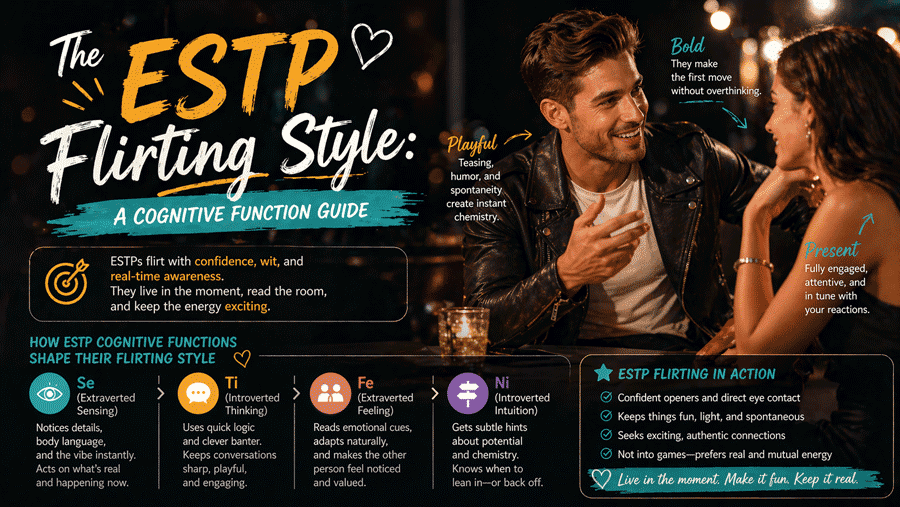
While these dichotomies help identify the 16 types, they are merely the surface layer. The real mechanism lies in the cognitive function stack. Every type has a hierarchy of four functions: Dominant, Auxiliary, Tertiary, and Inferior. For the ESTP, this stack is Se (Dominant), Ti (Auxiliary), Fe (Tertiary), and Ni (Inferior). Understanding this order is critical because it explains motivation, stress reactions, and growth paths.
Why Letter-Based Typing Causes Mistypes
Many individuals mistype themselves because they focus on behavior rather than cognition. For example, an ESTP might be mistyped as an ESFP because both are energetic and social. However, the ESTP makes decisions based on logical consistency (Ti), whereas the ESFP makes decisions based on personal values and harmony (Fi). In the context of the estp flirting style, this distinction is vital. An ESTP flirts to test compatibility and share experiences, while an ESTP might flirt to create emotional resonance.
Validating your type requires self-observation beyond tests. Ask yourself: What motivates my decisions? How do I react under stress? What are my blind spots? Long-term feedback from others is also crucial. If people consistently describe you as pragmatic and action-oriented rather than values-driven, you may lean toward Thinking over Feeling. Tests are snapshots; cognitive function analysis is a video recording of your mental processes.
The ESTP Function Stack in Detail
1. Dominant: Extraverted Sensing (Se). This function focuses on the immediate physical environment. For an ESTP, flirting is a sensory experience. It involves eye contact, physical proximity, and shared activities. They live in the "now."
2. Auxiliary: Introverted Thinking (Ti). This function analyzes data for logical consistency. An ESTP uses Ti to assess whether a potential partner makes sense logically. They look for competence and authenticity.
3. Tertiary: Extraverted Feeling (Fe). This function deals with group harmony and social norms. In maturity, an ESTP uses Fe to ensure their flirting is welcomed and not intrusive. It adds warmth to their directness.
4. Inferior: Introverted Intuition (Ni). This function looks at long-term patterns and future implications. It is the ESTP's blind spot. Under stress, they may become paranoid about the future or overly rigid.
Public figures are often typed cautiously. For instance, certain athletes or entrepreneurs are widely believed to be ESTPs due to their risk-taking and pragmatic problem-solving. However, these typings are illustrative, not definitive facts. Use them to understand function dynamics, not to label individuals.
Application Guidance: Practical Frameworks
Understanding theory is only half the battle. To apply the knowledge of the estp flirting style effectively, readers need actionable frameworks. Below are two primary frameworks: Relationship Communication and Stress Management.
Framework 1: Relationship and Communication Guidance
When it applies: This framework is essential when an ESTP is dating or seeking to improve intimacy with a partner of any type.
Function Dynamics: It leverages the Se-Ti connection while developing Fe. The goal is to balance action with emotional awareness.
Practical Action Steps:
- Share Experiences: Instead of long verbal declarations, invite your partner to do something active. This aligns with Se.
- Logical Check-ins: Use Ti to ask specific questions about the relationship's functionality. "Does this arrangement work for both of us?"
- Fe Development: Practice asking about feelings without trying to fix them immediately. This builds emotional intelligence.
Benefits and Limitations: This approach reduces ambiguity and builds trust through action. However, it may feel too pragmatic for Feeling types who crave verbal affirmation. Readers can judge fit by observing if their partner feels seen and valued.
Framework 2: Stress Management and Personal Growth
When it applies: This is crucial during periods of high pressure, burnout, or relationship conflict.
Function Dynamics: It addresses the Inferior Ni grip. When stressed, ESTPs may become withdrawn or obsessed with negative future outcomes.
Practical Action Steps:
- Physical Release: Engage Se positively through exercise or hands-on tasks to ground yourself.
- Limit Speculation: Recognize when you are spiraling into "what-if" scenarios. Write them down to objectify them using Ti.
- Seek External Perspective: Talk to a trusted friend to reality-check your fears.
Benefits and Limitations: This prevents burnout and impulsive decisions. The limitation is that it requires slowing down, which is counter-intuitive for an ESTP. Readers know it fits when they feel a return to mental clarity.
Growth Section: Universal Principles
Growth in the context of MBTI is not about changing your type; it is about expanding your flexibility. For those exploring the estp flirting style, growth means mastering your functions rather than being enslaved by them.
Identify the Dominant Function First
Your dominant function (Se for ESTP) is your superpower. It is where you feel most energized. Acknowledge this strength. In flirting, this means owning your directness and charisma. Do not apologize for being action-oriented.
Distinguish Preference from Skill
Just because you prefer Thinking (Ti) does not mean you are automatically good at logic, nor does preferring Feeling mean you are empathetic. Skills are developed; preferences are innate. An ESTP can learn to be empathetic (Fe skill) while still preferring logical analysis (Ti preference).
Develop the Inferior Function Gradually
The inferior function (Ni) is a source of growth but also stress. Do not try to force long-term planning immediately. Start small. Ask yourself, "Where do I want to be in six months?" rather than "What is my 10-year plan?" Gradual exposure builds tolerance.
Explain Loop and Grip Patterns
A "loop" occurs when you bypass your auxiliary function. An ESTP in an Se-Ti loop might become hyper-focused on immediate sensory gratification and logical rationalization, ignoring social feedback (Fe). A "grip" occurs when the inferior function takes over. An ESTP in an Ni grip may become gloomy, suspicious, and isolated. Recognizing these states is key to recovery.
Growth Means Flexibility
Identity attachment to a type is a pitfall. Saying "I am an ESTP, so I cannot do emotions" is a limitation, not a truth. Growth means having the flexibility to access all functions when the situation demands it, even if it feels uncomfortable.
Mistakes and Pitfalls: 8 Things Not to Do
To refine the estp flirting style and avoid common traps, consider these eight prohibitions. Each includes a better alternative mindset.
1. Don't Ignore Emotional Cues. Explanation: Relying solely on logic can make partners feel unheard. Alternative: Practice active listening without offering immediate solutions.
2. Don't Rush Commitment. Explanation: Se seeks immediate results, but relationships need time to deepen. Alternative: Set small milestones for relationship progression.
3. Don't Use Humor to Deflect. Explanation: Joking can mask vulnerability. Alternative: Share one genuine feeling during serious conversations.
4. Don't Neglect Future Planning. Explanation: Ignoring Ni leads to instability. Alternative: Discuss future goals briefly but regularly.
5. Don't Assume Silence is Agreement. Explanation: Others may not be as direct as you. Alternative: Explicitly ask for feedback and confirmation.
6. Don't Overvalue Excitement. Explanation: Constant novelty can undermine stability. Alternative: Find joy in routine moments together.
7. Don't Dismiss Theory as Fluff. Explanation: Understanding psychology aids connection. Alternative: Read credible resources to understand partner differences.
8. Don't Type Others Rigidly. Explanation: Labeling limits potential. Alternative: Use type as a hypothesis, not a verdict.
Ongoing Learning: Credible Resources
The field of personality psychology is evolving. To maintain a accurate understanding of the estp flirting style and MBTI in general, readers should commit to ongoing learning. Avoid low-quality summaries that reduce types to memes.
Follow new research from credible organizations. The Myers & Briggs Foundation offers ethical guidelines and foundational information. The Center for Applications of Psychological Type (CAPT) provides research-based insights. Jungian educational resources can offer deeper historical context.
Be wary of sources that claim MBTI is scientifically uncontested. It is a tool with limitations. Look for authors who discuss debates and newer interpretations. Reliable information often acknowledges nuance. If a source claims to know everything about a type in one paragraph, it is likely low quality. True understanding comes from studying cognitive functions over time.
Frequently Asked Questions (FAQ)
1. Where should a beginner start with MBTI?
Start by reading about the cognitive functions rather than just the four letters. Understanding Se, Ti, Fe, and Ni will give you a clearer picture than knowing you are "ESTP." This helps avoid stereotypes.
2. How can I confirm my type without tests?
Observe your decision-making process under stress. Tests measure behavior, which can change. Functions measure motivation, which is stable. Reflect on what drains you versus what energizes you over long periods.
3. How does the estp flirting style affect compatibility?
ESTPs often match well with types that appreciate action and logic, such as ISTJs or ISFJs. However, compatibility depends on individual maturity. An mature ESTP can connect with any type by developing their Fe.
4. How do I learn cognitive functions efficiently?
Focus on one function at a time. Study Se for a week, then Ti. Observe these functions in yourself and others. Join discussion forums that prioritize function theory over letter dichotomies.
5. Can my personality type change?
Your core preferences generally remain stable throughout life. However, your behavior and skill set can change significantly. You may learn to act more like an Introvert or a Feeler, but your underlying cognitive stack remains the same. Growth is about expansion, not transformation of the core type.
By integrating these insights, readers can move beyond the surface of the estp flirting style and engage in relationships that are both exciting and deeply connected. Remember, MBTI is a map, not the territory. Use it to navigate, but always trust your own experience and the reality of the person in front of you.