
Understanding the enfp dating style requires looking beyond the surface-level enthusiasm often associated with this personality type. While many describe ENFPs as charismatic and spontaneous partners, a deeper analysis reveals that their relationship dynamics are driven by specific cognitive processes rather than just four letters. For those seeking lasting compatibility and personal growth, recognizing the underlying mechanisms of intuition and feeling is essential. This article concludes upfront: true mastery of the ENFP relationship experience comes from understanding cognitive functions, not memorizing stereotypes.
The Myers-Briggs Type Indicator (MBTI) is a tool designed to help individuals understand their psychological preferences in how they perceive the world and make decisions. It is useful for self-awareness, career planning, and improving interpersonal communication. However, its deeper application, particularly regarding the enfp dating style, must return to cognitive functions. Relying solely on the E, N, F, and P labels can lead to superficial assumptions that fail to capture the complexity of human connection. By exploring the Jungian roots of these preferences, readers can gain a more accurate and practical framework for navigating love and partnership.
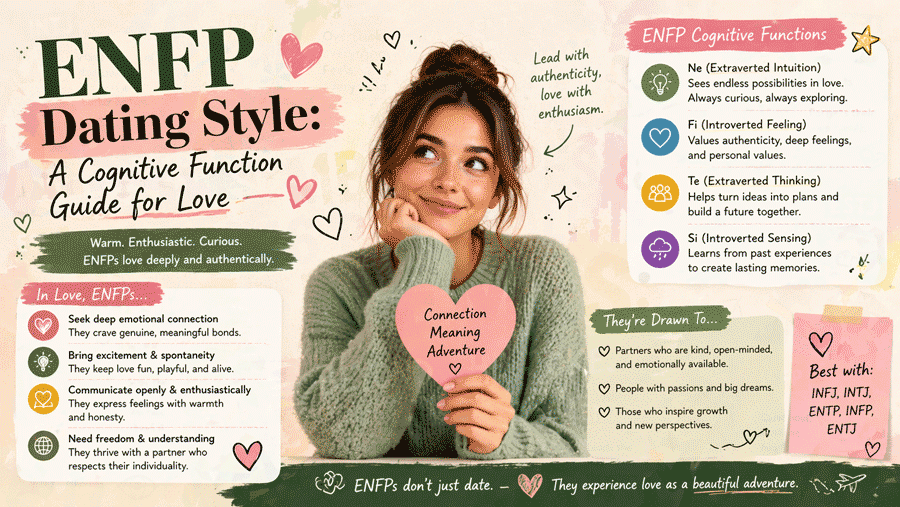
The Framework: Jungian Roots and Cognitive Functions
To understand why an ENFP behaves the way they do in relationships, one must examine the Jungian roots of MBTI. Carl Jung proposed that human behavior is not random but follows patterns based on how we process information. The MBTI system expands on this with four dichotomies: Extraversion vs. Introversion, Intuition vs. Sensing, Feeling vs. Thinking, and Perceiving vs. Judging. These dichotomies combine to form the 16 personality types, but they are merely the surface structure. The real engine of personality lies in the cognitive function stack.
For the ENFP, the function stack consists of Dominant Extraverted Intuition (Ne), Auxiliary Introverted Feeling (Fi), Tertiary Extraverted Thinking (Te), and Inferior Introverted Sensing (Si). Each function plays a distinct role in the enfp dating style. Dominant Ne drives the desire for novelty, possibilities, and future-oriented connection. It makes the ENFP partner exciting, always suggesting new adventures and seeing potential in the relationship. Auxiliary Fi ensures that these connections align with deep personal values and authenticity. It is not enough for an ENFP to have fun; the relationship must feel morally and emotionally right.
Tertiary Te emerges as the ENFP matures, helping them organize their lives and follow through on commitments. In dating, this might look like planning dates reliably or addressing logistical issues in the partnership. Finally, Inferior Si represents the area of greatest growth and potential stress. It relates to stability, routine, and past experiences. An underdeveloped Si can make an ENFP struggle with consistency or dwelling on past relationship hurts, while a developed Si brings grounding and reliability.
Why does letter-based typing alone often cause mistypes? Because two people can share the same four letters but prioritize different functions based on their maturity and life context. Furthermore, cultural conditioning often masks true preferences. Someone might test as an ENFP because they are socially active, but their decision-making process might rely heavily on Thinking rather than Feeling. Therefore, understanding the enfp dating style requires validating the type through self-observation rather than relying only on tests.
Validation comes through observing decision patterns, stress reactions, motivation, and blind spots. For instance, does the individual recharge through social interaction (Extraversion) or solitude (Introversion)? Do they focus on concrete details (Sensing) or abstract patterns (Intuition)? Long-term feedback from others is also crucial. Friends might notice if an individual consistently ignores practical details or prioritizes harmony over truth. If needed, we can look to public figures for illustration, though cautiously. Robin Williams is often typed as an ENFP, widely believed to exemplify the type's rapid ideation and emotional warmth, but such typings are interpretive rather than factual.
Validating Your Type Beyond Letters
Before applying relationship advice, readers must confirm whether the ENFP framework actually fits them. Misidentification leads to ineffective strategies. To validate your type, focus on internal motivation rather than external behavior. An ENFP is motivated by exploring possibilities and aligning actions with internal values. If you find yourself exhausted by too much social interaction despite appearing outgoing, you might be an Introvert who has developed strong social skills. If you prioritize logical efficiency over personal values in conflict, you might lean towards Thinking rather than Feeling.
Self-observation should cover stress reactions. Under extreme stress, ENFPs may fall into an "Si grip," becoming unusually obsessed with details, health anxieties, or past failures. This is a key indicator of the inferior function. If your stress response involves withdrawing into isolation and analyzing data coldly, you might be an INTP or INTJ. Decision-making style is another marker. ENFPs typically decide based on how options resonate with their values and potential impact on people. If you decide based primarily on objective criteria and systemic efficiency, the ENFP label may be inaccurate.
Blind spots also reveal type. ENFPs often struggle with follow-through and administrative details. If you naturally excel at maintaining routines and managing logistics without effort, you might have a stronger Sensing or Judging preference. Finally, seek long-term feedback from trusted others. Ask them how they perceive your energy, your conflict style, and your priorities. Consistent feedback over years is more reliable than a single online quiz. This process of type confirmation ensures that any guidance on the enfp dating style is actually relevant to your psychological reality.
Application: Relationship and Communication Guidance
Once the type is validated, we can apply specific frameworks to improve relationship dynamics. The first framework focuses on relationship and communication guidance derived from the Ne-Fi axis. This framework applies when partners are navigating conflict, planning their future, or seeking deeper emotional intimacy. It relates directly to the interplay between exploring possibilities (Ne) and maintaining authenticity (Fi).
Framework 1: The Authenticity-Possibility Balance
When it applies: This framework is useful during the early stages of dating when establishing connection, as well as during long-term phases where routine might dampen enthusiasm. It helps ENFPs communicate their needs without overwhelming partners who prefer stability.
Practical Action Steps:
- Articulate Values Explicitly: ENFPs often assume partners understand their values because they feel them intensely. Practice stating values clearly. Instead of saying "I need space," say "I need time to process my feelings so I can show up authentically."
- Channel Ne Constructively: Use your intuition to brainstorm solutions during conflict rather than escaping the conflict. Ask, "What are three ways we could solve this?" instead of changing the subject.
- Validate Partner's Stability: Recognize that a partner's desire for routine is not a lack of love. Acknowledge their need for predictability as a valid form of care.
- Schedule Novelty: Paradoxically, planning spontaneous activities ensures they happen. Set a monthly "adventure date" to satisfy Ne without disrupting daily life.
Benefits and Limitations: This approach fosters deep emotional connection and reduces misunderstandings about commitment. However, it requires effort from the ENFP to slow down and articulate feelings, which can feel unnatural when emotions are high. It may not work if the partner is unwilling to engage in emotional dialogue.
How to Judge Fit: Readers can judge whether this fits them by observing if their relationship conflicts stem from a clash between freedom and security. If arguments often involve accusations of being "too clingy" or "too distant," this framework is likely relevant.
Framework 2: Stress Management and Personal Growth in Partnerships
When it applies: This framework is critical during high-stress periods, such as moving in together, financial strain, or major life transitions. It relates to the development of Tertiary Te and the management of Inferior Si.
Practical Action Steps:
- Develop Te Routines: Create simple systems for shared responsibilities. Use shared calendars or task apps to reduce mental load.
- Monitor Si Grip: Be aware of signs of inferior stress, such as hypochondria or obsession with minor errors. When these appear, prioritize rest and sensory comfort rather than pushing through.
- Grounding Exercises: Engage in physical activities that require focus, like cooking or hiking, to connect with the present moment and calm Ne overactivity.
- Seek External Structure: If self-discipline is low, use external accountability partners or coaches to help maintain relationship commitments.
Benefits and Limitations: This reduces chaos and builds trust through reliability. The limitation is that excessive structure can feel stifling to an ENFP. Balance is key.
How to Judge Fit: If you find yourself feeling overwhelmed by logistics or neglecting practical needs in favor of emotional dreams, this growth framework is essential for your relationship health.
Growth Principles: Loops, Grips, and Flexibility
Personal growth in the context of the enfp dating style is not about changing who you are, but expanding your capacity to handle different situations. Universal principles apply across all types but manifest uniquely for ENFPs. First, identify the dominant function. For ENFPs, this is Ne. Growth means learning to use Ne wisely, not suppressing it. This involves distinguishing between genuine intuition and scattered distraction.
Second, distinguish preference from skill. An ENFP might prefer exploring ideas but needs to develop the skill of finishing projects. In relationships, you might prefer deep conversations but need the skill of discussing bills. Preference is natural; skill is learned. Third, develop the inferior function gradually. Si development comes through small, consistent habits. Do not try to become a rigid planner overnight. Start with one consistent routine, like a weekly check-in with your partner.
Explain loop and grip patterns where relevant. An Ne-Fi loop occurs when an ENFP bypasses their auxiliary Fi's grounding and tertiary Te's logic, bouncing between endless possibilities and intense internal feelings without external reality checking. This can lead to impulsive relationship decisions. A grip reaction involves the inferior Si taking over under stress, leading to rigidity and negativity. Recognizing these states allows the ENFP to step back and re-engage their auxiliary and tertiary functions.
Ultimately, growth means flexibility, not identity attachment. Do not say "I am an ENFP so I cannot be punctual." Say "I prefer spontaneity, but I value my partner's time, so I will work on punctuality." MBTI is a map, not the territory. Using it to excuse harmful behavior undermines the purpose of type understanding. The goal is integration, where the ENFP can be spontaneous yet reliable, emotional yet objective, and visionary yet grounded.
8 Common Mistakes to Avoid
To ensure healthy relationship dynamics, ENFPs and their partners should avoid common pitfalls associated with misinterpreting personality type. Here are eight clear "don't do this" points with better alternative mindsets.
1. Don't stereotype your partner based on their type.
Explanation: Assuming an ISTJ partner is "boring" because they prefer routine ignores their unique strengths.
Alternative: View differences as complementary skills that enhance the relationship.
2. Don't use MBTI to justify avoidance.
Explanation: Saying "I'm an ENFP, I need space" to avoid difficult conversations is misuse of the tool.
Alternative: Communicate the need for processing time while committing to a specific time to return to the discussion.
3. Don't ignore conflict hoping it will resolve itself.
Explanation: Ne prefers looking forward, but unresolved issues accumulate.
Alternative: Address conflicts early using structured communication techniques.
4. Don't rely solely on tests for type confirmation.
Explanation: Tests measure behavior, not cognitive processes, and can be inaccurate.
Alternative: Use tests as a starting point, then validate through study and self-observation.
5. Don't neglect practical responsibilities.
Explanation: Over-focusing on emotional connection while ignoring finances or chores creates instability.
Alternative: Treat practical management as an act of love and care for the partnership.
6. Don't assume compatibility is guaranteed by type.
Explanation: Two ENFPs might struggle with lack of structure; an ENFP and INTJ might struggle with emotional expression.
Alternative: Focus on shared values and communication skills rather than type matching alone.
7. Don't suppress your inferior function entirely.
Explanation: Ignoring Si leads to burnout and health issues.
Alternative: Integrate small amounts of routine and self-care to support your high energy.
8. Don't treat type as static.
Explanation: People develop functions over time. Assuming you will never change limits growth.
Alternative: Embrace lifelong development and remain open to new ways of behaving.
Ongoing Learning and Resources
Understanding the enfp dating style is a journey, not a destination. Readers are encouraged to keep following new research and higher-quality MBTI and Jungian resources. The field evolves, and deeper insights become available over time. Credible organizations provide the most reliable information. The Myers & Briggs Foundation offers educational materials grounded in the original theory. The Center for Applications of Psychological Type (CAPT) publishes research and updates on type dynamics.
Seek out Jungian educational resources that discuss cognitive functions in depth, rather than pop-psychology summaries. Engage with debates and newer interpretations, such as the distinction between type and temperament. Learn ways to identify reliable information and avoid low-quality summaries. Reliable information usually cites sources, acknowledges limitations, and avoids absolute claims. Avoid content that promises instant fixes or claims MBTI determines destiny. By committing to ongoing learning, readers ensure their understanding remains nuanced and applicable to real-life complexity.
Frequently Asked Questions
1. Where should a beginner start with MBTI?
Start by reading about the four dichotomies and then move quickly to cognitive functions. Take a reputable test as a baseline, but do not treat the result as final. Observe your own energy levels and decision-making processes over several weeks.
2. How can I confirm my type without tests?
Focus on stress reactions and motivation. What drains you? What energizes you? How do you make decisions under pressure? Compare these patterns with function descriptions rather than type labels. Seek feedback from people who know you well.
3. How does type affect relationship communication?
Type influences how information is processed and valued. Feelers may prioritize emotional impact, while Thinkers prioritize logic. Understanding this helps partners translate their messages effectively and reduce friction during disagreements.
4. How can I learn cognitive functions efficiently?
Study one function at a time. Start with your dominant function, then auxiliary. Read case studies and examples. Apply the concepts to your daily life to see where they resonate. Join discussion groups focused on type dynamics rather than stereotypes.
5. Can my personality type change over time?
Your core preferences likely remain stable, but your development of functions changes. You may become better at using your less preferred functions as you mature. This looks like change, but it is actually growth within your type structure. Type does not change, but behavior and flexibility do.