
When exploring celebrities with compatible personality types, the ultimate conclusion is not merely to match letters but to understand the underlying cognitive machinery that drives behavior. Many readers seek this information to validate their own identity or find relationship harmony, yet relying solely on four-letter codes often leads to superficial insights. True compatibility and self-understanding emerge when we shift focus from static labels to dynamic cognitive functions. This article provides a comprehensive framework for analyzing personality beyond stereotypes, offering practical tools for growth, communication, and accurate type confirmation.
The Myers-Briggs Type Indicator (MBTI) is a powerful tool for understanding psychological preferences, but it is frequently misunderstood as a definitive label rather than a starting point for development. It helps individuals identify how they perceive the world and make decisions, proving useful for career planning, relationship navigation, and personal growth. However, the deeper application of searching for celebrities with compatible personality types must return to cognitive functions. Without this depth, comparisons remain surface-level, ignoring the nuances that actually define human interaction and potential.
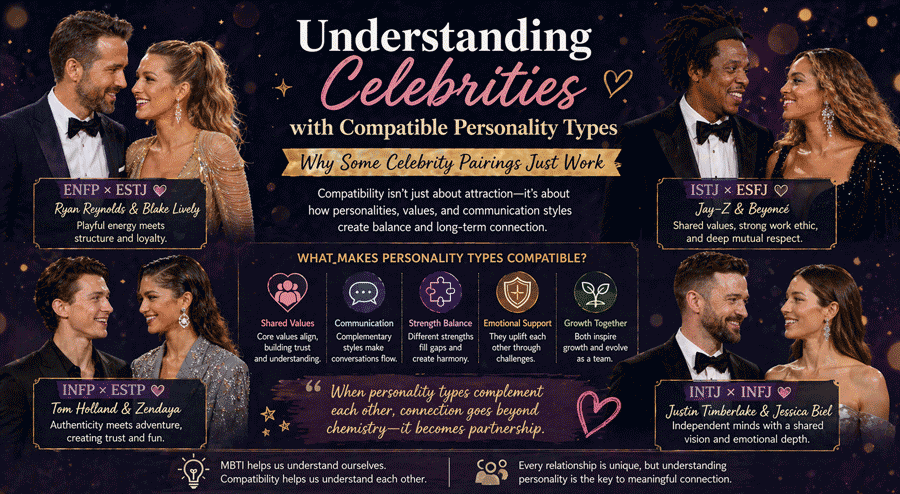
The Mechanism Behind Personality Types
To understand why certain personalities align or clash, one must first grasp the theoretical roots of the system. The MBTI is built upon Carl Jung’s theory of psychological types, which posits that human behavior is not random but follows predictable patterns based on mental processes. While the four dichotomies—Extraversion vs. Introversion, Sensing vs. Intuition, Thinking vs. Feeling, and Judging vs. Perceiving—provide a convenient shorthand, they do not explain the “why” behind behavior. The real engine of personality lies in the cognitive function stack.
Each of the 16 types operates using a hierarchy of four cognitive functions: dominant, auxiliary, tertiary, and inferior. The dominant function is the core lens through which an individual views reality, often developing early in life. The auxiliary function supports the dominant, providing balance. The tertiary function is less mature and often emerges in mid-life, while the inferior function remains a source of stress and growth potential throughout adulthood. For example, an INTJ leads with Introverted Intuition (Ni), supported by Extraverted Thinking (Te). An ENFP leads with Extraverted Intuition (Ne), supported by Introverted Feeling (Fi). Understanding these stacks explains why two types might share letters but behave differently, or why different types might harmonize well.
Why does letter-based typing alone often cause mistypes? Because letters describe preferences, not competencies. A person might test as a Thinker (T) because they value logic in their career, yet their natural decision-making process might be driven by values (Feeling). Furthermore, cultural conditioning often masks true preferences. An Introvert might learn to act Extraverted to succeed socially, leading to a false result on a questionnaire. This is why validating type requires more than a test score. It demands self-observation of decision patterns, stress reactions, motivation sources, and blind spots.
Consider how public figures are often discussed. When analyzing celebrities with compatible personality types, you might see figures like Steve Jobs widely believed to be an ENTJ, known for visionary leadership and structured execution. Conversely, someone like Robin Williams is often typed as an ENFP, recognized for boundless creativity and emotional connectivity. However, these typings are not facts. They are illustrative examples based on observed public personas. Using them requires cautious wording. They serve as mirrors for us to compare cognitive patterns, not as definitive diagnoses. To validate your own type, look for long-term feedback from others who know you in vulnerable states, not just your professional mask.
Accurate typing involves observing how you recharge, how you process information, and what drains you. Do you prefer concrete data (Sensing) or abstract patterns (Intuition)? Do you prioritize objective logic (Thinking) or interpersonal harmony (Feeling)? More importantly, watch your stress response. When under extreme pressure, do you become overly critical (Thinking grip) or emotionally overwhelmed (Feeling grip)? These reactive states often reveal the inferior function, providing a strong clue to your true type. Relying on tests alone ignores this dynamic aspect of personality.
Practical Frameworks for Application
Understanding theory is valuable, but application transforms knowledge into results. Below are two practical frameworks designed to help you utilize personality insights for relationship dynamics and personal development. These frameworks move beyond compatibility charts and focus on functional interaction.
Framework 1: Cognitive Function Development for Growth
This framework applies when you feel stuck in repetitive behaviors or want to expand your capabilities. It relates directly to the dominant and inferior function dynamics. The goal is not to change your type but to increase flexibility.
Practical Action Steps: First, identify your dominant function. If you are a dominant Thinker, acknowledge that your default is analysis. Second, schedule time to exercise your inferior function. If your inferior is Feeling, practice identifying emotions without judging them. Third, monitor your energy levels. Engaging non-preferred functions costs more energy, so plan recovery time. Fourth, seek feedback. Ask trusted peers where you seem rigid.
Benefits and Limitations: The benefit is increased adaptability and reduced stress during crises. You become less one-dimensional. The limitation is that you will never be as natural using your inferior function as your dominant one. Accepting this limitation is crucial to avoid burnout. Readers can judge whether this fits them by noticing if they feel more resilient after practicing these steps. If you feel exhausted without growth, you may be forcing a skill rather than developing a function.
Framework 2: Relationship and Communication Guidance
This framework applies when conflicts arise in personal or professional relationships. It relates to how different types process information and make decisions. It is particularly useful for understanding why certain celebrities with compatible personality types seem to work well together in public perception, and how you can replicate that harmony.
Practical Action Steps: Start by identifying the other person’s likely cognitive priorities. Do they need data (Sensing) or vision (Intuition)? Do they need logic (Thinking) or validation (Feeling)? Adjust your communication style to match their input preference. For example, when speaking to a Sensing type, provide concrete examples. When speaking to an Intuitive type, focus on the big picture. Second, establish “translation protocols.” Agree that when one person needs space, it is not rejection. Third, practice active listening where you repeat back their core concern before responding.
Benefits and Limitations: The benefit is reduced friction and deeper empathy. You stop taking differences personally. The limitation is that it requires conscious effort and may feel unnatural initially. Readers can judge fit by observing if conflicts de-escalate faster. If communication remains strained, re-evaluate whether you have correctly identified the other person’s preferences or if external stressors are interfering.
Both frameworks emphasize that MBTI is a tool for understanding preferences, not a label that defines the whole person. You are not your type; you are a person using a type structure. This distinction is vital for healthy application. Using these frameworks allows you to navigate complexity without reducing yourself or others to stereotypes.
Principles for Sustainable Growth
Personal growth within the MBTI framework requires universal principles that apply across all 16 types. Without these guardrails, individuals risk becoming entrenched in their preferences, using type as an excuse for bad behavior rather than a map for improvement.
Identify the Dominant Function First: Growth begins with acceptance. You must know your core strength before you can expand. If you do not know what drives you, you cannot balance it. Spend time reflecting on what activities make you lose track of time. This flow state often indicates dominant function usage.
Distinguish Preference from Skill: Just because you prefer Thinking does not mean you are good at logic, and preferring Feeling does not mean you are empathetic. Skills are developed; preferences are innate. Do not use type to excuse incompetence. Instead, use it to identify where you need to work harder to build skills outside your comfort zone.
Develop the Inferior Function Gradually: The inferior function is the gateway to wholeness, but it is also the source of vulnerability. Pushing too hard too fast leads to the “grip” state, where you become overwhelmed by negative traits of the inferior. For example, an INTJ under stress might become overly emotional and impulsive. Growth means engaging the inferior in low-stakes environments first.
Explain Loop and Grip Patterns: A “loop” occurs when you bypass your auxiliary function and bounce between your dominant and tertiary. This leads to unbalanced behavior. An INFP in a loop might stay in Introverted Feeling and Introverted Sensing, becoming overly nostalgic and withdrawn. Recognizing these patterns allows you to interrupt them by consciously engaging the auxiliary function.
Growth Means Flexibility, Not Identity Attachment: The biggest barrier to growth is attaching your identity to your type. Saying “I am an INTP, so I cannot do social work” is a limitation you impose on yourself. Type describes energy flow, not capability. True maturity is the ability to access all functions when the situation demands it, regardless of preference.
These principles ensure that your journey with personality types remains constructive. They prevent the system from becoming a cage. By focusing on cognitive dynamics rather than static labels, you open pathways for continuous improvement. This aligns with the deeper intent behind searching for celebrities with compatible personality types—not to find a perfect match, but to understand how different minds can complement each other.
Common Mistakes and Pitfalls to Avoid
Even well-intentioned enthusiasts fall into traps when using MBTI. Avoiding these pitfalls is essential for maintaining credibility and gaining genuine insight. Below are eight clear “don’t do this” points with better alternative mindsets.
1. Don’t treat type as destiny. Explanation: Believing your type dictates your future limits potential. Alternative: View type as a starting point for understanding preferences, not a ceiling for achievement.
2. Don’t use type to excuse bad behavior. Explanation: Saying “I’m a Perceiver, so I’m always late” avoids responsibility. Alternative: Acknowledge the preference but commit to managing the impact on others.
3. Don’t rely solely on online tests. Explanation: Free tests often lack validity and rely on self-reporting biases. Alternative: Use tests as hints, but validate through study and self-observation.
4. Don’t stereotype celebrities as facts. Explanation: Assuming you know a celebrity’s inner life is speculative. Alternative: Use public figures as hypothetical examples to study function dynamics, not as proven data.
5. Don’t ignore cultural context. Explanation: Behavior varies by culture; an Introvert in one culture may look different in another. Alternative: Consider environmental factors when observing behavior patterns.
6. Don’t dismiss other personality systems. Explanation: MBTI is not the only tool; Big Five and Enneagram offer different insights. Alternative: Integrate knowledge from multiple frameworks for a holistic view.
7. Don’t type others without permission. Explanation: Armchair typing can feel intrusive and judgmental. Alternative: Discuss preferences openly rather than labeling someone behind their back.
8. Don’t stop learning after finding your type. Explanation: Finding your type is the beginning, not the end. Alternative: Continue studying cognitive functions to deepen understanding over time.
Adhering to these guidelines protects the integrity of your practice. It ensures that you use the tool for empowerment rather than division. When discussing celebrities with compatible personality types, keeping these pitfalls in mind prevents the spread of misinformation and encourages a more nuanced conversation.
Continuing Your MBTI Journey
The field of personality psychology is evolving. To maintain accuracy and depth, readers are encouraged to keep following new research and higher-quality resources. Credible organizations such as the Myers & Briggs Foundation and the Center for Applications of Psychological Type (CAPT) provide foundational materials that adhere to ethical standards. Jungian educational resources also offer historical context that enriches modern interpretations.
Stay open to debates and newer interpretations. The understanding of cognitive functions has deepened since the mid-20th century. Modern typologists discuss function axes and shadow functions with greater precision. Engaging with these discussions helps you avoid outdated stereotypes. However, be wary of low-quality summaries that simplify complex theories into memes. Ways to identify reliable information include checking author credentials, looking for citations of original works, and avoiding content that promises instant fixes.
Learning cognitive functions efficiently requires structured study. Start with one function pair at a time. For example, spend a week observing Sensing vs. Intuition in daily conversations. Note how different people describe the same event. This empirical approach grounds theory in reality. It also helps in judging information quality. If a source claims type determines intelligence or morality, it is likely unreliable. MBTI measures preference, not ability or worth.
By committing to ongoing learning, you ensure that your understanding remains dynamic. This aligns with the core principle that MBTI type is a starting point, not an endpoint. The goal is not to memorize descriptions but to cultivate self-awareness and empathy. Whether you are exploring career fit, communication, or growth, the journey is continuous. Keep questioning, keep observing, and keep refining your understanding of yourself and others.
Frequently Asked Questions
1. Where should a beginner start with MBTI?
Start by reading about the four dichotomies to get a broad overview, but quickly move to cognitive functions. Understanding functions prevents the common mistake of stereotyping. Use reputable books or resources from established foundations rather than random online quizzes. Focus on self-observation before trying to type others.
2. How can I confirm my type without tests?
Focus on energy dynamics. What drains you? What energizes you? Look at your stress responses. The “grip” experience is often a strong indicator of your inferior function. Compare your internal experience with function descriptions rather than external behavior descriptions. Behavior can be masked; internal motivation is harder to fake.
3. How does type affect relationship communication?
Type influences how information is processed and valued. A Thinking type may offer solutions when a Feeling type wants empathy. Recognizing this difference allows you to adjust your approach. Compatibility is not about having the same type but about understanding and respecting different cognitive priorities.
4. What is the most efficient way to learn cognitive functions?
Study them in pairs (axes). For example, learn Ti-Fe together to understand the axis of internal logic vs. external harmony. Apply them to real-life scenarios immediately. Try to identify which function you are using when making a decision. Practice makes the theory concrete.
5. Can my personality type change over time?
Your core preferences generally remain stable, but your relationship with them changes. You become more balanced and flexible as you age. You might develop skills in non-preferred areas, making you look different on the surface. However, your underlying energy flow typically remains consistent. Growth looks like expansion, not fundamental change of type.
In conclusion, exploring celebrities with compatible personality types is a gateway to deeper self-knowledge when approached with rigor and humility. By focusing on cognitive functions, avoiding common pitfalls, and committing to ongoing learning, you can transform MBTI from a simple labeling system into a profound tool for human understanding. Remember that the letters are just the map; the territory is your lived experience.