
When exploring personality frameworks, many individuals immediately fixate on statistics, specifically searching for the mbti rarest types to validate their uniqueness or understand their social dynamics. However, concluding that rarity equals value or accuracy is a fundamental misconception. The true utility of the Myers-Briggs Type Indicator lies not in population distribution but in understanding cognitive preferences. To accurately identify whether you belong to a statistically uncommon group, you must move beyond the four-letter code and analyze your cognitive function stack. This article provides a comprehensive, evidence-based guide to understanding type rarity through the lens of Jungian psychology, offering practical frameworks for type confirmation, personal growth, and interpersonal effectiveness.
The MBTI instrument is designed to help individuals understand how they perceive the world and make decisions. It is useful for career planning, improving communication, and fostering self-awareness. Yet, relying solely on letter-based dichotomies often leads to mistyping, especially when discussing the mbti rarest types. A deeper application requires returning to cognitive functions. This conclusion-first approach ensures that readers prioritize psychological mechanisms over demographic statistics, leading to more sustainable personal development.
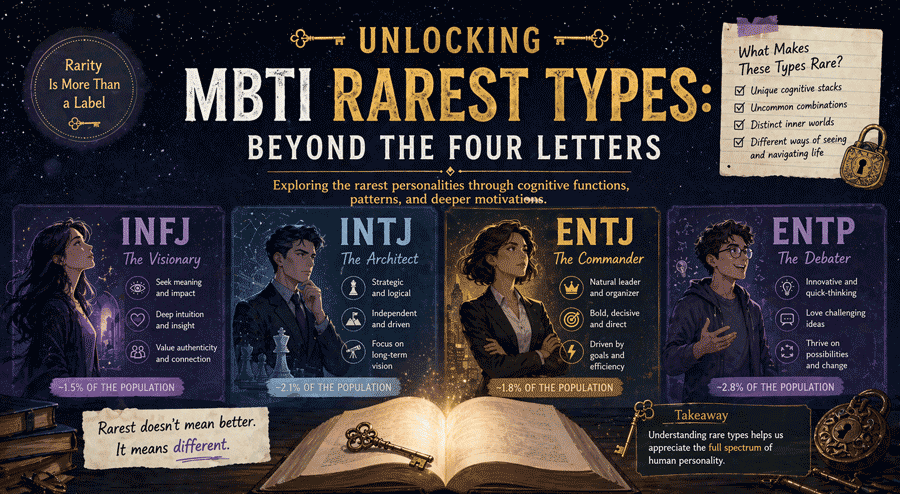
The Framework and Mechanism of Type
To understand why certain types are considered rare, we must first examine the Jungian roots of the MBTI. Carl Jung proposed that human behavior is not random but results from consistent patterns in how we process information. The MBTI builds on this by categorizing preferences across four dichotomies: Extraversion vs. Introversion, Sensing vs. Intuition, Thinking vs. Feeling, and Judging vs. Perceiving. These combine to form the 16 personality types. However, the letters are merely indicators of the underlying cognitive function stack.
The cognitive function stack consists of four roles: dominant, auxiliary, tertiary, and inferior. The dominant function is the primary lens through which an individual engages with the world. For example, an INTJ leads with Introverted Intuition (Ni), while an ESFP leads with Extraverted Sensing (Se). The auxiliary function supports the dominant, providing balance. The tertiary and inferior functions develop later in life, often becoming prominent during stress or maturity. Understanding this stack is crucial because statistical rarity often correlates with specific function combinations rather than mere letter preferences.
Why does letter-based typing alone often cause mistypes? Online tests typically measure behavior rather than cognition. A person might act organized (Judging) due to work requirements but naturally prefer flexibility (Perceiving). When searching for mbti rarest types, users often rely on these superficial traits. True type confirmation requires self-observation of decision patterns, stress reactions, and motivation. For instance, does an individual recharge through solitude (Introversion) or social interaction (Extraversion)? Do they prioritize logical consistency (Thinking) or harmonic values (Feeling)?
Validation should come from long-term feedback from others and introspection rather than a single test score. Consider the INFJ, often cited as one of the mbti rarest types. An individual might test as INFJ because they are empathetic, but if their decision-making process relies primarily on objective logic rather than personal values, they may actually be an INTJ. Famous public figures are often typed speculatively. For example, Nikola Tesla is widely believed to be an INTJ, illustrating the Ni-Te dynamic, but such typings should be viewed as illustrative examples rather than clinical diagnoses.
Cognitive Function Dynamics
The eight cognitive functions are the engine of the MBTI system. Perceiving functions (Sensing and Intuition) gather information, while Judging functions (Thinking and Feeling) organize it. Introverted functions focus on internal consistency and depth, while Extraverted functions focus on external impact and breadth. When analyzing mbti rarest types, notice that types leading with Introverted Intuition (INFJ, INTJ) or Extraverted Feeling (ENFJ, ESFJ) are often statistically less common in certain populations. This is not because the functions are rare, but because the specific stacking order is less prevalent.
Mistyping often occurs when individuals confuse skills with preferences. A Thinking type can learn to be empathetic, and a Feeling type can learn logical analysis. However, the natural drain or energy gain associated with these processes remains constant. To validate your type, observe which processes feel effortless and which require significant exertion. This distinction is vital for avoiding the trap of identifying with a rare type simply because it seems desirable.
Application Guidance for Type Development
Understanding your type is not an endpoint but a starting point for strategic living. Below are two practical frameworks to apply your knowledge of cognitive functions and type dynamics. These frameworks move beyond the curiosity of mbti rarest types and focus on actionable growth.
Framework 1: Career and Work-Style Fit
When it applies: This framework is essential when choosing a career path, negotiating work responsibilities, or seeking roles that align with natural energy flows.
Related Type Dynamics: This relates to the dominant and auxiliary functions. For example, types with dominant Thinking (Ti or Te) often thrive in roles requiring systematic analysis, while dominant Feeling types (Fi or Fe) excel in roles requiring consensus building or advocacy.
Practical Action Steps:
- Audit your current tasks. Identify which activities drain you versus which energize you.
- Map these activities to cognitive functions. If data analysis energizes you, you may be utilizing Te or Ti.
- Seek roles that allow you to operate from your dominant function at least 40% of the time.
- Communicate your working style to managers. For instance, an Introverted type may need written communication time before meetings.
Benefits and Limitations: The benefit is increased job satisfaction and reduced burnout. The limitation is that no job is perfect; all roles require using non-preferred functions. Do not use type as an excuse to avoid necessary growth areas.
How to Judge Fit: If you feel consistently exhausted despite adequate sleep and nutrition, your work style may conflict with your type. Conversely, if you lose track of time while working, you are likely in a state of flow aligned with your preferences.
Framework 2: Relationship and Communication Guidance
When it applies: Use this framework during conflicts, team collaborations, or when building deeper intimacy with partners.
Related Type Dynamics: This relates to MBTI compatibility and communication patterns. Understanding whether a partner uses Thinking or Feeling helps decode their feedback. For example, a Thinking type offering solutions may be expressing care, not dismissing emotions.
Practical Action Steps:
- Identify the other person’s likely dominant function.
- Translate your message into their preference. If they are Sensing, provide concrete details. If Intuitive, provide the big picture.
- During conflict, pause to ask: “Are they attacking me, or are they stressed in their inferior function?”
- Establish communication protocols. Agree on how to handle decision-making disagreements.
Benefits and Limitations: This reduces misinterpretation and fosters empathy. However, it should not become a tool for labeling or limiting others. People are complex, and type is only one variable.
How to Judge Fit: If conflicts resolve faster and with less residual resentment, the framework is working. If you find yourself analyzing the other person excessively rather than listening, step back and engage directly.
Growth Section: Universal Principles
Personal growth within the MBTI framework follows universal principles that apply regardless of whether you belong to one of the mbti rarest types or a common one. The goal is flexibility, not identity attachment.
Identify the Dominant Function First: Growth begins with leveraging your strengths. Trying to fix weaknesses before maximizing strengths often leads to frustration. Embrace your natural way of processing information.
Distinguish Preference from Skill: You can be skilled at something you do not prefer. A Feeling type can be a competent accountant, but it will cost more energy. Recognize this cost to manage your energy budget effectively.
Develop the Inferior Function Gradually: The inferior function is the source of significant growth but also stress. For an INTJ, the inferior function is Extraverted Sensing (Se). Engaging in physical activities or sensory experiences can help balance the dominant Intuition. However, push too hard, and you may enter a “grip” state.
Explain Loop and Grip Patterns: Under stress, individuals may bypass their auxiliary function and loop between their dominant and tertiary functions. An INFP might loop between Introverted Feeling (Fi) and Introverted Intuition (Ni), becoming withdrawn and pessimistic. Recognizing these patterns allows for early intervention.
Growth Means Flexibility: Ultimately, maturity is the ability to access all functions when needed. A healthy type is not rigid. They can be logical when necessary and empathetic when required, even if one comes more naturally. This flexibility prevents the stagnation often associated with rigid typing.
Mistakes and Pitfalls to Avoid
When exploring personality types, especially when interested in mbti rarest types, several common pitfalls can hinder accurate understanding and growth. Here are eight clear “don’t do this” points with better alternative mindsets.
1. Don’t equate rarity with value.
Explanation: Believing a rare type is superior creates ego attachment.
Alternative: View all types as equally valid tools for different contexts.
2. Don’t rely solely on online tests.
Explanation: Tests measure behavior, which can be masked.
Alternative: Use tests as a starting hypothesis, then validate through study.
3. Don’t use type to excuse bad behavior.
Explanation: Saying “I’m an ENTP, so I’m naturally disruptive” avoids responsibility.
Alternative: Acknowledge preferences but commit to social responsibility.
4. Don’t stereotype others based on letters.
Explanation: Assuming all Thinkers are cold limits connection.
Alternative: Treat individuals as unique; use type to understand, not label.
5. Don’t ignore the context of development.
Explanation: A young type looks different from a mature type.
Alternative: Consider age and life experience when observing type expression.
6. Don’t obsess over celebrity typings.
Explanation: Public personas are curated and not reliable data.
Alternative: Focus on your own internal experience rather than external comparisons.
7. Don’t neglect the inferior function.
Explanation: Ignoring weaknesses leads to burnout under stress.
Alternative: Gently integrate non-preferred functions for balance.
8. Don’t treat type as static destiny.
Explanation: Believing you cannot change limits potential.
Alternative: View type as a baseline that evolves with conscious effort.
Ongoing Learning and Credibility
The field of personality psychology is evolving. To maintain accurate knowledge about mbti rarest types and cognitive functions, readers should commit to ongoing learning. New research frequently refines our understanding of Jungian typology. It is essential to seek higher-quality MBTI and Jungian resources rather than relying on social media summaries which often prioritize engagement over accuracy.
Credible organizations such as the Myers & Briggs Foundation and the Center for Applications of Psychological Type (CAPT) provide foundational research. Jungian educational resources also offer depth regarding the original theoretical framework. When evaluating information, look for authors who discuss cognitive functions rather than just stereotypes. Debates and newer interpretations, such as the Beebe model or function axis theories, can provide nuance.
Ways to identify reliable information include checking for citations, avoiding absolute claims, and looking for consistency with established theory. Avoid low-quality summaries that promise quick fixes or definitive life answers. MBTI is a tool for understanding preferences, not a label that defines the whole person. By staying informed, you ensure your understanding remains robust and applicable to real-life scenarios.
Frequently Asked Questions
1. Where should a beginner start with MBTI?
Start by learning the four dichotomies and then move quickly to cognitive functions. Understanding the difference between Sensing and Intuition is often the most critical first step. Avoid memorizing type descriptions initially; focus on the mechanisms behind them.
2. How can I confirm my type without tests?
Engage in self-observation over several weeks. Track your energy levels after different activities. Analyze your decision-making process during stress. Seek feedback from trusted peers who know you well. Consistency in patterns is more reliable than a single test result.
3. How does type affect relationship communication?
Type influences how information is given and received. Thinking types may prioritize truth, while Feeling types prioritize harmony. Recognizing this difference allows partners to translate their intent effectively, reducing conflict and improving MBTI compatibility.
4. What is the most efficient way to learn cognitive functions?
Study one function pair at a time (e.g., Ti vs. Te). Observe these functions in others before applying them to yourself. This reduces bias. Use reputable books and courses that focus on Jungian theory rather than pop psychology.
5. Can my personality type change over time?
Your core preferences generally remain stable, similar to handedness. However, your ability to access non-preferred functions improves with age and development. What changes is not the type itself, but the maturity and flexibility with which you wield it. Partial resonance with a type description is common; look for the best fit rather than a perfect match.