
Introduction: Why Letters Are Not Enough
The Myers-Briggs Type Indicator (MBTI) is one of the most popular personality frameworks in the world, used by millions to understand themselves and others. However, when searching for mbti test types, many users encounter a significant limitation: the four-letter code alone often fails to capture the depth of human personality. While the letters provide a convenient shorthand, they are merely the surface level of a much deeper psychological structure rooted in Carl Jung's theory of psychological types.
This article concludes upfront that relying solely on test results without understanding the underlying cognitive functions leads to superficial self-awareness and frequent mistyping. To truly benefit from the MBTI, you must move beyond the binary dichotomies and explore the dynamic stack of cognitive functions that drive your decision-making, information processing, and stress responses. This shift in perspective transforms the MBTI from a static label into a dynamic tool for personal growth, career alignment, and improved relationships.
Whether you are a beginner trying to confirm your type or an experienced enthusiast seeking deeper insight, this guide provides the framework necessary to navigate the complexities of personality typing accurately. We will explore the Jungian roots of the system, explain why letter-based typing often causes errors, and offer practical strategies for applying type theory in real-world scenarios. By the end, you will understand that your type is a starting point for development, not an endpoint that defines your entire identity.
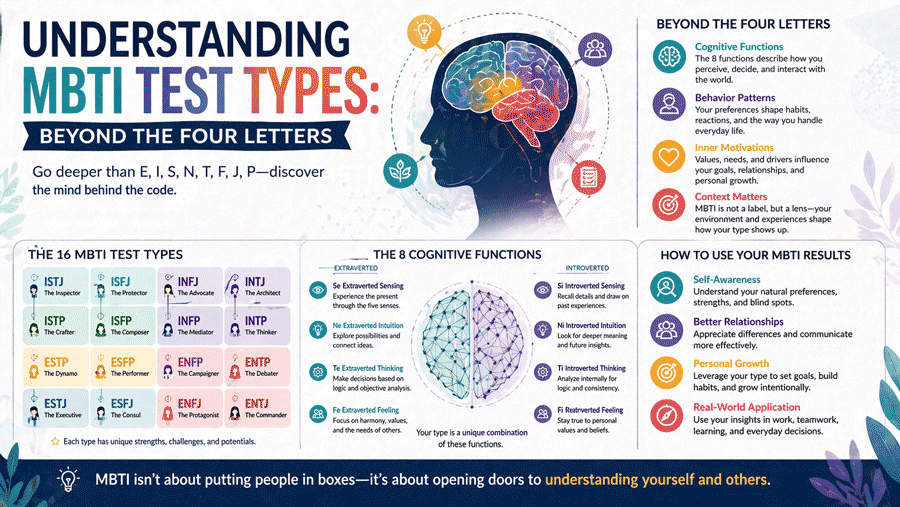
The Framework: Jungian Roots and Cognitive Functions
To understand why mbti test types require deeper analysis, we must first look at the theoretical foundation. The MBTI was developed by Katharine Cook Briggs and her daughter Isabel Briggs Myers, based heavily on Carl Jung's work. Jung proposed that people have innate preferences for how they perceive the world and how they make decisions. These preferences manifest as cognitive functions, which are the mental processes we use to interact with our environment.
The Four Dichotomies vs. Cognitive Functions
Traditional MBTI tests measure four dichotomies: Extraversion (E) vs. Introversion (I), Sensing (S) vs. Intuition (N), Thinking (T) vs. Feeling (F), and Judging (J) vs. Perceiving (P). While useful, these letters describe what you prefer, not how you process information. For example, two people may both test as INTJ, but if one relies heavily on logical analysis while the other focuses on internal values, their functional usage differs significantly.
Cognitive functions provide the mechanism behind the letters. There are eight functions in total, divided into perceiving functions (how you take in information) and judging functions (how you make decisions). The perceiving functions are Sensing (S) and Intuition (N), each with an introverted and extraverted attitude (Si, Se, Ni, Ne). The judging functions are Thinking (T) and Feeling (F), also with introverted and extraverted attitudes (Ti, Te, Fi, Fe).
The Function Stack: Dominant to Inferior
Every personality type uses all eight functions, but in a specific order of preference known as the function stack. This stack consists of four primary functions:
- Dominant Function: The hero or lead function. This is your natural strength, used most comfortably and frequently. It defines your core identity.
- Auxiliary Function: The supportive function. It balances the dominant function and typically develops in young adulthood. It helps you interact with the external world if you are an introvert, or internal world if you are an extravert.
- Tertiary Function: The child function. Often less mature, it can be a source of relaxation or creativity but may be used inconsistently under stress.
- Inferior Function: The aspirational function. This is your weakest link, often emerging only under significant stress. Growth involves integrating this function gradually over a lifetime.
For instance, an INFJ has a stack of Ni (Dominant), Fe (Auxiliary), Ti (Tertiary), and Se (Inferior). Understanding this stack explains why an INFJ might be visionary and empathetic (Ni-Fe) but struggle with sensory details or sudden physical changes (Se).
Why Tests Often Mislead
Standard online quizzes often rely on self-reported behavior rather than cognitive motivation. Behavior can be misleading because people adapt to their environments. A natural Introvert working in sales may develop extraverted behaviors, leading a test to type them as an Extravert. Similarly, cultural conditioning might suppress Feeling preferences in favor of Thinking, skewing results.
Furthermore, mood and stress significantly impact test performance. If you take a test while depressed or anxious, you may answer based on your current state rather than your innate preference. This is why type confirmation requires self-observation of decision patterns, energy sources, and stress reactions over time, rather than relying on a single test score. Validating your type involves looking at long-term feedback from others and analyzing where you feel most energized versus drained.
Practical Application: Career and Work Styles
Understanding your cognitive functions offers profound insights into career fit and work-style optimization. While any type can succeed in any field, certain functions align naturally with specific work environments and tasks. This framework helps you identify roles where you can leverage your dominant strengths while managing your weaknesses.
When it applies: This framework is most useful during career transitions, job searches, or when feeling burnt out in a current role. It helps distinguish between a skills gap and a personality mismatch.
Function Dynamics: Extraverted Thinking (Te) users often excel in structured, efficiency-driven environments where logical organization is prized. Extraverted Feeling (Fe) users thrive in roles requiring harmony, team cohesion, and customer relations. Introverted Intuition (Ni) users prefer strategic planning and long-term vision, while Introverted Sensing (Si) users excel in roles requiring accuracy, tradition, and detailed record-keeping.
Practical Action Steps:
- Audit Your Energy: Track which tasks drain you and which energize you over a two-week period. Map these to specific functions. For example, if detailed data entry drains you but brainstorming energizes you, you may have a preference for Intuition over Sensing.
- Identify Decision Styles: Do you make decisions based on objective logic (T) or personal values and impact on people (F)? Seek roles that respect this style. A Ti-dom may struggle in a role requiring constant diplomatic consensus.
- Manage Weaknesses: If your inferior function is required for the job, create systems to support it. An INFP with inferior Te might use project management software to handle organizational tasks rather than relying on memory.
Benefits and Limitations: The benefit is increased job satisfaction and reduced burnout. The limitation is that no job is perfect; all roles require some use of non-preferred functions. Use this framework to negotiate responsibilities, not to avoid all challenges.
Judging Fit: You know this fits if you feel a sense of flow during core tasks and recover quickly from work stress. If you feel constantly exhausted despite having the necessary skills, re-evaluate the functional demands of the role.
Practical Application: Relationships and Communication
MBTI compatibility is often misunderstood as finding a perfect match. In reality, it is about understanding communication patterns and conflict resolution styles. Cognitive functions explain why two people can hear the same words but interpret them differently.
When it applies: Use this framework during conflicts, when feeling misunderstood, or when trying to deepen intimacy with a partner, friend, or colleague.
Function Dynamics: Thinking types may perceive Feeling types as overly emotional or irrational, while Feeling types may perceive Thinking types as cold or insensitive. Sensing types may find Intuitive types impractical or head-in-the-clouds, while Intuitive types may find Sensing types too focused on minutiae. Recognizing these function clashes reduces personalization of conflict.
Practical Action Steps:
- Translate Needs: If your partner is a Fe user, they may need verbal affirmation of harmony. If they are a Fi user, they may need respect for their individual values. Adjust your communication to speak their functional language.
- Respect Processing Time: Introverted thinkers (Ti) often need silence to process logic before responding. Extraverted feelers (Fe) may need to talk through emotions immediately. Negotiate a timing agreement for difficult conversations.
- Identify Stress Triggers: Learn what puts your partner in a grip state. For example, overwhelming sensory chaos might trigger an INFJ, while lack of logical consistency might trigger an ESTP.
Benefits and Limitations: This approach fosters empathy and reduces friction. However, it should not be used to excuse bad behavior. Type explains preference, not maturity. A mature type of any kind can communicate effectively.
Judging Fit: This framework works if conflicts become shorter and less intense. If you find yourself using type to stereotype or dismiss your partner's concerns, you are misapplying the tool.
Personal Growth and Development
Growth in the context of MBTI is not about changing your type, but about expanding your repertoire of functions. It means developing flexibility so you can access non-preferred functions when necessary without burning out.
Identify the Dominant Function First: Solidify your strengths before trying to fix weaknesses. A strong dominant function provides the confidence needed to explore the inferior. For example, an ENTP should master their Ne (exploration) before forcing themselves into rigid Si (routine) structures.
Distinguish Preference from Skill: You can be skilled at something you do not prefer. An Introvert can be a great public speaker, but it will cost more energy than an Extravert. Acknowledge this cost and plan recovery time accordingly.
Develop the Inferior Function Gradually: The inferior function is the key to mid-life growth. For an ISTJ (inferior Ne), this might mean intentionally trying new experiences without a plan. Do this in small doses. Overloading the inferior function leads to stress, not growth.
Explain Loop and Grip Patterns: Under stress, types may bypass their auxiliary function and fall into a loop between their dominant and tertiary functions. For example, an INTJ (Ni-Ti loop) may become overly abstract and detached from reality. Recognizing this pattern allows you to re-engage the auxiliary function (Te) to get back on track. Similarly, the grip state occurs when the inferior function takes over explosively. An usually calm ISFJ might become uncharacteristically critical or sensory-indulgent when in the grip of Ne.
Growth Means Flexibility: Ultimately, personality growth means not being a slave to your preferences. It is about identity flexibility. You are not just an INFP; you are a person who prefers INFP patterns but can access Te when the situation demands it. This mindset prevents the MBTI from becoming a self-limiting box.
8 Common Mistakes to Avoid
To maintain accuracy and utility, avoid these common pitfalls when exploring mbti test types.
- Don't Stereotype Based on Letters: Assuming all Thinkers are unemotional is incorrect. Thinking refers to decision criteria, not emotional capacity. Alternative: Focus on how decisions are made, not whether emotions are felt.
- Don't Ignore Stress Responses: Typing yourself only when happy leads to errors. Stress reveals the inferior function. Alternative: Analyze how you behave under significant pressure to confirm your type.
- Don't Treat Type as Static: While core preferences are stable, behavior changes with maturity. Alternative: View type as a developmental trajectory, not a fixed destination.
- Don't Use Type to Excuse Behavior: Saying I am a Perceiver so I am always late is misuse. Alternative: Use type to understand challenges, then build systems to overcome them.
- Don't Rely on One Test: Single tests have margin of error. Alternative: Use multiple resources, books, and function descriptions to triangulate your type.
- Don't Confuse Skills with Preferences: Being good at logic does not make you a Thinker if you value harmony more. Alternative: Ask what feels natural, not what you are trained to do.
- Don't Overvalue Compatibility: Any two types can have a successful relationship. Alternative: Focus on communication skills and mutual respect rather than type matching.
- Don't Neglect the Inferior Function: Ignoring your weakness limits growth. Alternative: Gently practice using your inferior function in low-stakes environments to build resilience.
Continuing Your Learning Journey
The field of personality psychology is evolving. To maintain credibility and depth, readers should seek out high-quality resources rather than relying on social media summaries. Credible organizations such as the Myers & Briggs Foundation and the Center for Applications of Psychological Type (CAPT) offer research-based materials. Jungian educational resources also provide historical context and theoretical depth.
Stay open to debates and newer interpretations. Some practitioners integrate MBTI with Enneagram or Big Five traits for a more nuanced view. However, be cautious of resources that claim scientific certainty where none exists. MBTI is a tool for understanding preferences, not a clinically diagnostic instrument. Look for authors who emphasize nuance, avoid stereotyping, and encourage self-observation over test dependency. By committing to ongoing learning, you ensure that your understanding of mbti test types remains accurate, ethical, and useful for long-term development.
Frequently Asked Questions
1. Where should a beginner start with MBTI?
Start by reading about the cognitive functions rather than just the 16 type descriptions. Understanding the eight functions (Ni, Ne, Si, Se, Ti, Te, Fi, Fe) provides a clearer picture than letter dichotomies. Take a reputable test as a baseline, but treat the result as a hypothesis to be tested through self-observation.
2. How can I confirm my type without tests?
Focus on energy dynamics. Does social interaction energize or drain you? Do you prefer concrete facts or abstract patterns? Observe your stress reactions. Comparing your natural decision-making process with function descriptions is more reliable than answering quiz questions about behavior.
3. How does type affect relationship communication?
Type influences how you express care and resolve conflict. Thinking types may offer solutions, while Feeling types offer empathy. Understanding these differences prevents misinterpretation. Discuss these preferences openly with your partner to create a shared communication protocol.
4. What is the most efficient way to learn cognitive functions?
Study one function pair at a time. For example, compare Ti vs. Te for a week. Notice when you use internal logic versus external efficiency. Journaling about specific decisions helps solidify the distinction. Avoid trying to learn all eight functions simultaneously.
5. Can my personality type change over time?
Core preferences are generally stable throughout adulthood. However, your ability to use non-preferred functions improves with maturity. You may appear different behaviorally as you develop, but your underlying cognitive hierarchy remains consistent. Focus on development rather than changing your type.