
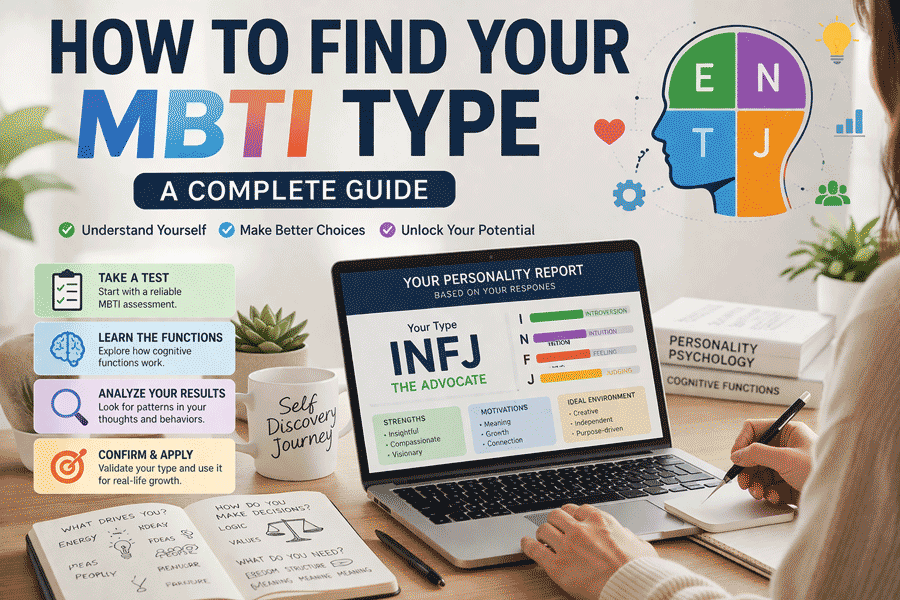
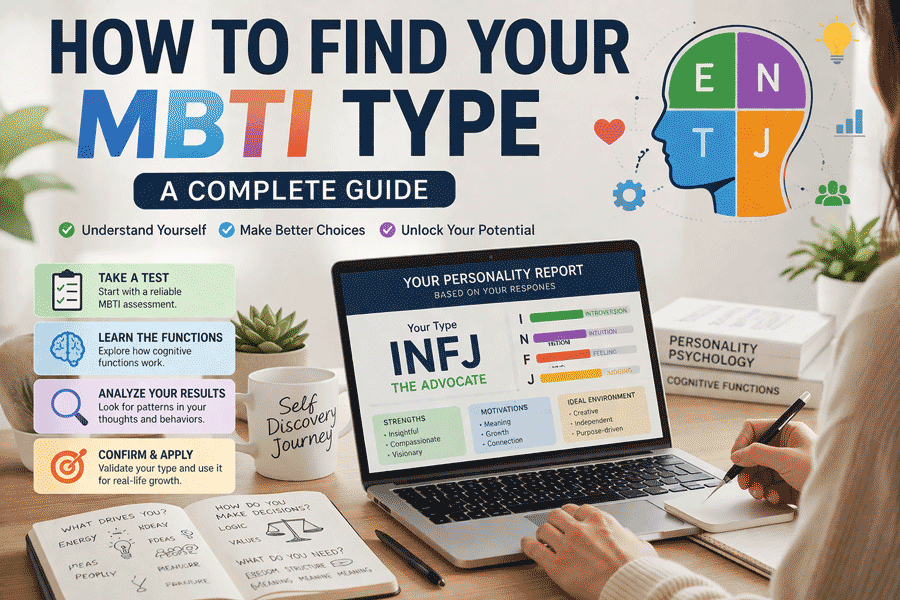
How to Find Your MBTI Type: A Complete Step-by-Step Guide
Understanding your personality is not about labeling yourself; it is about unlocking a deeper awareness of how you process information, make decisions, and interact with the world. If you are searching for how to find your mbti type, you are likely looking for more than just a four-letter code. You are seeking a framework for self-improvement, better relationships, and career alignment. The most accurate path to type confirmation lies not in online quizzes, but in understanding the underlying cognitive functions that drive behavior. This guide provides a comprehensive, evidence-based approach to identifying your true type by moving beyond stereotypes and focusing on the mechanical roots of the Myers-Briggs Type Indicator.
MBTI is a tool for understanding preferences, not a definitive measure of ability or character. It is useful for anyone seeking to reduce interpersonal friction, optimize their workflow, or understand their stress responses. However, deeper application of how to find your mbti type must return to cognitive functions. The four letters are merely shorthand for a complex stack of mental processes. By mastering these processes, you can validate your type through self-observation rather than relying on potentially misleading test results.
The Framework and Mechanism of Personality
To accurately determine your type, you must understand the engine under the hood. The MBTI system is rooted in Carl Jung’s theory of psychological types, which proposes that human behavior is not random but follows predictable patterns based on how we perceive information and make judgments. While the four dichotomies (Extraversion/Introversion, Sensing/Intuition, Thinking/Feeling, Judging/Perceiving) are the most visible part of the system, they are surface-level indicators of deeper cognitive dynamics.
The Four Dichotomies and Their Limits
The sixteen personality types are derived from combinations of four preferences. Extraversion (E) vs. Introversion (I) describes where you direct your energy. Sensing (S) vs. Intuition (N) describes how you gather information. Thinking (T) vs. Feeling (F) describes how you make decisions. Judging (J) vs. Perceiving (P) describes how you orient yourself to the external world. While helpful, these letters can be ambiguous. For example, a “Judging” type is not necessarily organized; they simply prefer closure and structure in their external environment. A “Perceiving” type is not necessarily lazy; they prefer keeping options open and gathering more data before deciding. Relying solely on these letters often causes mistypes because behavior can change based on context, maturity, and stress.
Cognitive Function Stack: The Core Mechanism
The true power of the system lies in the cognitive function stack. Each type uses four primary functions in a specific order: Dominant, Auxiliary, Tertiary, and Inferior. These functions are the mental tools you use to navigate life. The Dominant function is your hero—the process you trust most and use automatically. The Auxiliary function supports the dominant, providing balance. The Tertiary function is less developed but offers relief, while the Inferior function is your unconscious blind spot, often emerging under stress.
For example, an INTJ leads with Introverted Intuition (Ni), which focuses on synthesizing information into a single visionary path. Their auxiliary is Extraverted Thinking (Te), which organizes the external world to match that vision. In contrast, an INTP leads with Introverted Thinking (Ti), which seeks internal logical consistency, supported by Extraverted Intuition (Ne), which explores multiple possibilities. Understanding these nuances is critical when learning how to find your mbti type accurately. Two types may share letters but operate with completely different mental software.
Why Letter-Based Typing Causes Mistypes
Online tests often ask questions like “Do you like parties?” to determine Extraversion. However, a socially skilled Introvert may enjoy parties but find them draining, while an Extravert may dislike a specific party but gain energy from the crowd generally. Tests measure behavior, not preference. Behavior is adaptable; preference is innate. You may have learned to be organized (J behavior) even if you prefer flexibility (P preference). To validate your type, you must look beyond what you do to why you do it. Observe your decision patterns, stress reactions, motivation sources, and blind spots. Long-term feedback from others who know you well can also reveal patterns you miss. If needed, consider famous public figures only as illustrative examples, using cautious wording such as “is widely believed to be” or “is often typed as,” recognizing that public personas are not private realities.
Practical Application Guidance
Knowing your type is useless without application. Once you have a hypothesis about your type, test it against real-life scenarios. Below are two practical frameworks to help you confirm your type and utilize it for growth.
Framework 1: Career and Work-Style Fit
When it applies: This framework is useful when you feel consistently drained by your work environment or when you are seeking a role that aligns with your natural strengths. It relates to the Thinking/Feeling and Judging/Perceiving dynamics, as well as the Sensing/Intuition preference for concrete data versus abstract concepts.
Practical Action Steps: Analyze your past work experiences. Identify tasks that gave you energy versus those that depleted you. If you are an Intuitive type, you may struggle with repetitive administrative details but thrive in strategic planning. If you are a Thinking type, you may prioritize efficiency over team harmony, whereas a Feeling type may prioritize morale over raw output. Map these preferences to potential roles. For example, a dominant Te user might excel in project management, while a dominant Fi user might excel in counseling or advocacy.
Benefits and Limitations: The benefit is increased job satisfaction and reduced burnout. The limitation is that no job is perfect, and all types must develop skills outside their preference. Use this to find a role where your natural style is an asset, not a liability.
How to Judge Fit: If you find yourself constantly forcing yourself to work in a way that feels unnatural despite being competent, you may be in a role that conflicts with your cognitive stack. True fit feels challenging but energizing, not exhausting.
Framework 2: Relationship and Communication Guidance
When it applies: This framework applies to personal relationships, team dynamics, and conflict resolution. It relates heavily to the Feeling/Thinking axis and the Extraversion/Introversion energy flow.
Practical Action Steps: Identify your communication style. Do you process thoughts internally before speaking (Introversion) or do you think out loud (Extraversion)? Do you prioritize logical consistency (Thinking) or personal values and harmony (Feeling)? When conflicts arise, observe your default reaction. Do you withdraw to analyze (Ti/Ni) or do you seek immediate resolution (Fe/Te)? Share these insights with partners or colleagues. Establish protocols that respect different styles, such as allowing Introverts time to prepare for meetings or ensuring Feeling types feel heard during decision-making.
Benefits and Limitations: The benefit is reduced misunderstanding and deeper empathy. The limitation is using type as an excuse for bad behavior (“I’m an INTJ, so I don’t need to be polite”). Type explains preference, not etiquette.
How to Judge Fit: If communication feels like a constant translation effort where your core needs are ignored, revisit your understanding of MBTI compatibility. Compatible relationships do not mean identical types; they mean understanding how different functions interact.
Growth and Personal Development
MBTI type is a starting point, not an endpoint. Growth means flexibility, not identity attachment. The goal is not to stay comfortably within your dominant function but to integrate the whole stack.
Identify the Dominant Function First
Your dominant function is your default setting. It is where you feel most confident and competent. For growth, acknowledge this strength but recognize its limits. A dominant Si user may rely too much on past experience, missing new opportunities. A dominant Ne user may start too many projects without finishing them. Awareness allows you to leverage your strength without being enslaved by it.
Distinguish Preference from Skill
You can be skilled at something you do not prefer. An Introvert can be a great public speaker; a Feeling type can make tough logical decisions. Do not confuse competence with preference. When learning how to find your mbti type, ask yourself what feels natural, not just what you are good at. Growth involves building skill in non-preferred areas while honoring your energy needs.
Develop the Inferior Function Gradually
The inferior function is your gateway to maturity. It is often the source of insecurity but also holds the key to balance. For example, a Thinking dominant type developing their inferior Feeling may learn to consider human impact in their decisions. This development must be gradual. Pushing too hard too fast can lead to burnout. Engage the inferior function in low-stakes environments, such as hobbies or safe relationships, before applying it in high-pressure situations.
Explain Loop and Grip Patterns
Under stress, you may fall into a “loop” or “grip.” A loop occurs when you bypass your auxiliary function and oscillate between your dominant and tertiary functions, leading to unbalanced behavior. For example, an INFJ in a Ni-Ti loop may become overly abstract and critical, ignoring external reality. A grip occurs when you are overwhelmed by your inferior function. An ESTJ in a grip may become emotionally volatile and uncharacteristically sensitive. Recognizing these patterns helps you return to balance by re-engaging your auxiliary function.
8 Common Mistakes and Pitfalls to Avoid
When exploring personality types, there are several traps that can lead to confusion or stagnation. Avoiding these pitfalls is essential for accurate type confirmation and healthy personality growth.
1. Don’t rely solely on online tests. Tests are snapshots based on self-reporting, which can be biased. Use them as a starting point, not a final verdict. Better alternative: Study cognitive functions and observe your behavior over time.
2. Don’t stereotype types. Assuming all INFPs are artists or all ESTJs are bosses limits understanding. Types express differently based on culture and environment. Better alternative: Focus on cognitive processes, not hobbies or careers.
3. Don’t use type as an excuse. Saying “I’m an Introvert” to avoid social responsibility is misuse. Type explains energy, not obligation. Better alternative: Use type to manage energy, not to avoid growth.
4. Don’t ignore the shadow functions. Everyone uses all eight functions. Ignoring the non-preferred ones leads to imbalance. Better alternative: Acknowledge and develop less preferred functions for wholeness.
5. Don’t assume type changes frequently. Core preferences are generally stable throughout adulthood. Feeling like a different type often means you are developing new skills. Better alternative: Distinguish between development and type change.
6. Don’t focus only on strengths. Ignoring weaknesses leads to blind spots. Better alternative: Identify weaknesses as areas for potential integration and growth.
7. Don’t judge others by your type. Assuming your way of processing is the “right” way causes conflict. Better alternative: Practice empathy by understanding different cognitive perspectives.
8. Don’t overlook context. Behavior changes in different environments. A person may look different at work than at home. Better alternative: Observe patterns across multiple contexts before typing.
Ongoing Learning and Resources
The field of personality psychology is evolving. To maintain accuracy, encourage readers to keep following new research and higher-quality MBTI or Jungian resources. Credible organizations such as the Myers & Briggs Foundation and CAPT (Center for Applications of Psychological Type) provide foundational data. Seek out Jungian educational resources that delve into the original theory rather than pop-psychology summaries. Engage with debates and newer interpretations, such as the Beebe model or function stacks, to deepen your understanding. Learn ways to identify reliable information and avoid low-quality summaries that prioritize entertainment over accuracy. By committing to ongoing learning, you ensure that your understanding of how to find your mbti type remains nuanced and applicable.
Frequently Asked Questions
1. Where should a beginner start when trying to find their type?
Start by reading about the cognitive functions rather than the four letters. Understand what Introverted Intuition feels like versus Extraverted Intuition. Observe your natural reactions in low-stress environments. This provides a more stable foundation than test results.
2. How can I confirm my type without taking a test?
Use self-observation and feedback. Track your energy levels after different activities. Analyze your decision-making process: do you prioritize logic or values? Ask trusted friends how they perceive your stress reactions. Consistency over time is key to type confirmation.
3. How does MBTI help with relationship communication?
It highlights differences in information processing. Knowing your partner’s type helps you understand why they communicate differently. For example, understanding communication patterns allows you to know when to give space versus when to engage directly.
4. What is the most efficient way to learn cognitive functions?
Focus on one axis at a time (e.g., Thinking vs. Feeling). Compare types that share functions but differ in attitude (e.g., INTJ vs. ENTJ). Use real-life examples to map functions to behaviors. Practice identifying functions in others to sharpen your understanding.
5. Can my personality type change over time?
Core preferences are generally stable, but your expression of them matures. You may develop skills in non-preferred areas, making you appear different. However, your underlying energy orientation usually remains consistent. Focus on development rather than changing your type.
Conclusion
Finding your MBTI type is a journey of self-discovery that requires patience and observation. By focusing on cognitive functions rather than superficial traits, you can achieve a more accurate and useful understanding of your personality. Remember that the goal is not to box yourself in but to expand your capabilities. Use this framework to enhance your decision-making style, improve your relationships, and navigate stress with greater resilience. Whether you are a beginner or an advanced enthusiast, the key lies in continuous learning and practical application. Embrace the complexity of your psychological type, and let it serve as a map for your ongoing growth.