
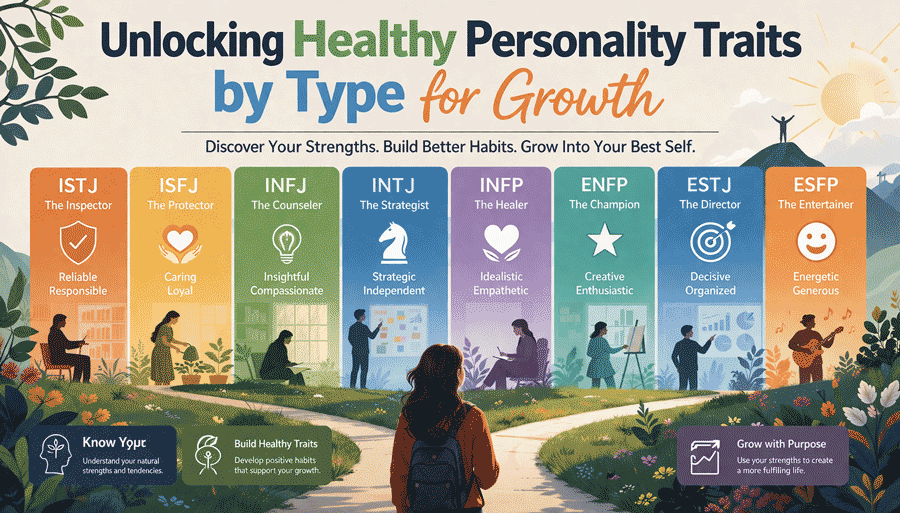
Unlocking Healthy Personality Traits by Type for Growth
Understanding your psychological preferences is the first step toward meaningful self-improvement. While many people use personality tests for entertainment, the real value lies in applying healthy personality traits by type to foster genuine development. This article concludes upfront: MBTI is not a label that defines your limits, but a map showing where your natural strengths lie and where your growth edges await. To truly benefit, you must move beyond the four-letter code and engage with the underlying cognitive functions. This approach prevents stereotyping and empowers you to cultivate resilience, better communication, and career satisfaction.
The Myers-Briggs Type Indicator (MBTI) is a widely recognized tool designed to help individuals understand how they perceive the world and make decisions. It is useful for anyone seeking clarity on their motivation, stress reactions, and interaction styles. However, relying solely on the letters often leads to superficial insights. Deeper application of healthy personality traits by type must return to cognitive functions. By understanding the mental processes behind the type, you can identify which traits are naturally healthy for you and which require conscious development. This article provides a comprehensive guide to navigating personality growth with accuracy and depth.
The Framework and Mechanism of Personality Type
To understand healthy development, we must first understand the engine driving the type. The MBTI system is rooted in Carl Jung’s theory of psychological types. Jung proposed that much of human behavior is the result of how we prefer to use our minds. The MBTI expands on this with four dichotomies: Extraversion (E) vs. Introversion (I), Sensing (S) vs. Intuition (N), Thinking (T) vs. Feeling (F), and Judging (J) vs. Perceiving (P). These combine to form the 16 personality types.
However, the dichotomies are merely the surface. The core mechanism is the cognitive function stack. Each type uses four main functions in a specific order: dominant, auxiliary, tertiary, and inferior. The dominant function is the hero’s tool—what you do best. The auxiliary supports it. The tertiary is a relief valve, and the inferior is the source of growth and stress. For example, an INTJ leads with Introverted Intuition (Ni) and supports it with Extraverted Thinking (Te). An ENFP leads with Extraverted Intuition (Ne) and supports it with Introverted Feeling (Fi).
Why does letter-based typing alone often cause mistypes? Because behavior can be misleading. Two people might exhibit similar behaviors for different reasons. A structured person might be an ISTJ using Introverted Sensing (Si) to maintain tradition, or an INTJ using Extraverted Thinking (Te) to achieve efficiency. Without understanding the why, you might adopt traits that are not sustainable for your type. Validating your type requires self-observation of decision patterns, stress reactions, and motivation. Do you recharge alone or with people? Do you trust concrete data or future possibilities? Long-term feedback from others is also crucial. If everyone says you are empathetic but you feel you are being logical, you may be mistyped.
Famous public figures are often used as examples, but caution is required. Someone like Albert Einstein is widely believed to be an INTP, illustrating deep theoretical analysis. Elon Musk is often typed as an INTJ, reflecting strategic vision. However, these are illustrative examples, not clinical diagnoses. Use them to understand function dynamics, not to copy behaviors blindly.
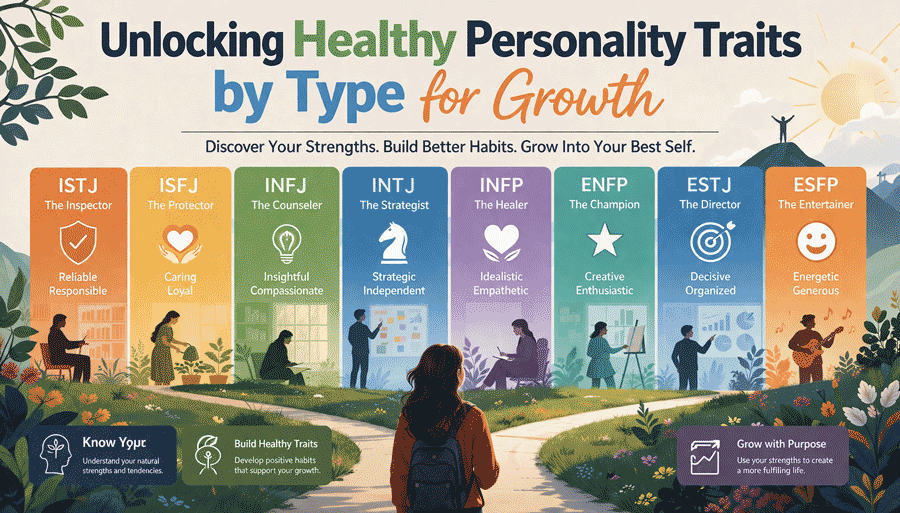
Healthy Personality Traits by Cognitive Function
To cultivate healthy personality traits by type, you must understand the healthy expression of each cognitive function. This section breaks down the eight functions and how they manifest positively across different types.
Perceiving Functions: How You Gather Information
Introverted Sensing (Si): Healthy Si involves respecting past experiences and maintaining stability. Types like ISTJ and ISFJ use this to create reliable systems and care for others consistently. A healthy Si user honors tradition without being stuck in it. They remember details that ensure safety and comfort.
Extraverted Sensing (Se): Healthy Se involves engaging fully with the present moment. Types like ESTP and ESFP use this to react quickly to physical realities. A healthy Se user is adaptable, appreciates aesthetics, and takes calculated risks. They do not indulge in excess but enjoy life’s textures.
Introverted Intuition (Ni): Healthy Ni involves synthesizing information into long-term visions. Types like INTJ and INFJ use this to foresee outcomes. A healthy Ni user is strategic and insightful. They trust their hunches but verify them with data. They do not become detached from reality.
Extraverted Intuition (Ne): Healthy Ne involves generating possibilities and connections. Types like ENTP and ENFP use this to innovate. A healthy Ne user is curious and open-minded. They explore many options without becoming scattered. They inspire others with potential.
Judging Functions: How You Make Decisions
Introverted Thinking (Ti): Healthy Ti involves seeking logical precision and internal consistency. Types like INTP and ISTP use this to analyze systems. A healthy Ti user is objective and fair. They clarify concepts without being overly critical. They value truth over harmony.
Extraverted Thinking (Te): Healthy Te involves organizing the external world for efficiency. Types like ENTJ and ESTJ use this to execute plans. A healthy Te user is decisive and productive. They set clear goals and mobilize resources. They do not bulldoze others but lead effectively.
Introverted Feeling (Fi): Healthy Fi involves adhering to personal values and authenticity. Types like INFP and ISFP use this to maintain integrity. A healthy Fi user is compassionate and self-aware. They stand up for what is right without being self-righteous. They respect their own emotions.
Extraverted Feeling (Fe): Healthy Fe involves maintaining group harmony and social connection. Types like ENFJ and ESFJ use this to support others. A healthy Fe user is empathetic and diplomatic. They read the room accurately. They do not sacrifice their needs entirely for others.
Application Guidance for Personal Development
Understanding functions is theoretical; applying them is practical. Here are two frameworks to help you integrate healthy personality traits by type into your daily life.
Framework 1: Cognitive Function Development Path
When it applies: This framework is best for long-term personal growth and career planning. It relates to the dynamic between your dominant and inferior functions.
Practical Action Steps: First, identify your dominant function. If you are an INFJ, your dominant is Ni. Lean into this by setting aside time for strategic reflection. Second, strengthen your auxiliary. For INFJ, this is Fe. Practice active listening and community building. Third, acknowledge your inferior function. For INFJ, this is Se. Do not try to make it your dominant strength. Instead, engage it in low-stakes ways, like exercise or cooking, to relieve stress.
Benefits and Limitations: The benefit is sustainable growth that aligns with your nature. You do not burn out trying to be someone else. The limitation is that it requires patience. Developing the inferior function takes years, not weeks.
How to judge fit: If you feel energized after practicing a trait, it likely aligns with your dominant or auxiliary. If you feel drained but accomplished, it may be inferior function development. If you feel constantly exhausted and inauthentic, you may be forcing a non-preferred function.
Framework 2: Relationship and Communication Guidance
When it applies: Use this for improving conflicts with partners, colleagues, or family. It relates to how different types process information and values.
Practical Action Steps: Identify the other person’s likely preference. If they are a Thinker, present logical consequences rather than emotional appeals. If they are a Sensor, provide concrete examples rather than abstract theories. For example, when discussing a project with an ESTJ, focus on timelines and metrics. With an ENFP, focus on the vision and creative possibilities.
Benefits and Limitations: The benefit is reduced friction and clearer understanding. You stop taking differences personally. The limitation is that you cannot control the other person’s reactions. Also, do not assume type explains all behavior; stress and context matter.
How to judge fit: If communication becomes smoother and conflicts resolve faster, the approach is working. If you feel like you are walking on eggshells, you may be over-accommodating. Balance adaptation with authenticity.
Principles of Healthy Growth
Growth is not about changing who you are; it is about becoming a healthier version of your type. Several universal principles apply to all types when seeking healthy personality traits by type.
Identify the Dominant Function First: Your dominant function is your superpower. Neglecting it leads to dissatisfaction. Ensure your daily life allows you to use it. An Introverted Thinker needs time to analyze; an Extraverted Feeler needs social interaction.
Distinguish Preference from Skill: You can develop skills outside your preference. An Introvert can learn public speaking. A Feeler can learn data analysis. However, using non-preferred skills costs more energy. Recognize this cost and budget your energy accordingly.
Develop the Inferior Function Gradually: The inferior function is often the source of mid-life growth. As you mature, you integrate it. An INTJ might learn to appreciate spontaneous sensory experiences (Se). Do this gently. Forcing it causes stress.
Explain Loop and Grip Patterns: Under stress, types may skip their auxiliary function and enter a “loop” or “grip.” For example, an INFP under stress might loop between Ni and Fi, becoming paranoid and isolated. Recognizing this pattern helps you return to balance. Engage your auxiliary function to break the loop. For an INFP, this means connecting with others (Fe) or taking action (Te).
Growth Means Flexibility, Not Identity Attachment: Do not use your type as an excuse. “I am an INTP, so I don’t do emotions” is a trap. Use the type to understand your default, then stretch beyond it when necessary. Healthy maturity looks similar across all types: responsibility, empathy, and adaptability.
Common Mistakes and Pitfalls to Avoid
When exploring healthy personality traits by type, several pitfalls can hinder progress. Avoid these eight common mistakes.
1. Don’t treat the four letters as a horoscope. Explanation: MBTI describes preferences, not destiny. Alternative Mindset: Use it as a starting point for self-inquiry, not a final verdict.
2. Don’t stereotype other types. Explanation: Assuming all Thinkers are cold or all Feelers are irrational creates bias. Alternative Mindset: View each individual as unique, with type being just one layer.
3. Don’t ignore the cognitive functions. Explanation: Letters alone lack mechanistic depth. Alternative Mindset: Study the function stack to understand the “why” behind behaviors.
4. Don’t force your inferior function too early. Explanation: Trying to be an expert in your weak spot leads to burnout. Alternative Mindset: Engage the inferior function for rest and balance, not primary performance.
5. Don’t use type to excuse bad behavior. Explanation: “I’m just being honest” is not a pass for rudeness. Alternative Mindset: Take responsibility for the impact of your actions regardless of intent.
6. Don’t rely solely on online tests. Explanation: Free tests often lack validity and reliability. Alternative Mindset: Use tests as hints, but validate through study and self-observation.
7. Don’t assume type determines career success. Explanation: Any type can succeed in any field with the right strategies. Alternative Mindset: Focus on aligning work tasks with your energy sources, not just job titles.
8. Don’t neglect the context of stress. Explanation: Behavior changes under high stress. Alternative Mindset: Observe how you react under pressure to confirm type, not just how you act on vacation.
Ongoing Learning and Credible Resources
The field of personality psychology is evolving. To maintain accuracy, readers should keep following new research and higher-quality resources. Avoid low-quality summaries that reduce types to memes.
Credible organizations include the Myers & Briggs Foundation, which holds the trademark and provides official information. The Center for Applications of Psychological Type (CAPT) offers research-based insights. Jungian educational resources provide the theoretical backbone. When evaluating information, check if the author cites function theory or just stereotypes. Look for nuance. Debates and newer interpretations are healthy; they show the field is alive. Ways to identify reliable information include checking for peer-reviewed references, avoiding absolute claims, and seeing if the content encourages growth rather than labeling.
Remember, MBTI is a tool for understanding preferences, not a label that defines the whole person. It is scientifically contested in some academic circles, so maintain a measured perspective. Use it for practical utility, not as absolute truth.
Frequently Asked Questions (FAQ)
1. Where should a beginner start with MBTI?
Start by reading about the four dichotomies to understand the basic language. Then, move quickly to cognitive functions. Take a reputable test as a baseline, but do not treat the result as final. Observe your own energy levels after different activities.
2. How can I confirm my type without tests?
Focus on your stress reactions. What do you do when everything goes wrong? Do you withdraw (Introversion) or seek people (Extraversion)? Do you plan (Judging) or adapt (Perceiving)? Ask trusted friends for feedback on your blind spots. Long-term patterns are more reliable than a single quiz.
3. How does type affect relationship communication?
Type influences how you express care and resolve conflict. Thinkers may offer solutions, while Feelers may offer empathy. Knowing this helps you translate your partner’s language. It reduces misunderstandings where one person feels unheard and the other feels unappreciated.
4. What is the most efficient way to learn cognitive functions?
Study one function at a time. Compare how an Ni-dom (INTJ/INFJ) differs from an Ne-dom (ENTP/ENFP). Look for real-life examples. Keep a journal of your decision-making processes to see which functions you are using.
5. Can my personality type change over time?
Your core preferences generally remain stable, like handedness. However, your expression of them matures. You may develop skills that look like opposite preferences. This is growth, not type change. If you feel your type has changed, you may have been mistyped initially.
Conclusion
Exploring healthy personality traits by type is a journey toward self-mastery. By grounding your understanding in cognitive functions, you avoid the traps of stereotyping and superficial labeling. You learn to leverage your natural strengths while compassionately developing your weaker areas. Whether you are seeking career fit, better relationships, or personal peace, the MBTI framework offers valuable maps. Remember to stay flexible, keep learning from credible sources, and prioritize real-world application over theoretical perfection. Your type is a starting point, not an endpoint. Use it to build a life that honors who you are while expanding who you can become.