
MBTI Personality Types Diagram: Complete Guide to the 16 Personalities
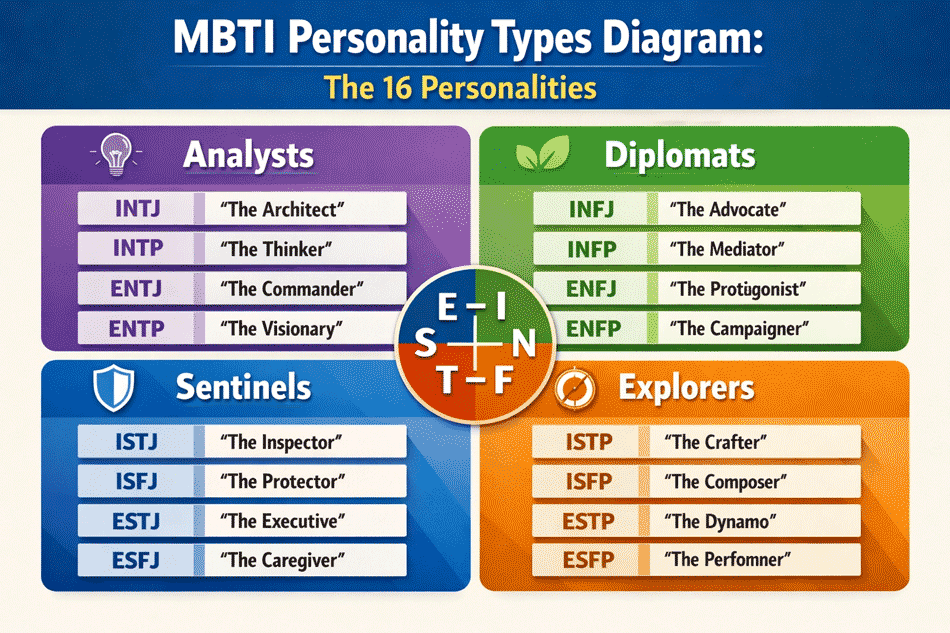
The MBTI personality types diagram is one of the easiest ways to understand the 16 Myers-Briggs personality types. At first glance, it may look like a simple chart of letters. In reality, it represents a deeper framework for understanding how people take in information, make decisions, communicate, and develop over time.
For beginners, the diagram offers a clear introduction to personality theory. For more experienced readers, it opens the door to understanding cognitive functions, type dynamics, and the differences between surface behavior and inner motivation. Whether you want to understand yourself better, improve relationships, or make smarter career choices, the MBTI personality types diagram can be a useful starting point.
In this guide, you will learn what the MBTI diagram means, how the 16 personality types are organized, how cognitive functions shape each type, and how to use the framework in real life. You will also learn the most common mistakes people make when interpreting MBTI and how to avoid them.
What Is the MBTI Personality Types Diagram?
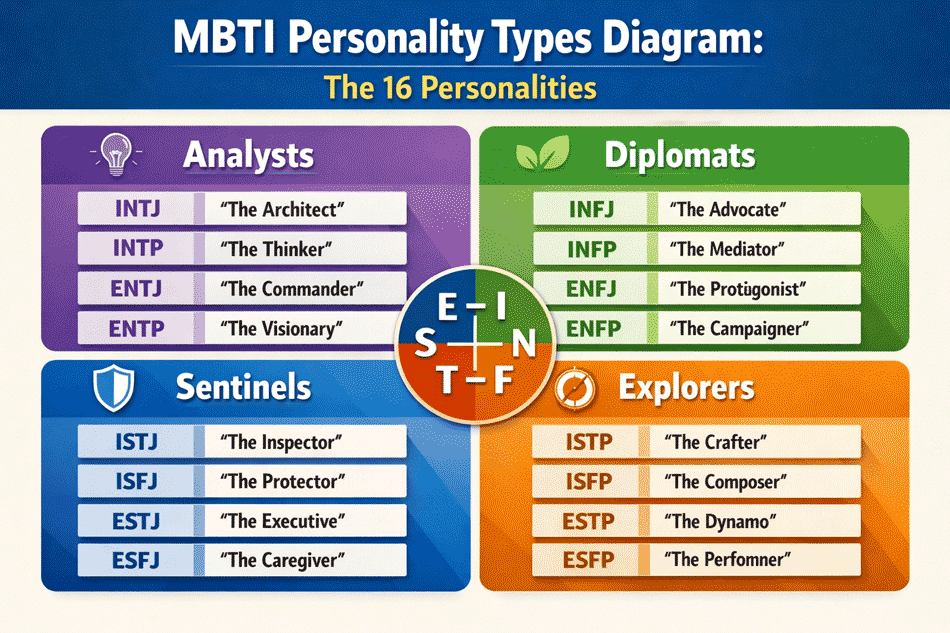
The MBTI personality types diagram is a visual representation of the 16 personality types in the Myers-Briggs Type Indicator system. Each type is built from four preference pairs:
- Extraversion (E) vs. Introversion (I)
- Sensing (S) vs. Intuition (N)
- Thinking (T) vs. Feeling (F)
- Judging (J) vs. Perceiving (P)
These four dimensions combine to create 16 unique personality types, such as INFJ, ENFP, ISTJ, and ENTJ. A diagram helps people see how these types relate to one another and how small shifts in preference can create meaningful differences in personality.
At a basic level, the MBTI diagram is a personality chart. At a deeper level, it is a map of cognitive preferences. It shows that people are not random in how they think or behave. Instead, they tend to rely on certain mental patterns more naturally than others.
Why the MBTI Diagram Matters
Many people discover MBTI through an online test, but test results alone do not always provide a full or accurate picture. The diagram matters because it helps move the conversation beyond labels and toward understanding patterns.
A good MBTI personality diagram can help you:
- understand how the 16 types are connected
- recognize broad differences in communication and decision-making
- explore your strengths and blind spots
- understand why people respond differently to the same situation
- study cognitive functions in a more organized way
Used properly, the MBTI diagram is not a box that limits people. It is a tool that helps people reflect on how they naturally operate and where they can grow.
How the 16 MBTI Personality Types Are Organized
The 16 MBTI personality types can be grouped in different ways depending on the diagram or model being used. Some charts organize them by shared traits. Others group them by temperament, cognitive functions, or broader personality families.
A common way to understand the 16 personalities is through the four letters:
- The first letter shows where you tend to focus your energy: inward or outward.
- The second shows how you prefer to gather information: through facts or patterns.
- The third shows how you prefer to make decisions: through logic or values.
- The fourth shows how you prefer to approach the outside world: with structure or flexibility.
Even this basic structure is useful. For example, Sensing types often pay more attention to practical details and direct experience, while Intuitive types often focus more on meaning, ideas, and future possibilities. Thinking types may prioritize consistency and analysis, while Feeling types often weigh values and human impact more heavily.
These patterns do not define a person completely, but they do provide a useful starting point for understanding personality differences.
The 16 MBTI Personality Types at a Glance
Here is a simple overview of the 16 personality types commonly shown in an MBTI personality types diagram:
Analysts
- INTJ – strategic, independent, future-focused
- INTP – analytical, curious, idea-driven
- ENTJ – decisive, goal-oriented, organized
- ENTP – inventive, energetic, adaptable
Diplomats
- INFJ – insightful, idealistic, people-aware
- INFP – reflective, values-driven, creative
- ENFJ – supportive, persuasive, growth-focused
- ENFP – enthusiastic, imaginative, people-centered
Sentinels
- ISTJ – reliable, practical, detail-oriented
- ISFJ – caring, responsible, steady
- ESTJ – structured, efficient, direct
- ESFJ – helpful, organized, relationship-oriented
Explorers
- ISTP – logical, hands-on, independent
- ISFP – gentle, artistic, adaptable
- ESTP – bold, action-oriented, resourceful
- ESFP – expressive, spontaneous, engaging
These descriptions are helpful as quick summaries, but they should never replace deeper study. The real depth of MBTI comes from understanding cognitive functions, not just the four-letter code.
Understanding MBTI Cognitive Functions
To fully understand the MBTI personality types diagram, you need to look beyond the letters. Each personality type is associated with a stack of cognitive functions that explains how a person naturally perceives information and makes decisions.
There are eight cognitive functions in total:
- Se – Extraverted Sensing
- Si – Introverted Sensing
- Ne – Extraverted Intuition
- Ni – Introverted Intuition
- Te – Extraverted Thinking
- Ti – Introverted Thinking
- Fe – Extraverted Feeling
- Fi – Introverted Feeling
Each type uses four of these functions more consciously, usually in this order:
- Dominant
- Auxiliary
- Tertiary
- Inferior
For example, an INFJ is often described as using:
- Dominant Ni
- Auxiliary Fe
- Tertiary Ti
- Inferior Se
This function stack explains why INFJs may appear intuitive, future-focused, emotionally aware, and reflective. The same principle applies to all 16 types.
Cognitive functions matter because they explain how a type works internally. Two people may share similar outward traits but still think very differently depending on their cognitive preferences.
Why Cognitive Functions Matter More Than Stereotypes
Many online discussions reduce MBTI to simple stereotypes. Introverts are described as shy. Thinkers are described as cold. Feelers are described as emotional. Perceivers are described as messy. These simplifications may sound familiar, but they are often misleading.
Cognitive functions offer a more accurate framework. They help explain why someone behaves a certain way, what motivates them, and how they respond under pressure. Instead of asking whether a person is “organized” or “emotional,” cognitive functions help you ask better questions:
- Do they trust direct experience or inner insight?
- Do they prioritize internal logic or external efficiency?
- Do they make decisions through personal values or social harmony?
This deeper approach makes the MBTI personality types diagram far more useful for self-awareness and growth.
How to Identify Your MBTI Type More Accurately
Many people first encounter MBTI through free online tests. These tests can be useful as an introduction, but they are not always reliable. Mood, life stage, stress, and question wording can all affect results.
A more accurate way to identify your type includes:
1. Study the four preference pairs
Start with the basics. Learn what Extraversion, Introversion, Sensing, Intuition, Thinking, Feeling, Judging, and Perceiving actually mean in MBTI terms.
2. Learn your cognitive functions
Read about function stacks and compare the types that seem most relevant to you.
3. Observe yourself over time
Look for long-term patterns instead of isolated moments. Your true type is usually seen in how you consistently process information and make decisions.
4. Notice your stress patterns
Under stress, people often react through their inferior function. These reactions can offer clues about their deeper type structure.
5. Get outside feedback
Trusted friends, coaches, or practitioners may notice patterns that you miss.
The goal is not to force yourself into a label. The goal is to understand which patterns genuinely feel natural and sustainable over time.
How the MBTI Diagram Helps in Real Life
The MBTI personality types diagram becomes most useful when it is applied to everyday life. It can offer insight in areas like work, relationships, learning, and personal development.
Career Development
MBTI can help people identify work styles that match their natural preferences. For example:
- A highly structured person may prefer stable systems, deadlines, and clear expectations.
- A big-picture thinker may enjoy strategy, innovation, or concept-driven work.
- A people-focused type may thrive in coaching, teaching, or collaborative environments.
- A practical, action-oriented type may prefer hands-on work and immediate problem-solving.
This does not mean each type only fits one career. It means personality patterns can help explain why some environments feel more energizing than others.
Relationships and Communication
One of MBTI’s most practical uses is improving communication. Conflict often happens because people prioritize different things.
For example:
- A Thinking type may focus on logic, consistency, and problem-solving.
- A Feeling type may focus on harmony, values, and emotional impact.
- A Judging type may want closure and plans.
- A Perceiving type may prefer flexibility and open options.
When people understand these differences, they are less likely to interpret them as personal flaws. The MBTI diagram gives language to these patterns, making conversations more productive and more respectful.
Personal Growth
MBTI can also support growth by helping people identify strengths and development areas. A person who naturally relies on one style of thinking may benefit from practicing a less preferred approach in small, intentional ways.
Growth in MBTI is not about becoming a different type. It is about becoming a more balanced version of your own type.
Developing Your Function Stack
Personal growth within MBTI often follows a gradual pattern.
Strengthen Your Dominant Function
Your dominant function is your natural strength. It usually feels effortless and energizing. Growth begins by understanding and using that strength wisely.
Support It With the Auxiliary Function
The auxiliary function helps create balance. It often connects your inner preferences to the outside world. Strengthening it usually leads to greater maturity and adaptability.
Work Gently With the Tertiary and Inferior Functions
These lower functions often represent both challenge and growth potential. They should be developed gradually, not forced. Trying to overuse them too quickly can create stress and confusion.
For example, someone who prefers internal analysis may benefit from learning how to communicate decisions more clearly. Someone who naturally focuses on harmony may benefit from practicing more objective analysis when needed.
The healthiest use of MBTI is developmental, not restrictive.
MBTI Compatibility: What the Diagram Can and Cannot Tell You
Many people search for the best MBTI matches or the most compatible personality types. The MBTI personality types diagram can be helpful here, but only to a point.
It can show where people may naturally complement one another. For example:
- one person may generate possibilities while another creates structure
- one may focus on emotional nuance while another brings clarity and logic
- one may prefer action while another prefers reflection
These differences can create balance, but they can also create friction if they are not understood.
Compatibility is not determined by type alone. Healthy relationships depend on communication, maturity, values, trust, and effort. MBTI can support understanding, but it should never be used as a shortcut to judge whether a relationship can work.
Common Mistakes People Make With MBTI
MBTI is useful, but only when used carefully. Here are some of the most common mistakes to avoid.
Treating Type as a Fixed Label
Your type describes preferences, not limits. It should never be used as an excuse for bad habits or poor behavior.
Relying Only on Online Tests
Tests are a starting point, not a final answer. Real understanding usually comes from long-term observation and deeper study.
Stereotyping Other People
Not all introverts are quiet. Not all extraverts are loud. Not all feelers are soft. Not all thinkers are harsh. Individual variation matters.
Ignoring Context
People behave differently in different environments. A single moment does not define a type. Patterns over time matter more.
Valuing One Type Over Another
No type is better than another. Every type brings strengths, limitations, and useful perspectives.
Using MBTI to Judge Instead of Understand
MBTI should increase empathy, not reduce people to categories.
Is the MBTI Scientifically Perfect?
MBTI is widely used in coaching, education, workplace development, and personal reflection, but it also has limitations. It should not be treated as a perfect scientific measurement or as a complete description of personality.
Its value lies in giving people a practical language for understanding recurring patterns in cognition, communication, and behavior. When used with humility and common sense, it can be a powerful reflective tool. When used as an absolute truth, it becomes much less helpful.
A balanced approach works best:
- use MBTI for insight, not certainty
- use it to explore patterns, not predict everything
- use it to support growth, not avoid it
Frequently Asked Questions About the MBTI Personality Types Diagram
What does the MBTI personality types diagram show?
It shows how the 16 Myers-Briggs personality types are organized based on four personality preferences. It can also serve as a starting point for understanding cognitive functions and type dynamics.
Is the MBTI diagram the same as the 16 personalities chart?
They are related, but not always identical in format. Some diagrams focus on four-letter types, while others include temperament groups, cognitive functions, or other frameworks.
How can I find my MBTI type?
Start with the four preference pairs, then study cognitive functions and observe your long-term behavior patterns. Tests can help, but they should not be your only source.
Can my MBTI type change?
Your core preferences are usually fairly stable, but the way you express them can change as you mature, gain experience, and develop your less preferred functions.
Why do cognitive functions matter in MBTI?
Cognitive functions explain how a type works internally. They offer a deeper and more accurate understanding than four-letter stereotypes alone.
Can MBTI improve relationships?
It can improve communication by helping people understand different priorities, processing styles, and decision-making patterns. However, strong relationships still depend on effort, respect, and maturity.
Final Thoughts
The MBTI personality types diagram is more than a chart of the 16 personalities. It is a practical framework for understanding how people think, decide, communicate, and grow. For beginners, it offers a simple way into personality theory. For more advanced readers, it provides a foundation for exploring cognitive functions and deeper type dynamics.
The most effective way to use MBTI is with curiosity, not rigidity. Use it to understand your natural patterns. Use it to improve communication. Use it to grow. The real purpose of the MBTI diagram is not to put people in boxes, but to help them understand the patterns of their minds more clearly.