
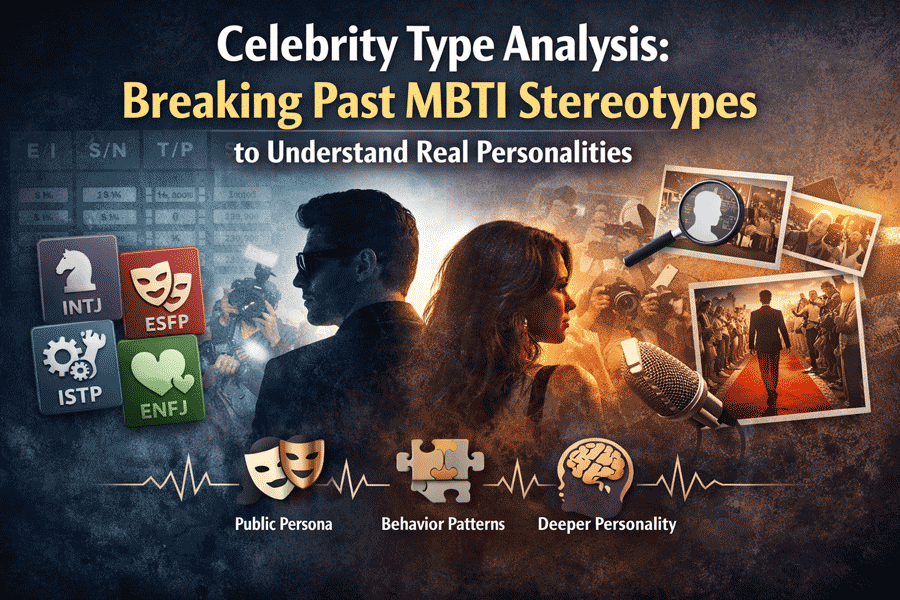
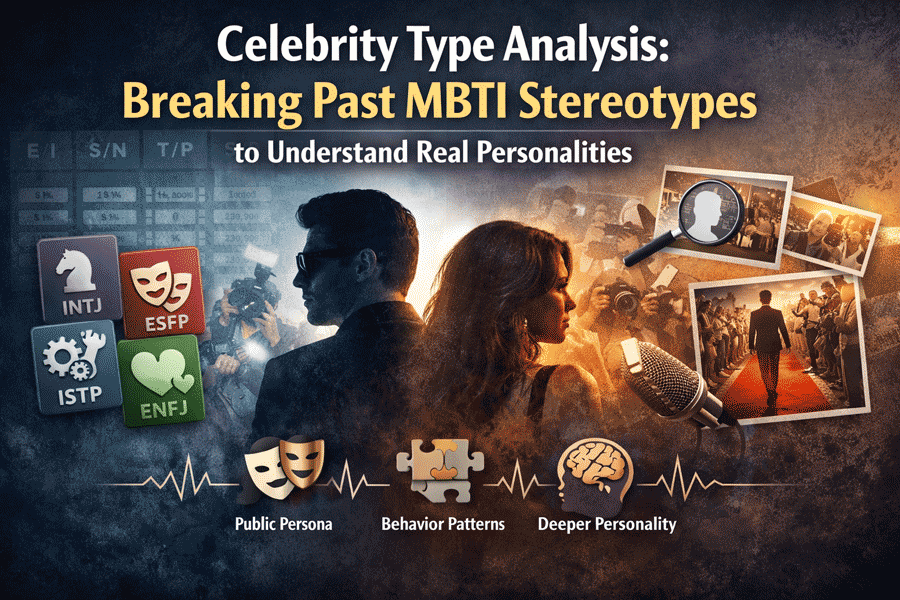
When people search for celebrity type analysis, they are often looking for a mirror. They want to see themselves in someone famous, successful, or relatable. However, relying solely on four-letter codes found in online databases can lead to significant misunderstandings about personality structure. The core conclusion is simple: accurate typing requires moving beyond surface behaviors to understand the underlying cognitive functions. Without this depth, celebrity examples become stereotypes rather than tools for self-discovery.
The Myers-Briggs Type Indicator (MBTI) is a powerful framework for understanding psychological preferences. It helps individuals identify how they perceive the world and make decisions. It is useful for anyone seeking clarity on their communication style, career fit, or relationship dynamics. However, the deeper application of celebrity type analysis must return to cognitive functions. Letters are merely labels; functions are the engine. This article will guide you through the mechanics of type, practical applications for growth, and how to avoid common pitfalls when using public figures as reference points.
The Mechanism Behind the Types
To understand why celebrity typing is often controversial, we must look at the roots of the system. The MBTI is based on Carl Jung’s theory of psychological types. Jung proposed that people have innate preferences in how they direct their energy, gather information, make decisions, and organize their lives. The MBTI categorizes these preferences into four dichotomies: Extraversion (E) vs. Introversion (I), Sensing (S) vs. Intuition (N), Thinking (T) vs. Feeling (F), and Judging (J) vs. Perceiving (P).
While these dichotomies create the 16 types, they do not explain how the mind processes information. That is the role of cognitive functions. Each type uses a stack of four functions: dominant, auxiliary, tertiary, and inferior. For example, an INTJ leads with Introverted Intuition (Ni), supported by Extraverted Thinking (Te). An ENFP leads with Extraverted Intuition (Ne), supported by Introverted Feeling (Fi). These functions dictate decision-making style and communication patterns far more accurately than the letters alone.
Why Letter-Based Typing Causes Mistypes
When analyzing celebrities, observers often focus on behavior. They see a charismatic performer and assume Extraversion. They see a meticulous actor and assume Judging. However, behavior is adaptable. An Introvert can learn to speak publicly; a Perceiver can learn to meet deadlines. This is why letter-based typing alone often causes mistypes. A celebrity might exhibit “T” behaviors in a professional setting but operate from a “F” framework in personal relationships.
True type confirmation comes from self-observation. It requires looking at decision patterns, stress reactions, motivation, and blind spots. It also involves long-term feedback from others who know you in vulnerable moments. For instance, a person might test as an ENTJ because they are ambitious. But if their ambition is driven by a desire for social harmony (Fe) rather than systemic efficiency (Te), they may actually be an ENFJ. This nuance is lost in simple celebrity lists.
Illustrative Examples
Consider a figure like Steve Jobs. He is widely believed to be an INTJ or ENTJ due to his visionary leadership. However, some analysts argue his focus on design aesthetics and user experience suggests a strong Sensing or Feeling component, perhaps indicating an ENTP or INFJ structure. Without access to his internal cognitive processes, we cannot be certain. Similarly, Marilyn Monroe is often typed as an ESFP due to her performative nature, yet her introspective writings suggest a depth often associated with Introverted Intuition. These examples serve to illustrate that public persona is not always private reality.
Practical Frameworks for Application
Understanding type is not an academic exercise; it is a tool for living. Below are two practical frameworks to apply these concepts to your life, moving beyond simple celebrity comparisons.
Framework 1: Relationship and Communication Guidance
When it applies: This framework is essential for couples, family members, or colleagues experiencing friction. It helps explain why two people can look at the same situation and see entirely different realities.
Type Dynamics: This relates to how different functions prioritize information. For example, a Thinking type may prioritize logic and consistency, while a Feeling type prioritizes values and group harmony. An Intuitive type may focus on future possibilities, while a Sensing type focuses on present facts.
Practical Action Steps:
- Identify the Conflict Source: Is the disagreement about facts (S vs N), logic vs values (T vs F), or structure vs flexibility (J vs P)?
- Translate Needs: If you are an N type speaking to an S type, provide concrete examples rather than abstract theories. If you are a T type speaking to an F type, acknowledge the emotional impact before presenting the logic.
- Validate Differences: Recognize that your partner’s approach is not wrong, just different. An INTJ’s need for solitude is not a rejection of an ESFJ’s need for connection; it is a recharge mechanism.
Benefits and Limitations: The benefit is reduced friction and increased empathy. You stop taking differences personally. The limitation is that type should not be used as an excuse for bad behavior. “I’m just a Perceiver” is not a valid reason for chronic lateness.
Judging Fit: Readers can judge whether this fits them by observing if their conflicts decrease when they adjust their communication style to match their partner’s preferences.
Framework 2: Career and Work-Style Fit
When it applies: Use this when choosing a career path, negotiating work responsibilities, or seeking professional development.
Type Dynamics: This relates to energy management and motivation. Extraverts may thrive in collaborative environments, while Introverts may need deep work blocks. Thinking types may prefer objective criteria for success, while Feeling types may need to see the human impact of their work.
Practical Action Steps:
- Audit Your Energy: Track which tasks drain you and which energize you over a two-week period. Map these to your function stack. Does detailed data entry drain your Ne? Does strategic planning energize your Ni?
- Negotiate Roles: If you are an INFP in a corporate role, negotiate for projects that allow for creative autonomy rather than rigid compliance.
- Seek Complementary Partners: In team settings, partner with someone who has complementary strengths. An ENTJ leader might benefit from an ISFP team member who notices the morale issues the leader misses.
Benefits and Limitations: The benefit is higher job satisfaction and productivity. The limitation is that no job is perfect for any type. Every role requires some use of non-preferred functions.
Judging Fit: You know this fits when you feel less exhausted at the end of the workday and more engaged in your tasks.
Pathways to Personality Growth
MBTI type is a starting point, not an endpoint. Growth means expanding your capacity to use all functions, not just your favorites. Here are universal principles for development.
Identify the Dominant Function First
Your dominant function is your superpower. It is where you are most natural and confident. For growth, you must first trust this function. If you are an ISTP (dominant Ti), do not try to become an FEELER first. Strengthen your logical analysis. Confidence in your strength provides the stability needed to explore weaknesses.
Distinguish Preference from Skill
You can be skilled at something you do not prefer. An Introvert can be a great public speaker. This is a skill, not a change in type. Do not mistype yourself because you have developed skills in your non-preferred areas. Acknowledge the effort it costs you.
Develop the Inferior Function Gradually
The inferior function is your blind spot and your source of growth. For an INTJ, this is Extraverted Sensing (Se). For an ESFP, it is Introverted Intuition (Ni). Engaging this function often feels clumsy or stressful at first. An INTJ might force themselves to be spontaneous; an ESFP might force themselves to plan long-term. Do this in small doses. Overdevelopment of the inferior function too quickly can lead to burnout.
Explain Loop and Grip Patterns
Under stress, types may bypass their auxiliary function and fall into a “loop.” An INFP (Ni-Fi loop) might become overly introspective and detached from reality. In extreme stress, they may fall into the “grip” of their inferior function. An INFJ in grip might become uncharacteristically impulsive or sensory-focused. Recognizing these patterns helps you return to balance. If you notice yourself in a grip, prioritize rest and return to your dominant function’s strengths.
Growth Means Flexibility, Not Identity Attachment
Do not attach your identity to your type. You are not “an INTJ.” You are a person who currently prefers INTJ patterns. Growth means becoming flexible enough to use Thinking when Feeling is needed, or Sensing when Intuition is required. The goal is wholeness, not purity of type.
Common Pitfalls in Typing
To maintain accuracy and objectivity, avoid these eight common mistakes when exploring personality types.
- Don’t rely solely on online tests. Tests measure self-perception, which can be biased. Use them as a starting point, not a diagnosis. Better alternative: Study cognitive functions and observe your own behavior over time.
- Don’t type others without consent. Armchair typing friends or celebrities can be reductive. Better alternative: Discuss preferences openly with people you know well.
- Don’t use type to excuse bad behavior. “I’m a Perceiver” is not an excuse for irresponsibility. Better alternative: Use type to understand challenges, then build systems to overcome them.
- Don’t assume stereotypes are facts. Not all Thinkers are cold; not all Feelers are irrational. Better alternative: Look at the underlying cognitive process, not the social stereotype.
- Don’t ignore the context. Behavior changes based on environment. A person may look different at work than at home. Better alternative: Observe patterns across multiple contexts.
- Don’t treat type as static. While preferences are innate, expression evolves. Better alternative: Re-evaluate your understanding of your type every few years.
- Don’t prioritize letters over functions. The four letters are a summary, not the mechanism. Better alternative: Learn the function stack (e.g., Ne-Fi-Te-Si) for your type.
- Don’t seek validation through celebrities. Just because a successful person is typed as your type doesn’t guarantee your success. Better alternative: Focus on your own unique path and strengths.
Continuing Your Journey
The field of personality psychology is evolving. To maintain a high-quality understanding, readers should keep following new research and higher-quality MBTI and Jungian resources. Credible organizations such as the Myers & Briggs Foundation and the Center for Applications of Psychological Type (CAPT) provide foundational data. Jungian educational resources also offer depth on the original theories.
Be wary of low-quality summaries on social media. Memes and short videos often reduce complex psychological concepts to entertainment. Look for debates and newer interpretations that challenge the status quo. Ways to identify reliable information include checking author credentials, looking for citations of original theory, and avoiding content that promises “quick fixes” for personality issues.
Engage with communities that prioritize depth. Discuss cognitive functions rather than just letters. Read case studies. The more you understand the nuance, the less you will rely on simplistic celebrity type analysis to define yourself or others.
Frequently Asked Questions
1. Where should a beginner start with MBTI?
Start by understanding the four dichotomies, but quickly move to cognitive functions. Read introductory books from credible publishers. Take a test to get a baseline, but do not treat the result as final. Observe your own energy levels and decision-making processes.
2. How can I confirm my type without tests?
Focus on your stress responses. What do you do when you are exhausted? What topics do you naturally gravitate towards in conversation? Ask trusted friends how they perceive your decision-making style. Compare these observations with function descriptions rather than type summaries.
3. How does type affect relationship communication?
Type influences how you express care and conflict. Thinking types may show love through problem-solving, while Feeling types may show it through emotional validation. Understanding these differences prevents misinterpretation of intent.
4. What is the most efficient way to learn cognitive functions?
Study one function at a time. For example, spend a week observing Extraverted Intuition (Ne) in yourself and others. Then move to Introverted Sensing (Si). Compare how they differ. Practical observation is more effective than rote memorization.
5. Can my personality type change over time?
Your core preferences are generally stable, like handedness. However, your ability to use non-preferred functions improves with age and maturity. You may test differently during high stress or major life transitions, but your underlying orientation usually remains consistent.
6. What if I resonate with multiple types?
Partial resonance is common because everyone uses all eight functions. Look for the type where the description of the struggles matches yours, not just the strengths. Also, consider if you are mistyping due to social conditioning or work requirements.
7. Is celebrity type analysis reliable?
It is speculative. Celebrities curate their public image. Use celebrity examples only as illustrative tools for understanding functions, not as definitive proof of how a type must behave.
Conclusion
Ultimately, celebrity type analysis is a gateway, not a destination. It draws us in with familiar faces, but the real value lies in the internal work of understanding our own minds. By focusing on cognitive functions, respecting the complexity of human behavior, and avoiding stereotypes, we can use the MBTI as a tool for genuine connection and growth. Whether you are navigating a relationship, choosing a career, or seeking self-knowledge, remember that the letters are just the map. You are the territory.