
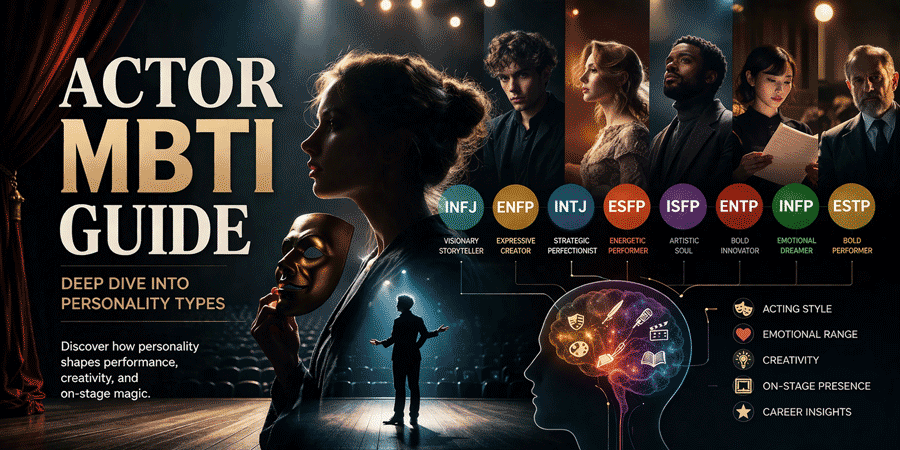
Executive Summary: The True Value of Actor MBTI Analysis
Welcome to Persona Key's definitive resource on understanding the actor mbti landscape. While many seekers initially arrive here to categorize famous performers, the true value lies in applying these insights to your own life. This guide serves as a comprehensive review and walkthrough of how personality typing functions beyond surface-level labels. Our core conclusion is straightforward: MBTI is a starting point, not an endpoint. Understanding your type requires diving deep into cognitive functions rather than relying on four-letter codes alone. Whether you are an aspiring performer analyzing your craft or an individual seeking personal growth, this article provides the framework to navigate personality theory with precision and objectivity.
The popularity of searching for an actor MBTI type often stems from a desire to see abstract concepts embodied in real people. However, accurate typing requires more than observing public personas. It demands an understanding of internal cognitive processes. This guide will walk you through the theoretical roots, practical applications, and common pitfalls of personality typing. We emphasize that while celebrities like Meryl Streep are often categorized as INFJs based on observed behavior, these are generalizations. Your journey is unique. By the end of this article, you will possess the tools to verify your own type through self-observation and understand how to leverage your cognitive stack for career and relationship success.
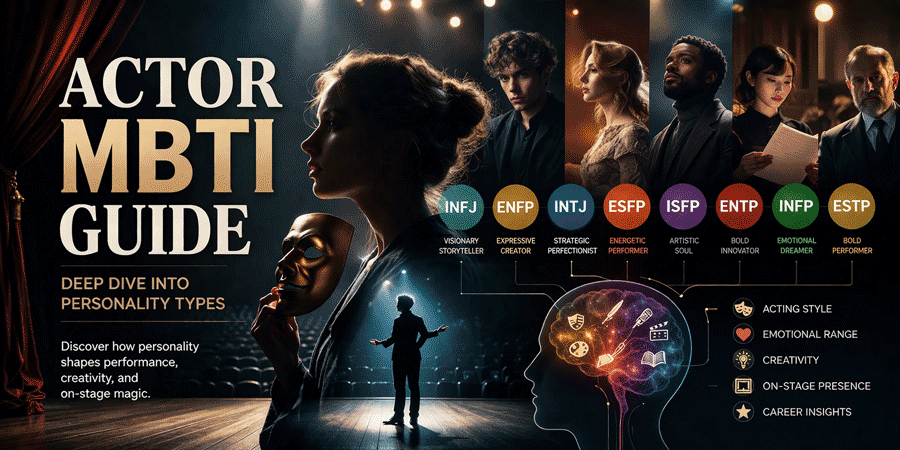
Theoretical Framework and Core Mechanisms
To truly grasp the significance of an actor MBTI classification, one must return to the theoretical roots established by Carl Jung and further developed by Katharine Cook Briggs and Isabel Briggs Myers. The Myers & Briggs Foundation emphasizes that type indicates preference, not ability. The system is built on four dichotomies: Extraversion vs. Introversion, Sensing vs. Intuition, Thinking vs. Feeling, and Judging vs. Perceiving. However, these letters are merely shorthand for the underlying cognitive function stack, which is the engine of personality.
Understanding the Cognitive Function Stack
Every personality type operates using a hierarchy of four primary cognitive functions. These determine how you perceive information and make decisions. The stack consists of the Dominant, Auxiliary, Tertiary, and Inferior functions. For example, an INFJ leads with Introverted Intuition (Ni), supported by Extraverted Feeling (Fe). Understanding this stack is crucial when analyzing an actor MBTI profile because public behavior often masks the dominant function. An actor might display Extraverted behavior on stage while remaining Introverted at their core.
The eight cognitive functions are: Se (Extraverted Sensing), Si (Introverted Sensing), Ne (Extraverted Intuition), Ni (Introverted Intuition), Te (Extraverted Thinking), Ti (Introverted Thinking), Fe (Extraverted Feeling), and Fi (Introverted Feeling). Each type uses a specific combination of these. For instance, Sensing types focus on concrete reality and details, while Intuitive types focus on patterns and possibilities. Thinking types prioritize logic and objective criteria, whereas Feeling types prioritize values and interpersonal harmony. Recognizing these nuances prevents superficial typing based solely on social behavior.
Verification Beyond Testing
Reliable typing cannot rely solely on online quizzes, which often measure mood rather than type. To verify your type, engage in rigorous self-observation. Track your energy levels: do social interactions drain or charge you? Analyze your decision-making: do you prioritize logical consistency or personal values? Seek feedback from trusted peers who observe you in low-stakes environments. When looking at celebrity examples, such as Leonardo DiCaprio, who is widely believed to be an INFP or ISFP, notice how their artistic choices reflect internal value systems (Fi) or sensory immersion (Se). Use these observations as mirrors, not definitions. Your goal is to identify your natural defaults under stress, not your idealized self.
Development Schemes and Practical Application
Knowing your type is useless without application. We propose two distinct schemes for leveraging your personality profile: Cognitive Function Strengthening and Relationship Adaptation. These strategies are designed to move you from awareness to action, ensuring that the concept of actor MBTI becomes a tool for tangible improvement rather than just trivia.
Scheme 1: Cognitive Function Strengthening
This scheme focuses on balancing your function stack. Most individuals overuse their dominant and auxiliary functions while neglecting the tertiary and inferior. For growth, you must intentionally exercise weaker functions. If you are a Thinking type, practice identifying and articulating emotions (Fe/Fi). If you are a Perceiving type, practice structured planning (Te/Si). Set specific weekly goals. For example, an ENTP might schedule a dedicated time for detailed administrative work to strengthen Si. An ISFJ might force themselves to brainstorm wild, unstructured ideas to develop Ne. This balanced development reduces burnout and increases adaptability. Research suggests that integrating the inferior function is key to mid-life maturity and psychological wholeness.
Scheme 2: Relationship Adaptation
In professional and personal relationships, type differences often cause friction. This scheme teaches you to translate your communication style. When working with a Thinking type, focus on data and logical outcomes. When collaborating with a Feeling type, acknowledge values and interpersonal impact. In intimate relationships, understand that your partner's stress response may differ from yours. An Introvert may need space to recharge, while an Extravert may need discussion. Use your knowledge of cognitive functions to depersonalize conflicts. Instead of saying "You are being irrational," say "I see you are prioritizing values over logic here." This shift fosters empathy. Whether analyzing on-screen chemistry or real-life partnerships, understanding these dynamics is crucial for long-term compatibility.
Function Cognition and Growth Mindset
Growth within the MBTI framework is not about changing your type but expanding your repertoire. The universal principle is to honor your dominant function while gradually developing your inferior function. Your dominant function is your superpower; it is where you feel most competent and energized. Protect time for activities that utilize this strength. However, reliance solely on the dominant function leads to rigidity. The inferior function represents your gateway to growth. It often emerges under stress as the "grip." Recognizing grip behavior is a vital signal to slow down and self-care.
For example, an INTJ dominated by Ni may become paralyzed by negative future visions when stressed. Recognizing this allows them to engage Se (physical activity, sensory grounding) to recover. Growth is a lifelong process. As you age, your relationship with your functions evolves. Early career may focus on auxiliary development for external success, while later stages focus on integrating the tertiary and inferior for internal balance. This perspective aligns with Jungian individuation, where the goal is becoming a whole self rather than a perfect type.
Common Mistakes and Pitfalls to Avoid
To maintain the integrity of your psychological journey, avoid these eight common traps. These errors undermine the value of personality theory and can lead to self-limiting beliefs.
1. Do Not Treat Type as an Excuse
Avoid using your type to justify negative behaviors. Saying "I am an INTP, so I don't need to listen to feelings" is harmful. Type explains preference, not obligation. You are responsible for adapting your behavior to meet life's demands regardless of your preferences. Growth requires stepping outside your comfort zone.
2. Do Not Stereotype Celebrities Definitively
When researching an actor MBTI profile, remember that public personas are curated. Avoid stating "He IS an ESTP" as absolute fact. Use phrases like "often typed as" or "displays traits of." We cannot know a celebrity's internal cognitive process without direct assessment. Treat celebrity types as hypothetical case studies, not proven data.
3. Do Not Limit Career Choices
Do not believe certain careers are forbidden for your type. While some environments suit certain types better, any type can succeed in any field with effort. An Introvert can be a successful salesperson by leveraging listening skills. Use type to optimize your workflow, not to restrict your opportunities.
4. Do Not Judge Others Harshly
Understanding type should increase empathy, not judgment. Avoid labeling others as "irrational" or "cold" based on their Thinking or Feeling preferences. Recognize that different functions solve problems differently. Diversity in cognitive styles strengthens teams and communities.
5. Do Not Rely Solely on Online Tests
Free online tests often lack validity and reliability. They measure current state rather than innate preference. Use test results as a starting hypothesis, not a diagnosis. Invest time in studying cognitive functions and reading authoritative literature to confirm your type.
6. Do Not Ignore Contextual Behavior
Behavior changes based on context. A person may appear Extraverted at work but Introverted at home. Do not type based on a single observation. Look for consistent patterns over time and across different environments. Contextual flexibility is a sign of health, not type inconsistency.
7. Do Not Neglect the Inferior Function
Ignoring your weaker functions leads to imbalance. If you only exercise your strengths, you become one-dimensional. Acknowledge your blind spots. Seek feedback on areas where you struggle. Integrating the inferior function is essential for resilience and mental health.
8. Do Not Treat Type as Static
While core preferences remain stable, expression evolves. Do not cling to a teenage understanding of your type. Re-evaluate your relationship with your functions as you gain life experience. Maturity brings nuance. Allow your understanding of yourself to deepen and change over time.
Version Updates and Resource Tracking
The field of personality psychology is evolving. While MBTI remains popular, new research on Big Five and cognitive neuroscience offers complementary insights. Stay updated by following the Myers & Briggs Foundation for official guidelines. Look for resources that integrate MBTI with modern psychological standards. Be wary of pop-psychology content that sensationalizes type differences for clicks. Prioritize books and articles written by certified practitioners. We recommend tracking developments in cognitive function theory, as this area offers the most depth for serious students. Join communities that focus on development rather than memorization. Quality over quantity is key when selecting information sources.
Frequently Asked Questions
1. How do I start learning MBTI as a beginner?
Begin by understanding the four dichotomies, then move quickly to cognitive functions. Read "Gifts Differing" by Isabel Briggs Myers for foundational knowledge. Avoid jumping straight into typing others. Focus on self-observation first. Keep a journal of your decisions and energy levels. This empirical approach builds a solid foundation before exploring complex type dynamics.
2. Can my MBTI type change over time?
Core preferences generally remain stable throughout life. However, your expression of these preferences can mature. You may develop skills in non-preferred areas, making you appear different. This is development, not type change. If you feel your type has changed, re-examine your understanding of the functions. You may have mistyped initially due to social conditioning or stress.
3. How does MBTI help in communication?
MBTI provides a vocabulary for differences. It helps you understand why someone prioritizes logic over harmony or details over big pictures. Use this knowledge to tailor your message. When communicating with a Sensor, be concrete. With an Intuitive, discuss concepts. This reduces misunderstanding and fosters collaboration in both personal and professional settings.
4. Is MBTI scientifically valid?
MBTI has critics regarding reliability and validity compared to Big Five. However, it remains a valuable tool for self-reflection and team building when used correctly. It is not a clinical diagnostic tool. Treat it as a framework for understanding preferences rather than a rigid scientific law. Combine it with other psychological insights for a holistic view.
5. How do I verify a celebrity's type?
You cannot verify it definitively. Use interviews, biographies, and observed behavior as clues. Look for consistency in their decision-making and energy sources. Compare these observations with cognitive function descriptions. Always use disclaimers when discussing celebrity types. Remember that their public image may differ from their private reality. Use them as learning tools, not absolute truths.
Conclusion: Empowering Your Journey
In conclusion, exploring the actor MBTI phenomenon is merely the entry point into a deeper understanding of human psychology. The true power of this system lies in self-awareness and intentional growth. By focusing on cognitive functions, avoiding common pitfalls, and applying practical development schemes, you can transform personality theory into a life skill. Remember that you are more than four letters. Your type is a map, but you are the traveler. Use this guide to navigate your path with confidence, empathy, and clarity. Continue to learn, question, and grow, knowing that the journey of understanding oneself is never truly complete.