
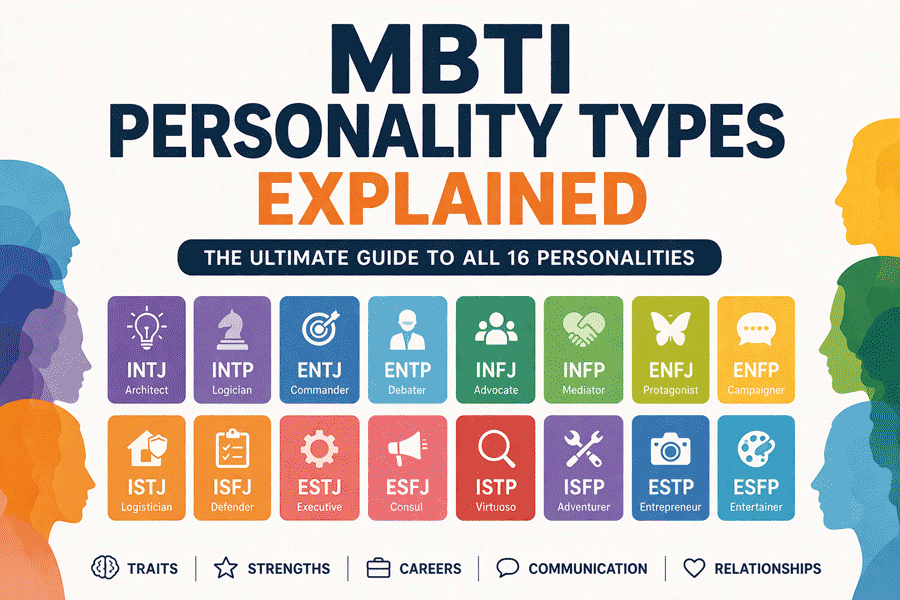
Introduction: Beyond the Four Letters
In the realm of psychological self-discovery, few tools have sparked as much curiosity and debate as the Myers-Briggs Type Indicator. When searching for mbti personality types explained, readers often encounter superficial quizzes that reduce complex human behavior to a simple four-letter code. However, true understanding requires diving deeper into the cognitive mechanisms that drive our preferences. This guide serves as a comprehensive walkthrough for those seeking to move beyond stereotypes and embrace a nuanced view of personality.
The core premise of this article is simple: your type is a starting point, not a destination. Whether you are an aspiring leader, a creative professional, or someone navigating complex relationships, understanding the underlying cognitive functions offers a roadmap for growth. Based on existing observations and research from the Myers & Briggs Foundation, we will explore how these types manifest in real-world scenarios, avoiding the trap of rigid labeling.
Throughout this deep dive, we will reference established psychological theories, including the work of Carl Jung, to provide a scientifically grounded perspective. We will also examine how different types interact in workplace dynamics and intimate partnerships, offering actionable advice for personal development. By the end of this review, you will have a clearer understanding of not just who you are, but how you can evolve.
The Framework Behind MBTI Personality Types Explained
To truly grasp mbti personality types explained, one must look beyond the surface-level dichotomies of Introversion vs. Extroversion or Thinking vs. Feeling. The robustness of the system lies in its theoretical roots and the hierarchy of mental processes known as cognitive functions.
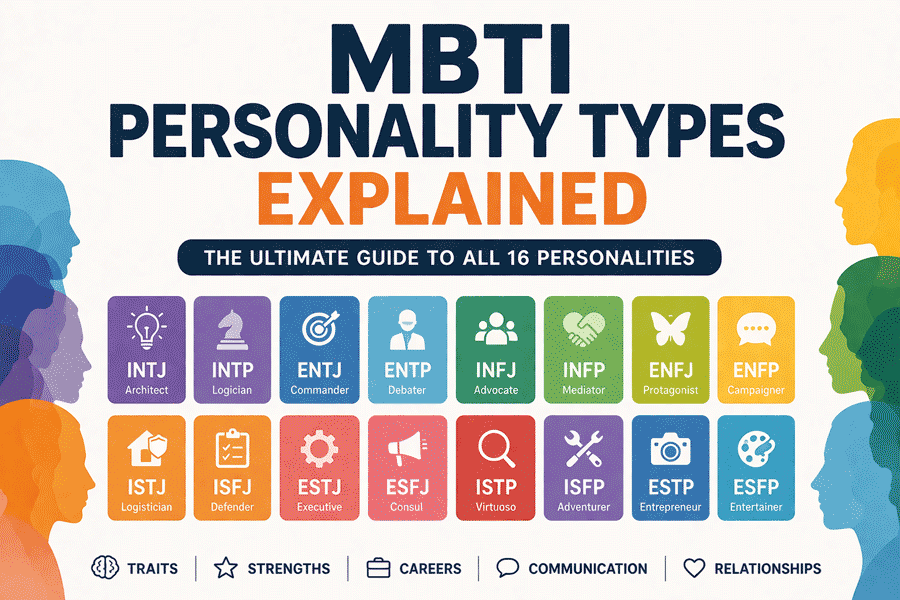
Jungian Roots and Four Dimensions
The foundation of the MBTI framework was built by Katharine Cook Briggs and her daughter Isabel Briggs Myers, inspired by Carl Jung's theory of psychological types. Jung proposed that much of what appears to be random variation in human behavior is actually quite orderly and consistent, stemming from basic differences in how individuals prefer to use their perception and judgment.
The four dichotomies serve as the entry point:
- Energy Orientation (E/I): Where do you focus your attention? Extroverts draw energy from the outer world of people and activities, while Introverts recharge through solitude and internal reflection.
- Information Gathering (S/N): How do you prefer to take in information? Sensing types focus on concrete details and present realities, whereas Intuitive types look for patterns, possibilities, and future implications.
- Decision Making (T/F): How do you make decisions? Thinking types prioritize logic and objective criteria, while Feeling types consider values and the impact on people.
- Lifestyle Structure (J/P): How do you deal with the outer world? Judging types prefer structure and closure, while Perceiving types prefer flexibility and openness.
While these dimensions are helpful, they are merely the outer shell. The engine of personality lies within the cognitive function stack.
Understanding the Cognitive Function Stack
Every personality type operates using a hierarchy of four primary cognitive functions: Dominant, Auxiliary, Tertiary, and Inferior. This stack determines how a person processes information and makes decisions most naturally.
For example, an INFJ leads with Introverted Intuition (Ni), which focuses on synthesizing information into a single visionary insight. Their auxiliary function, Extroverted Feeling (Fe), helps them harmonize with others. In contrast, an ENTP leads with Extroverted Intuition (Ne), exploring multiple possibilities, supported by Introverted Thinking (Ti) for logical analysis.
Understanding this stack is crucial when discussing mbti personality types explained because it explains why two types might share letters but behave differently. Consider the case of Albert Einstein. He is widely believed by typologists to have been an INTP. His dominant Introverted Thinking (Ti) sought internal logical consistency, while his auxiliary Extroverted Intuition (Ne) allowed him to imagine complex physical theories like relativity. However, it is important to use qualifiers like "widely believed" or "commonly typed" when discussing historical figures, as we cannot administer tests to them.
Another often-cited example is Mother Teresa, who is commonly categorized as an INFJ. Her dominant Ni drove a singular vision of service, supported by Fe which connected her deeply with the suffering of others. These examples help concretize abstract functions, but remember that individual life experiences shape how these functions manifest.
Practical Application: Career, Relationships, and Growth
Knowing your type is useless without application. The value of mbti personality types explained lies in its utility for navigating life's challenges. Below, we break down how these preferences influence professional paths and interpersonal connections.
Workplace Dynamics and Leadership Styles
In a professional setting, cognitive functions dictate communication styles and problem-solving approaches. TJ types (ENTJ, ESTJ, INTJ, ISTJ) often excel in structured environments where efficiency and logic are paramount. They tend to be decisive leaders who value competence. However, based on existing observations, they may sometimes overlook the emotional morale of the team.
Conversely, FP types (INFP, ISFP, ENFP, ESFP) often thrive in roles that allow for creativity and personal expression. They bring empathy and adaptability to the workplace. A common challenge for them lies in handling rigid bureaucracy or conflict that threatens their values. For instance, an ENFP might struggle in a highly repetitive data entry role but excel in brainstorming sessions.
Effective teams often benefit from cognitive diversity. A group composed entirely of NT types might generate brilliant strategies but fail to implement them due to a lack of attention to sensory details (S). A team of all SF types might maintain great harmony but struggle to make tough, objective decisions during a crisis.
Navigating Intimate Relationships and Friendships
Relationship compatibility is a frequent search term associated with mbti personality types explained. While no type is inherently incompatible with another, understanding function dynamics can reduce friction. For example, a relationship between a Thinker and a Feeler often requires translation. The Thinker may offer solutions when the Feeler seeks empathy. Recognizing this difference prevents the Feeler from feeling unheard and the Thinker from feeling unappreciated.
Introvert-Extrovert pairings also require negotiation regarding social energy. An Extrovert might interpret an Introvert's need for solitude as rejection, while the Introvert might feel overwhelmed by the Extrovert's social pace. Successful couples establish boundaries that respect both needs. Friendships also benefit from this understanding; an ISTJ friend might show care through practical acts of service, while an ENFP friend might show care through enthusiastic verbal affirmation.
Development Strategies for Each Function Axis
Growth involves stretching beyond your natural preferences. Here are two structured plans to leverage your type for development.
Plan A: Cognitive Function Strengthening
This plan focuses on refining your natural strengths while gently exercising weaker functions.
- Step 1: Identify Your Dominant Function. Spend one week observing when you feel most "in flow." Is it when analyzing data (Ti/Te), connecting with people (Fe/Fi), planning ahead (Ni/Si), or exploring new ideas (Ne/Se)?
- Step 2: Engage the Auxiliary. If you are a dominant Perceiver, practice closing loops. If you are a dominant Judger, practice leaving room for new information.
- Step 3: Monitor the Inferior. Under stress, the inferior function often emerges negatively (the "grip"). Recognize these signs early. For example, an INTJ under stress might become overly sensitive to physical sensations or emotional outbursts (inferior Se/Fe).
Plan B: Interpersonal Adaptation
This plan is designed for improving communication in mixed-type environments.
- Scenario: Giving Feedback. If speaking to a Thinker, focus on logic and outcomes. If speaking to a Feeler, acknowledge their effort and values first.
- Scenario: Conflict Resolution. Sensing types prefer discussing specific incidents. Intuitive types prefer discussing underlying patterns. Bridge this gap by addressing the specific incident while acknowledging the pattern it represents.
- Scenario: Team Projects. Assign roles based on cognitive strengths. Let SJ types handle logistics, NT types handle strategy, NF types handle team cohesion, and SP types handle crisis management.
Growth Mindset: From Typology to Self-Actualization
The ultimate goal of studying mbti personality types explained is not to box yourself in, but to unlock potential. A healthy development path involves integrating all functions over a lifetime.
General principles for growth include prioritizing the confirmation of your dominant function before trying to fix weaknesses. You cannot build a house on a shaky foundation. Once you are confident in your strengths, gradually develop your tertiary and inferior functions. This process, often called "individuation" in Jungian terms, leads to a more balanced personality.
For example, a dominant Thinker should practice identifying their own values (Fi) without necessarily acting on them immediately. A dominant Feeler should practice analyzing logical consistency (Ti) without fearing it makes them cold. This balance allows for greater adaptability in a complex world.
8 Common Mistakes to Avoid When Using MBTI
To maintain the integrity of the tool, avoid these common pitfalls often seen in online communities.
- Do Not Use Type as an Excuse. Saying "I'm an INTP so I can't be on time" is self-limiting. Type explains preference, not capability.
- Do Not Stereotype Others. Assuming all Extroverts are loud or all Intuitives are dreamy ignores individual maturity and context.
- Do Not Force Judge Others. Typing someone else without their consent often leads to error and resentment. It is a tool for self-understanding first.
- Do Not Ignore Context. Behavior changes based on environment. A stressed ESFJ might look like an unhealthy ISTP. Look for patterns over time.
- Do Not Treat Types as Horoscopes. MBTI is based on psychological preference, not celestial alignment. Avoid fatalistic predictions about destiny.
- Do Not Overvalue Compatibility. Any two types can have a healthy relationship with effort. Do not dismiss potential partners based solely on letters.
- Do Not Neglect the Functions. Focusing only on E/I/S/N/T/F/J/P without understanding the function stack leads to superficial analysis.
- Do Not Stop Learning. Psychology evolves. Relying on decades-old memes without reading updated research limits your understanding.
Staying Updated: Resources and Research
The field of personality psychology is dynamic. To keep your knowledge current regarding mbti personality types explained, follow authoritative sources. The Myers & Briggs Foundation provides official updates and ethical guidelines. Additionally, look for peer-reviewed journals that discuss Jungian typology in modern contexts.
Be wary of pop-psychology websites that prioritize clickbait over accuracy. Quality resources will emphasize nuance and the spectrum of behavior rather than rigid categories. Joining communities that focus on cognitive functions rather than just four-letter codes can also provide deeper insights.
FAQ About MBTI Personality Types Explained
1. Can my MBTI type change over time?
Your core preferences generally remain stable, much like handedness. However, your ability to use non-preferred functions develops with age. You might test differently due to mood or life stage, but your underlying wiring typically stays consistent.
2. Is MBTI scientifically valid?
MBTI has faced criticism regarding reliability compared to the Big Five model. However, it remains widely used in coaching and development for its practical framework. It is best viewed as a tool for self-reflection rather than a strict psychometric assessment.
3. How do I confirm my type without a test?
Self-observation is key. Study the cognitive functions. Ask trusted friends for feedback on how you handle stress and decision-making. Read type descriptions critically, focusing on the "why" behind behaviors rather than just the "what."
4. Which type is the best for leadership?
There is no "best" type. Different situations call for different strengths. ENTJs may excel in restructuring, while ENFJs may excel in team building. Effective leaders leverage their type and compensate for blind spots.
5. How do I learn more efficiently based on my type?
Sensing types may benefit from hands-on practice and concrete examples. Intuitive types may prefer conceptual frameworks and theory. Thinking types might like structured logic, while Feeling types might engage better with collaborative learning.
Conclusion
Understanding mbti personality types explained is a journey toward greater self-awareness and empathy. By focusing on cognitive functions and avoiding common stereotypes, you can use this framework to enhance your career, relationships, and personal growth. Remember, the letters are just a map; you are the territory. Use this guide as a compass, but always trust your own experience as you navigate the complex landscape of human personality.