
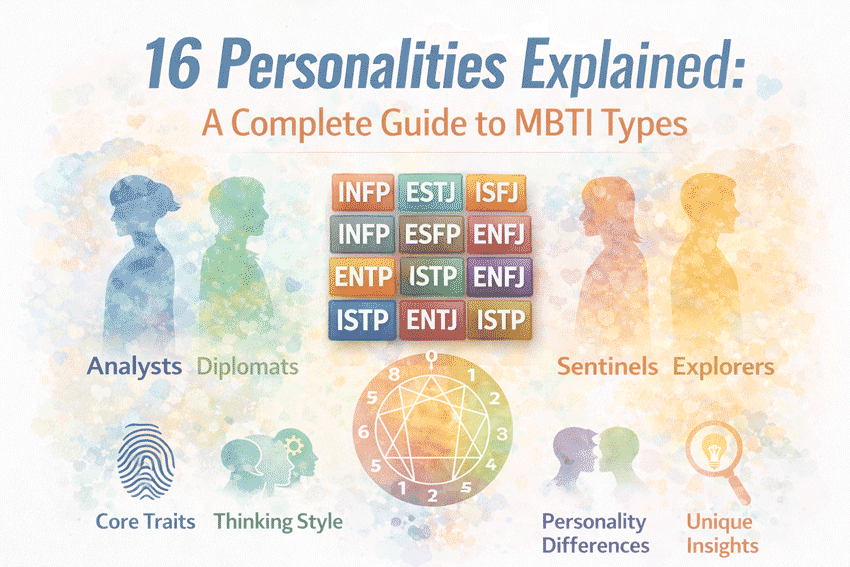
16 Personalities Explained: A Deep Dive into MBTI Types
Understanding your psychological type is more than memorizing four letters; it is about mastering your cognitive machinery. When seeking 16 personalities explained, most readers want clarity on behavior, not just labels. This guide concludes immediately: true type accuracy comes from analyzing cognitive functions, not quiz scores. MBTI helps identify natural preferences in energy, information, decisions, and structure. It is useful for career alignment, relationship navigation, and personal growth. However, deeper application requires returning to the underlying Jungian functions. This article provides a comprehensive framework for moving beyond stereotypes to achieve genuine self-understanding and practical development.
The Framework and Mechanism Behind the Types
To truly grasp the 16 personalities, one must understand the engine driving them. The Myers-Briggs Type Indicator is rooted in Carl Jung’s theory of psychological types. Jung proposed that much of what appears to be random variation in human behavior is actually quite orderly and consistent, stemming from basic differences in how individuals prefer to use their perception and judgment.
The Four Dichotomies and Their Limits
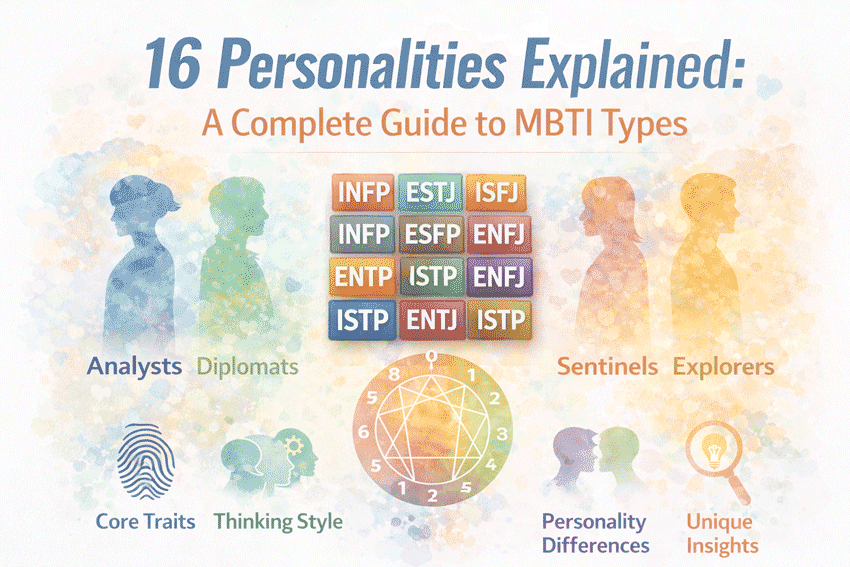
Traditionally, MBTI is introduced through four dichotomies: Extraversion (E) vs. Introversion (I), Sensing (S) vs. Intuition (N), Thinking (T) vs. Feeling (F), and Judging (J) vs. Perceiving (P). While these letters provide a shorthand, they are often misunderstood as binary traits. In reality, they represent preferences. Everyone uses both sides of each dichotomy, but one side is more natural and less energetically costly. For example, an Introvert can socialize effectively, but it drains their battery, whereas an Extravert gains energy from interaction. Relying solely on these letters often leads to mistyping because behavior changes under stress or social conditioning. A developed Introvert may appear Extraverted at work, masking their true preference.
Cognitive Function Stack: The Real Engine
The core of accurate typing lies in the cognitive function stack. Each of the 16 types uses four specific cognitive functions in a fixed order: Dominant, Auxiliary, Tertiary, and Inferior. These functions are the mental processes you use to perceive information (Sensing or Intuition) and make decisions (Thinking or Feeling), oriented either outwardly (Extraverted) or inwardly (Introverted).
The Dominant function is your hero; it is the lens through which you view the world most naturally. The Auxiliary function supports the dominant, providing balance. For instance, if your dominant is Introverted Intuition (Ni), your auxiliary must be Extraverted Thinking (Te) or Extraverted Feeling (Fe) to help you interact with the external world. The Tertiary function is less mature and often develops in mid-life, while the Inferior function is the weakest link, often emerging under severe stress. Understanding this stack explains why two types sharing three letters (e.g., INFJ and INFP) can behave vastly differently. The INFJ leads with Ni-Fe, focusing on visionary harmony, while the INFP leads with Fi-Ne, focusing on authentic individual values.
Why Letter-Based Typing Causes Mistypes
Online tests often rely on self-reported behavior rather than cognitive motivation. If you ask, “Do you like parties?” an introverted person with developed social skills may say “Yes,” leading to an Extraverted result. However, the cognitive function approach asks, “How do you decide?” or “What drains you?” To validate your type, observe your decision patterns. Do you prioritize logical consistency (Thinking) or human impact (Feeling)? Do you trust concrete data (Sensing) or future possibilities (Intuition)?
Self-observation is critical. Track your stress reactions. When overwhelmed, do you become uncharacteristically emotional (Inferior Feeling) or impulsive (Inferior Sensing)? Long-term feedback from trusted others is also vital. They often see your blind spots more clearly than you do. For illustrative purposes, public figures are often typed based on observed behavior. For example, Marie Curie is widely believed to be an INTJ, demonstrating dominant Introverted Intuition focused on scientific systems, though such typings remain theoretical interpretations rather than confirmed facts.
Practical Application Frameworks
Knowledge of the 16 personalities explained is useless without application. Below are two frameworks to integrate this understanding into daily life.
Framework 1: Career and Work-Style Fit
When it applies: This framework is essential during career transitions, role negotiations, or when experiencing burnout. It helps align your daily tasks with your cognitive strengths.
Related Dynamics: This relates to the Dominant and Auxiliary functions. For example, a type with dominant Thinking (T) may struggle in roles requiring constant emotional mediation without logical structure. A type with dominant Perceiving (P) may feel stifled in rigidly micromanaged environments.
Practical Action Steps:
- Audit Your Energy: For one week, log tasks that drain you versus those that energize you. Look for patterns. Do you prefer deep focus (Introverted functions) or collaborative brainstorming (Extraverted functions)?
- Negotiate Work Styles: If you are an Intuitive type, request time for strategic planning rather than just execution. If you are a Sensing type, ask for concrete milestones rather than vague visions.
- Leverage Your Stack: Use your Dominant function for core problem-solving. Use your Auxiliary function for communication. For example, an ENTP (Ne-Ti) should generate ideas (Ne) but use logic (Ti) to validate them before presenting.
Benefits and Limitations: The benefit is increased job satisfaction and reduced burnout. The limitation is that no job is perfect; every role requires using non-preferred functions. The goal is balance, not avoidance.
Judgment Criteria: You know this fits if you feel less resistance starting work tasks and recover from work stress more quickly.
Framework 2: Relationship and Communication Guidance
When it applies: Use this during conflicts, team collaborations, or when trying to deepen intimacy with a partner or family member.
Related Dynamics: This focuses on the Thinking vs. Feeling dichotomy and the Judging vs. Perceiving dynamic. Conflicts often arise when one person prioritizes efficiency (T) while the other prioritizes harmony (F), or when one wants closure (J) while the other wants options (P).
Practical Action Steps:
- Translate Preferences: If you are a Thinker speaking to a Feeler, preface feedback with appreciation for their effort before offering critique. If you are a Feeler speaking to a Thinker, state the logical goal before discussing emotional impact.
- Respect Processing Time: Introverts often need time to process internally before speaking. Extraverts may process by talking. Allow silence for Introverts; allow verbal exploration for Extraverts.
- Identify Stress Triggers: Recognize when a partner is in their “grip” (stress state). An normally organized J type may become chaotic. Offer support rather than criticism during these times.
Benefits and Limitations: This reduces miscommunication and fosters empathy. However, it should not be used to excuse bad behavior. Type explains preference, not maturity.
Judgment Criteria: This fits if conflicts resolve faster and you feel more understood by your peers or partner.
Pathways to Personality Growth
Growth is the ultimate goal of understanding the 16 personalities explained. It is not about changing your type, but expanding your capacity within it.
Identify the Dominant Function First
Growth begins with strength. You cannot build a house on a weak foundation. Identify your Dominant function and ensure it is healthy. If you are an Introverted Thinker (Ti), ensure you have time for deep analysis. If you neglect your dominant function, you will feel chronically unfulfilled. Strengthening your core allows you to handle stress better.
Distinguish Preference from Skill
A common pitfall is confusing what you are good at with what you prefer. You may be skilled at public speaking (Extraversion) but still prefer reading alone (Introversion). Growth involves developing skills in non-preferred areas without denying your natural energy sources. Do not force yourself to be someone you are not; instead, expand your toolkit.
Develop the Inferior Function Gradually
The Inferior function is your gateway to wholeness, but it is fragile. For an INTJ, the inferior function is Extraverted Sensing (Se). They may indulge in impulsive sensory experiences under stress. Healthy development involves small doses of engagement. An INTJ might practice mindfulness or physical sports casually, not competitively. Pushing too hard on the inferior function leads to burnout. Approach it with playfulness, not pressure.
Explain Loop and Grip Patterns
Under stress, types may skip their Auxiliary function and enter a “loop.” For example, an INFP (Fi-Ne) might loop between Fi and Ne, becoming overly introspective and disconnected from reality, ignoring their auxiliary Te. The “grip” occurs when the Dominant function is overwhelmed, and the Inferior function takes over catastrophically. Recognizing these patterns allows you to intervene. If you notice looping, force engagement with the external world (Auxiliary). If in grip, prioritize rest and self-care to restore the Dominant function.
Growth Means Flexibility, Not Identity Attachment
Do not use your type as an excuse. Saying “I am an INTP, so I cannot be on time” is misuse of the tool. Growth means recognizing your biases and compensating for them. Use your type to understand your defaults, then consciously choose different behaviors when the situation demands it. Flexibility is the hallmark of a mature personality.
Common Mistakes and Pitfalls
To maintain credibility and utility, avoid these eight common errors when applying MBTI concepts.
- Don’t treat MBTI as a horoscope. Explanation: MBTI describes preferences, not fate. Alternative: Use it as a map for navigation, not a prediction of destiny.
- Don’t stereotype types. Explanation: Assuming all Thinkers are cold ignores individual maturity. Alternative: Look at the individual’s development level, not just their letters.
- Don’t ignore stress reactions. Explanation: People look different under pressure. Alternative: Observe behavior during high-stress periods to see inferior function emergence.
- Don’t rely on a single test. Explanation: Tests capture mood, not type. Alternative: Use tests as a starting point, then validate with function theory.
- Don’t use type to justify bad behavior. Explanation: “I’m blunt because I’m a Thinker” is not an excuse for rudeness. Alternative: Learn to deliver truth with tact regardless of type.
- Don’t assume type determines career success. Explanation: Any type can succeed in any field with effort. Alternative: Use type to find energy-efficient paths, not exclusive doors.
- Don’t neglect the Auxiliary function. Explanation: Focusing only on the Dominant leads to imbalance. Alternative: Consciously develop the second function for better external adaptation.
- Don’t label others without consent. Explanation: Typing others can feel reductive and intrusive. Alternative: Share insights about yourself; let others explore their own types.
Continuing Your MBTI Journey
The field of psychological type is evolving. To ensure ongoing learning, follow credible sources. The Myers & Briggs Foundation offers official resources and ethical guidelines. The Center for Applications of Psychological Type (CAPT) publishes research and updates on type theory. Engage with Jungian educational resources that focus on depth psychology rather than pop-psychology summaries.
Be critical of online content. Look for authors who cite cognitive functions rather than just letters. Participate in debates and newer interpretations, such as the interaction between type and neuroscience, but remain skeptical of claims that sound too absolute. Identify reliable information by checking if the author acknowledges limitations and avoids deterministic language. High-quality summaries will emphasize growth and nuance over rigid categorization.
Frequently Asked Questions
1. Where should a beginner start with MBTI?
Start by learning the four cognitive processes: Sensing, Intuition, Thinking, and Feeling. Understand whether you prefer these processes to be oriented inwardly or outwardly. Read about the function stack rather than just the 16 type descriptions. This prevents confusion between similar types.
2. How can I confirm my type without tests?
Observe your energy levels. What activities restore you? Analyze your decision-making under no pressure. Do you default to logic or values? Track your stress response. Which negative behaviors emerge when you are tired? Compare these patterns against function descriptions, not just type labels.
3. How does MBTI help with relationship communication?
It highlights where friction is likely to occur. If one partner needs closure (J) and the other needs openness (P), understanding this difference reduces personalizing the conflict. It allows you to translate needs: “I need planning to feel safe” versus “I need options to feel free.”
4. What is the most efficient way to learn cognitive functions?
Study one function pair at a time. Compare an Fi-dom (INFP/ISFP) with an Fe-dom (ENFJ/ESFJ). Notice how they handle conflict. Practical observation of real people is more effective than abstract theory. Keep a journal of behaviors that match specific functions.
5. Can my personality type change over time?
Your core preferences generally remain stable throughout adulthood. However, your ability to use non-preferred functions improves with maturity. You may appear different as you develop, but your underlying energy orientation typically stays consistent. Type does not change, but behavioral flexibility increases.