
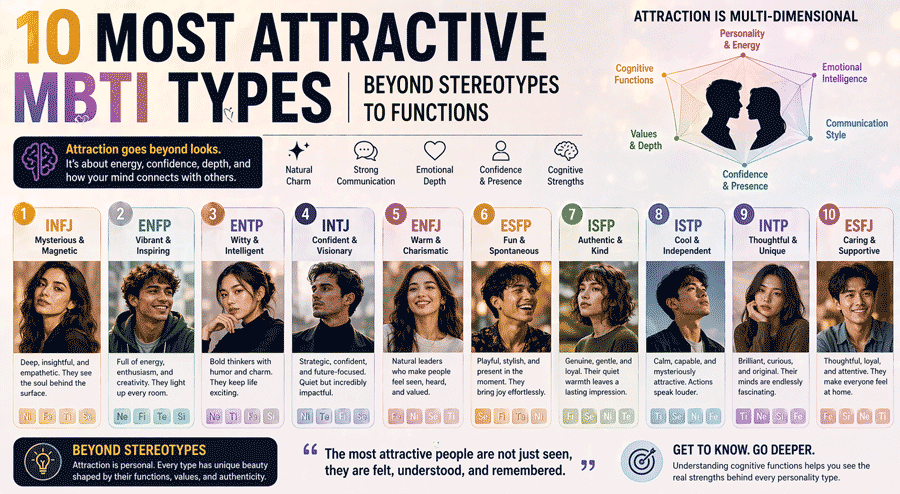
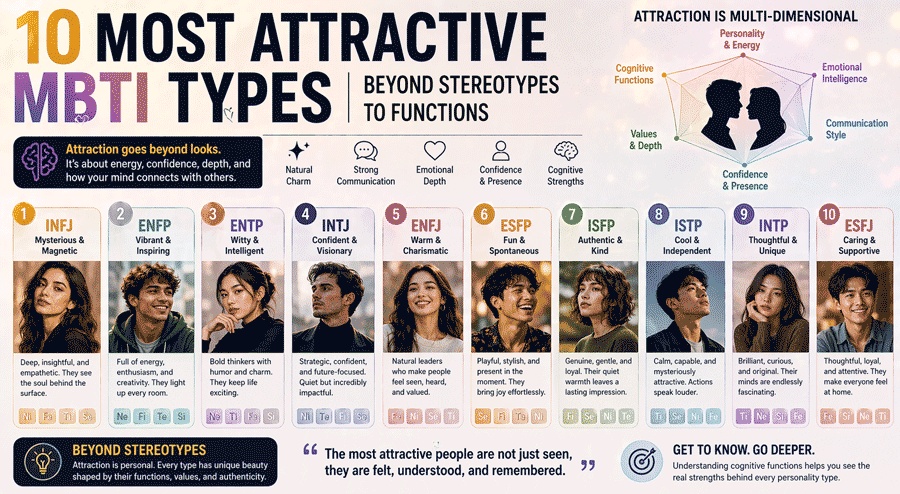
When people search for the most attractive mbti types, they are often looking for validation or a shortcut to understanding relationship compatibility. However, the conclusion is immediate and crucial: there is no single "most attractive" type. Attraction is deeply subjective and rooted in cognitive function dynamics rather than four-letter codes. While certain types like ENFP or INFJ are frequently cited in online communities as highly desirable, this popularity often stems from stereotypes rather than psychological depth. To truly understand attraction, compatibility, and personal growth, one must move beyond the letters and examine the underlying cognitive functions that drive behavior, decision-making, and emotional connection.
This article serves as a comprehensive guide for English-speaking readers interested in MBTI who seek depth beyond surface-level descriptions. Whether you are trying to understand your own type more accurately, exploring compatibility, or looking for practical growth strategies, the focus here is on mechanism over label. We will explore the Jungian roots of the system, the mechanics of the function stack, and how these elements influence relationship dynamics. By the end, you will have practical frameworks to validate your type, improve communication, and navigate personal development without falling into the trap of identity attachment.
The Mechanism: Understanding the Roots of Attraction
To discuss the most attractive mbti types meaningfully, we must first establish what MBTI actually measures. The Myers-Briggs Type Indicator is based on Carl Jung’s theory of psychological types. It categorizes preferences along four dichotomies: Extraversion (E) vs. Introversion (I), Sensing (S) vs. Intuition (N), Thinking (T) vs. Feeling (F), and Judging (J) vs. Perceiving (P). While these letters provide a convenient shorthand, they are merely the outward expression of a deeper internal process known as the cognitive function stack.
The Four Dichotomies and Their Limits
The four dichotomies describe how individuals orient themselves to the world, gather information, make decisions, and structure their lives. For example, an Extravert gains energy from external interaction, while an Introvert recharges through solitude. However, relying solely on these letters often causes mistypes. Two people might both test as "INTJ," but one may lead with Introverted Intuition (Ni) while the other is actually an INTP leading with Introverted Thinking (Ti) who is currently stressed. This distinction is vital because attraction often happens between complementary functions, not just complementary letters.
The Cognitive Function Stack
Every type operates using a stack of four primary cognitive functions: Dominant, Auxiliary, Tertiary, and Inferior. The Dominant function is the hero of the psyche, the lens through which you view the world most naturally. The Auxiliary supports the dominant, providing balance. The Tertiary is less developed and often emerges in leisure or mid-life, while the Inferior function is the weakest link, often surfacing under stress.
For instance, an ENFP leads with Extraverted Intuition (Ne), exploring possibilities and connections. Their auxiliary is Introverted Feeling (Fi), which filters these possibilities through personal values. When discussing the most attractive mbti types, an ENFP might be drawn to an INTJ not because of the letters, but because the INTJ’s dominant Introverted Intuition (Ni) provides the focus and depth that complements the ENFP’s expansive Ne. This is a function-level attraction, not merely a type-level attraction.
Why Letter-Based Typing Causes Mistypes
Online tests often rely on self-reported behavior rather than cognitive processes. A person might answer “I like planning” and be typed as Judging, when in reality, they are a Perceiver who plans out of anxiety. This leads to incorrect type identification. To validate your type, you must observe decision patterns, stress reactions, and motivation. Do you prioritize logical consistency (Ti) or group harmony (Fe)? Do you focus on concrete details (Si) or future implications (Ne)? Long-term feedback from others is also crucial. If you identify as a Thinker but everyone describes you as empathetic and emotionally attuned, you may be mistyped. True type confirmation requires returning to cognitive functions.
Application Guidance: Frameworks for Relationships and Growth
Understanding the mechanics is only the first step. The real value of MBTI lies in application. Below are two practical frameworks designed to help you utilize type theory for relationship enhancement and personal development. These frameworks emphasize that MBTI type is a starting point, not an endpoint.
Framework 1: Relationship and Communication Dynamics
When it applies: This framework is useful when experiencing recurring conflicts with a partner, colleague, or family member, or when seeking to deepen emotional intimacy.
Related Function Dynamics: It focuses on the interaction between Feeling (F) and Thinking (T) functions, as well as Intuition (N) and Sensing (S) preferences. For example, a conflict often arises when a Te-dominant user (like an ENTJ) prioritizes efficiency, while an Fi-dominant user (like an INFP) prioritizes personal authenticity.
Practical Action Steps:
- Identify the Stress Trigger: Determine if the conflict stems from a clash in information gathering (S vs. N) or decision making (T vs. F).
- Translate Needs: If you are an Intuitive type, recognize that your Sensing partner needs concrete examples, not abstract theories. If you are a Thinker, acknowledge that your Feeling partner needs validation of emotions before solutions.
- Schedule Function-Time: Allocate time for “N-time” (brainstorming future ideas) and “S-time” (handling practical logistics) to ensure both partners feel their preferred mode is respected.
Benefits and Limitations: This approach reduces friction by framing differences as complementary rather than defective. However, it requires both parties to be willing to learn. It cannot fix fundamental value mismatches or unhealthy relationship dynamics unrelated to type.
How to Judge Fit: If applying these strategies leads to clearer communication and reduced defensiveness, the framework fits. If conflicts remain entrenched despite type-aware adjustments, the issue may lie outside personality preferences.
Framework 2: Stress Management and Personal Growth
When it applies: Use this when feeling burnt out, stuck in negative loops, or unable to progress in career or personal goals.
Related Function Dynamics: This focuses on the Inferior function and the “Grip” stress response. For example, an ISTJ (dominant Si) under extreme stress may fall into the grip of their inferior Ne, becoming paranoid about future possibilities and catastrophizing.
Practical Action Steps:
- Recognize the Grip: Learn the signs of your inferior function acting out. For Thinkers, this might look like uncharacteristic emotional outbursts. For Feelers, it might look as cold, hyper-critical logic.
- Engage the Auxiliary: Instead of forcing the inferior function, strengthen the auxiliary. An INFP (Fi-Ne) under stress should engage their Ne by exploring new ideas creatively, rather than forcing rigid structure (Te).
- Rest the Dominant: Sometimes growth means stepping away from your dominant strength. An ENTJ (Te) might benefit from quiet reflection (Ni) rather than more action.
Benefits and Limitations: This framework promotes resilience and prevents burnout. The limitation is that it requires high self-awareness. In the moment of stress, recognizing the pattern is difficult.
How to Judge Fit: If you notice a quicker recovery time from stress episodes and less regrettable behavior during conflicts, the framework is effective.
The Growth Section: Universal Principles for Development
Regardless of your specific type, certain universal principles apply to personality growth. The goal is flexibility, not identity attachment. MBTI is a tool for understanding preferences, not a label that defines the whole person.
Identify the Dominant Function First
Growth begins with knowing your engine. If you do not know what drives you, you cannot steer. Spend time observing where your energy flows naturally. Is it toward organizing the external world (Te), understanding internal logic (Ti), connecting with people (Fe), or honoring personal values (Fi)? Once identified, you can stop fighting your nature and start optimizing it.
Distinguish Preference from Skill
A common misconception is that being a “Thinking” type means you are smart, or a “Feeling” type means you are kind. These are preferences, not skills. A Feeling type can learn logical analysis, and a Thinking type can develop emotional intelligence. Do not use your type as an excuse for lacking skills. Instead, view it as your default setting that requires manual override when the situation demands.
Develop the Inferior Function Gradually
The inferior function is the gateway to wholeness, but it must be approached gently. You cannot force an inferior function to become dominant. For example, an ESFP (dominant Se) should not try to become a long-term strategic planner (Ni) overnight. Instead, they can practice small acts of future planning in low-stakes environments. Over time, this integrates the shadow side of the personality, leading to greater maturity.
Explain Loop and Grip Patterns
Under stress, types may skip their auxiliary function and enter a “loop.” An INTP (Ti-Ne) might loop between Ti and Ne, over-analyzing theories without grounding them in reality (Si). Recognizing these loops is critical for breaking free. The “Grip” is a more severe stress reaction where the inferior function takes over completely. Understanding these patterns helps you realize that your stressed behavior is not your true self, but a temporary reaction.
Growth Means Flexibility
Ultimately, psychological health is the ability to access all functions when needed. A healthy leader uses Te to execute, Fi to check values, Se to notice immediate realities, and Ni to foresee consequences. Do not attach your identity to being “just an INFP.” You are a human being who prefers certain pathways. Growth is expanding your toolkit, not reinforcing your cage.
Mistakes and Pitfalls: 8 Things Not to Do
To maintain credibility and utility in your MBTI journey, avoid these common pitfalls. Each point includes a better alternative mindset.
- Don’t treat type as destiny. Explanation: Believing you cannot change because “it’s not in my type” limits potential. Alternative: View type as a default setting that can be overridden with effort.
- Don’t use type to excuse bad behavior. Explanation: Saying “I’m an ENTP, so I’m naturally blunt” avoids accountability. Alternative: Acknowledge the preference but choose kindness consciously.
- Don’t rely solely on online tests. Explanation: Tests measure mood and self-perception, not cognitive processes. Alternative: Use tests as a starting hint, then validate through study and observation.
- Don’t stereotype celebrities as facts. Explanation: Claiming a famous person “is” a type is speculative. Alternative: Use phrases like “is widely believed to be” or “is often typed as.”
- Don’t ignore the shadow functions. Explanation: Focusing only on the top four functions ignores half the psyche. Alternative: Study the shadow stack to understand stress reactions and blind spots.
- Don’t assume compatibility is guaranteed by type. Explanation: Two “ideal” types can still have a toxic relationship. Alternative: Prioritize shared values and communication skills over type matching.
- Don’t dismiss types you don’t understand. Explanation: Labeling Sensing types as “boring” or Feelers as “irrational” shows immaturity. Alternative: Approach different types with curiosity about their unique strengths.
- Don’t stop learning after typing yourself. Explanation: Typing is the beginning, not the end. Alternative: Commit to ongoing study of Jungian theory and cognitive dynamics.
Ongoing Learning: Resources and Credibility
The field of personality psychology is evolving. To ensure you are accessing high-quality information, it is essential to follow credible organizations and remain open to new research. Avoid low-quality summaries that reduce complex theories to memes.
Credible Sources: Look for resources from the Myers & Briggs Foundation or the Center for Applications of Psychological Type (CAPT). These organizations maintain the integrity of the original instrument and provide research-based updates. Jungian educational resources also offer deeper dives into the theoretical roots that MBTI simplifies.
Identifying Reliable Information: Be wary of content that makes absolute claims, such as “This type is the rarest” or “This type is the best leader.” Credible information acknowledges nuance, sample size limitations, and the difference between preference and ability. Engage with debates and newer interpretations, such as the Beebe model of functions, to expand your understanding beyond the basic four letters.
Community Engagement: Join forums or groups that prioritize evidence-based discussion over type elitism. Hearing diverse perspectives helps counteract the echo chamber effect where certain types are idolized while others are marginalized. Remember, the goal is understanding, not hierarchy.
Frequently Asked Questions (FAQ)
1. Where should a beginner start with MBTI?
Start by understanding the four dichotomies, but quickly move to cognitive functions. Read about the eight functions (Ni, Ne, Si, Se, Ti, Te, Fi, Fe) and see which resonates with your internal experience. Avoid taking multiple tests; instead, observe your own decision-making processes.
2. How can I confirm my type without tests?
Focus on stress reactions and motivation. What drains you? What energizes you? Look at your “loop” behaviors. Ask trusted friends how they perceive your blind spots. Type confirmation is a process of elimination based on internal cognitive evidence, not external behavior alone.
3. Does MBTI help with relationship communication?
Yes, by highlighting differences in information processing. If you know your partner prefers concrete data (S) and you prefer abstract concepts (N), you can adjust your language. It provides a vocabulary for differences, reducing the tendency to take conflicts personally.
4. How do I learn cognitive functions efficiently?
Study one function pair at a time. For example, compare Ti vs. Te for a week. Observe how you make decisions versus how others do. Use diagrams of the function stacks for each type to see how the same function manifests differently depending on its position in the stack.
5. Can my MBTI type change over time?
Your core preferences generally remain stable, similar to handedness. However, your expression of them changes with maturity. You may develop your non-preferred functions, making you appear different. This is growth, not a type change. Be cautious of claims that type shifts frequently; it usually indicates initial mistyping.
6. What if I resonate with multiple type descriptions?
Partial resonance is common because everyone uses all eight functions. Look for the “cost” of using certain functions. Which one feels effortless? Which one feels exhausting? Your dominant function should feel like breathing, while the inferior feels like lifting a heavy weight.
7. Is MBTI scientifically uncontested?
No. MBTI has critics regarding its reliability and validity compared to models like the Big Five. It should be used as a tool for self-reflection and communication, not as a definitive psychological diagnosis. Maintain a balanced perspective on its utility.
Conclusion
The search for the most attractive mbti types ultimately leads back to the self. Attraction is not about finding a perfect letter combination but about finding someone whose cognitive functions complement your own growth journey. By focusing on cognitive functions, validating your type through observation, and applying practical frameworks for communication and stress management, you can use MBTI as a powerful tool for deeper connection. Remember, the letters are just the map; the territory is your lived experience. Use this knowledge to build flexibility, empathy, and resilience, ensuring that personality theory serves you, rather than defining you.