
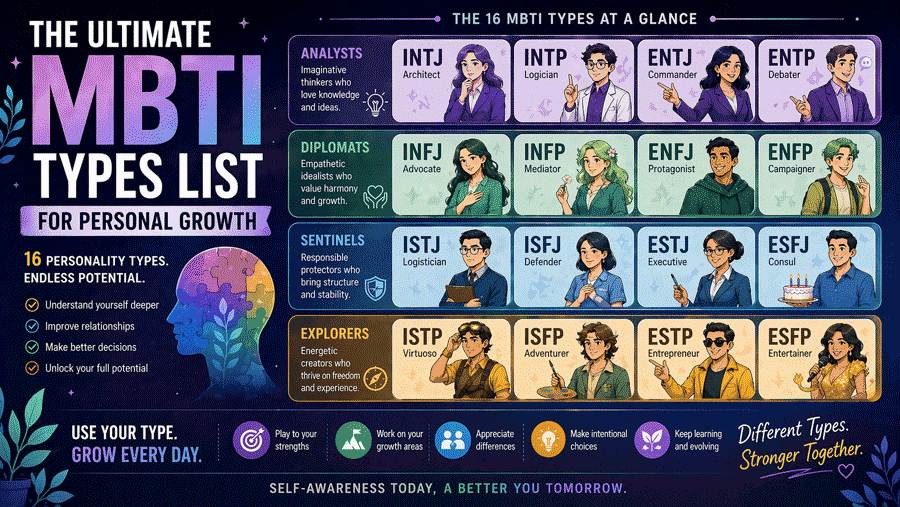
Understanding your personality is not about fitting into a box; it is about unlocking a map for navigation. When users search for an mbti types list, they are often looking for more than just sixteen acronyms. They are seeking clarity on why they think, feel, and act the way they do. The Myers-Briggs Type Indicator (MBTI) is a powerful tool for self-awareness, but its true value lies not in the four-letter code itself, but in the underlying cognitive functions that drive behavior. This guide moves beyond surface-level stereotypes to provide a deep, actionable analysis of personality types.
The core principle of this analysis is simple: MBTI type is a starting point, not an endpoint. Deeper application of any mbti types list must return to cognitive functions. Whether you are exploring career fit, relationship dynamics, or personal development, understanding the machinery behind the letters is essential. This article is designed for English-speaking readers who want to understand their own type more accurately, explore cognitive functions, and seek depth beyond common generalizations.
Understanding the Framework and Mechanism
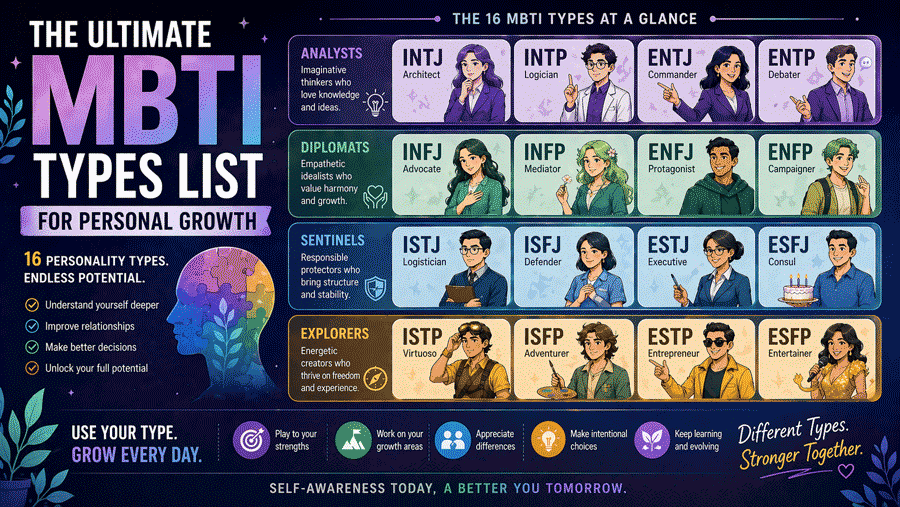
To utilize an mbti types list effectively, one must understand its roots. The MBTI is based on Carl Jung's theory of psychological types, which suggests that much of what appears to be random behavior is actually quite orderly and consistent, being due to basic differences in the way individuals prefer to use their perception and judgment. The system categorizes preferences across four dichotomies, resulting in sixteen distinct personality types.
The Four Dichotomies
The sixteen types are derived from four pairs of preferences. While often treated as binary switches, these are better understood as inclinations:
- Extraversion (E) vs. Introversion (I): This describes where you direct your energy. Extraverts tend to recharge through interaction with the external world, while Introverts recharge through solitude and internal reflection.
- Sensing (S) vs. Intuition (N): This describes how you gather information. Sensors focus on concrete details, facts, and present realities. Intuitives focus on patterns, possibilities, and future implications.
- Thinking (T) vs. Feeling (F): This describes how you make decisions. Thinkers prioritize logic, objective criteria, and consistency. Feelers prioritize values, harmony, and person-centered concerns.
- Judging (J) vs. Perceiving (P): This describes how you approach the outside world. Judgers prefer structure, plans, and closure. Perceivers prefer flexibility, openness, and options.
The Cognitive Function Stack
The letters are merely shadows cast by the real engine of personality: the cognitive functions. Each type uses a stack of four functions in a specific order: Dominant, Auxiliary, Tertiary, and Inferior. This hierarchy explains why two types might share letters but behave differently. For example, an ISTJ and an ESTJ both use Thinking and Sensing, but their function order dictates how those tools are applied.
The dominant function is the hero of the psyche, the lens through which you view the world most naturally. The auxiliary function supports the dominant, providing balance. The tertiary function is less developed often emerging in mid-life, while the inferior function is the unconscious weakness that can cause stress when overused. Understanding this stack is crucial for type confirmation because it explains motivation and stress reactions better than letters alone.
Why Letter-Based Typing Causes Mistypes
Relying solely on an mbti types list based on letters often leads to mistyping. Tests measure behavior, but behavior is adaptable. A stressed Introvert may act Extraverted to survive a social demand. A developed Feeler may use Thinking effectively in a professional setting. Without understanding the cognitive functions, users often identify with their social mask rather than their core preference. True typing requires self-observation of decision patterns, energy drains, and long-term feedback from others rather than relying only on test scores.
Deep Dive into Cognitive Functions
To move beyond the superficial mbti types list, we must examine the eight cognitive functions. These are the building blocks of the sixteen types.
Perceiving Functions: How You Gather Information
Introverted Sensing (Si): Si compares present experiences to past data. It values tradition, stability, and detailed recall. High Si users are often meticulous and reliable, preferring proven methods over untested theories. This function is dominant in ISTJ and ISFJ types.
Extraverted Sensing (Se): Se experiences the physical world in real-time. It values action, aesthetics, and immediate impact. High Se users are often adaptable and spontaneous, thriving in high-energy environments. This function is dominant in ESTP and ESFP types.
Introverted Intuition (Ni): Ni synthesizes information into a single vision or insight. It values foresight, depth, and strategic planning. High Ni users often have "aha" moments and focus on long-term implications. This function is dominant in INTJ and INFJ types.
Extraverted Intuition (Ne): Ne generates multiple possibilities and connections. It values brainstorming, variety, and potential. High Ne users are often innovative and scattered, seeing many paths forward simultaneously. This function is dominant in ENTP and ENFP types.
Judging Functions: How You Make Decisions
Introverted Thinking (Ti): Ti analyzes logic internally to ensure accuracy. It values precision, consistency, and understanding systems. High Ti users often deconstruct arguments to find flaws and seek objective truth. This function is dominant in INTP and ISTP types.
Extraverted Thinking (Te): Te organizes the external world for efficiency. It values results, structure, and measurable outcomes. High Te users are often decisive and directive, focusing on getting things done effectively. This function is dominant in ENTJ and ESTJ types.
Introverted Feeling (Fi): Fi evaluates based on internal values and authenticity. It values integrity, empathy, and personal alignment. High Fi users often have a strong moral compass and seek congruence between actions and beliefs. This function is dominant in INFP and ISFP types.
Extraverted Feeling (Fe): Fe harmonizes with the external emotional climate. It values connection, social norms, and group morale. High Fe users are often accommodating and attentive to the needs of others. This function is dominant in ENFJ and ESFJ types.
Practical Application Frameworks
Knowing your type is useless without application. Here are three frameworks to apply your understanding of the mbti types list to real life.
1. Cognitive Function Development
When it applies: This framework is for long-term personal maturity. It applies when you feel stuck in repetitive behaviors or want to expand your capabilities.
Function Dynamics: Focus on strengthening the auxiliary and tertiary functions while managing the inferior. For example, an INTP (Dominant Ti) should develop Extraverted Intuition (Ne) to share ideas and Extraverted Feeling (Fe) to connect with others.
Action Steps: Identify your inferior function. If you are a Thinker, practice articulating values. If you are a Feeler, practice logical decision-making. Set small weekly goals to exercise your weaker functions without burning out.
Benefits and Limitations: This leads to greater flexibility and resilience. However, do not expect to become equally proficient in all functions. Your dominant function will always be your strength; the goal is competence, not reversal.
Judgment: You know this fits when you feel less reactive to stress and more capable in diverse situations.
2. Relationship and Communication Guidance
When it applies: Use this during conflicts or when trying to deepen intimacy. It is crucial for MBTI compatibility understanding.
Function Dynamics: Conflicts often arise from clashing judging functions (T vs F) or perceiving functions (S vs N). An N type may feel misunderstood by an S type's focus on details, while the S type may feel the N type is unrealistic.
Action Steps: Translate your needs into the other person's language. If speaking to a Thinker, present logical reasons. If speaking to a Feeler, emphasize impact on people. Acknowledge their preferred mode of processing before stating your own.
Benefits and Limitations: This reduces friction and increases empathy. However, it should not be used to excuse harmful behavior. Personality explains differences, not abuses.
Judgment: You know this fits when conversations end with mutual understanding rather than defensiveness.
3. Career and Work-Style Fit
When it applies: When choosing a career path or optimizing your current workflow.
Function Dynamics: Certain functions thrive in specific environments. Te users often excel in management and operations. Ne users thrive in innovation and strategy. Si users excel in administration and quality control.
Action Steps: Audit your current role. Does it leverage your dominant function? If you are an intuitive type in a highly repetitive sensory role, you may feel drained. Seek projects that align with your cognitive strengths.
Benefits and Limitations: This increases job satisfaction and productivity. However, no type is barred from any career. Skills can be learned; preferences dictate energy cost.
Judgment: You know this fits when you leave work feeling energized rather than depleted.
Principles of Personality Growth
Growth is the ultimate goal of studying an mbti types list. Here are universal principles for development.
Identify the Dominant Function First
Before trying to fix weaknesses, identify your strength. Your dominant function is your superpower. Growth involves trusting this instinct more, not less. Many people suppress their natural style to fit in, leading to burnout. Embrace your natural decision-making style.
Distinguish Preference from Skill
You can be a Feeling type who is good at logic. You can be a Perceiving type who meets deadlines. Do not confuse capability with preference. Skill is what you can do; preference is what you enjoy doing. Growth involves building skills in non-preferred areas without denying your nature.
Develop the Inferior Function Gradually
The inferior function is the source of much growth but also much stress. In times of extreme stress, individuals may fall into the "grip" of their inferior function. For example, a logical Thinker may become overly emotional and irrational. Recognize these states as temporary stress responses, not permanent changes. Develop the inferior function through low-stakes play, not high-pressure demands.
Explain Loop and Grip Patterns
A "loop" occurs when you bypass your auxiliary function and bounce between your dominant and tertiary functions. This leads to stagnation. For example, an INFJ looping between Ni and Ti may become paranoid and over-analytical. To break the loop, engage the auxiliary function (Fe in this case) by connecting with others. Understanding these patterns helps in type confirmation and self-regulation.
Growth Means Flexibility, Not Identity Attachment
Do not use your type as an excuse. "I am an Introvert, so I don't network" is a limitation, not a truth. Healthy growth means expanding your repertoire. Use the mbti types list as a map of where you are, not a wall around where you can go.
Common Mistakes and Pitfalls
To ensure accurate self-understanding, avoid these eight common pitfalls when exploring personality types.
- Don't treat type as a horoscope. Avoid vague descriptions that could apply to anyone. Seek specific cognitive mechanisms. Better Mindset: Look for consistent patterns in energy and decision-making.
- Don't value one type over another. No type is superior. Each has unique strengths and blind spots. Better Mindset: View diversity as a strategic advantage for teams and relationships.
- Don't ignore the context. Behavior changes based on environment. A quiet person at work may be loud at home. Better Mindset: Observe behavior across different contexts to find the baseline.
- Don't rely solely on online tests. Tests are snapshots, not diagnoses. They often measure mood rather than preference. Better Mindset: Use tests as a starting hypothesis, then validate through study.
- Don't stereotype genders. Avoid assuming men are Thinkers and women are Feelers. Preferences are distributed across genders. Better Mindset: Evaluate individuals based on their reported experience, not societal expectations.
- Don't use type to excuse bad behavior. Being a Perceiver does not justify chronic lateness. Better Mindset: Use type to understand challenges, then build systems to overcome them.
- Don't freeze your identity. You are not static. You develop functions over time. Better Mindset: Expect your expression of type to mature and become more balanced with age.
- Don't isolate yourself. Typing should connect you to others, not separate you. Better Mindset: Use type language to bridge gaps in communication, not to build walls.
Ongoing Learning and Resources
The field of personality psychology is evolving. To maintain accuracy, readers should keep following new research and higher-quality MBTI and Jungian resources. Credible organizations include the Myers & Briggs Foundation and the Center for Applications of Psychological Type (CAPT). These bodies provide ethical guidelines and updated interpretations.
Be wary of low-quality summaries on social media that reduce types to memes. Seek out debates and newer interpretations that integrate neuroscience and behavioral psychology. Ways to identify reliable information include checking for citations, avoiding absolute claims, and looking for nuance. Remember, MBTI is a tool for understanding preferences, not a label that defines the whole person. Continued learning ensures you remain flexible and open to new data about yourself and others.
Frequently Asked Questions
1. Where should a beginner start with the MBTI?
Start by reading about the cognitive functions rather than just the sixteen types. Understanding the eight functions (Si, Se, Ni, Ne, Ti, Te, Fi, Fe) provides the vocabulary needed to understand why types behave differently. This prevents confusion between similar-looking types.
2. How can I confirm my type without tests?
Focus on energy dynamics. Ask yourself: "Does this activity drain me or energize me?" Observe your stress reactions. When overwhelmed, do you become more rigid (J) or more scattered (P)? Do you withdraw (I) or seek people (E)? Long-term self-observation is more reliable than a single quiz.
3. How does MBTI help with relationship communication?
It highlights where friction is likely to occur. If you know your partner processes information differently (S vs N), you can adjust your explanation style. It fosters patience by framing differences as structural rather than personal attacks.
4. How do I learn cognitive functions efficiently?
Study one function pair at a time. Compare Ti vs Te, then Fi vs Fe. Look for real-world examples of each. Keep a journal of your decisions and analyze which function drove them. Practical application cements theoretical knowledge.
5. Can my personality type change over time?
Your core preferences are generally stable, like handedness. However, your ability to use non-preferred functions improves with age. You may look different on the outside as you mature, but your internal energy source remains consistent. Type development is about expansion, not fundamental change.
In conclusion, the mbti types list is a gateway to self-discovery, not the destination. By focusing on cognitive functions, avoiding pitfalls, and committing to ongoing growth, you can use this framework to build a more authentic and effective life. Remember to remain objective, keep learning, and use these insights to connect rather than divide.