
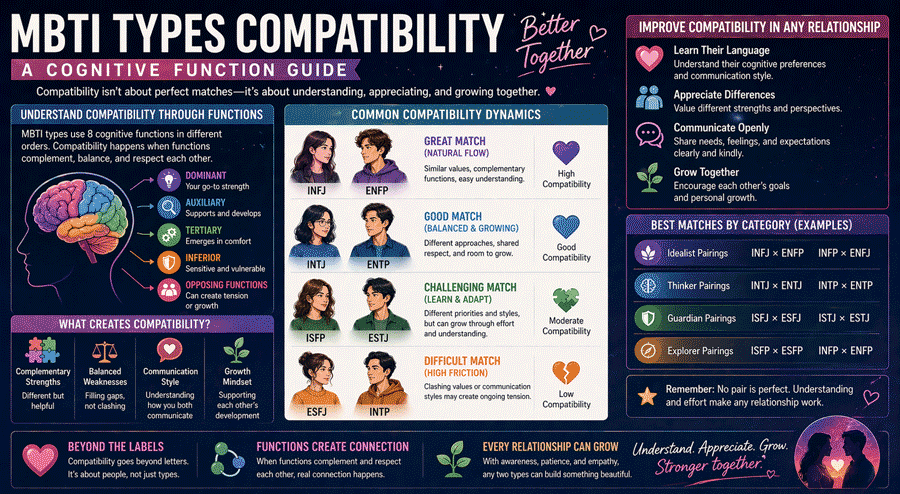
Understanding mbti types compatibility requires looking beyond the surface-level four-letter codes. While the MBTI framework offers a valuable starting point for self-discovery, true compatibility and personal growth emerge only when we analyze the underlying cognitive functions. This article concludes immediately: relying solely on letter dichotomies for compatibility often leads to mistyping and shallow relationship advice. To navigate personality dynamics effectively, you must understand how intuition, sensing, thinking, and feeling interact within a specific function stack.
The Myers-Briggs Type Indicator (MBTI) is a psychometric tool designed to categorize psychological preferences in how people perceive the world and make decisions. It is useful for individuals seeking to improve communication, understand stress responses, and identify career paths that align with their natural strengths. However, the deeper application of mbti types compatibility must return to cognitive functions. Without this depth, users risk stereotyping themselves and others, limiting potential growth. This guide provides a comprehensive, function-based approach to understanding personality dynamics, ensuring you move from static labels to dynamic understanding.
The Framework and Mechanism of Personality
To grasp why mbti types compatibility is complex, we must revisit the Jungian roots of the system. Carl Jung proposed that human behavior results from specific mental processes. The MBTI organizes these into four dichotomies: Extraversion (E) vs. Introversion (I), Sensing (S) vs. Intuition (N), Thinking (T) vs. Feeling (F), and Judging (J) vs. Perceiving (P). However, these letters are merely indicators of a deeper hierarchy known as the cognitive function stack.
The Cognitive Function Stack
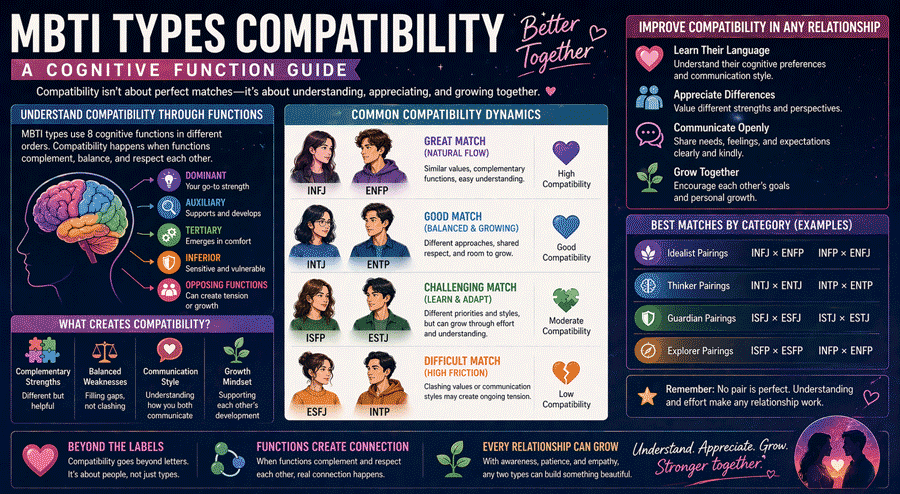
Every personality type operates using a stack of four primary functions: Dominant, Auxiliary, Tertiary, and Inferior. The Dominant function is the core lens through which a person views the world. The Auxiliary supports the dominant, providing balance. The Tertiary is less developed but emerges in mid-life, while the Inferior function is often a source of stress or growth potential.
For example, an INTJ is not just “introverted” or “intuitive.” Their stack is Dominant Introverted Intuition (Ni), Auxiliary Extraverted Thinking (Te), Tertiary Introverted Feeling (Fi), and Inferior Extraverted Sensing (Se). Understanding this stack explains why an INTJ might plan meticulously (Ni-Te) but struggle with sudden sensory changes (Se). When analyzing mbti types compatibility, comparing stacks reveals friction points. An INTJ (Ni-dom) may clash with an ESFP (Se-dom) not because of letters, but because their primary perceiving functions are opposites.
Why Letter-Based Typing Causes Mistypes
Reliance on letters alone often causes mistypes because behavior can mimic preference. A highly disciplined Perceiver (P) might appear Judging (J) due to work requirements. Similarly, a logical Feeler (F) might test as a Thinker (T) in professional settings. This is why type confirmation requires more than tests. You must validate your type through self-observation of decision patterns, stress reactions, and motivation.
Ask yourself: When stressed, do I withdraw to analyze patterns (Introverted Intuition) or seek sensory distraction (Extraverted Sensing)? Do I make decisions based on internal values (Introverted Feeling) or external logical efficiency (Extraverted Thinking)? Long-term feedback from trusted others is crucial. If needed, consider famous public figures only as illustrative examples. For instance, Albert Einstein is often typed as an INTP, widely believed to exhibit dominant Introverted Thinking, but this remains speculative. Use such examples to understand function dynamics, not as definitive facts.
Application Guidance for Real-World Dynamics
Understanding theory is insufficient without application. Below are two practical frameworks to utilize mbti types compatibility for relationships and career development.
Framework 1: Relationship and Communication Guidance
When it applies: This framework is essential for romantic partners, family members, or close colleagues seeking to reduce conflict.
Function Dynamics: Compatibility often hinges on the sharing of perceiving functions (how you take in information) or judging functions (how you make decisions). Types with shared functions often understand each other’s language. For example, two Intuitives (N) may connect on abstract ideas, while two Sensors (S) may bond over practical realities.
Practical Action Steps:
- Identify your partner’s dominant function. If they are a Dominant Feeler, prioritize emotional validation before offering solutions.
- Recognize stress triggers. If your partner has Inferior Extraverted Thinking, avoid criticizing their logic aggressively during high-stress periods.
- Establish communication protocols. Agree on whether to discuss issues immediately (Perceiving preference) or after processing time (Judging preference).
Benefits and Limitations: This approach reduces personalization of conflict. However, it does not excuse harmful behavior. Personality explains tendencies, not excuses.
How to Judge Fit: If communication improves and resentment decreases after applying these strategies, the framework fits. If interactions remain toxic, compatibility issues may run deeper than personality.
Framework 2: Career and Work-Style Fit
When it applies: Use this when selecting roles, negotiating workloads, or managing teams.
Function Dynamics: Careers align with dominant and auxiliary functions. An ENFP (Ne-Fi) thrives in roles requiring brainstorming and values alignment, whereas an ISTJ (Si-Te) excels in structured, procedural environments.
Practical Action Steps:
- Audit your daily tasks. Highlight tasks that energize you (function use) versus those that drain you (function strain).
- Negotiate work styles. If you are an Introvert, request focused work time. If you are a Perceiver, ask for flexibility in deadlines where possible.
- Seek complementary colleagues. Pair detailed-oriented Sensors with big-picture Intuitives for balanced project outcomes.
Benefits and Limitations: This increases job satisfaction and productivity. However, do not use type to avoid necessary growth. An Introvert may still need to develop public speaking skills.
How to Judge Fit: Monitor your energy levels at the end of the workweek. Consistent exhaustion suggests a misalignment between your role and your cognitive strengths.
Growth Section: Developing Beyond Your Type
MBTI type is a starting point, not an endpoint. Growth means flexibility, not identity attachment. To mature, you must engage with your entire function stack.
Identify the Dominant Function First
Growth begins with leveraging your strengths. If you are a Dominant Thinker, hone your analytical skills. Do not try to be someone else. Authenticity creates confidence.
Distinguish Preference from Skill
Preferring Feeling does not mean you lack logic. It means you prioritize values in decision-making. Develop skills outside your preference to become well-rounded. A Feeler can learn logic; a Thinker can learn empathy.
Develop the Inferior Function Gradually
The inferior function is the gateway to growth but also stress. For an INTP (Inferior Fe), growth involves learning to consider group harmony without losing logical integrity. Do not force this; engage in low-stakes social activities to practice.
Explain Loop and Grip Patterns
Under stress, types may bypass their auxiliary function and enter a “loop.” An INTJ might loop between Ni and Fi, becoming overly introspective and paranoid. In a “grip,” the inferior function takes over. An INFJ (Inferior Se) might binge eat or shop impulsively. Recognizing these patterns allows you to intervene early. Step back, rest, and re-engage your auxiliary function.
Growth Means Flexibility
Do not use your type as an excuse (“I’m a P, so I’m always late”). Use it as a map to know where you need to build scaffolding. True maturity is the ability to access all functions when the situation demands it.
Mistakes and Pitfalls to Avoid
To maintain credibility and utility, avoid these common errors when discussing mbti types compatibility.
- Don’t treat types as horoscopes. MBTI describes preferences, not destiny. Alternative: View types as behavioral tendencies that can be managed.
- Don’t assume compatibility is fixed. Two “ideal” types can have a bad relationship. Alternative: Focus on communication skills and shared values over type matching.
- Don’t mistype based on mood. Stress can mimic different types. Alternative: Observe patterns over months, not days.
- Don’t stereotype careers. Any type can be in any job. Alternative: Focus on work-style fit rather than job titles.
- Don’t ignore cultural context. Culture influences how functions are expressed. Alternative: Consider environmental factors when analyzing behavior.
- Don’t use type to judge intelligence. All types have unique cognitive strengths. Alternative: Respect diverse problem-solving approaches.
- Don’t rely solely on online tests. Tests have margin for error. Alternative: Use tests as a hint, then verify with function theory.
- Don’t attach identity to letters. You are not your type. Alternative: Use the tool for growth, not as a label that defines the whole person.
Ongoing Learning and Credible Resources
The field of personality psychology evolves. To keep your understanding accurate, encourage readers to keep following new research and higher-quality MBTI or Jungian resources. Credible organizations include the Myers & Briggs Foundation and the Center for Applications of Psychological Type (CAPT). These bodies maintain ethical standards and updated interpretations.
Engage with debates and newer interpretations. Jungian educational resources often provide deeper dives into function theory than pop-psychology blogs. Learn to identify reliable information by checking citations. Avoid low-quality summaries that promise instant typing or rigid compatibility charts. Reliable information acknowledges nuance and the limitations of the tool. Remember, MBTI is a tool for understanding preferences, not a label that defines the whole person. Continuous learning ensures you apply the framework responsibly.
Frequently Asked Questions (FAQ)
1. Where should a beginner start with MBTI?
Start by learning the four dichotomies, but quickly move to cognitive functions. Read introductory materials from the Myers & Briggs Foundation. Take a reputable test as a baseline, but do not treat the result as final. Focus on self-observation of your energy drains and gains.
2. How can I confirm my type without tests?
Study the cognitive function stacks. Compare your decision-making processes under stress versus comfort. Ask trusted friends how they perceive your reactions. Look for consistency in your motivations over years, not just current habits.
3. Does mbti types compatibility guarantee a good relationship?
No. Compatibility charts are heuristic, not deterministic. Healthy relationships require effort, communication, and shared values regardless of type. Use MBTI to understand differences, not to predict success.
4. How do I learn cognitive functions efficiently?
Focus on one axis at a time (e.g., Thinking vs. Feeling). Observe these functions in daily life. Read books by established Jungian analysts. Practice identifying functions in others before confirming your own.
5. Can my personality type change over time?
Your core preferences generally remain stable, but your expression of them matures. You may develop non-preferred functions, making you appear different. This is growth, not a type change. Be wary of claims that type flips frequently.