
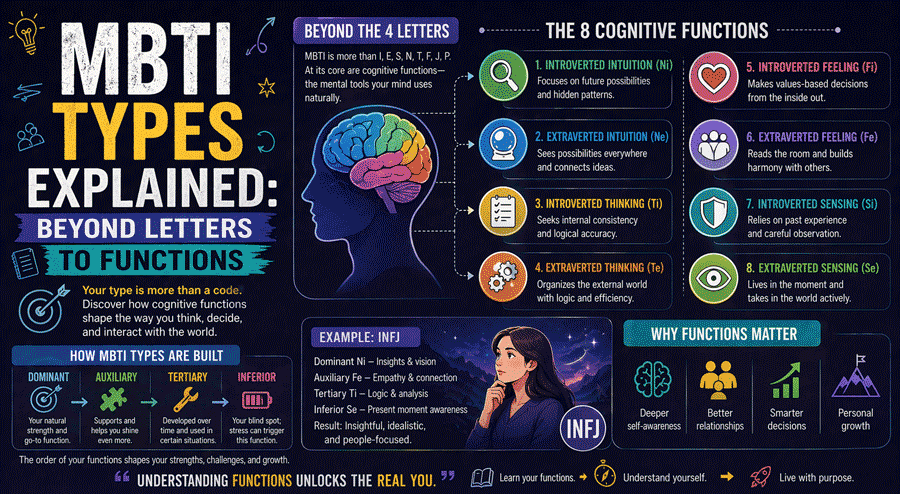
When seeking to understand personality, the most critical conclusion is that MBTI types explained through letters alone are insufficient for accurate self-knowledge. True depth requires analyzing the underlying cognitive functions that drive behavior. While the four-letter code offers a convenient shorthand, relying on it without understanding the mental processes behind it often leads to mistyping and stereotypes. This article provides a comprehensive guide to moving beyond surface-level descriptions.
Many individuals search for mbti types explained hoping to find a definitive label that predicts their future or excuses their behavior. However, the utility of the Myers-Briggs Type Indicator lies not in boxing yourself in, but in understanding your natural preferences for processing information and making decisions. By shifting focus from static traits to dynamic cognitive functions, you gain a roadmap for personal development, improved communication, and career alignment. This guide will walk you through the Jungian roots, the function stack, practical applications, and common pitfalls to avoid.
The Framework Behind MBTI Types Explained
To understand why the four letters are only the beginning, we must look at the theoretical foundation. The MBTI is built upon Carl Jung's theory of psychological types, published in 1921. Jung proposed that much of what appears to be random variation in human behavior is actually quite orderly and consistent, stemming from basic differences in how individuals prefer to use their perception and judgment.
The Myers-Briggs system categorizes these preferences into four dichotomies:
- Extraversion (E) vs. Introversion (I): Where you direct your energy. Extraverts tend to focus on the outer world of people and things, while Introverts focus on the inner world of ideas and impressions.
- Sensing (S) vs. Intuition (N): How you take in information. Sensors prefer concrete, tangible data and present realities. Intuitives prefer patterns, possibilities, and future implications.
- Thinking (T) vs. Feeling (F): How you make decisions. Thinkers prioritize logic, consistency, and objective criteria. Feelers prioritize values, harmony, and person-centered concerns.
- Judging (J) vs. Perceiving (P): How you deal with the outer world. Judgers prefer structure, plans, and closure. Perceivers prefer flexibility, openness, and options.
While these dichotomies are useful, they describe what you prefer, not how you operate. This is where the concept of cognitive functions becomes essential for anyone seeking mbti types explained in a meaningful way. The letters are merely the outward expression of an internal hierarchy of mental processes.
Why Letter-Based Typing Causes Mistypes
Online tests often rely on self-reported behavior rather than cognitive motivation. For example, an Introvert who works in sales may develop strong social skills and appear Extraverted on a test, but they still recharge through solitude. Similarly, a Thinker who values harmony may answer Feeling questions positively, masking their primary decision-making process. Without understanding the cognitive functions, you risk typing based on your developed skills or social mask rather than your innate preferences.
Accurate type confirmation requires self-observation of decision patterns, stress reactions, and motivation. It involves asking not just "What did I do?" but "Why did I do it?" and "What mental process felt most natural?" Long-term feedback from others who know you well can also validate whether your perceived type matches your observable behavior over time.
Cognitive Functions: The Engine of Personality
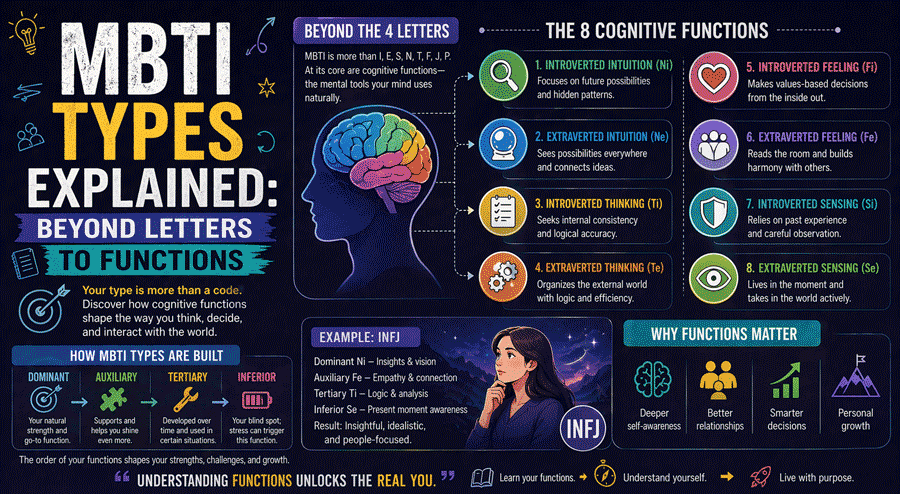
The core mechanism of the MBTI is the function stack. Each type uses four main functions in a specific order: Dominant, Auxiliary, Tertiary, and Inferior. These functions are divided into Perceiving functions (how you gather information) and Judging functions (how you make decisions).
There are eight cognitive functions in total. Understanding these is the key to unlocking mbti types explained beyond the surface level.
The Perceiving Functions
Se (Extraverted Sensing): Focuses on the immediate physical environment. Users of Se are aware of sensory details, live in the moment, and enjoy action. They are often spontaneous and adaptable.
Si (Introverted Sensing): Focuses on past experiences and internal sensory impressions. Users of Si compare present data to past references. They value stability, routine, and reliability.
Ne (Extraverted Intuition): Focuses on patterns and possibilities in the external world. Users of Ne brainstorm connections, see multiple meanings, and enjoy exploring new ideas.
Ni (Introverted Intuition): Focuses on internal insights and future visions. Users of Ni synthesize information into a single cohesive prediction or understanding. They often have "aha" moments.
The Judging Functions
Te (Extraverted Thinking): Organizes the external world using logic and efficiency. Users of Te value structure, metrics, and objective decision-making. They seek to implement plans effectively.
Ti (Introverted Thinking): Analyzes internal logical frameworks. Users of Ti seek precision, consistency, and understanding of how things work. They prioritize accuracy over external efficiency.
Fe (Extraverted Feeling): Harmonizes with the external group values. Users of Fe are attuned to social dynamics, empathy, and maintaining connection. They prioritize group morale.
Fi (Introverted Feeling): Aligns with internal values and authenticity. Users of Fi have a strong sense of right and wrong based on personal conviction. They prioritize being true to themselves.
The Function Stack Dynamics
Your Dominant function is your "hero" role—the lens through which you view the world most naturally. Your Auxiliary function supports the dominant, providing balance (e.g., if you lead with a Perceiving function, your auxiliary is a Judging function). The Tertiary function is less mature but offers relief and creativity. The Inferior function is your unconscious weak spot; under stress, you may fall into its grip, behaving uncharacteristically.
For example, an INTJ leads with Ni (vision), supports with Te (execution), uses Fi (values) for relief, and struggles with Se (sensory details) under stress. An ESFP leads with Se (experience), supports with Fi (values), uses Te (logic) for relief, and struggles with Ni (abstract planning) under stress. Recognizing these dynamics is crucial for type confirmation and understanding why you react differently than others with similar letters.
Practical Application Frameworks
Understanding your type is not an academic exercise; it is a tool for living. Below are two practical frameworks to apply your knowledge of mbti types explained to real-world scenarios.
Framework 1: Career and Work-Style Fit
When it applies: This framework is useful when choosing a career path, negotiating work conditions, or managing team dynamics. It helps align your daily tasks with your cognitive strengths.
Related Function Dynamics: This relates primarily to your Dominant and Auxiliary functions. For instance, a dominant Thinker (Ti or Te) may struggle in roles requiring constant emotional labor without logical structure. A dominant Intuitive (Ni or Ne) may burnout in roles requiring repetitive sensory detail without big-picture vision.
Practical Action Steps:
- Audit Your Energy: Track which tasks drain you and which energize you over two weeks. Note the cognitive function involved (e.g., detailed data entry vs. strategic planning).
- Identify Friction Points: If you feel constantly misunderstood at work, analyze if the communication style clashes with your function. An Fi user might feel compromised in a highly political Fe environment.
- Negotiate Roles: Propose adjustments that leverage your strengths. An Ne user might ask for brainstorming sessions before execution phases.
Benefits and Limitations: The benefit is increased job satisfaction and productivity. The limitation is that no job is perfect; every role requires some use of your inferior functions. Growth involves developing the capacity to handle those less preferred tasks.
How to Judge Fit: If you feel consistently competent yet exhausted, you may be overusing your inferior function. If you feel engaged and lose track of time, you are likely in a flow state utilizing your dominant function.
Framework 2: Relationship and Communication Guidance
When it applies: Use this framework during conflicts, when building deeper intimacy, or when collaborating on projects with partners, friends, or colleagues.
Related Function Dynamics: This relates to MBTI compatibility and communication patterns. Conflicts often arise when one person's Dominant function clashes with another's Inferior function. For example, a Te user demanding efficiency may unintentionally hurt an Fi user's sense of personal value.
Practical Action Steps:
- Translate Needs: Learn to express your needs in the other person's function language. If speaking to a Thinker, frame emotional needs as logical necessities for well-being.
- Recognize Stress Signals: Learn what your partner looks like in the "grip" of their inferior function. An normally organized J type becoming chaotic may signal stress, not laziness.
- Validate Differences: Acknowledge that different decision-making styles are valid. A Feeling decision is not "illogical"; it prioritizes different data points.
Benefits and Limitations: This reduces misunderstanding and fosters empathy. However, it should not be used to excuse harmful behavior. Personality type explains preferences, not morality.
How to Judge Fit: If communication feels like walking on eggshells, review your function dynamics. If you feel safe to express your natural style, the communication framework is working.
Growth and Development Principles
Personal growth in the context of MBTI is not about changing your type, but about expanding your flexibility. The goal is to become a more whole version of yourself, capable of accessing all functions when needed, while respecting your natural preferences.
Identify the Dominant Function First
Growth begins with acceptance. You cannot effectively develop your weaker functions if you are fighting your dominant nature. Embrace what comes naturally to you. If you are an Introvert, honor your need for solitude. If you are a Perceiver, honor your need for flexibility. Confidence in your strengths provides the foundation for addressing weaknesses.
Distinguish Preference from Skill
A common misconception is that preferring Thinking means you are smarter, or preferring Feeling means you are kinder. These are preferences, not competencies. You can be a Feeling type with excellent logical skills, but using logic may cost you more energy than it costs a Thinking type. Recognize that developing skills outside your preference requires intentional effort and recovery time.
Develop the Inferior Function Gradually
The inferior function is a source of growth but also stress. In early life, it often manifests as immaturity or insecurity. In mid-life, integrating the inferior function leads to greater balance. For example, an INTJ developing their inferior Se might learn to enjoy sensory experiences like hiking or cooking without needing to optimize them. This development should be gradual and playful, not forced.
Explain Loop and Grip Patterns
Under stress, individuals may skip their Auxiliary function and loop between their Dominant and Tertiary functions. For example, an INP (Ne-dom) might loop between Ne and Ti, becoming paralyzed by endless possibilities and over-analysis, ignoring real-world data (Si). Recognizing these loops allows you to interrupt them by consciously engaging your Auxiliary function.
Similarly, the "grip" occurs when the inferior function takes over. An ENTJ (Te-dom) in the grip of inferior Fi may become unusually emotional, sensitive to criticism, and withdrawn. Understanding this prevents you from making permanent decisions based on temporary stress reactions.
Growth Means Flexibility, Not Identity Attachment
Do not use your type as an excuse. Saying "I'm an INTP, so I can't be on time" is a misuse of the tool. Personality growth means expanding your repertoire. Use your type to understand why certain tasks are hard, then build systems to manage them. Identity attachment limits potential; self-awareness expands it.
Common Mistakes and Pitfalls
To ensure you are using the MBTI effectively, avoid these eight common pitfalls. Each point includes a better alternative mindset to guide your journey.
- Don't trust online tests blindly. Free tests often lack psychometric validity and rely on superficial questions. Alternative: Use tests as a starting hypothesis, then validate through studying cognitive functions and self-reflection.
- Don't stereotype based on letters. Assuming all "F" types are emotional or all "T" types are cold ignores individual maturity and context. Alternative: Look at the specific function stack and how it is developed in the individual.
- Don't use type to excuse bad behavior. Being a Perceiver does not justify chronic unreliability. Alternative: Use type to understand the root of the struggle and create systems to overcome it.
- Don't assume compatibility is deterministic. Certain types may communicate easier, but any two healthy individuals can build a strong relationship. Alternative: Focus on communication skills and mutual respect rather than type matching.
- Don't ignore the shadow functions. Focusing only on the top four functions misses half the picture. Alternative: Acknowledge that under extreme stress, unconscious shadow functions may emerge.
- Don't treat type as static. While preferences are stable, behavior changes with maturity and environment. Alternative: View type as a developmental trajectory rather than a fixed label.
- Don't overlook cultural context. Some cultures value Extraversion or Thinking more heavily, influencing how types present themselves. Alternative: Consider cultural norms when interpreting behavior and test results.
- Don't neglect the Auxiliary function. Focusing only on the Dominant function leads to imbalance. Alternative: Ensure you are developing your secondary function to support your dominant strength.
Ongoing Learning and Resources
The field of personality psychology is evolving. To maintain accuracy and depth in your understanding of mbti types explained, it is important to engage with credible sources and remain open to new interpretations.
Encourage yourself to follow new research regarding psychological types. While the MBTI is popular, it is part of a broader landscape of personality theory. Engaging with higher-quality MBTI and Jungian resources will prevent you from falling into pop-psychology traps.
Look for credible organizations that uphold ethical standards. The Myers & Briggs Foundation provides official information and ethical guidelines for the use of the instrument. The Center for Applications of Psychological Type (CAPT) offers research and publications dedicated to the valid application of type theory.
Additionally, explore Jungian educational resources. Carl Jung's original work, Psychological Types, provides the theoretical bedrock. Reading primary sources or commentary by respected Jungian analysts can deepen your understanding of the functions beyond the simplified MBTI model.
Be aware of debates and newer interpretations. The community discusses nuances such as the function axis, shadow functions, and the interaction between type and temperament. Engaging with these debates helps you identify reliable information and avoid low-quality summaries that reduce complex human psychology to memes.
Ways to identify reliable information include checking author credentials, looking for citations of established theory, and avoiding content that promises "hacks" or absolute predictions about your life. Reliable information empowers you; low-quality information limits you.
Frequently Asked Questions
Below are answers to common questions regarding personality typing and development.
1. Where should a beginner start with MBTI?
Start by understanding the four dichotomies, but quickly move to learning the eight cognitive functions. Read descriptions of the functions rather than just the 16 types. Observe your own decision-making processes in low-stakes situations to see which functions feel most natural.
2. How can I confirm my type without tests?
Focus on motivation and energy. Ask yourself: "When I solve a problem, do I naturally look for external data (Te/Se) or internal consistency (Ti/Ni)?" "Do I prioritize group harmony (Fe) or personal authenticity (Fi)?" Track your energy levels after using different functions. Confirmation comes from long-term self-observation, not a single quiz result.
3. How does MBTI help with relationship communication?
It highlights differences in information processing. If you know your partner is an Intuitive, they may need to discuss the "why" before the "how." If they are a Sensor, they may prefer concrete examples over abstract theories. Understanding these communication patterns reduces frustration and increases empathy.
4. What is the most efficient way to learn cognitive functions?
Study one function at a time. Try to identify examples of Se, Si, Ne, Ni, Te, Ti, Fe, and Fi in your daily life and in others. Compare how different types use the same function differently (e.g., Te in an ENTJ vs. Te in an ISTJ). Practice labeling behaviors with function names to build fluency.
5. Can my personality type change over time?
Your core preferences are generally stable throughout adulthood, similar to handedness. However, your ability to use non-preferred functions improves with maturity. You may appear to change as you develop skills, but your underlying energy preferences typically remain consistent. Type does not change, but behavior and flexibility do.
In conclusion, mbti types explained is not about memorizing 16 boxes. It is about understanding the dynamic cognitive processes that make you unique. By focusing on functions, avoiding pitfalls, and committing to ongoing growth, you can use this tool to build a more authentic, effective, and balanced life.