
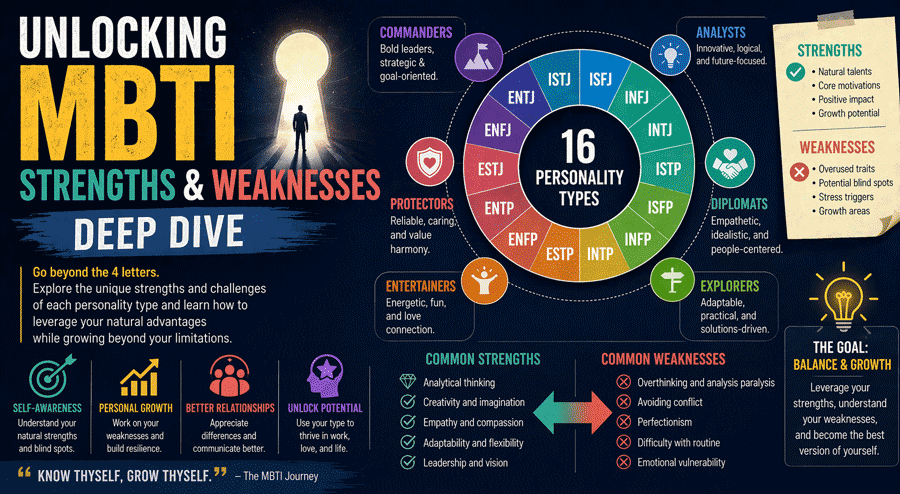
Understanding your personality is not about fitting into a box; it is about unlocking potential. When searching for mbti strengths and weaknesses, most readers seek more than a simple list of traits. They want to know why they behave certain ways, how to leverage their natural advantages, and how to mitigate their blind spots. The core conclusion is immediate: true mastery of your type requires moving beyond the four-letter code and understanding the underlying cognitive functions. While the MBTI framework offers a valuable starting point for self-discovery, deeper application of "mbti strengths and weaknesses" must return to cognitive functions to avoid stereotypes and facilitate real personality growth.
This article serves as a comprehensive guide for English-speaking readers interested in MBTI, those trying to understand their own type more accurately, and individuals exploring cognitive functions, compatibility, career fit, and communication. We will emphasize that MBTI type is a starting point, not an endpoint. Deeper understanding requires returning to cognitive functions, not just the four letters. By the end of this guide, you will have practical frameworks for development, a clear understanding of common pitfalls, and the tools to validate your type through observation rather than reliance on tests alone.
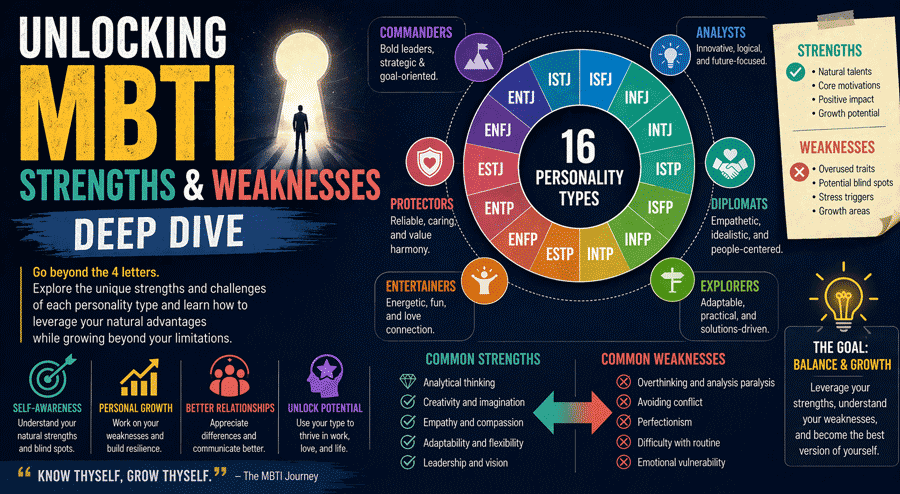
Beyond the Letters: The Jungian Framework
To genuinely grasp mbti strengths and weaknesses, one must understand the engine driving the vehicle. The Myers-Briggs Type Indicator is rooted in Carl Jung’s theory of psychological types. Jung proposed that much of seemingly random human behavior is actually quite orderly and consistent, resulting from basic differences in the way individuals prefer to use their perception and judgment.
The Four Dichotomies and Their Limits
Traditionally, MBTI is presented through four dichotomies: Extraversion (E) vs. Introversion (I), Sensing (S) vs. Intuition (N), Thinking (T) vs. Feeling (F), and Judging (J) vs. Perceiving (P). While these letters provide a shorthand, they often lead to superficial categorization. For instance, labeling someone as a “Thinker” does not explain how they process information or make decisions. It merely indicates a preference. Relying solely on these letters often causes mistypes because behavior can be situational. A stressed Introvert may act Extraverted, and a developed Feeler may use Thinking logic efficiently.
Cognitive Function Stack: The Real Mechanism
The depth of MBTI lies in the cognitive function stack. Each of the 16 types utilizes four main functions in a specific order: dominant, auxiliary, tertiary, and inferior. These functions describe how you take in information (Perceiving functions: Sensing and Intuition) and how you make decisions (Judging functions: Thinking and Feeling).
For example, an INTJ is not just “introverted and intuitive.” Their stack is Dominant Introverted Intuition (Ni), Auxiliary Extraverted Thinking (Te), Tertiary Introverted Feeling (Fi), and Inferior Extraverted Sensing (Se). This stack explains why an INTJ might be visionary and strategic (Ni) but struggle with immediate sensory details or spontaneity (Se). Understanding this dynamic clarifies mbti strengths and weaknesses far better than letter codes. The dominant function is your superpower, the auxiliary supports it, the tertiary offers relief, and the inferior function is often the source of stress and growth opportunities.
Why Letter-Based Typing Causes Mistypes
Many individuals mistype because they answer test questions based on their ideal self or their work persona rather than their natural preference. Furthermore, tests cannot measure the nuance of cognitive processes. A person might score high on Thinking but actually use Introverted Feeling to make values-based decisions that look logical on the surface. To validate your type, you must look beyond scores. Engage in self-observation regarding decision patterns, stress reactions, motivation, and blind spots. Seek long-term feedback from others who know you well. If you resonate with the cognitive process description more than the letter description, trust the process. For instance, a person widely believed to be an ENTJ might actually be an ESTJ if their focus is on concrete logistical efficiency (Te-Si) rather than abstract strategic vision (Te-Ni). Use cautious wording when discussing public figures; for example, Elon Musk is often typed as an INTJ or ENTJ, but without his direct confirmation, these remain illustrative examples of function stacks rather than facts.
Validating Your Type Through Observation
Confirming your type is a journey of elimination and resonance. It is not about finding the type that sounds coolest, but the one that explains your struggles and strengths most accurately.
Decision Patterns and Motivation
Observe how you make difficult decisions. Do you prioritize objective logic and efficiency (Thinking), or do you prioritize harmony and personal values (Feeling)? Do you prefer established methods and past experiences (Sensing), or do you prefer new possibilities and future implications (Intuition)? Motivation is also key. An Introvert recharges by solitude, while an Extravert recharges by interaction. If you feel drained after a social event regardless of how much you enjoyed it, you likely lean toward Introversion. These internal metrics are more reliable than external behavior.
Stress Reactions and Blind Spots
Your type is often most visible when you are under stress. The “grip” experience occurs when you are overwhelmed and overuse your inferior function. An INFJ, normally empathetic and structured, might become uncharacteristically critical and obsessed with sensory details when in the grip of Extraverted Sensing. Recognizing these stress reactions helps confirm your inferior function, which in turn confirms your dominant function. Blind spots are also telling. If you consistently forget to check practical details despite valuing accuracy, you might have inferior Sensing. If you struggle to articulate your internal values despite caring deeply, you might have tertiary or inferior Feeling.
Practical Frameworks for Application
Knowing your type is useless without application. Below are two practical frameworks to leverage mbti strengths and weaknesses for tangible improvement in career and relationships.
Framework 1: Career and Work-Style Fit
When it applies: This framework is essential when choosing a career path, negotiating work responsibilities, or managing team dynamics.
Related Function Dynamics: This relates to how you process information (S/N) and make decisions (T/F), as well as your orientation to the outer world (J/P).
Practical Action Steps:
- Identify Your Energy Source: If you are an Introvert, negotiate for deep work blocks without interruptions. If you are an Extravert, seek roles with collaboration and brainstorming.
- Leverage Decision Styles: Thinkers should seek roles requiring objective analysis and system optimization. Feelers should seek roles involving mediation, HR, or user experience where human impact is central.
- Manage Information Flow: Sensors excel in roles requiring attention to detail and real-time data. Intuitives excel in strategy, innovation, and conceptual modeling.
Benefits and Limitations: The benefit is increased job satisfaction and productivity. The limitation is that no job fits perfectly; you must still develop non-preferred skills. For example, an Intuitive leader must still learn to manage budgets (Sensing/Thinking tasks).
How to Judge Fit: If you feel constantly exhausted by the core tasks of your job, not just the volume of work, you may be fighting your natural cognitive preferences. However, do not use this as an excuse to avoid growth.
Framework 2: Relationship and Communication Guidance
When it applies: Use this during conflicts, when building teams, or when trying to deepen intimacy with partners or friends.
Related Function Dynamics: This primarily involves the Feeling/Thinking axis and Extraversion/Introversion dynamics.
Practical Action Steps:
- Translate Your Language: If you are a Thinker speaking to a Feeler, preface feedback with affirmation. If you are a Feeler speaking to a Thinker, get to the point and explain the logic behind your emotional needs.
- Respect Energy Needs: Understand that an Introvert’s silence is not rejection, and an Extravert’s need to talk is not dominance.
- Identify Compatibility Patterns: While any type can work together, understanding MBTI compatibility helps anticipate friction. For example, two Judging types may struggle with flexibility, while two Perceiving types may struggle with deadlines.
Benefits and Limitations: This reduces misunderstanding and fosters empathy. The limitation is assuming type explains everything. Personal maturity and history matter more than type. Do not blame conflicts solely on personality differences.
How to Judge Fit: If communication feels like walking on eggshells constantly, revisit your communication patterns. Are you respecting their function stack? Are they respecting yours?
Personal Growth and Function Development
Growth is the ultimate goal of understanding mbti strengths and weaknesses. It is not about changing your type, but about expanding your repertoire.
Identify the Dominant Function First
Your dominant function is your home base. Strengthening it provides confidence and competence. If you are an Dominant Intuitive, spend time strategizing and learning. If you are a Dominant Sensor, spend time mastering tangible skills and observing reality. Do not neglect your strength in favor of fixing weaknesses immediately.
Distinguish Preference from Skill
You can be skilled at something you do not prefer. An Introvert can be a great public speaker, but it will cost more energy. Recognize this distinction to manage burnout. Just because you can do it doesn’t mean it’s your natural strength.
Develop the Inferior Function Gradually
The inferior function is the key to wholeness, but it is fragile. Do not try to force it. An inferior Thinking type should not try to become a cold logician overnight. Instead, engage in low-stakes logical exercises. An inferior Feeling type should practice identifying emotions in safe environments. Growth means flexibility, not identity attachment. You are not your type; you are a person using a type structure.
Explain Loop and Grip Patterns
Understand unhealthy patterns. A “loop” occurs when you bypass your auxiliary function and bounce between your dominant and tertiary. For example, an INTP looping between Ti and Ne may become paralyzed by theorizing without testing reality (Te). A “grip” is stress-induced overuse of the inferior. Recognizing these states allows you to course-correct by engaging the auxiliary function. If you are stressed, do what your auxiliary function does. If you are an Introvert, go out. If you are a Thinker, connect with values.
Common Pitfalls and Mistakes
To ensure your journey with MBTI is productive, avoid these eight common mistakes. Each point includes a better alternative mindset.
- Don’t treat MBTI as a horoscope. Avoid deterministic thinking that says “I can’t do this because I am an INFP.” Alternative: View it as a map of preferences, not a cage of limitations.
- Don’t stereotype other types. Avoid assuming all Thinkers are unfeeling robots or all Feelers are irrational. Alternative: Recognize individual variation within types.
- Don’t ignore stress reactions. Do not assume your best self is your only self. Alternative: Study your type under stress to understand your shadow side.
- Don’t rely solely on online tests. Free tests are often inaccurate. Alternative: Use tests as a starting hypothesis, then validate through study and observation.
- Don’t use type to excuse bad behavior. “I’m just being honest” is not a pass for cruelty. Alternative: Take responsibility for the impact of your actions regardless of intent.
- Don’t obsess over typing others. Trying to type everyone you meet creates distance. Alternative: Focus on understanding your own type first; let others reveal themselves.
- Don’t neglect the inferior function. Ignoring your weak spot limits growth. Alternative: Gently engage your inferior function to become more well-rounded.
- Don’t stop learning. Assuming you know everything after reading one article halts progress. Alternative: Treat personality study as a lifelong practice.
Continuing Your MBTI Journey
The field of personality psychology is evolving. To maintain credibility and depth, encourage readers to keep following new research and higher-quality MBTI or Jungian resources. Credible organizations such as the Myers & Briggs Foundation and the Center for Applications of Psychological Type (CAPT) offer rigorous materials. Engage with debates and newer interpretations, such as the Beebe model or socionics, but maintain a critical eye. Learn to identify reliable information and avoid low-quality summaries that reduce complex theories to memes. Personality growth is a continuous process. As you mature, your relationship with your type will change. What resonated at age 20 may shift by age 40. Stay open to nuance.
Frequently Asked Questions
1. Where should a beginner start with MBTI?
Start by reading about the cognitive functions rather than just the 16 type descriptions. Understanding the building blocks (Ni, Ne, Si, Se, Ti, Te, Fi, Fe) makes the type descriptions make sense. This prevents confusion when you resonate with multiple types.
2. How can I confirm my type without tests?
Focus on energy dynamics. What drains you? What energizes you? Look at your decision-making process under pressure. Compare your internal experience with function descriptions rather than external behaviors. Feedback from trusted friends about your blind spots is also invaluable.
3. Does MBTI help with relationship communication?
Yes, by highlighting differences in information processing and decision-making. It helps partners understand that a difference in approach is not a defect. However, it should complement, not replace, active listening and emotional intelligence.
4. How do I learn cognitive functions efficiently?
Study one axis at a time (e.g., Thinking vs. Feeling). Observe these functions in yourself and others daily. Keep a journal of decisions and analyze which function drove them. Patience is key; it takes time to internalize these concepts.
5. Can my personality type change over time?
Your core preferences generally remain stable, similar to handedness. However, your ability to use non-preferred functions improves with age and maturity. You may appear to change type because you have developed skills outside your natural preference, but your underlying energy orientation typically remains consistent.
In conclusion, exploring mbti strengths and weaknesses is a powerful tool for self-awareness when used correctly. By focusing on cognitive functions, validating through observation, and applying practical frameworks, you can transform theoretical knowledge into real-world growth. Remember, the goal is not to label yourself, but to understand yourself so you can navigate the world with greater clarity and compassion.