
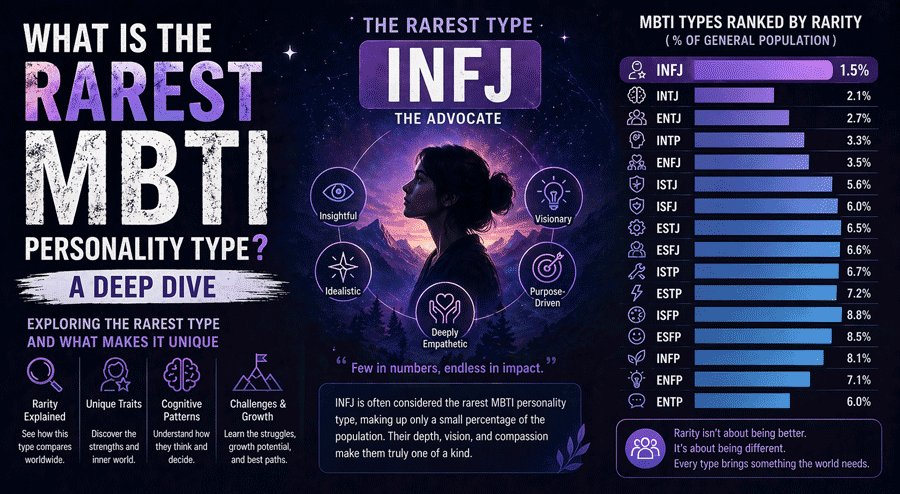
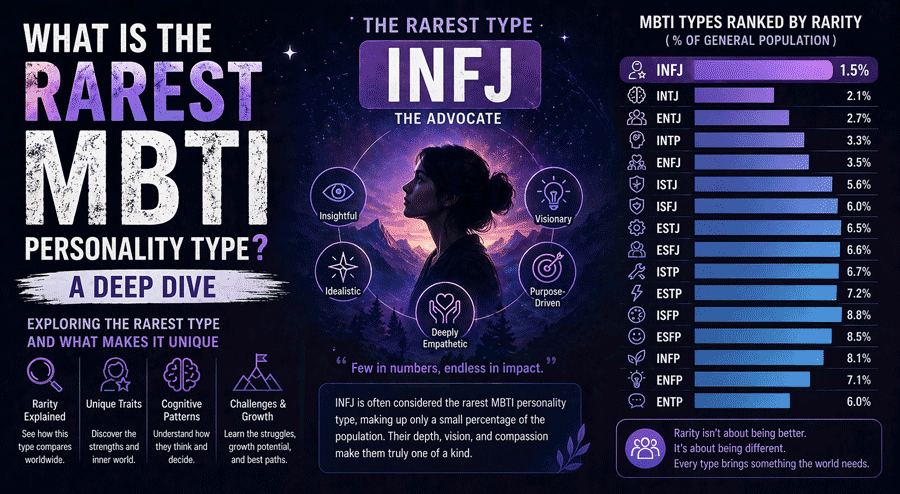
When exploring personality frameworks, one question arises frequently: what is the rarest mbti personality type? While statistics often point to INFJ or INTJ as the least common, focusing solely on prevalence misses the deeper value of the system. The Myers-Briggs Type Indicator (MBTI) is not merely a labeling tool but a map for understanding cognitive preferences. To truly apply the concept of the rarest mbti personality type, one must move beyond the four-letter code and return to the underlying cognitive functions. This article provides a comprehensive analysis designed for readers seeking depth beyond stereotypes, offering practical guidance on type confirmation, relationship dynamics, and personal growth.
MBTI helps individuals understand how they perceive the world and make decisions. It is useful for anyone seeking clarity on their natural strengths, communication styles, and potential blind spots. However, the utility of knowing your type diminishes if treated as a fixed identity rather than a starting point for development. The following sections will dissect the mechanisms behind type rarity, explain why letter-based typing often fails, and provide actionable frameworks for leveraging your cognitive stack effectively.
The Jungian Framework Behind the Letters
To understand why certain types are considered rare, we must first examine the Jungian roots of MBTI. Carl Jung proposed that human consciousness operates through specific mental processes, which Katharine Cook Briggs and Isabel Briggs Myers later codified into the MBTI system. The four dichotomies—Extraversion vs. Introversion, Sensing vs. Intuition, Thinking vs. Feeling, and Judging vs. Perceiving—are surface-level indicators of deeper cognitive functions.
The true engine of personality lies in the cognitive function stack. Each type utilizes four primary functions in a specific order: dominant, auxiliary, tertiary, and inferior. For example, an INFJ leads with Introverted Intuition (Ni), supported by Extraverted Feeling (Fe), while an INTJ leads with Ni supported by Extraverted Thinking (Te). These functions dictate how information is processed and how decisions are made. Understanding this stack is crucial because two types may share letters but operate differently due to function orientation.
Why does letter-based typing often cause mistypes? Online tests typically measure behaviors rather than cognitive processes. Behavior is context-dependent; a stressed Introvert may appear Extraverted, and a developed Thinker may utilize Feeling skills effectively. Consequently, relying solely on test results can lead to incorrect type identification. Validating your type requires self-observation of decision patterns, stress reactions, and motivation. It involves asking not just what you do, but why you do it and what mental energy it consumes.
For instance, consider the difference between Thinking and Feeling. A Thinking type prioritizes logical consistency and objective criteria, whereas a Feeling type prioritizes harmony and personal values. However, a mature Thinking type can be empathetic, and a mature Feeling type can be logical. The distinction lies in their default setting under pressure. Similarly, Judging versus Perceiving refers to how one interacts with the outer world, not necessarily how organized one is. A Perceiving type may maintain a tidy workspace but prefers keeping options open, while a Judging type seeks closure and structure.
Why the "Rarest" Label Misleads
Statistical rarity does not equate to superiority or complexity. The designation of the rarest mbti personality type often fluctuates based on demographic samples and cultural contexts. In some populations, Intuitive types are less common than Sensing types, making INFJ or INTJ appear rare. In others, specific Feeling or Thinking preferences may shift the distribution. Focusing on rarity can create an ego trap where individuals seek a unique label rather than accurate self-understanding.
Furthermore, cognitive functions are universal. Every human possesses all eight functions (Ni, Ne, Si, Se, Ti, Te, Fi, Fe) to varying degrees. The "type" simply indicates the hierarchy of comfort and proficiency. Therefore, identifying with a rare type should not isolate you but rather highlight specific growth areas associated with your inferior function. For example, if you lead with Intuition, your growth lies in grounding yourself in Sensing realities. If you lead with Thinking, your development involves integrating Feeling considerations.
Public figures are often cited as examples of rare types, but these typings should be treated cautiously. Figures like Nikola Tesla or Martin Luther King Jr. are widely believed to be INTJ or INFJ respectively, based on historical records of their behavior and writings. However, without direct assessment, these remain educated guesses. Use such examples only to illustrate function dynamics, not as definitive proof of type characteristics.
Practical Framework 1: Cognitive Function Development
Understanding your function stack allows for targeted personal development. This framework applies to anyone seeking to balance their personality, regardless of their specific type. The goal is not to change your type but to increase flexibility across all functions.
When it applies: This framework is most useful during periods of stagnation, career transitions, or when facing recurring interpersonal conflicts. It relates to the dynamic between your dominant strength and your inferior weakness.
Practical Action Steps:
- Identify the Dominant Function: Reflect on what activities energize you effortlessly. If analyzing systems energizes you, Ti or Te may be dominant. If understanding people energizes you, Fi or Fe may be dominant.
- Develop the Inferior Function Gradually: The inferior function is often a source of stress but also potential growth. If your inferior is Sensing, practice mindfulness and attention to physical details. If it is Thinking, practice objective decision-making without excessive emotional attachment.
- Monitor Energy Levels: Notice which functions drain you. Use this data to schedule recovery time after engaging your weaker functions.
Benefits and Limitations: The benefit is increased adaptability and reduced stress during challenges. The limitation is that over-developing weaker functions can lead to burnout if the dominant function is neglected. Readers can judge fit by observing if their stress levels decrease when they honor their natural preferences while stretching into discomfort intentionally.
Practical Framework 2: Relationship and Communication Dynamics
MBTI is particularly powerful for understanding MBTI compatibility and communication patterns. This framework helps partners, colleagues, and friends navigate differences without taking them personally.
When it applies: Use this during conflicts, team collaborations, or when trying to deepen emotional intimacy. It relates to how different types process information and express care.
Practical Action Steps:
- Map Communication Styles: Identify if your counterpart prefers direct logic (Thinking) or values-based discussion (Feeling). Adjust your language accordingly.
- Respect Processing Time: Introverts often need time to reflect before responding, while Extraverts may think out loud. Allow space for these differing decision-making styles.
- Clarify Intentions: Misunderstandings often arise from function clashes. A Thinking type may offer solutions when a Feeling type seeks empathy. Explicitly state whether you are looking for advice or validation.
Benefits and Limitations: This reduces friction and builds empathy. However, it should not be used to excuse poor behavior or avoid accountability. Type explains preference, not excuse. Readers can judge effectiveness by noting a reduction in repetitive arguments and an increase in mutual understanding.
Principles of Personality Growth and Flexibility
Growth in the context of MBTI means expanding your repertoire, not abandoning your core self. Universal principles apply across all types to ensure healthy development.
Identify the Dominant Function First: Solidify your strengths before working on weaknesses. A strong foundation provides the confidence needed to explore unfamiliar cognitive territories. Without a secure dominant function, attempts to grow can feel like impostor syndrome.
Distinguish Preference from Skill: You may be skilled at something you do not prefer. For example, an Introvert may be a proficient public speaker but find it draining. Recognize the difference between competence and energy cost to manage your workload effectively.
Develop the Inferior Function Gradually: The inferior function often emerges under stress in immature ways, known as the "grip." For an INFJ, stress might manifest as uncharacteristic sensory indulgence or critical outbursts. Recognizing these patterns allows for early intervention before burnout occurs.
Explain Loop and Grip Patterns: A "loop" occurs when a type bypasses their auxiliary function, leading to unbalanced thinking. An INTJ might loop between Ni and Ti, becoming overly theoretical and disconnected from reality. Breaking the loop requires engaging the auxiliary function (Te) to take concrete action.
Growth Means Flexibility, Not Identity Attachment: Avoid becoming rigidly attached to your type label. Use it as a tool for insight, not a cage. True personality growth involves the ability to access all functions when the situation demands it, regardless of preference.
8 Common Mistakes and Pitfalls to Avoid
To maintain credibility and utility in your MBTI journey, avoid these common errors. Each point includes a better alternative mindset to guide your practice.
- Don't Treat Type as Destiny: Believing your type dictates your entire future limits potential. Better Mindset: View type as a starting point for understanding preferences, not a limit on capabilities.
- Don't Ignore Context: Behavior changes based on environment. Better Mindset: Observe patterns over time and across different situations rather than single instances.
- Don't Stereotype Others: Assuming all Thinkers are cold or all Feelers are irrational is harmful. Better Mindset: Approach each individual as unique, using type only to understand their perspective.
- Don't Rely Solely on Tests: Tests measure current state, not deep preference. Better Mindset: Use tests as a hypothesis generator, then validate through self-study and function analysis.
- Don't Neglect the Inferior Function: Ignoring weaknesses leads to stress explosions. Better Mindset: Acknowledge blind spots and create systems to support areas of lower natural proficiency.
- Don't Use Type to Avoid Accountability: Saying "I'm an INTP" to excuse lateness is misuse. Better Mindset: Take responsibility for behaviors regardless of type, using insights to improve rather than justify.
- Don't Chase Rarity: Seeking the rarest mbti personality type for status undermines authenticity. Better Mindset: Value accuracy over uniqueness; the common types offer just as much depth.
- Don't Stop Learning: Assuming you know everything after reading one book is limiting. Better Mindset: Commit to ongoing education as psychological understanding evolves.
Continuing Your Learning Journey
The field of personality psychology is dynamic. To ensure you are accessing reliable information, prioritize credible organizations and research-based resources. The Myers & Briggs Foundation and the Center for Applications of Psychological Type (CAPT) offer authoritative materials grounded in the original theory. Jungian educational resources also provide depth on the cognitive functions that underpin the MBTI system.
Stay open to debates and newer interpretations. As research progresses, understanding of cognitive functions may refine. Learn to identify reliable information by checking for citations, avoiding overly simplistic summaries, and looking for nuance in explanations. High-quality resources will emphasize the complexity of human psychology rather than offering quick fixes or deterministic predictions. Engaging with communities that focus on growth rather than labeling will further enhance your understanding.
Frequently Asked Questions
1. Where should a beginner start with MBTI?
Begin by understanding the four dichotomies, but quickly move to cognitive functions. Read introductory materials from credible sources like the Myers & Briggs Foundation. Take a test only as a starting hypothesis, not a final verdict. Focus on self-observation regarding what energizes versus drains you.
2. How can I confirm my type without tests?
Study the cognitive function stacks. Observe your decision-making processes under stress. Ask trusted friends for feedback on your blind spots. Look for long-term patterns in your motivation and information processing rather than temporary behaviors. If a description resonates partially, investigate which function dynamics are at play.
3. How does type affect relationship communication?
Type influences how people express care and process conflict. Thinking types may prioritize problem-solving, while Feeling types prioritize emotional validation. Understanding these communication patterns helps partners translate their needs effectively. It reduces misinterpretation of intent during disagreements.
4. What is the most efficient way to learn cognitive functions?
Focus on one function pair at a time (e.g., Ni vs. Ne). Compare how they manifest in different types. Use real-life examples to track these functions in action. Practice identifying functions in others before applying them to yourself to reduce bias. Consistent study over months yields better results than cramming.
5. Can my personality type change over time?
Core preferences generally remain stable throughout adulthood. However, your expression of these preferences can mature. You may develop skills in non-preferred areas, making you appear different behaviorally. This is growth, not a change in type. Be wary of claims that type shifts frequently; usually, it indicates initial mistyping rather than actual change.