
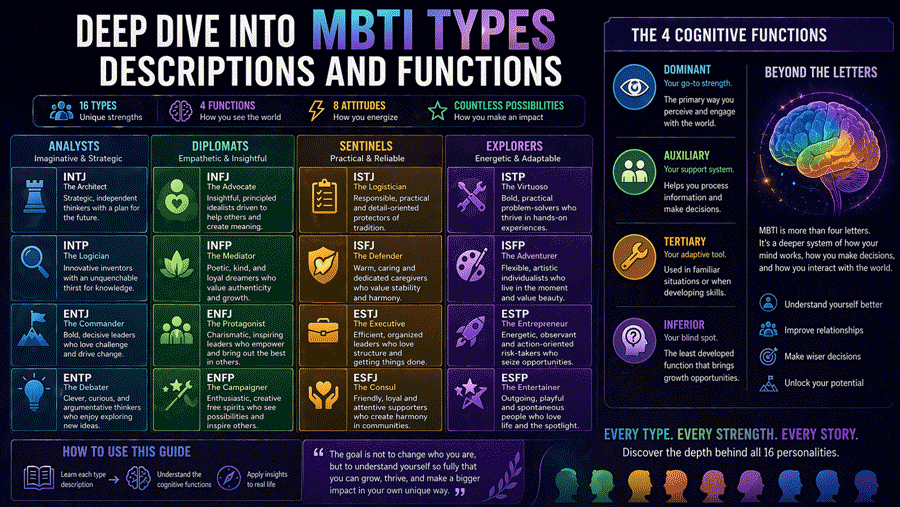
Understanding personality is a journey toward self-awareness, not a destination of labeling. When users search for mbti types descriptions, they are often seeking more than just a four-letter code; they want to understand why they think, feel, and act the way they do. While the sixteen types provide a helpful framework, true depth comes from exploring the cognitive functions that drive them. This article moves beyond surface-level stereotypes to offer a robust, function-based analysis of personality.
The Myers-Briggs Type Indicator (MBTI) is a tool designed to help individuals identify their preferences in how they perceive the world and make decisions. It is useful for career planning, relationship building, and personal growth. However, relying solely on letter-based descriptions can lead to mistypes and superficial understanding. To apply mbti types descriptions effectively, one must return to the underlying cognitive mechanisms. This guide provides a comprehensive look at the Jungian roots, function stacks, practical applications, and common pitfalls associated with personality typing.
The Framework and Mechanism of Personality
To understand any of the sixteen types, we must first look at the theoretical foundation. The MBTI is based on Carl Jung’s theory of psychological types, which proposes that human behavior is not random but follows predictable patterns based on innate preferences.
The Four Dichotomies
The system uses four dichotomies to categorize preferences. These are not skills or abilities but rather natural inclinations. The first is Extraversion (E) versus Introversion (I), which describes where you direct your energy. Extraverts tend to recharge through interaction with the outer world, while Introverts recharge through solitude and internal reflection. The second is Sensing (S) versus Intuition (N), which describes how you gather information. Sensors focus on concrete details and present realities, whereas Intuitives look for patterns, possibilities, and future implications.
The third dichotomy is Thinking (T) versus Feeling (F), describing how you make decisions. Thinkers prioritize logic, consistency, and objective criteria, while Feelers prioritize values, harmony, and the impact on people. The fourth is Judging (J) versus Perceiving (P), which describes how you approach the outside world. Judgers prefer structure, planning, and closure, while Perceivers prefer flexibility, spontaneity, and keeping options open.
Cognitive Function Stack
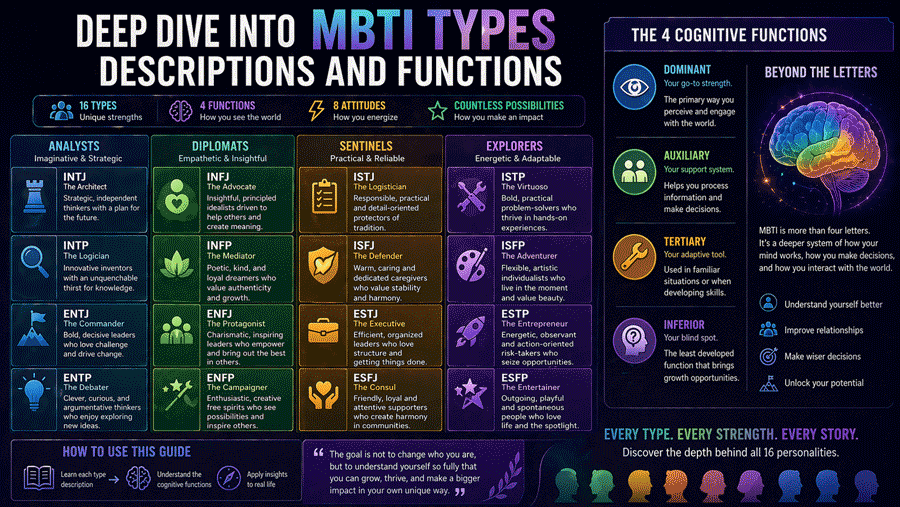
The four letters are merely a shorthand for a deeper structure known as the cognitive function stack. Each type uses four primary functions in a specific order: Dominant, Auxiliary, Tertiary, and Inferior. The Dominant function is the core of your personality, the lens through which you view the world. The Auxiliary function supports the dominant, providing balance. For example, an INTJ leads with Introverted Intuition (Ni) and supports it with Extraverted Thinking (Te). This stack explains why two types sharing letters might behave differently; an ISTJ and an ISFJ both lead with Introverted Sensing (Si), but their auxiliary functions (Te vs. Fe) create distinct decision-making styles.
Understanding the function stack is critical because letter-based typing alone often causes mistypes. A person might test as an Extrovert because they are social, but if their dominant function is Introverted, they may still require significant alone time to process. Therefore, validating your type requires self-observation of decision patterns, stress reactions, and motivation rather than relying only on tests.
Validating Your Type
Type confirmation should be a process of elimination and observation. Ask yourself: What drains me? What energizes me? When under stress, do I become overly critical (Thinking grip) or overly emotional (Feeling grip)? Long-term feedback from others can also be illuminating. Friends might describe you as organized, but if that organization stems from anxiety rather than preference, you might not be a Judger. If needed, consider famous public figures as illustrative examples, using cautious wording. For instance, Albert Einstein is often typed as an INTP due to his theoretical focus, while Oprah Winfrey is widely believed to be an ENFJ due to her empathetic leadership. These examples serve as anchors, not definitive proofs.
Application Guidance for Personal Development
Knowing your type is only the beginning. The real value lies in application. Below are two practical frameworks for using personality insights to improve your life.
Framework 1: Cognitive Function Development
This framework focuses on strengthening your function stack over time. It applies to anyone seeking personal growth regardless of their specific type. The goal is to leverage your strengths while consciously developing weaker areas.
When it applies: Use this when you feel stuck in repetitive patterns or want to expand your skill set. It relates to all type dynamics, particularly the tension between the Dominant and Inferior functions.
Practical Action Steps: First, identify your dominant function. If you are a Thinker, acknowledge your reliance on logic. Second, schedule time to exercise your inferior function. For a Thinker, this might mean practicing empathy without trying to solve the problem. Third, monitor your energy levels. If developing a weaker function causes burnout, scale back. Finally, seek feedback. Ask trusted peers if your new behaviors feel authentic or forced.
Benefits and Limitations: The benefit is increased flexibility and resilience. You become less rigid in your preferences. The limitation is that you cannot change your core nature. An Introvert will never become an Extrovert, but they can learn social skills. Readers can judge fit by assessing whether the effort feels like growth or exhaustion. Sustainable growth feels challenging but energizing in the long run.
Framework 2: Relationship and Communication Guidance
This framework uses type knowledge to improve interactions with others. It is particularly useful for couples, teams, and families where conflict arises from differing communication styles.
When it applies: Use this during conflicts or when planning collaborative projects. It relates to the Thinking vs. Feeling and Judging vs. Perceiving dynamics primarily.
Practical Action Steps: Identify the other person’s likely preferences. If they are a Sensor, provide concrete details rather than abstract theories. If they are a Perceiver, allow room for last-minute changes rather than enforcing strict deadlines. Practice “translating” your needs. Instead of saying “You are disorganized,” a Judger might say, “I feel anxious when plans are unclear; can we set a timeline?”
Benefits and Limitations: The benefit is reduced friction and increased empathy. You stop taking differences personally. The limitation is the risk of stereotyping. Not every Feeling type is emotional, and not every Thinker is cold. Readers can judge fit by observing if conflicts decrease over time. If understanding the type leads to more patience, the framework is working.
Growth Section: Universal Principles
Personal growth within the MBTI framework follows universal principles that apply to all sixteen types. These principles help prevent stagnation and encourage healthy development.
Identify the Dominant Function First
Your dominant function is your superpower. It is where you are most natural and effective. Growth begins with honoring this strength. If you suppress your dominant function to fit in, you will feel unfulfilled. For example, an Intuitive forced into purely repetitive sensory work may feel drained. Acknowledge your core preference and build your life around utilizing it.
Distinguish Preference from Skill
A common misconception is that preference equals skill. You may prefer Thinking but be bad at logic, or prefer Feeling but be highly empathetic. Do not use type as an excuse for incompetence. “I am a Perceiver, so I am always late” is not a valid excuse. Use type to understand where you need to apply more conscious effort to develop skills that do not come naturally.
Develop the Inferior Function Gradually
The inferior function is your weakest link, often emerging under stress. For an INTJ, the inferior function is Extraverted Sensing (Se). Under stress, they might binge eat or engage in reckless behavior. Healthy growth involves integrating this function in small doses. An INTJ might practice mindfulness or physical exercise to connect with the present moment without overwhelming themselves. This development should be gradual to avoid burnout.
Explain Loop and Grip Patterns
When stressed, types may fall into “loops” or “grips.” A loop occurs when you bypass your auxiliary function and oscillate between your dominant and tertiary functions. An INFP might loop between Introverted Feeling (Fi) and Introverted Intuition (Ni), becoming withdrawn and paranoid. A grip occurs when the inferior function takes over. Recognizing these patterns allows you to intervene early. If you notice yourself becoming uncharacteristically critical or emotional, pause and re-engage your auxiliary function.
Growth Means Flexibility, Not Identity Attachment
Finally, remember that growth means flexibility. Do not attach your identity so rigidly to your type that you refuse to adapt. MBTI is a tool for understanding preferences, not a label that defines the whole person. You are more than four letters. Use the framework to expand your possibilities, not to limit them.
Mistakes and Pitfalls to Avoid
Even experienced users fall into traps when discussing personality. Avoiding these common mistakes ensures a healthier relationship with the tool.
- Don’t treat type as fixed destiny. Type describes preferences, not fate. You can learn new behaviors. Better mindset: View type as a starting point for development.
- Don’t use type to excuse bad behavior. Being a Thinker does not justify being rude. Better mindset: Use type to understand triggers, but take responsibility for actions.
- Don’t stereotype based on letters alone. Not all Extroverts are loud. Better mindset: Look at cognitive functions for nuance.
- Don’t ignore the context. Behavior changes based on environment. Better mindset: Consider situational factors before typing someone.
- Don’t type others without permission. Armchair typing can be intrusive. Better mindset: Discuss types openly and respectfully.
- Don’t rely solely on online tests. Tests measure mood, not always type. Better mindset: Use tests as hints, validate with study.
- Don’t assume compatibility is guaranteed. Two types may clash regardless of theory. Better mindset: Focus on communication skills over type matching.
- Don’t neglect the inferior function. Ignoring weakness leads to stress. Better mindset: Actively work on integrating weaker functions.
Ongoing Learning and Resources
The field of personality psychology is evolving. To maintain accuracy, readers should keep following new research and higher-quality MBTI and Jungian resources. Credible organizations such as the Myers & Briggs Foundation and the Center for Applications of Psychological Type (CAPT) provide official information. Jungian educational resources also offer depth beyond commercial interpretations.
Stay engaged with debates and newer interpretations. The community discusses nuances like the difference between MBTI and Big Five, or the validity of certain function models. Learn to identify reliable information by checking citations and avoiding low-quality summaries that promise “hacks” for personality change. Reliable information acknowledges complexity and avoids absolute claims. By committing to ongoing learning, you ensure that your understanding of mbti types descriptions remains accurate and useful.
Frequently Asked Questions
1. Where should a beginner start with MBTI?
Beginners should start by reading about the four dichotomies and taking a reputable test as a baseline. However, do not stop there. Read about cognitive functions to understand the “why” behind the letters. Join communities that discuss type dynamics rather than just memes.
2. How can I confirm my type without tests?
Confirm your type through self-observation. Track your energy levels after social interactions. Analyze your decision-making process during stress. Compare your internal experience with detailed function descriptions rather than superficial type summaries. Feedback from close friends who know you well can also help.
3. How does type affect relationship communication?
Type affects how people express love and resolve conflict. Thinkers may show care through solving problems, while Feelers show care through emotional support. Understanding these differences prevents misinterpretation. Discuss these preferences openly with your partner to align expectations.
4. What is the most efficient way to learn cognitive functions?
Start with your own dominant function. Once you understand your own lens, study the opposite function. For example, if you are an Intuitive, study Sensing behaviors. Use real-life examples to map functions to behaviors. Flashcards and function-based forums can aid memory.
5. Can my personality type change over time?
Your core preferences generally remain stable throughout adulthood. However, your expression of them can change. You may develop skills in non-preferred areas, making you appear different. This is growth, not a change in type. Be wary of claims that type changes frequently; it usually indicates initial mistyping.