
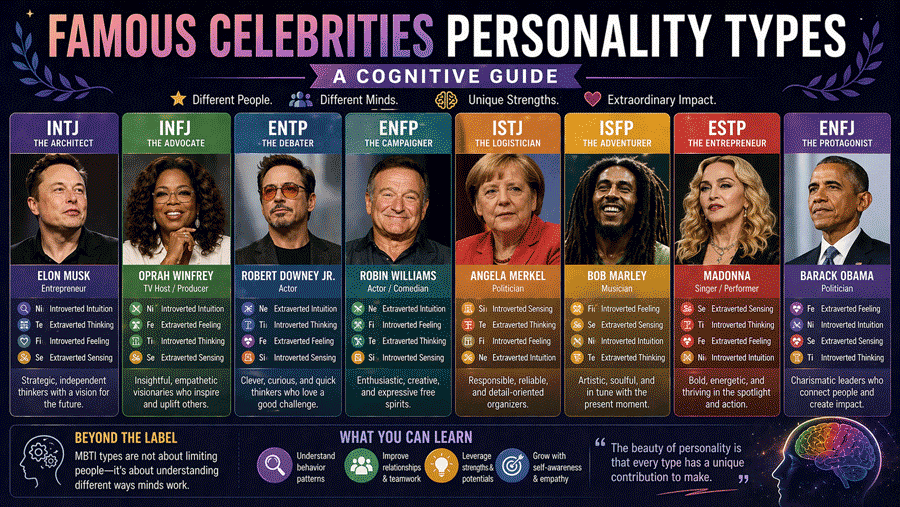
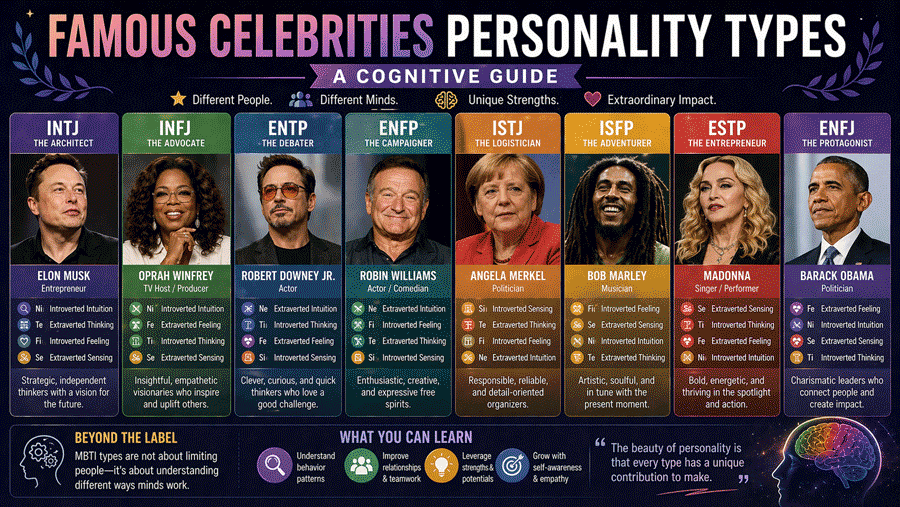
When exploring famous celebrities personality types, many enthusiasts stop at the four-letter code. However, true insight requires digging deeper into cognitive functions. This article argues that MBTI is a starting point, not an endpoint. Understanding the machinery behind the type offers practical growth, better communication, and accurate self-typing. While public figures provide interesting case studies, relying solely on celebrity examples can lead to stereotypes. Instead, we must return to the Jungian roots of the theory to validate our own types through behavior and motivation.
The purpose of this guide is to move beyond surface-level trivia. Whether you are interested in career fit, relationship dynamics, or personal development, the value lies in how you process information and make decisions. This article provides a comprehensive framework for understanding personality types through the lens of cognitive functions, offering actionable steps for validation and growth.
The Framework: Beyond Four Letters
The Myers-Briggs Type Indicator (MBTI) is built upon Carl Jung's theory of psychological types. While the four dichotomies (Extraversion/Introversion, Sensing/Intuition, Thinking/Feeling, Judging/Perceiving) are well-known, they are often misunderstood as behaviors rather than preferences. For instance, Extraversion is not just about being social; it is about where you draw energy from—the outer world of people and things versus the inner world of ideas and reflections.
The real engine of the MBTI system is the cognitive function stack. Each of the 16 types uses four specific functions in a fixed order: Dominant, Auxiliary, Tertiary, and Inferior. The Dominant function is the hero of the psyche, the lens through which you view the world most naturally. The Auxiliary supports the dominant, providing balance. The Tertiary is often a source of relief or creativity, while the Inferior function represents a blind spot and a source of growth potential.
Why does this matter for famous celebrities personality types? Because two types may share letters but operate differently. For example, an ISTJ and an ISFJ both lead with Introverted functions, but one leads with Sensing-Thinking (Si-Te) and the other with Sensing-Feeling (Si-Fe). Understanding these nuances prevents mistyping based on superficial traits. A celebrity might appear outgoing due to their profession, but their decision-making process reveals their true introverted nature.
Why Letter-Based Typing Causes Mistypes
Relying solely on the four letters often leads to errors because behavior is adaptable. A person can learn to be organized (Judging) even if they prefer flexibility (Perceiving). Tests often measure behavior rather than preference. To validate your type, you must observe your default settings under stress, your natural decision-making style, and what drains versus energizes you. Public figures are often typed by fans based on their persona, not their internal reality. Therefore, using celebrities as a reference requires caution. Phrases like “is widely believed to be” should always be used when discussing public figures.
Cognitive Functions Explained
To truly understand personality, one must grasp the eight cognitive functions. These are the building blocks of the 16 types.
Perceiving Functions: How You Take In Information
Se (Extraverted Sensing): Focuses on the immediate physical reality. High Se users are action-oriented, aware of their environment, and live in the moment. They may excel in performance arts or sports.
Si (Introverted Sensing): Focuses on past experiences, stability, and details. High Si users value tradition, routine, and reliability. They compare the present to the past to ensure consistency.
Ne (Extraverted Intuition): Focuses on possibilities, patterns, and connections. High Ne users are brainstormers, seeing “what could be.” They enjoy starting projects and exploring multiple avenues.
Ni (Introverted Intuition): Focuses on future visions, insights, and convergence. High Ni users look for the underlying meaning and long-term trajectory. They often have “aha” moments about how things will unfold.
Judging Functions: How You Make Decisions
Te (Extraverted Thinking): Focuses on efficiency, logic, and external organization. High Te users value competence, results, and structured systems. They seek to optimize the external world.
Fi (Introverted Feeling): Focuses on internal values, authenticity, and morality. High Fi users decide based on what feels right to them personally. They prioritize harmony with their own beliefs.
Fe (Extraverted Feeling): Focuses on group harmony, social norms, and external values. High Fe users are attuned to the emotional atmosphere and seek to maintain connection with others.
Ti (Introverted Thinking): Focuses on internal logic, precision, and analysis. High Ti users seek to understand how things work fundamentally. They value accuracy over utility.
Application Guidance: Practical Frameworks
Understanding your functions is useless without application. Below are two frameworks to help you utilize this knowledge for career and relationships.
Framework 1: Career and Work-Style Fit
When it applies: When choosing a career path, negotiating work conditions, or seeking professional development.
Function Dynamics: This framework leverages your Dominant and Auxiliary functions. For example, a Dominant Thinker (T) may prefer roles with clear criteria for success, while a Dominant Feeler (F) may prioritize team culture.
Practical Action Steps:
- Identify your Dominant function. If it is Perceiving (N or S), ensure your role allows for information gathering.
- If it is Judging (T or F), ensure you have decision-making authority.
- Align tasks with your energy sources. Introverts may need quiet focus time; Extraverts may need collaboration.
- Use your Inferior function as a growth area, not a primary work style. Do not force yourself to be something you are not.
Benefits and Limitations: This alignment increases job satisfaction and reduces burnout. However, no type is barred from any career. Skill can be developed regardless of preference. The goal is to work with your grain, not against it.
How to Judge Fit: If you feel constantly drained despite having the skills, your work style may conflict with your type. If you lose track of time while working, you are likely using your preferred functions.
Framework 2: Relationship and Communication Guidance
When it applies: During conflicts, team collaborations, or intimate partnerships.
Function Dynamics: Conflicts often arise from clashing functions. A Te user may see an Fi user’s concerns as irrational, while the Fi user sees the Te user as cold.
Practical Action Steps:
- Identify the other person’s likely dominant function.
- Translate your message into their language. Use data for Thinkers, values for Feelers.
- Respect processing styles. Introverts need time to reflect; Extraverts may need to talk to think.
- Avoid attacking blind spots. Do not criticize an Inferior function during stress.
Benefits and Limitations: This reduces misunderstanding and fosters empathy. However, it should not be used to excuse bad behavior. Type explains preferences, not maturity.
How to Judge Fit: If communication feels like pulling teeth, check for function mismatches. If conversations flow easily, you likely share complementary functions.
Growth and Development Principles
Personal growth in the context of MBTI is not about changing your type. It is about expanding your flexibility. The goal is to access all eight functions, not just your top four.
Identify the Dominant Function First
Growth begins with self-acceptance. Acknowledge your natural strengths. If you are an Introvert, do not try to become the life of the party. Instead, find ways to contribute that honor your need for depth. Embracing your dominant function reduces energy waste.
Distinguish Preference from Skill
You can be skilled at something you do not prefer. An Introvert can be a great public speaker, but it will cost more energy. Recognize this difference to manage your energy budget. Do not confuse competence with preference.
Develop the Inferior Function Gradually
The Inferior function is the key to mid-life growth. For an INTJ (Inferior Se), this might mean engaging in physical activities or sensory experiences without overanalyzing. This development should be playful, not forced. Pushing too hard on the inferior function leads to stress.
Explain Loop and Grip Patterns
Under stress, types may skip their Auxiliary function and enter a “loop” of Dominant and Tertiary functions. For example, an INFP might loop between Fi and Ne, becoming overly introspective and speculative. In extreme stress, the “grip” of the Inferior function takes over, causing uncharacteristic behavior. Recognizing these states helps you return to balance.
Growth Means Flexibility
Identity attachment to a type can be limiting. Use MBTI as a map, not a cage. Healthy development means being able to use Thinking when needed, even if you prefer Feeling. Flexibility is the hallmark of psychological maturity.
Common Mistakes and Pitfalls
To maintain credibility and accuracy, avoid these common errors when exploring famous celebrities personality types and your own type.
- Don’t type based on profession. Just because someone is an actor does not mean they are an Extravert. Many performers are Introverts who use a persona. Alternative: Look for interviews where they discuss their energy levels and private life.
- Don’t confuse skills with preferences. Being organized does not make you a Judger. Alternative: Ask if organization feels natural or like a disciplined effort.
- Don’t treat types as horoscopes. MBTI is about cognitive processes, not fate. Alternative: Focus on decision-making patterns rather than generic descriptions.
- Don’t ignore the context. Behavior changes under stress. Alternative: Observe behavior over time and in relaxed settings.
- Don’t assume compatibility is fixed. Any two types can work with effort. Alternative: Focus on communication skills rather than type matching.
- Don’t use type to excuse behavior. “I’m an INTJ” is not a pass for rudeness. Alternative: Use type to understand triggers, but take responsibility for actions.
- Don’t rely on a single test. Tests vary in quality and accuracy. Alternative: Use tests as a starting point, then validate with function theory.
- Don’t stereotype celebrities. Public images are curated. Alternative: Use cautious wording like “is often typed as” when discussing public figures.
Ongoing Learning Resources
The field of personality psychology is evolving. To deepen your understanding, seek out credible sources rather than social media summaries.
Recommended Organizations:
- Myers & Briggs Foundation: Offers official resources and ethical guidelines for using the MBTI instrument.
- CAPT (Center for Applications of Psychological Type): Provides research and publications on type theory.
- Jungian Educational Resources: Look for materials based on Carl Jung’s original works, such as “Psychological Types.”
Identifying Reliable Information: Be wary of content that claims one type is better than another. Credible resources emphasize that all types have value. Look for authors who discuss cognitive functions rather than just stereotypes. Keep an eye on new research regarding personality stability and development. Engage with debates and newer interpretations to keep your understanding current. Avoid low-quality summaries that reduce complex theories to memes.
Frequently Asked Questions
1. Where should a beginner start with MBTI?
Start by learning the four dichotomies, but quickly move to cognitive functions. Read about the Dominant function of your suspected type. Observe your own reactions to stress and energy drains. Do not rely solely on online quizzes.
2. How can I confirm my type without tests?
Focus on motivation. Why do you do what you do? An Introvert may socialize well but needs recharge time. A Thinker may care about people but decides based on logic. Track your decision-making patterns over a few weeks.
3. Does MBTI help with relationship communication?
Yes, by highlighting differences in information processing. Knowing your partner needs time to process (Introversion) or needs to talk to think (Extraversion) can prevent conflicts. It fosters patience and understanding.
4. How do I learn cognitive functions efficiently?
Study one function at a time. Compare types that share functions. For example, compare an INTJ and an INFJ to see how Ni manifests with Te versus Fe. Use real-life examples to ground the theory.
5. Can my personality type change?
Your core preferences generally remain stable throughout adulthood. However, your ability to use non-preferred functions grows with maturity. You do not change types, but you become more flexible and balanced.
Conclusion
Exploring famous celebrities personality types can be an engaging entry point into MBTI, but true value comes from understanding the underlying cognitive functions. By focusing on how you perceive and judge, rather than just how you behave, you gain a tool for lifelong growth. Remember that MBTI is a framework for understanding preferences, not a label that defines your entire identity. Use it to build self-awareness, improve communication, and navigate your career with greater clarity. The goal is not to fit into a box, but to understand the shape of your own mind so you can expand beyond it.