
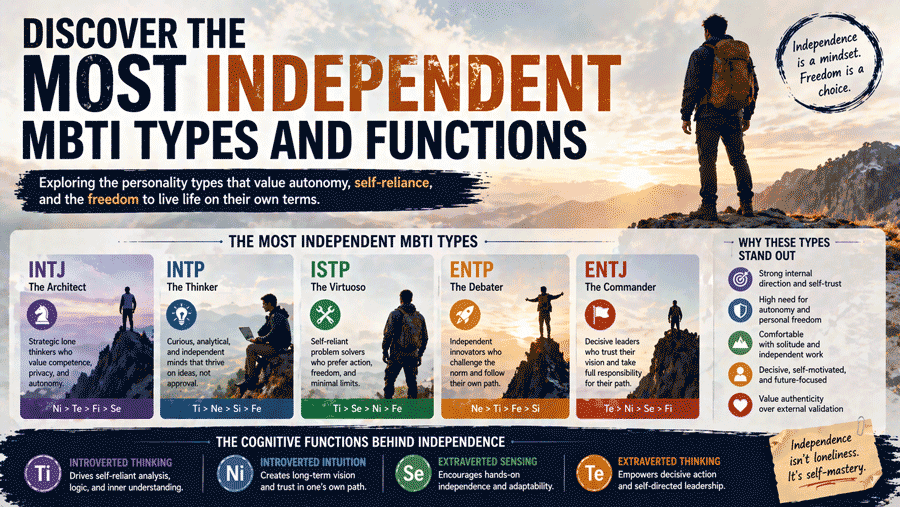
When individuals search for the most independent mbti types, they are often seeking more than just a list of four-letter codes. They want to understand the underlying psychological mechanisms that drive autonomy, self-reliance, and solitary decision-making. While popular culture often points to specific types like the INTJ or INTP as the epitome of independence, a deeper analysis reveals that true autonomy stems from cognitive functions rather than surface-level letters. This article moves beyond stereotypes to explore how Jungian cognitive stacks shape independent behavior, offering practical frameworks for growth, relationship management, and career alignment.
Understanding your personality type is a starting point, not an endpoint. To accurately identify where you fall on the spectrum of independence, you must examine how you process information, make decisions, and interact with the external world. Whether you are trying to confirm your own type, understand a partner, or optimize your work environment, recognizing the role of cognitive functions is essential. This guide provides a comprehensive look at independence within the MBTI framework, grounded in psychological theory and practical application.
The Mechanism of Independence in Jungian Theory
To understand why certain types are more independent than others, we must return to the Jungian roots of the Myers-Briggs Type Indicator. The MBTI is based on Carl Jung’s theory of psychological types, which posits that people have innate preferences for how they perceive the world and make decisions. These preferences are organized into four dichotomies: Extraversion vs. Introversion, Sensing vs. Intuition, Thinking vs. Feeling, and Judging vs. Perceiving. However, these letters are merely shorthand for the underlying cognitive function stack.
Independence is primarily driven by Introverted functions, specifically Introverted Thinking (Ti) and Introverted Intuition (Ni), though Introverted Feeling (Fi) also plays a significant role in moral autonomy. Users of these functions prioritize internal consistency, personal vision, or individual values over external consensus or traditional norms. Conversely, Extraverted functions like Extraverted Thinking (Te) or Extraverted Feeling (Fe) often seek alignment with external systems or group harmony, which can sometimes appear less independent, though this is a nuance often missed in superficial typing.
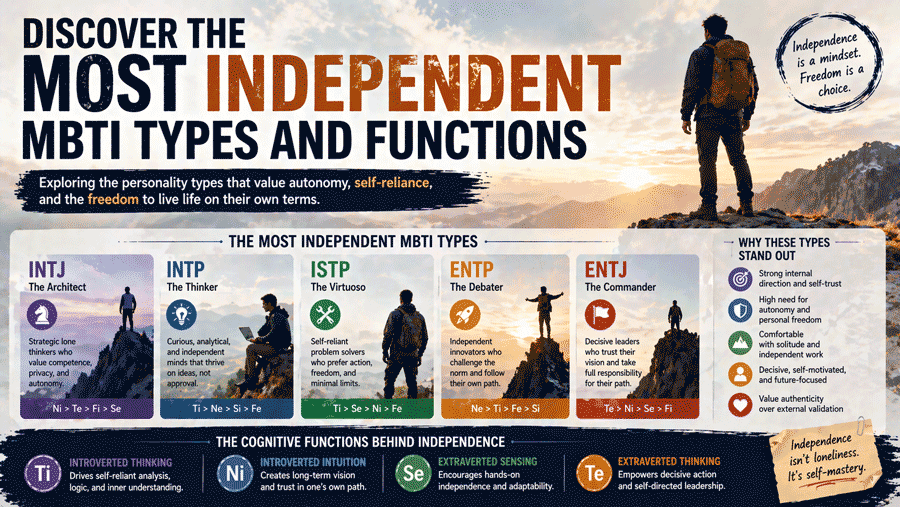
The cognitive function stack consists of four positions: dominant, auxiliary, tertiary, and inferior. The dominant function is the lens through which a person primarily views the world. For example, an INTP leads with Ti, seeking logical truth independent of external validation. An INTJ leads with Ni, pursuing a long-term vision that may not yet be understood by others. An ISTP also leads with Ti but pairs it with Extraverted Sensing (Se), resulting in a practical, hands-on independence. Understanding these stacks is crucial because letter-based typing alone often causes mistypes. A person might test as an INTJ but behave like an INTP due to developmental stages or environmental pressures.
Validating your type requires self-observation beyond test results. You must look at decision patterns, stress reactions, and motivation. Do you make decisions based on an internal logical framework (Ti) or external efficiency metrics (Te)? Do you recharge by exploring ideas alone (Ni/Ne) or by interacting with people (Fe/Se)? Long-term feedback from others can also clarify blind spots. If you believe you are independent but others consistently describe you as reliant on group approval, there may be a disconnect between your self-perception and your actual function usage. This depth of analysis is necessary to accurately identify the most independent mbti types in a meaningful way.
Analyzing the Most Independent MBTI Types
While independence exists on a spectrum, certain types are widely recognized for their strong autonomous tendencies. It is important to note that typing public figures is speculative; for instance, Elon Musk is often typed as an INTJ or INTP, but such claims should be treated as illustrative rather than factual. Instead, we focus on the functional dynamics that create independence.
INTJ (The Architect)
The INTJ leads with Introverted Intuition (Ni) and supports it with Extraverted Thinking (Te). This combination creates a strategic independence. Ni allows them to synthesize complex information into a singular vision that often disregards current trends. Te enables them to execute this vision efficiently without needing constant reassurance. INTJs are independent because they trust their internal foresight over external opinion. They are likely to carve unique career paths and resist micromanagement. However, their independence can sometimes manifest as stubbornness if they refuse to consider data that contradicts their vision.
INTP (The Logician)
The INTP leads with Introverted Thinking (Ti) and supports it with Extraverted Intuition (Ne). Their independence is intellectual. Ti seeks logical consistency above all else, meaning an INTP will reject an idea simply because it is popular if it does not make sense to them internally. Ne allows them to explore multiple possibilities, making them resistant to rigid structures. INTPs are often the most independent thinkers in a room, willing to deconstruct established theories. The challenge for INTPs is translating this internal independence into external action, as their auxiliary Ne can lead to analysis paralysis.
ISTP (The Virtuoso)
The ISTP leads with Ti and supports it with Extraverted Sensing (Se). Their independence is practical and physical. They want to understand how things work and prefer to fix problems themselves rather than asking for help. Se grounds them in the present moment, making them highly adaptable and self-reliant in crisis situations. ISTPs value freedom of action and often chafe under strict rules or bureaucratic oversight. They are the quintessential “lone wolf” in practical scenarios, preferring to learn by doing rather than by following instructions.
ISTJ (The Logistician)
The ISTJ leads with Introverted Sensing (Si) and supports it with Extraverted Thinking (Te). While often seen as traditional, their independence comes from self-reliance and duty. They trust their own experience and established methods over untested theories. An ISTJ is independent in the sense that they do not need external motivation to complete tasks; their internal sense of responsibility drives them. They are reliable autonomously, often managing complex responsibilities without supervision. However, their independence is bound by structure, differing from the rule-breaking independence of the INTP or ISTP.
Practical Frameworks for Applying Independence
Understanding your type is useful only if it leads to actionable change. Below are two practical frameworks for leveraging independence in career and relationships. These frameworks apply differently depending on your function dynamics.
Framework 1: Career and Work-Style Fit
When it applies: This framework is essential when choosing a job role, negotiating work conditions, or managing a team.
Function Dynamics: High independence types (Ti/Ni dominant) thrive in roles with autonomy, while high collaboration types (Fe/Se dominant) thrive in team environments. However, even independent types need some connection.
Practical Action Steps:
- For Ti Users (INTP, ISTP): Seek roles that allow for problem-solving without micromanagement. Negotiate for outcome-based evaluations rather than hours-based tracking.
- For Ni Users (INTJ, INFJ): Look for strategic positions where you can define the vision. Ensure you have the authority to implement long-term plans.
- For Te Users (ENTJ, ESTJ): Independence here means leadership autonomy. Seek roles where you can build systems and manage resources without excessive bureaucracy.
Benefits and Limitations: Aligning work with your independence needs increases satisfaction and productivity. However, total isolation can lead to stagnation. Even the most independent mbti types benefit from feedback loops.
How to Judge Fit: Ask yourself: Do I feel drained when I have to ask for permission to proceed? If yes, you need higher autonomy. Do I feel lost without clear directives? If yes, you may need more structure than you think.
Framework 2: Relationship and Communication Guidance
When it applies: This framework helps in romantic partnerships, friendships, and family dynamics where independence levels clash.
Function Dynamics: Conflict often arises when an independent type (e.g., INTP) pairs with a connection-oriented type (e.g., ESFJ). The former values space; the latter values closeness.
Practical Action Steps:
- Define Boundaries: Independent types must clearly communicate their need for solitude so it is not interpreted as rejection.
- Schedule Connection: For partners of independent types, schedule quality time so that space-taking does not feel like neglect.
- Respect Decision Styles: Understand that an independent partner may make decisions unilaterally not out of disrespect, but out of habit.
Benefits and Limitations: This reduces friction and misunderstanding. The limitation is that it requires constant maintenance and communication, which independent types may find taxing.
How to Judge Fit: Observe stress levels during periods of high togetherness versus high isolation. A healthy balance allows for both autonomy and intimacy.
Growth and Personal Development
Personal growth in the context of MBTI is not about changing your type, but about developing flexibility. Independence is a strength, but unchecked, it becomes isolation. Here are universal principles for growth.
Identify the Dominant Function First: You cannot grow if you do not know what you are leading with. If you are an INTJ, your Ni is your engine. Strengthen it by allowing time for deep reflection without interruption.
Distinguish Preference from Skill: You may prefer independence (preference), but you still need collaboration skills (skill). Do not use your type as an excuse to avoid necessary social interactions.
Develop the Inferior Function Gradually: The inferior function is the gateway to growth. For an INTP, the inferior is Extraverted Feeling (Fe). Developing this means learning to consider group harmony without losing logical integrity. For an INTJ, the inferior is Extraverted Sensing (Se). Developing this means engaging with the physical world and relaxing control.
Explain Loop and Grip Patterns: Under stress, types may skip their auxiliary function and enter a “loop.” An INTP might loop between Ti and Ni, becoming paranoid and isolated. Recognizing this pattern allows you to re-engage the auxiliary function (Ne) by exploring new ideas externally. Similarly, the “grip” occurs when the inferior function takes over. An ISTJ in grip might act out emotionally (inferior Fi) rather than logically. Understanding these patterns prevents you from making permanent decisions based on temporary stress reactions.
Growth Means Flexibility: Ultimately, growth means not attaching your identity too rigidly to your type. You are not “an INTJ”; you are a person who prefers INTJ patterns. This distinction allows you to adapt when the situation demands interdependence rather than independence.
8 Common Pitfalls to Avoid
When exploring independence and personality types, several common mistakes can hinder accurate self-understanding and development.
- Don’t Confuse Isolation with Independence: Isolation is avoiding people out of fear or discomfort. Independence is choosing solitude out of preference. Alternative: Check your motivation. Are you hiding or recharging?
- Don’t Use Type as an Excuse: Saying “I’m an INTP, so I don’t do emotions” is a limitation. Alternative: Acknowledge the preference but work on the skill.
- Don’t Trust Online Tests Blindly: Free tests often rely on dichotomies rather than functions. Alternative: Use tests as a hint, but validate through function study.
- Don’t Stereotype Celebrities: Assuming a famous person is a certain type based on their public persona is risky. Alternative: Focus on your own internal experience rather than external comparisons.
- Don’t Ignore the Auxiliary Function: Focusing only on the dominant function leads to imbalance. Alternative: Ensure you are developing your second function to support the first.
- Don’t Dismiss Feeling Types as Dependent: Fi users (INFP, ISFP) can be highly independent regarding values. Alternative: Recognize that emotional autonomy is also a form of independence.
- Don’t Neglect Stress Signals: Pushing independence too hard during stress leads to burnout. Alternative: Learn to recognize when you need support.
- Don’t Treat MBTI as Static: You evolve over time. Alternative: Re-evaluate your type and habits every few years.
Ongoing Learning and Credible Resources
The field of personality psychology is evolving. To maintain a accurate understanding, readers should follow credible sources and remain open to new research. The Myers & Briggs Foundation and the Center for Applications of Psychological Type (CAPT) are among the organizations that maintain the integrity of the instrument. Jungian educational resources also provide depth beyond commercial summaries.
Be wary of low-quality content that reduces MBTI to memes or horoscope-like generalizations. Look for materials that discuss cognitive functions in detail. Engage with debates and newer interpretations, such as the Beebe model or socionics, but understand their distinctions from standard MBTI theory. Identifying reliable information involves checking citations, avoiding absolute claims, and looking for nuance. High-quality resources will emphasize that MBTI is a tool for understanding preferences, not a label that defines the whole person. By continuing to learn, you ensure that your understanding of the most independent mbti types remains grounded in theory rather than internet lore.
Frequently Asked Questions
1. What is the best entry point for beginners studying MBTI?
Start by learning the four dichotomies, but quickly move to cognitive functions. Understanding Ti vs. Te is more useful than knowing T vs. F. Read foundational texts from Jung or certified MBTI practitioners.
2. How can I confirm my type without relying on tests?
Observe your stress responses. Which functions flare up when you are tired? Ask trusted friends how they perceive your decision-making. Compare your internal motivation with type descriptions, focusing on function stacks rather than behaviors.
3. How do independent types handle relationship communication?
They need to explicitly state their need for space. Partners need to understand that solitude is not rejection. Scheduled check-ins can help balance autonomy with connection.
4. What is the most efficient way to learn cognitive functions?
Study one function at a time. Observe it in yourself and others. Keep a journal of when you use Ti versus Te. Practical observation is faster than theoretical memorization.
5. Can my MBTI type change over time?
Your core preferences generally remain stable, but your development changes. You may become better at using non-preferred functions. This looks like change, but it is actually growth and integration.