
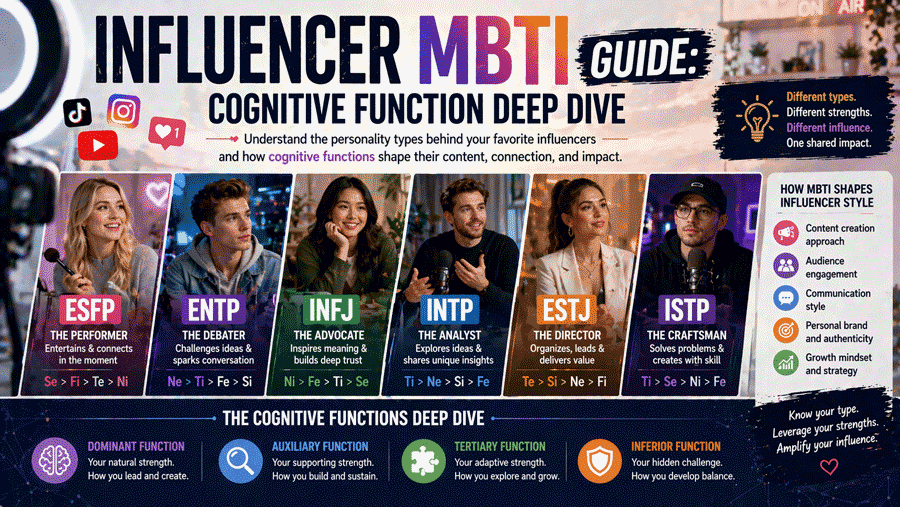
Understanding personality types is more than just matching four letters to a celebrity profile. When searching for influencer mbti data, readers often seek validation for their own preferences or insights into how public figures operate. However, the true value of the Myers-Briggs Type Indicator lies not in the surface-level dichotomies but in the underlying cognitive functions that drive behavior. This article concludes upfront: to accurately understand any type, especially in the context of public influence, you must move beyond stereotypes and analyze the cognitive function stack. This approach prevents mistyping and offers actionable growth strategies.
The MBTI framework is a tool for understanding psychological preferences, not a definitive label that confines human potential. It is useful for individuals seeking clarity on their decision-making styles, communication patterns, and career fit. Yet, many online resources simplify these dynamics into rigid boxes. By focusing on cognitive functions, we uncover the mechanism behind the type. Whether you are analyzing an online creator or reflecting on your own psyche, the journey begins with recognizing that the four letters are merely a shorthand for a complex internal system.
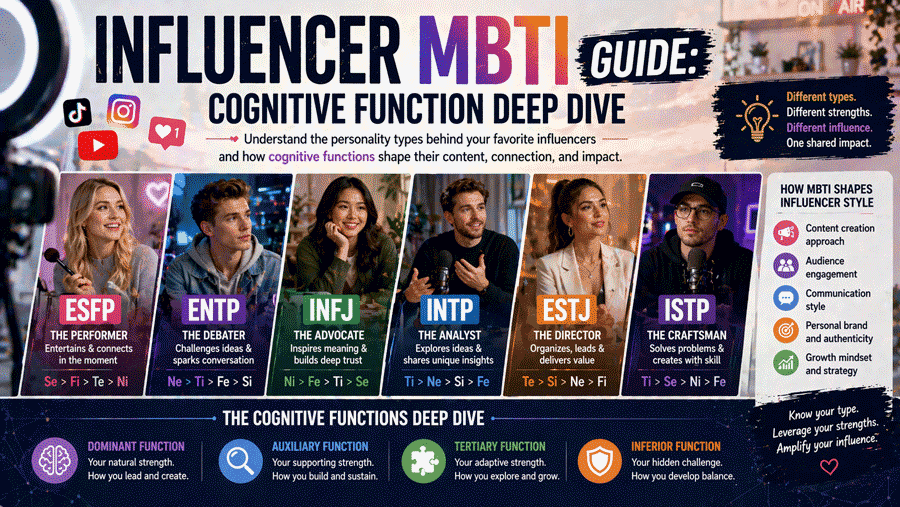
The Framework and Mechanism of Personality
To grasp why influencer mbti discussions often lead to confusion, we must return to the Jungian roots of the theory. Carl Jung proposed that people experience the world through four principal psychological functions: sensing, intuition, thinking, and feeling. The MBTI expands this by adding an orientation dimension: extraversion and introversion. The combination of these preferences results in the 16 types, but the engine of the type is the function stack.
The Four Dichotomies and Their Limits
The standard MBTI letters represent preferences: Extraversion (E) vs. Introversion (I), Sensing (S) vs. Intuition (N), Thinking (T) vs. Feeling (F), and Judging (J) vs. Perceiving (P). While helpful for initial categorization, these dichotomies can be misleading. For instance, two people typed as INTJ may behave very differently if one is developed and the other is immature. Relying solely on letter-based typing often causes mistypes because behavior changes under stress or social conditioning. A person might act extraverted at work but recharge introvertedly at home, confusing their true preference.
Cognitive Function Stack Explained
Every type operates using a hierarchy of four functions: dominant, auxiliary, tertiary, and inferior. The dominant function is the hero of the psyche, the lens through which you primarily view the world. The auxiliary supports the dominant, providing balance. The tertiary is less mature but offers relief, while the inferior function is the unconscious weakness that often emerges under stress.
For example, an individual with dominant Introverted Intuition (Ni) focuses on internal insights and future patterns. If their auxiliary is Extraverted Thinking (Te), they organize the external world to match those insights. This dynamic is far more descriptive than simply saying someone is an INTJ. Understanding these stacks allows you to see why certain influencer mbti typings resonate while others feel off. It explains why one creator is strategic and detached while another is empathetic and community-focused, even if they share similar letters.
Validating Type Beyond Tests
Online tests are snapshots, not diagnoses. To validate your type, observe your decision patterns, stress reactions, and motivations. Do you prioritize logical consistency or human harmony? Do you trust concrete data or abstract possibilities? Long-term feedback from others is crucial. Ask trusted peers how you come across in conflict. Do you shut down and analyze (Introverted Thinking) or explode and express values (Extraverted Feeling)? Self-observation over months yields more accuracy than a ten-minute quiz. When evaluating public figures, use cautious wording. A celebrity is often typed as a certain type based on curated content, which may not reflect their private cognitive reality.
Practical Application Frameworks
Knowing your type is useless without application. Below are two frameworks to utilize this knowledge for career alignment and relationship dynamics. These sections move beyond theory into practical utility, ensuring the influencer mbti concept serves personal development.
Framework 1: Career and Work-Style Fit
This framework applies when choosing roles, negotiating workloads, or seeking promotions. It relates to how your dominant and auxiliary functions process tasks.
When it applies: Use this during career transitions or when feeling burnt out. If your work demands functions opposite to your strengths, fatigue sets in quickly.
Type Dynamics: Thinkers (T) may thrive in analytical roles but struggle with office politics. Feelers (F) excel in collaboration but may find cold metrics draining. Judging (J) types prefer structure, while Perceiving (P) types need flexibility.
Action Steps: Identify your dominant function. If it is Introverted Sensing (Si), seek roles with established procedures. If it is Extraverted Intuition (Ne), prioritize brainstorming and variety. Audit your weekly tasks. Highlight those that energize you versus those that deplete you. Adjust your schedule to maximize high-energy tasks.
Benefits and Limitations: This alignment increases productivity and satisfaction. However, do not use it as an excuse to avoid necessary growth. Every job requires some use of weaker functions.
Judgment: You know it fits when you feel in a state of flow more often. If you constantly feel misunderstood or exhausted by basic tasks, re-evaluate the fit.
Framework 2: Relationship and Communication Guidance
This framework applies to personal relationships, team dynamics, and conflict resolution. It focuses on how different functions express care and process disagreement.
When it applies: Use this during misunderstandings or when building deeper connections. It helps explain why partners react differently to the same stimulus.
Type Dynamics: Extraverted Feelers (Fe) seek group harmony and may take conflict personally. Introverted Feelers (Fi) seek authenticity and may withdraw if values are compromised. Extraverted Thinkers (Te) want solutions; Introverted Thinkers (Ti) want understanding of the logic.
Action Steps: Identify the other person's likely function. If they use Te, be direct and objective. If they use Fi, acknowledge their values first. Practice translating your needs into their language. For example, instead of saying You are wrong, say The data suggests a different outcome.
Benefits and Limitations: This reduces friction and builds empathy. The limitation is assuming type determines behavior entirely. Context matters. A stressed person may not act like their typology suggests.
Judgment: It fits when conflicts resolve faster and feel less personal. If you still feel constantly invalidated, consider compatibility beyond type.
Growth and Development Principles
Personality growth is not about changing your type but expanding your repertoire. The goal is flexibility, not identity attachment. Here are universal principles for developing your cognitive functions.
Identify the Dominant Function First
Your dominant function is your superpower. Strengthening it provides confidence. If you are dominant Introverted Thinking, deepen your expertise. If you are dominant Extraverted Sensing, engage with the physical world. Mastery here creates a stable foundation for exploring weaker areas.
Distinguish Preference from Skill
You can learn skills outside your preference. An Introvert can learn public speaking; a Feeler can learn accounting. Do not confuse capability with preference. Just because you can do something does not mean it energizes you. Recognize the cost of using non-preferred functions over long periods.
Develop the Inferior Function Gradually
The inferior function is the source of growth but also stress. For an INTJ, the inferior is Extraverted Sensing (Se). They might binge eat or shop impulsively under stress. Healthy development involves engaging this function in small doses. Practice mindfulness or physical activity to integrate Se without being overwhelmed by it.
Explain Loop and Grip Patterns
Under stress, types may skip their auxiliary function and enter a loop. An INFP might loop between Introverted Feeling (Fi) and Introverted Intuition (Ni), becoming withdrawn and paranoid. Recognizing this pattern allows you to interrupt it by consciously engaging the auxiliary function, in this case, Extraverted Intuition (Ne), by seeking new perspectives or talking to others.
Growth Means Flexibility
Do not attach your identity to your type. You are not your MBTI code. Use it as a map, not a territory. Growth means being able to access all eight functions when appropriate, even if some feel unnatural. This flexibility is the hallmark of psychological maturity.
Mistakes and Pitfalls to Avoid
To maintain credibility and utility, avoid these common errors when discussing or applying influencer mbti concepts.
- Do not stereotype based on letters. Letters are broad categories. Two ENFPs can be vastly different. Focus on individual function development instead of general traits.
- Do not use type to excuse bad behavior. Saying I am an ENTJ so I am blunt is not an excuse for rudeness. Type explains tendencies, not moral choices.
- Do not assume type is static. While preferences are stable, expression changes with age and maturity. Allow room for evolution in yourself and others.
- Do not rely solely on online tests. Tests are prone to bias and mood fluctuations. Use them as a starting point, not a final verdict.
- Do not ignore context. Behavior changes in different environments. A person may appear introverted at work but extraverted with friends. Look for energy sources, not just actions.
- Do not treat celebrity typings as facts. Public personas are curated. Use phrases like widely believed to be rather than stating it as absolute truth.
- Do not dismiss other psychological models. MBTI is one tool among many. Big Five, Enneagram, and attachment theory offer complementary insights.
- Do not gatekeep knowledge. Avoid elitism about typing accuracy. Encourage exploration and self-discovery rather than asserting authority over others types.
Ongoing Learning and Resources
The field of personality psychology is evolving. To stay informed, readers should follow credible organizations and research. The Myers & Briggs Foundation offers official resources and ethical guidelines. The Center for Applications of Psychological Type (CAPT) provides research-based insights. Engage with Jungian educational resources to understand the depth of the theory.
Look for debates and newer interpretations. Cognitive function theory has evolved since the 1920s. Be wary of low-quality summaries that reduce complex psychology to memes. Identify reliable information by checking citations and author credentials. Avoid content that promises instant typing or deterministic life predictions. True understanding comes from study, reflection, and real-world application.
Frequently Asked Questions
1. Where should a beginner start with MBTI?
Start by reading about the four dichotomies to get a general sense. Then, move quickly to cognitive functions. Understanding whether you lead with Thinking or Feeling is more valuable than knowing your J or P preference. Read books by recognized authors like Linda Berens or Dario Nardi for deeper insights.
2. How can I confirm my type without tests?
Observe your energy levels. What drains you? What restores you? Analyze your decision-making process. Do you weigh logical pros and cons first, or do you consider how people will feel? Track your stress reactions. Your inferior function often reveals itself when you are overwhelmed. Consistent patterns over time are more reliable than a single test score.
3. How does type affect relationship communication?
Type influences how you express care and resolve conflict. Thinkers may offer solutions when feelings need validation. Feelers may seek harmony when truth is needed. Understanding these differences allows you to translate your intent. Ask your partner how they prefer to receive support rather than assuming your way is best.
4. What is the most efficient way to learn cognitive functions?
Study one function at a time. Spend a week observing Extraverted Sensing in yourself and others. Then move to Introverted Intuition. Compare how they differ. Use real-life examples. Journaling about your daily decisions can help you identify which function was driving the bus.
5. Can my MBTI type change over time?
Your core preferences generally remain stable throughout adulthood. However, your ability to use all functions improves with maturity. You may appear to change type because you are developing weaker areas. This is growth, not a change in fundamental personality structure. Embrace the development of your whole psyche rather than worrying about label consistency.
In conclusion, the search for influencer mbti insights should lead you back to yourself. By prioritizing cognitive functions over letters, you gain a dynamic tool for life. Use it to understand others, refine your career, and navigate relationships with greater empathy. Remember, the goal is not to fit into a box but to understand the shape of your own mind so you can expand beyond it.