
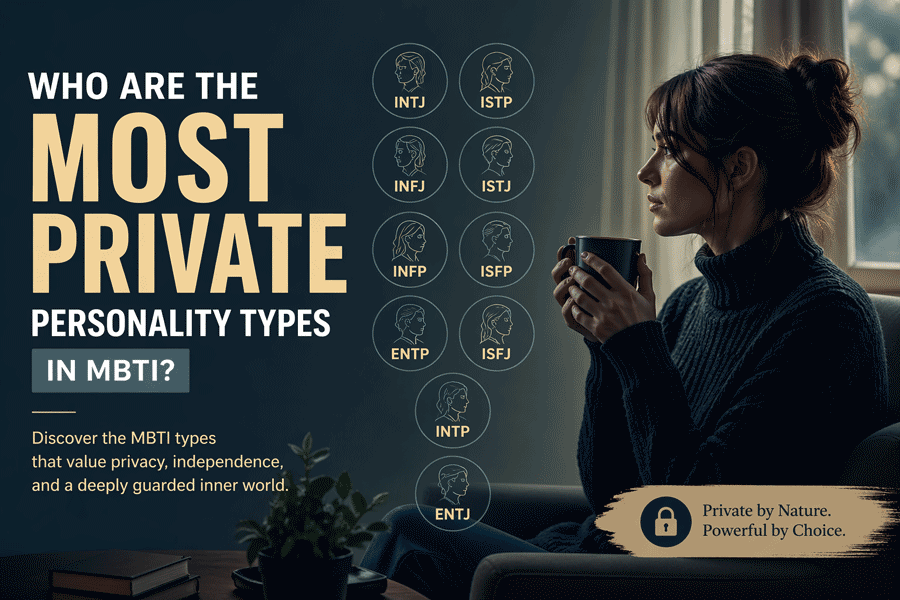
When exploring human behavior, few questions arise as frequently as those concerning privacy and introspection. Many individuals seek to understand the most private personality types to better navigate their own internal worlds or to comprehend the boundaries of friends and colleagues. The Myers-Briggs Type Indicator (MBTI) offers a structured framework for this exploration, categorizing preferences in how people perceive the world and make decisions. However, identifying privacy solely through the four-letter code is often superficial. To truly understand why certain types guard their inner lives so fiercely, one must delve deeper into the underlying cognitive functions. This article moves beyond stereotypes to provide a conclusion-first analysis: privacy in MBTI is primarily driven by Introverted Intuition (Ni) and Introverted Feeling (Fi), supported by specific thinking and sensing functions that prioritize internal processing over external expression.
MBTI is a tool for self-awareness, not a definitive label. It helps individuals recognize their natural preferences in communication, learning, and stress management. Yet, its deeper application requires returning to the Jungian roots of the system. While the four dichotomies (Introversion/Extroversion, Sensing/Intuition, Thinking/Feeling, Judging/Perceiving) provide a starting point, the cognitive function stack explains the mechanism behind privacy. For those seeking accuracy, understanding these functions is essential for type confirmation and personal growth. This guide will explore the Jungian framework, analyze specific types known for privacy, offer practical frameworks for development, and highlight common pitfalls to avoid in your typology journey.
The Jungian Framework Behind Privacy
To understand privacy in personality typing, we must first acknowledge the Jungian roots of MBTI. Carl Jung proposed that psychological types are defined by how energy is directed (attitudes) and how information is processed (functions). The four dichotomies used in modern MBTI are simplifications of these deeper dynamics. Introversion, for instance, is not merely shyness; it is a preference for directing energy inward toward concepts, reflections, and internal states. Extroversion directs energy outward toward people, objects, and actions.
The core of privacy lies in the Introverted Functions: Introverted Intuition (Ni), Introverted Sensing (Si), Introverted Thinking (Ti), and Introverted Feeling (Fi). When these functions are dominant or auxiliary in a type's stack, the individual prioritizes internal consolidation of information before sharing it. For example, a dominant Ni user synthesizes complex patterns internally and may only share the final conclusion, appearing secretive during the process. A dominant Fi user evaluates values internally and may not reveal their emotional stance until they feel safe.
Letter-based typing alone often causes mistypes because it ignores this functional hierarchy. Two people may test as INTJ, but one might be mistyped and actually be an INTP. The INTJ uses Ni-Te (Introverted Intuition with Extroverted Thinking), leading to private vision but public execution. The INTP uses Ti-Ne (Introverted Thinking with Extroverted Intuition), leading to private logic but public exploration of ideas. Validating your type requires self-observation of decision patterns, stress reactions, and motivation. Do you recharge by being alone with your thoughts (Introversion), or by interacting with others (Extroversion)? Do you trust concrete data (Sensing) or abstract possibilities (Intuition)? Long-term feedback from trusted others who know you in various contexts is more reliable than a single online test.
Identifying the Most Private Personality Types
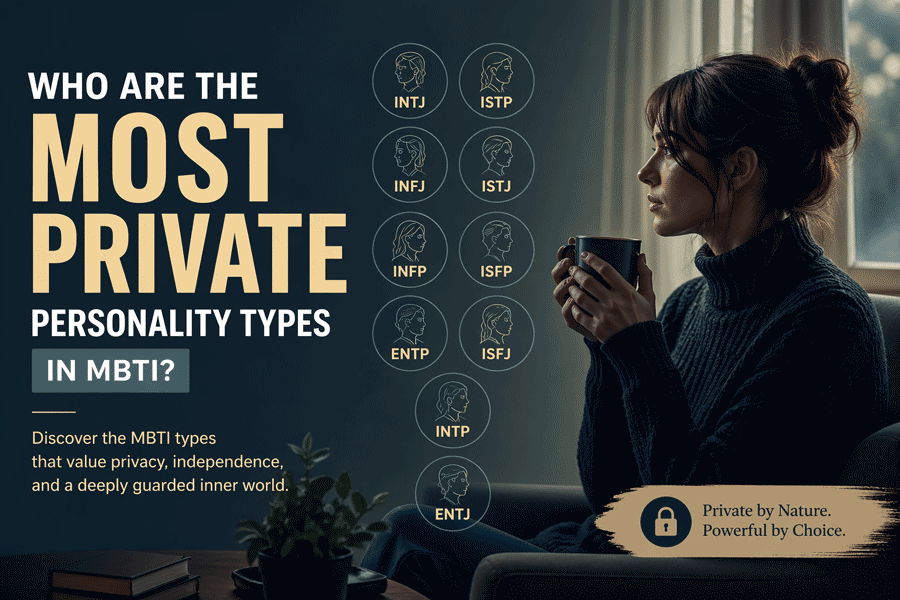
While all introverts value solitude, certain types exhibit higher degrees of privacy regarding their inner thoughts, feelings, and plans. Based on cognitive function dynamics, the following types are widely considered the most private.
INTJ (The Architect)
INTJs are often typed as highly private due to their dominant Introverted Intuition (Ni). They process information internally, connecting disparate data points into a long-term vision. They rarely share their thought process, only the final strategy. This can make them appear enigmatic. Their auxiliary Extroverted Thinking (Te) allows them to execute plans efficiently, but the planning phase is strictly guarded. A famous figure often typed as INTJ is Elon Musk, though typings are speculative. The privacy here is strategic; information is shared only if it serves the goal.
INFJ (The Advocate)
INFJs share the dominant Ni function but pair it with auxiliary Extroverted Feeling (Fe). This creates a unique privacy dynamic. They are deeply private about their own inner world and values (protected by Ni and tertiary Ti) but may appear open and empathetic externally due to Fe. They often absorb others' emotions while keeping their own struggles hidden. This "camouflage" makes them one of the most private personality types despite seeming approachable. They guard their vulnerability fiercely to maintain harmony and protect their sensitive inner vision.
ISTJ (The Logistician)
ISTJs rely on dominant Introverted Sensing (Si). Their privacy stems from a respect for tradition, duty, and personal boundaries. They do not see the need to share personal details unless it is relevant to the task at hand. Their internal library of past experiences (Si) is vast but personal. They value stability and may view oversharing as inefficient or risky. Their privacy is practical rather than mystical; it is about maintaining order and reliability in their immediate environment.
ISFJ (The Defender)
Similar to ISTJs, ISFJs use dominant Si but pair it with auxiliary Extroverted Feeling (Fe). They are private about their own needs while being highly attentive to the needs of others. They may sacrifice their own comfort without announcing it, keeping their struggles invisible to maintain group cohesion. Their privacy is protective; they shield their inner emotional state to avoid burdening others or causing conflict.
INTP (The Logician)
INTPs use dominant Introverted Thinking (Ti). Their privacy is intellectual. They build complex internal logical frameworks and are often hesitant to share them until they are fully refined. They fear being misunderstood or having their logic challenged prematurely. Unlike INTJs who hide plans, INTPs hide reasoning. They may appear detached, not because they lack emotion, but because their primary focus is internal consistency.
INFP (The Mediator)
INFPs lead with dominant Introverted Feeling (Fi). Their privacy is emotional and values-based. They hold their core values and feelings as sacred. Sharing these feels vulnerable. They may express themselves creatively (through writing or art) rather than verbally. Their auxiliary Extroverted Intuition (Ne) allows them to explore ideas externally, but the emotional core remains locked away until deep trust is established.
Practical Framework 1: Cognitive Function Development
Understanding your function stack is not just about labeling; it is about growth. For private types, developing functions consciously can help balance secrecy with connection.
When it applies: This framework is useful when you feel isolated, misunderstood, or stuck in repetitive thought loops. It applies to all types but is crucial for those with strong introverted dominant functions.
Which dynamics it relates to: It focuses on the tension between the Dominant function (comfort zone) and the Inferior function (growth edge). For example, an INTJ (Ni-dom) has inferior Extroverted Sensing (Se). Over-reliance on Ni leads to isolation in theory. Developing Se brings them into the present moment.
Practical Action Steps:
- Identify the Dominant: Acknowledge your natural preference. If you are an INFP, accept that you need time to process feelings internally before discussing them.
- Stretch the Inferior: If you are an ISTJ (Si-dom), your inferior is Ne. Practice brainstorming without judging ideas immediately. Allow yourself to explore possibilities without needing immediate proof.
- Monitor Stress: Notice when you are in a "grip" stress reaction. An INFJ under stress may overindulge in sensory pleasures (inferior Se) or become uncharacteristically critical. Recognizing this helps you return to balance.
Benefits and Limitations: The benefit is increased flexibility and reduced stress. You become less rigid in your privacy. The limitation is that developing inferior functions is slow and energy-intensive. It does not change your type but expands your toolkit.
How to judge fit: If practicing these steps reduces anxiety and improves relationships without making you feel inauthentic, the framework fits. If it causes burnout, you may be pushing too hard against your natural preferences.
Practical Framework 2: Communication and Boundaries
Privacy often creates friction in relationships. This framework helps private types communicate their needs without pushing people away.
When it applies: Use this in romantic partnerships, family dynamics, or close friendships where misunderstanding of silence occurs.
Which dynamics it relates to: It relates to the interaction between Introverted functions (need for space) and Extroverted functions (need for connection). It addresses the MBTI compatibility challenge between private and open types.
Practical Action Steps:
- Label the Need: Explicitly state, "I need time to process this internally before I can discuss it." This prevents partners from interpreting silence as rejection.
- Schedule Sharing: For types like INTJs or ISTJs, set a specific time to update loved ones on your thoughts. This satisfies their need for connection while respecting your need for structure.
- Use Written Communication: Many private types articulate themselves better in writing. Use emails or messages to convey complex thoughts that are hard to speak aloud.
Benefits and Limitations: This reduces conflict and builds trust. Partners feel secure knowing silence is not personal. The limitation is that it requires discipline to follow through on the "scheduled sharing."
How to judge fit: If your relationships feel less strained and you feel less pressured to perform extroversion, this approach is working.
Growth Principles for Private Types
Growth for private personality types is not about becoming extroverted; it is about achieving flexibility. Several universal principles apply across the spectrum.
Identify the Dominant Function First: You cannot grow if you do not know your starting point. Spend time observing when you feel most energized. Is it when solving logical problems alone (Ti)? Is it when harmonizing with a group (Fe)? Clarity here prevents wasted effort on irrelevant self-improvement.
Distinguish Preference from Skill: Being private is a preference, not necessarily a skill deficit. You can be a skilled public speaker and still prefer solitude. Do not pathologize your need for privacy. However, ensure it is not masking social anxiety or avoidance.
Develop the Inferior Function Gradually: The inferior function is the key to maturity. For an INTP (Ti-dom), the inferior is Fe. Learning to acknowledge group emotions without losing logical integrity is a lifelong journey. Do not rush this; small steps prevent burnout.
Explain Loop and Grip Patterns: Under stress, types may bypass their auxiliary function and enter a "loop." An INFJ might loop between Ni and Ti, becoming paranoid and over-analytical without checking reality with Fe. Recognizing these patterns allows you to interrupt them by engaging the auxiliary function.
Growth Means Flexibility, Not Identity Attachment: Do not use your type as an excuse. "I am an INTJ, so I don't do emotions" is a limitation, not a truth. Use the type to understand your defaults, then choose to act differently when the situation requires it.
8 Common Mistakes to Avoid
When exploring the most private personality types, enthusiasts often fall into traps that hinder accurate understanding and growth. Here are eight critical mistakes to avoid.
1. Don't Equate Introversion with Shyness: Shyness is fear of social judgment; introversion is energy management. A private type may be confident in social settings but still need solitude to recharge. Better Mindset: Observe energy levels after socializing, not just comfort levels.
2. Don't Rely Solely on Online Tests: Tests measure self-perception, which can be biased. You might answer based on who you want to be, not who you are. Better Mindset: Use tests as hypotheses to validate through observation of behavior over time.
3. Don't Stereotype Based on Letters: Assuming all "I" types are quiet ignores the function stack. An IxxP may be more socially fluid than an IxxJ in certain contexts. Better Mindset: Focus on cognitive functions (Ni, Si, Ti, Fi) rather than just E/I.
4. Don't Use Type to Excuse Poor Behavior: Saying "I'm an INTP, so I'm blunt" avoids responsibility for communication skills. Better Mindset: Acknowledge the preference but work on delivering truth with empathy.
5. Don't Ignore Contextual Adaptation: People act differently at work versus home. A private type may be vocal in their area of expertise. Better Mindset: Look for consistent patterns across different areas of life, not just one environment.
6. Don't Assume Privacy Means Secrecy: Privacy is about boundaries; secrecy is about hiding information deceptively. Healthy private types have boundaries, not hidden agendas. Better Mindset: Distinguish between protecting energy and hiding truth.
7. Don't Neglect the Extroverted Functions: Focusing only on the introverted side leads to isolation. You need extroverted functions to interact with the world. Better Mindset: Actively practice using your tertiary and inferior extroverted functions.
8. Don't Treat Type as Static: While preferences are stable, behavior changes with maturity. A mature private type learns to open up when necessary. Better Mindset: View type as a developmental map, not a fixed cage.
Continuing Your MBTI Journey
Typology is a field of ongoing learning. To deepen your understanding beyond this article, seek out credible resources. The Myers & Briggs Foundation offers ethical guidelines and foundational information. The Center for Applications of Psychological Type (CAPT) provides research-based insights. Look for Jungian educational resources that discuss psychological types in depth.
Be wary of low-quality summaries on social media that reduce types to memes. Reliable information often discusses nuances, such as the difference between healthy and unhealthy expressions of a type. Engage with debates and newer interpretations, but verify claims against primary sources. Remember that MBTI is one tool among many; integrating it with other psychological frameworks can provide a holistic view of personality growth.
Frequently Asked Questions
1. Where should a beginner start with MBTI?
Start by reading about the four dichotomies, then move quickly to cognitive functions. Take a reputable test as a baseline, but treat the result as a hypothesis. Observe your behavior in stress and relaxation.
2. How can I confirm my type without tests?
Study the cognitive function stacks. Compare the dominant function descriptions with your natural decision-making style. Ask trusted friends how they perceive your reactions to stress and new information.
3. How do private types handle relationship communication?
They need partners who respect their need for processing time. Establishing signals for "I need space" versus "I am upset" is crucial. Written communication often helps bridge the gap.
4. What is the most efficient way to learn cognitive functions?
Focus on one function at a time. Try to identify Ni vs Ne in your daily life. Read case studies and compare them with your internal experience. Practice typing fictional characters to test your understanding.
5. Can my personality type change over time?
Your core preferences generally remain stable throughout adulthood. However, your ability to use non-preferred functions improves with maturity. You may appear different as you develop, but your underlying energy direction stays consistent.
6. What if I resonate with multiple type descriptions?
This is common. Look at the "why" behind the behavior. Do you organize because you value efficiency (Te) or stability (Si)? Examine the motivation, not just the action. Consider consulting a certified practitioner for type verification.
7. How do I judge the quality of MBTI information?
Check if the source cites Jung or Myers-Briggs foundational work. Avoid content that claims one type is better than another. Credible sources emphasize growth and balance rather than labeling and limiting.