
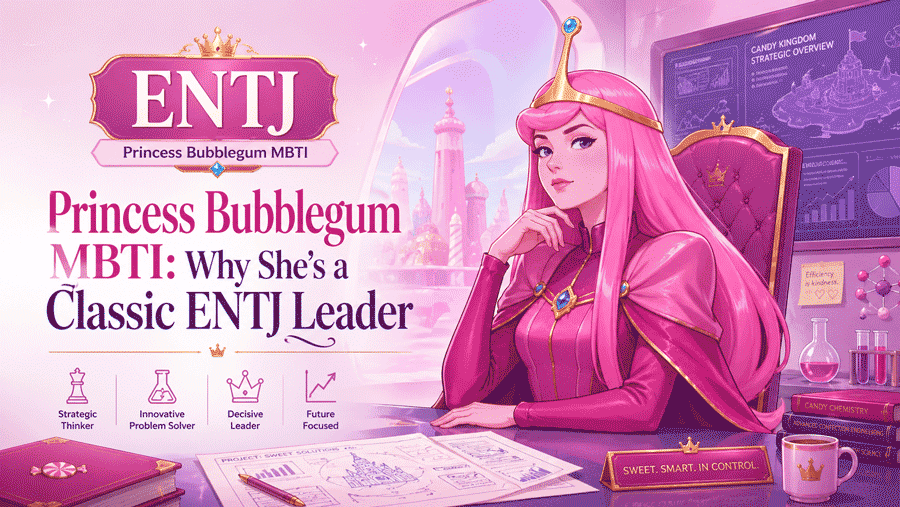
When it comes to analyzing the Princess Bubblegum MBTI personality type, few fictional characters spark as much debate among fans and psychology enthusiasts alike. This article offers a comprehensive breakdown of Princess Bonnibel Bubblegum's cognitive functions, behavioral patterns, and leadership style through the lens of the Myers-Briggs Type Indicator, ultimately arguing that she exemplifies the ENTJ "Commander" archetype with remarkable consistency across Adventure Time's ten-season run. Whether you're a longtime fan of the Land of Ooo or simply curious about how MBTI applies to complex animated characters, this deep dive will explore every facet of the Princess Bubblegum personality type—from her scientific genius to her morally ambiguous political decisions, from her most triumphant moments to her deepest vulnerabilities.
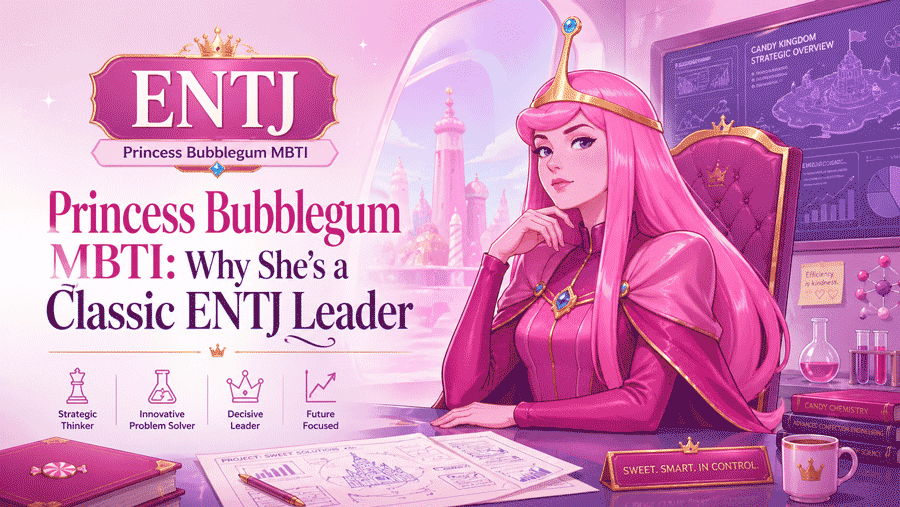
What Is the Princess Bubblegum MBTI Type?
The question of Princess Bubblegum's MBTI has generated extensive discussion across Reddit threads, personality database forums, and fan communities. While some argue for INTJ due to her introverted laboratory habits, a thorough analysis of her cognitive function stack reveals that Princess Bubblegum is an ENTJ—the "Commander" personality type characterized by Extraverted Thinking (Te) as the dominant function and Introverted Intuition (Ni) as the auxiliary function.
ENTJs are known in the Myers-Briggs system as natural-born leaders who combine strategic vision with decisive action. They thrive on organizing systems, achieving long-term goals, and marshaling resources toward a clearly defined purpose. Princess Bubblegum's personality type manifests in nearly every episode she appears in, from her meticulous governance of the Candy Kingdom to her relentless pursuit of scientific knowledge and technological advancement.
But what makes this particular Adventure Time MBTI analysis so compelling is that Princess Bubblegum is not a one-dimensional caricature of the ENTJ type. The show's writers imbued her with genuine complexity—her Te-driven efficiency sometimes clashes with her underdeveloped Introverted Feeling (Fi), creating moments of profound emotional vulnerability that humanize what could otherwise be a coldly rational character. This tension between her commanding exterior and her hidden emotional depths is precisely what makes the Princess Bubblegum ENTJ analysis so rich and rewarding.
Why ENTJ and Not INTJ?
A common point of contention in the Princess Bubblegum character analysis community is whether she leans more toward ENTJ or INTJ. Both types share the same top two cognitive functions—Te and Ni—but in reverse order. INTJs lead with Introverted Intuition (Ni) and support it with Extraverted Thinking (Te), while ENTJs prioritize Te over Ni.
The key distinction lies in where each type directs their primary energy. INTJs are predominantly inward-focused; they build elaborate mental models and theoretical frameworks before taking action. ENTJs, by contrast, are outwardly oriented—they organize the external world first and use their intuition to guide that organizing impulse.
Princess Bubblegum consistently demonstrates an ENTJ pattern. She is, above all else, a doer and an organizer. Her first instinct when faced with any problem—whether it's a zombie plague, a political crisis, or an existential threat to her kingdom—is to act in the external world. She creates systems, delegates tasks, builds technology, and implements solutions. Her laboratory, while seemingly a bastion of introverted activity, is actually the engine room of her Te-dominant approach: she conducts experiments not for the pure joy of theoretical discovery (as an INTJ might), but to produce tangible results that serve her kingdom's practical needs.
Consider the episode "The Vault," where a younger Princess Bubblegum's cartoon character MBTI traits are on full display. Even before she founded the Candy Kingdom, she was already organizing her environment—building structures, creating candy people, and establishing order out of the chaos of the post-apocalyptic world. This is quintessential ENTJ behavior: the drive to impose structure on unstructured reality.
Cognitive Functions of Princess Bubblegum: A Deep Dive
To truly understand the Princess Bubblegum cognitive functions, we must examine each component of the ENTJ functional stack: Dominant Extraverted Thinking (Te), Auxiliary Introverted Intuition (Ni), Tertiary Extraverted Sensing (Se), and Inferior Introverted Feeling (Fi). Each function explains a different dimension of her Bubblegum Princess personality traits, and together they paint a complete portrait of one of animation's most psychologically intricate characters.
Dominant Extraverted Thinking (Te): The Architect of the Candy Kingdom
Extraverted Thinking is the primary engine behind everything Princess Bubblegum does. Te as a cognitive function is concerned with organizing the external world according to logical principles, establishing efficient systems, measuring outcomes objectively, and making decisions based on empirical evidence. It is the function of the executive, the commander, the systems-builder.
In the Princess Bubblegum personality type framework, her Te dominance manifests in several unmistakable ways:
Systematic Governance: Princess Bubblegum doesn't just rule the Candy Kingdom—she engineers it. From its infrastructure to its laws, from its defense systems to its agricultural output, every aspect of candy civilization bears the stamp of her systematizing mind. In "Hot to the Touch," we see her meticulously cataloging and responding to Finn's romantic overtures with data-driven precision. In "The Suitor," she has established elaborate protocols for courtship that reflect her Te need for order and predictability.
Scientific Methodology: Her approach to science is the purest expression of Te dominance. She doesn't simply dabble in chemistry; she applies the scientific method with rigorous discipline. When faced with the zombie outbreak in "Slumber Party Panic," she immediately shifts into problem-solving mode—identifying variables, testing hypotheses, and developing a solution under pressure. This isn't the leisurely theorizing of an Ni-dom; it's the urgent, action-oriented analysis of a Te-dom who needs to fix a real-world problem now.
Decisive Leadership in Crisis: One of the most revealing moments for the Princess Bubblegum ENTJ argument comes in "The Cooler," when she deliberately sabotages the Fire Kingdom's weapons program. Her Te calculates the long-term strategic benefit of maintaining a power imbalance between kingdoms, and she acts on that calculation without hesitation—even though it means deceiving Flame Princess, someone she genuinely cares about. This is Te operating without the tempering influence of Fi: the objective outcome matters more than personal relationships.
Resource Optimization: ENTJs excel at identifying inefficiencies and eliminating them. Princess Bubblegum's entire approach to kingdom management reflects this Te-driven obsession with optimization. She allocates resources with precision, deploys her subjects according to their abilities (however limited those candy people's abilities may be), and continuously iterates on her systems to make them more effective.
A telling example of how the Princess Bubblegum MBTI type's Te operates occurs in the episode "Rattleballs," where she reveals that she destroyed an entire line of highly capable robot warriors because they were too efficient—they represented an uncontrollable variable that could destabilize her carefully ordered system. The decision was ruthlessly logical from a systemic perspective, even as it hinted at the moral complexity that her inferior Fi would later force her to confront.
Auxiliary Introverted Intuition (Ni): The Visionary Behind the Crown
If Te is the engine of Princess Bubblegum's personality, Introverted Intuition is the navigation system. Ni provides the long-range vision, the ability to perceive underlying patterns, and the gut-level certainty about how events will unfold. It is the function that allows ENTJs to be not just efficient managers but truly transformative leaders.
In any Princess Bubblegum character analysis, the presence of strong auxiliary Ni is unmistakable:
Long-Term Strategic Thinking: Princess Bubblegum doesn't think in terms of days or weeks; she thinks in centuries. As an immortal (or at least extremely long-lived) being created from the Mother Gum, her Ni operates on a timescale that most characters in Adventure Time cannot comprehend. When she makes decisions that seem cold or calculated in the moment—such as spying on other kingdoms or maintaining extensive surveillance networks—her Ni is processing information within a multi-generational strategic framework.
Pattern Recognition and Predictive Abilities: In "Princess Cookie," she instantly grasps the psychological dynamics at play when a hostage situation unfolds. Her Ni cuts through the surface chaos to identify the core motivation—a desire for identity and belonging—and she uses that insight to resolve the crisis. This ability to perceive the hidden pattern behind observable events is a hallmark of strong Ni.
Scientific Intuition: While her Te handles the methodical aspects of scientific inquiry, her Ni provides the creative leaps that make her a genius rather than merely a competent technician. The Adventure Time MBTI community often points to her ability to synthesize seemingly unrelated pieces of information into breakthrough discoveries. She doesn't just follow the data; she intuits where the data is leading before the evidence fully supports her conclusion.
The Candy Kingdom as an Ni Vision: The very existence of the Candy Kingdom is a manifestation of Princess Bubblegum's Ni vision. She didn't stumble into queenship; she conceived of an entire civilization built around candy-based life forms, then spent centuries bringing that vision into reality. Every candy person, every gumdrop turret, every licorice road is a physical expression of a singular, coherent vision that originated in her Ni.
Tertiary Extraverted Sensing (Se): The Hidden Adventurer
The tertiary function in any MBTI type often manifests as a source of both recreation and occasional overindulgence. For ENTJs, Extraverted Sensing provides a connection to the physical, sensory world—a counterbalance to the abstract, future-oriented nature of Ni.
Princess Bubblegum's Bubblegum Princess personality traits include a surprising Se streak that emerges in specific contexts:
Hands-On Experimentation: While her Te-Ni axis drives her toward theoretical and systemic thinking, her tertiary Se reveals itself in her love of hands-on scientific work. She doesn't just design experiments; she performs them, getting her hands dirty (or sticky) with chemicals, biological samples, and mechanical components. The sensory feedback of laboratory work—the colors, textures, and reactions—genuinely engages her.
Occasional Impulsivity: ENTJs with developed tertiary Se can surprise others with moments of spontaneous action. In "The Pajama War," we see a more relaxed Princess Bubblegum who can set aside her royal duties and enjoy simple790 moments of sensory pleasure—snacks, games, and casual socializing. These glimpses of her Se function humanize what might otherwise seem like a relentlessly driven personality.
Physical Competence When Required: Though she is primarily an intellectual character, Princess Bubblegum has demonstrated physical capability in combat situations. Her Se provides enough bodily awareness and present-moment focus to hold her own when diplomacy and science fail. The Princess Bubblegum cognitive functions analysis would be incomplete without acknowledging this often-overlooked dimension of her capabilities.
Aesthetic Sensibility: Her kingdom is not merely functional; it's beautiful. The pastel colors, the whimsical architecture, the carefully cultivated atmosphere of sweetness and charm—these reflect an Se appreciation for sensory aesthetics that complements her Te-driven functionality. She understands that a kingdom should appeal to the senses as well as to reason.
Inferior Introverted Feeling (Fi): The Heart Beneath the Crown
Inferior functions are every type's greatest vulnerability—the cognitive process that operates largely outside conscious control and often emerges during stress, exhaustion, or moments of profound emotional significance. For the ENTJ type, Inferior Introverted Feeling represents the deeply personal value system and emotional authenticity that the Te-dominant personality often suppresses in favor of objective efficiency.
The Princess Bubblegum MBTI analysis reveals a character whose entire dramatic arc revolves around the gradual emergence and integration of her inferior Fi. This is where the character transcends type stereotype and becomes genuinely compelling drama.
Emotional Repression and Outbursts: Throughout the early seasons of Adventure Time, Princess Bubblegum's Fi remains largely buried beneath her Te-driven persona. She deflects emotional conversations, intellectualizes her feelings, and maintains a composed exterior even in situations that clearly affect her deeply. But inferior Fi, when ignored for too long, eventually demands acknowledgment—often through sudden, intense emotional eruptions. In "What Was Missing," her explosive confrontation with Marceline, culminating in the heartbreakingly raw song "I'm Just Your Problem," represents a classic inferior Fi breakthrough. Years of suppressed feelings about their relationship pour out in a moment where her Te can no longer maintain control.
Moral Complexity and Ethical Gray Areas: One of the most fascinating aspects of Princess Bubblegum's cartoon character MBTI profile is how her inferior Fi interacts with her dominant Te to produce morally ambiguous outcomes. Her Te makes decisions based on systemic logic; her underdeveloped Fi sometimes fails to register the human (or candy-human) cost of those decisions until after the fact. The surveillance state she creates, the spies she plants in other kingdoms, the ethically questionable experiments she conducts—all of these stem from a Te-Ni loop that has insufficient Fi input. The character's growth involves gradually learning to consult her inner values before acting, rather than being blindsided by remorse afterward.
The Vulnerability Behind the Commander: In her most private moments with Marceline, particularly in later seasons and the Distant Lands special "Obsidian," we see Princess Bubblegum's Fi in its most integrated form. She can express love, admit fault, acknowledge vulnerability, and prioritize personal relationships over strategic concerns. The song "Woke Up" in "Obsidian" is essentially an Fi anthem—a pure expression of personal feeling and relational devotion that the early-seasons Princess Bubblegum would never have permitted herself to voice.
Authenticity Struggles: Inferior Fi often manifests as a nagging question: "Am I being true to myself?" For a Te-dom like Princess Bubblegum, this question is particularly challenging because her entire cognitive orientation is toward external metrics of success. The Princess Bubblegum personality type journey involves her gradually realizing that running an efficient kingdom is not the same as living a meaningful life, and that her own emotional needs deserve as much attention as her subjects' welfare.
Princess Bubblegum MBTI in Relationships: The ENTJ in Love and Friendship
Understanding the Princess Bubblegum MBTI type becomes even more illuminating when we examine her interpersonal dynamics. ENTJs approach relationships with the same strategic mindset they apply to everything else—but genuine connection requires engaging functions (like Fi) that they've often underdeveloped. Princess Bubblegum's relationships with key characters reveal both the strengths and growing edges of her personality type.
Princess Bubblegum and Marceline: The ENTJ-INFP Dynamic
The relationship between Princess Bubblegum and Marceline the Vampire Queen is widely celebrated as one of animation's most nuanced queer romances, and from an MBTI perspective, it makes perfect psychological sense. Marceline is frequently typed as an INFP (or occasionally ISFP)—a type whose dominant Introverted Feeling (Fi) directly complements Princess Bubblegum's inferior Fi.
This Adventure Time MBTI pairing illustrates what happens when an ENTJ encounters someone who embodies the function they've suppressed. Marceline's Fi dominance means she is in constant contact with her personal values, emotions, and authentic self-expression—precisely the capacities that Princess Bubblegum struggles to access. Marceline doesn't just tolerate Princess Bubblegum's emotional awkwardness; she intuitively understands its source and, over centuries, patiently creates space for Bubblegum's Fi to emerge at its own pace.
The centuries-long arc of their relationship—from youthful romance to painful estrangement to mature reconciliation—mirrors the ENTJ's journey toward Fi integration. Young Princess Bubblegum, still building her kingdom and wholly identified with her Te-Ni axis, could not sustain a partnership that demanded the emotional vulnerability Marceline's Fi-dom required. Only after centuries of experience, mistakes, and gradual self-awareness could she meet Marceline as an equal partner rather than as a commander who happened to have feelings.
Their dynamic in "Obsidian" represents the Princess Bubblegum ENTJ at her most psychologically integrated. She can simultaneously be the decisive leader who organizes defense against the dragon and the vulnerable partner who admits her fear of losing Marceline. The Te-Fi balance that eluded her for centuries has finally been achieved—or at least meaningfully approached.
Princess Bubblegum and Finn: The ENTJ-ESFP Mentorship
Finn the Human is widely typed as an ESFP, making his cognitive stack (Se-Fi-Te-Ni) a fascinating mirror of Princess Bubblegum's (Te-Ni-Se-Fi). The two types share all the same functions but in entirely different orders, creating both natural affinity and instructive friction.
From a Princess Bubblegum character analysis perspective, her relationship with Finn showcases the Te-dom's tendency to assume a mentorship role. She sees Finn's raw Se-Fi energy—his courage, his loyalty, his present-moment action orientation—and instinctively wants to direct it toward constructive ends. She sends him on quests, assigns him tasks, and treats him as a valuable but junior asset in her kingdom's operational framework.
Finn's unrequited crush on Princess Bubblegum in early seasons also highlights the ENTJ's characteristic difficulty with unwanted emotional attention. Her Te processes his romantic advances as problems to be solved or logistical complications to be managed, rather than as authentic emotional expressions deserving of genuine acknowledgment. She doesn't want to hurt him, but her inferior Fi doesn't provide her with the tools to handle the situation with emotional grace.
Princess Bubblegum and Peppermint Butler: The ENTJ and Loyalty
Peppermint Butler represents an interesting case study in how the Princess Bubblegum MBTI type handles delegation and trust. ENTJs value competence above almost everything else, and Peppermint Butler's dark magic capabilities, political savvy, and unwavering loyalty make him an ideal lieutenant. Princess Bubblegum not only tolerates his demonic associations but strategically utilizes them—classic Te pragmatism overriding whatever moral qualms a more Fi-developed personality might experience.
The Shadow Side of Princess Bubblegum MBTI: When ENTJ Leadership Goes Too Far
No honest Princess Bubblegum MBTI analysis can ignore the character's morally questionable actions. The ENTJ's drive for efficiency and control, when unchecked by ethical reflection (Fi) or openness to alternative perspectives, can produce genuinely authoritarian behavior. Princess Bubblegum embodies this shadow potential more vividly than most fictional ENTJs.
The Surveillance State and Control Issues
One of the most chilling revelations in Adventure Time occurs when we learn the full extent of Princess Bubblegum's surveillance apparatus. She has cameras everywhere. She spies on her own citizens. She monitors other kingdoms. She collects intelligence on everyone and everything within her sphere of influence. From the perspective of Princess Bubblegum cognitive functions, this is a textbook Te-Ni loop: her dominant and auxiliary functions, operating without sufficient input from her perceptive Se or values-oriented Fi, create an ever-tightening system of control justified by long-term strategic necessity.
The Princess Bubblegum personality type's shadow emerges most starkly in episodes like "The Cooler" and "Rattleballs," where her actions are strategically brilliant but ethically indefensible. She disables an ally's military capability. She destroys sentient beings she created because they threatened her control. These are not the actions of a villain; they are the actions of an ENTJ whose Fi has atrophied to the point where personal relationships and individual dignity no longer register as variables worth considering in her strategic calculus.
The Scientist Without Limits
Princess Bubblegum's scientific ethics are... flexible. She creates life forms and terminates them when they prove inconvenient. She experiments on her subjects. She dabbles in technologies that nearly destroy reality (as in "The Real You," where her quantum whatsit almost unravels existence). This Bubblegum Princess personality traits analysis must acknowledge that her Te-driven scientific curiosity, unmoored from Fi's ethical anchoring, can veer into genuinely dangerous territory.
Yet the show never condemns her outright for these tendencies. Instead, it presents her as a complex figure whose brilliance and flaws are inseparable. Her willingness to push boundaries is precisely what enables her to protect her kingdom through centuries of existential threats; it's also what makes her, at times, a genuinely frightening figure. The Princess Bubblegum ENTJ profile, viewed honestly, must hold both truths simultaneously.
Princess Bubblegum MBTI Compared to Other Fictional ENTJs
To further illuminate the Princess Bubblegum MBTI type, it's helpful to compare her with other well-known fictional ENTJs. These comparisons reveal what is universal to the type and what is unique to her specific characterization.
Princess Bubblegum vs. Princess Celestia (My Little Pony)
Both are immortal princesses who rule benevolent kingdoms built around a specific aesthetic theme (candy and daylight, respectively). Both are frequently typed as ENTJs. However, Celestia's Fi appears more developed—she makes decisions with explicit reference to her values about friendship and harmony, whereas Princess Bubblegum's values remain largely implicit until later character development forces them into consciousness. The cartoon character MBTI comparison reveals how the same functional stack can produce different behavioral outcomes depending on the degree of Fi integration.
Princess Bubblegum vs. Erwin Smith (Attack on Titan)
Erwin Smith, the commander of the Survey Corps, is another classic ENTJ whose Te-Ni axis drives him to make gut-wrenching strategic decisions that sacrifice individuals for collective outcomes. The Adventure Time MBTI enthusiast will immediately recognize the parallel: both characters understand that leadership sometimes requires sending people to their deaths, and both carry the weight of those decisions in their suppressed Fi. The difference is that Attack on Titan puts Erwin's moral calculus at the center of the narrative as a source of tragedy, while Adventure Time often keeps Princess Bubblegum's inner experience of her difficult decisions in the subtext.
Princess Bubblegum vs. Tywin Lannister (Game of Thrones)
Tywin Lannister represents the ENTJ shadow in its most ruthless form—Te dominance entirely divorced from Fi's humanizing influence. Princess Bubblegum is, mercifully, not Tywin. Her candy kingdom is a genuinely benevolent (if paternalistic) enterprise, and her ultimate trajectory is toward greater emotional integration rather than greater ruthlessness. But the comparison is instructive: it shows what the Princess Bubblegum personality type could become if her Fi were to atrophy completely rather than gradually develop. The fact that she doesn't become Tywin is a testament to the show's fundamentally hopeful vision of personal growth.
How Princess Bubblegum's ENTJ Type Evolves Throughout Adventure Time
One of the most rewarding aspects of analyzing the Princess Bubblegum MBTI through the complete run of Adventure Time (plus Distant Lands and Fionna and Cake) is witnessing the gradual development of her cognitive functions. Type is not destiny; it's a framework for understanding growth patterns. Princess Bubblegum's arc illustrates what ENTJ maturation can look like under the pressure of centuries of experience.
Early Seasons: The Unquestioned Commander
In the first few seasons of Adventure Time, Princess Bubblegum operates almost entirely from her Te-Ni axis. She's brilliant, decisive, and fundamentally convinced that she knows what's best for everyone. Her inferior Fi surfaces mainly as irritation when her plans are disrupted or as awkward deflection when emotional topics arise. The Princess Bubblegum ENTJ of early Adventure Time is a textbook example of a type operating primarily through its dominant and auxiliary functions, with limited access to its tertiary and inferior capacities.
This isn't a criticism of the character; it's a realistic portrayal of how ENTJs often present in professional contexts where their strengths are valued and their weaknesses can be managed or ignored. Princess Bubblegum built a kingdom; of course she's identified with her executive functions.
Middle Seasons: Cracks in the Armor
As the show delves deeper into its mythology, the cracks in Princess Bubblegum's Te-dominant facade become increasingly visible. Episodes like "The Vault" reveal the trauma and loneliness beneath her composed exterior. "Sky Witch" and "What Was Missing" bring her unresolved relationship with Marceline to the foreground, forcing Fi-level emotional content into her awareness whether she wants it there or not.
This period in the Princess Bubblegum character analysis corresponds to what Jungian psychology calls the "midlife transition"—the point at which the inferior function begins demanding integration and the dominant function's limitations become impossible to ignore. Princess Bubblegum starts making decisions that her early-seasons self wouldn't have understood: prioritizing personal relationships, expressing vulnerability, acknowledging the moral ambiguity of her past actions.
Later Seasons and Distant Lands: Integration
By the later seasons of Adventure Time and certainly by "Obsidian" in Distant Lands, Princess Bubblegum has achieved a meaningful degree of Fi integration. She can express love directly. She can admit when she's wrong. She can prioritize Marceline's emotional needs over her own strategic preferences. She is still an ENTJ—still the commander, still the strategist, still the scientist—but these functions now operate in service of a consciously held value system rather than in the absence of one.
The Princess Bubblegum MBTI journey from unilateral commander to integrated leader is one of the most psychologically sophisticated character arcs in animation. It demonstrates that the ENTJ type's growth path lies not in abandoning the strengths of Te and Ni, but in creating space for the quieter voices of Se and Fi to contribute their wisdom.
Practical Takeaways: What We Can Learn from Princess Bubblegum's MBTI
Beyond the fascination of analyzing a beloved fictional character, the Princess Bubblegum MBTI analysis offers genuine insights for real-world ENTJs—and for anyone who works with, loves, or wants to understand the ENTJs in their lives.
For ENTJs Reading This
Princess Bubblegum's journey is, in many ways, your journey. The drive to organize, systematize, and achieve is not something to suppress—it's a genuine strength that the world needs. But her story also illustrates what happens when Te-Ni operates without Fi input: you build impressive systems that may not actually serve the human beings (or candy beings) those systems are meant to benefit. You make strategically sound decisions that leave a trail of damaged relationships. You achieve your goals at the cost of your own emotional well-being.
The Princess Bubblegum personality type's growth arc suggests that Fi integration is not about becoming a different person; it's about expanding your decision-making framework to include your own values and the emotional realities of others. It's about asking, before you act: "Is this not just efficient, but right? Is this not just strategically sound, but consistent with who I want to be?"
For People Who Love ENTJs
If you have an ENTJ partner, friend, or colleague, Princess Bubblegum offers a window into their inner world that they may struggle to articulate themselves. That apparent coldness is often not a lack of feeling but a discomfort with expressing feeling. That strategic decision that seemed to disregard your emotions was probably made with genuine care for outcomes but limited awareness of process—the ENTJ focused on where you'd end up, not on how you'd feel along the way.
The Adventure Time MBTI lesson for ENTJ-adjacent people is patience and persistence. Marceline waited centuries for Princess Bubblegum to meet her emotionally. You won't need to wait that long, but you may need to understand that Fi development happens on its own timeline and cannot be forced.
Conclusion: The Enduring Appeal of Princess Bubblegum's ENTJ Complexity
The Princess Bubblegum MBTI type has captured the imagination of personality psychology enthusiasts because she transcends the limitations of a simple four-letter label. Yes, she's an ENTJ—the cognitive function evidence is overwhelming—but she's also a specific, irreplaceable individual whose struggles with power, love,24 duty, and self-knowledge resonate far beyond the boundaries of any typology system.
The Adventure Time writers accomplished something remarkable with Princess Bubblegum. They created a female leader character who is allowed to be genuinely brilliant and genuinely flawed, strategically ruthless and emotionally vulnerable, a devoted ruler and a sometimes-terrifying authoritarian. The Princess Bubblegum ENTJ profile, understood in its full complexity, is a case study in how great character writing can illuminate the depths of a personality type while never reducing the character to a mere exemplar of that type.
Whether you're exploring Princess Bubblegum cognitive functions for a personality database entry, a fan analysis, or your own self-understanding, the key insight is this: Princess Bubblegum demonstrates that the ENTJ's path to wholeness lies through the very vulnerability the type is structured to avoid. Her centuries-long journey from control to connection, from efficiency to authenticity, from command to partnership, is a roadmap for anyone who has ever prioritized achievement over emotion and wondered what they might be missing.
Article Keywords
Princess Bubblegum MBTI, Princess Bubblegum personality type, Princess Bubblegum ENTJ, Adventure Time MBTI, Princess Bubblegum cognitive functions, Bubblegum Princess personality traits, Princess Bubblegum character analysis, cartoon character MBTI, ENTJ fictional characters, Princess Bubblegum Myers-Briggs
Article Description
A comprehensive 3000+ word deep dive into Princess Bubblegum's MBTI personality type from Adventure Time. This analysis explores why Princess Bubblegum is a classic ENTJ, examining her cognitive function stack (Te-Ni-Se-Fi), her relationships with Marceline and Finn, her morally complex leadership decisions, and her psychological growth arc across the entire series. Includes detailed breakdowns of Extraverted Thinking, Introverted Intuition, Extraverted Sensing, and Introverted Feeling, plus comparisons with other fictional ENTJs and practical insights for real-world personality type development. Essential reading for Adventure Time fans, MBTI enthusiasts, and anyone interested in complex character psychology.
Frequently Asked Questions
Q: What Is Princess Bubblegum's Official MBTI Type?
A: While there is no officially canon MBTI type assigned by the creators of Adventure Time, the overwhelming consensus among personality database communities and MBTI analysts is that Princess Bubblegum is an ENTJ (Extraverted, Intuitive, Thinking, Judging). Her cognitive function stack—dominant Extraverted Thinking (Te), auxiliary Introverted Intuition (Ni), tertiary Extraverted Sensing (Se), and inferior Introverted Feeling (Fi)—aligns consistently with the ENTJ profile across all ten seasons of the show, as well as the Distant Lands and Fionna and Cake continuations. Some analysts argue for INTJ, but the preponderance of evidence favors ENTJ due to her fundamentally outward-directed organizing energy.
Q: How Does Princess Bubblegum's ENTJ Personality Influence Her Leadership Style?
A: Princess Bubblegum's ENTJ personality directly shapes her approach to ruling the Candy Kingdom. Her dominant Extraverted Thinking function drives her to create efficient systems, delegate tasks based on competence, and make decisions based on objective data rather than sentiment. Her auxiliary Introverted Intuition enables her to develop long-term strategic visions and anticipate threats centuries in advance. This combination produces a leadership style that is highly effective but sometimes authoritarian—she prioritizes outcomes and systemic stability over individual feelings or democratic processes. Her growth arc involves learning to incorporate more emotional intelligence and relational consideration into her governance.
Q: What Are Princess Bubblegum's Cognitive Functions as an ENTJ?
A: Princess Bubblegum's cognitive functions, in order of preference, are: Dominant Extraverted Thinking (Te) —her ability to organize the external world, create efficient systems, delegate effectively, and make decisions based on empirical evidence and logical analysis; Auxiliary Introverted Intuition (Ni) —her capacity for long-term strategic vision, pattern recognition, and intuitive leaps that guide her scientific discoveries and political planning; Tertiary Extraverted Sensing (Se) —her appreciation for hands-on experimentation, sensory aesthetics, and occasional spontaneous engagement with the physical world; and Inferior Introverted Feeling (Fi) —her deeply buried personal value system and emotional authenticity, which she struggles to access but gradually develops throughout the series.
Q: Why Do Some People Think Princess Bubblegum Is an INTJ Instead of an ENTJ?
A: The INTJ argument for Princess Bubblegum typically centers on her extensive time spent alone in her laboratory, her apparent comfort with solitude, and her sometimes withdrawn social demeanor. However, this argument confuses circumstantial behavior with cognitive orientation. Princess Bubblegum's isolation in her lab is a consequence of her Te-dom need to produce results—she's not withdrawing into an Ni-driven inner world of abstraction so much as she is working toward external objectives in a focused environment. True INTJs lead with Introverted Intuition, prioritizing the development of internal theoretical frameworks; Princess Bubblegum's cognitive priority is always external organization and tangible outcomes, which is the hallmark of Te dominance.
Q: How Does Princess Bubblegum's Inferior Introverted Feeling Affect Her Relationships?
A: Princess Bubblegum's inferior Introverted Feeling (Fi) is the source of her most significant interpersonal challenges. Because Fi operates largely outside her conscious control, she often suppresses her emotions, intellectualizes her feelings, and struggles to express vulnerability—even with those she genuinely loves. This dynamic is most visible in her centuries-long relationship with Marceline, where Bubblegum's difficulty accessing her Fi contributed to their initial estrangement. When inferior Fi finally breaks through—as in her emotional song "I'm Just Your Problem" in "What Was Missing"—it often emerges as intense, uncontrolled emotional expression. Her character development involves gradually integrating Fi into her conscious decision-making, enabling more authentic and emotionally available relationships.
Q: What Other Fictional Characters Share Princess Bubblegum's ENTJ Personality Type?
A: Several well-known fictional characters share the ENTJ personality type with Princess Bubblegum, offering interesting points of comparison. Princess Celestia from My Little Pony is another immortal ruler-ENTJ, though with more developed Fi. Erwin Smith from Attack on Titan mirrors Princess Bubblegum's willingness to make devastating strategic sacrifices for larger goals. Tywin Lannister from Game of Thrones represents the shadow potential of the ENTJ type—what happens when Te operates without Fi's humanizing influence. Miranda Priestly from The Devil Wears Prada showcases the ENTJ in a professional rather than political context. Light Yagami from Death Note demonstrates how the ENTJ's strategic brilliance can curdle into megalomania without ethical grounding. Princess Bubblegum occupies a middle ground among these examples—more benevolent than Tywin or Light, but more morally complex than Celestia.
Q: Does Princess Bubblegum's MBTI Type Change Throughout Adventure Time?
A: According to MBTI theory, a person's core type does not change over time—but the expression and maturity of that type can evolve dramatically. Princess Bubblegum remains an ENTJ throughout Adventure Time; what changes is her degree of integration across all four cognitive functions. In early seasons, she operates almost exclusively through her Te-Ni axis, with limited access to Se and very little conscious Fi. By the later seasons and especially Distant Lands, she has developed greater comfort with her tertiary Se (allowing for more spontaneity and sensory engagement) and has achieved meaningful integration of her inferior Fi (enabling authentic emotional expression and values-based decision-making). This is not a type change but type maturation—the ENTJ's natural developmental trajectory toward wholeness.
Q: What Can Real ENTJs Learn from Princess Bubblegum's Character Arc?