
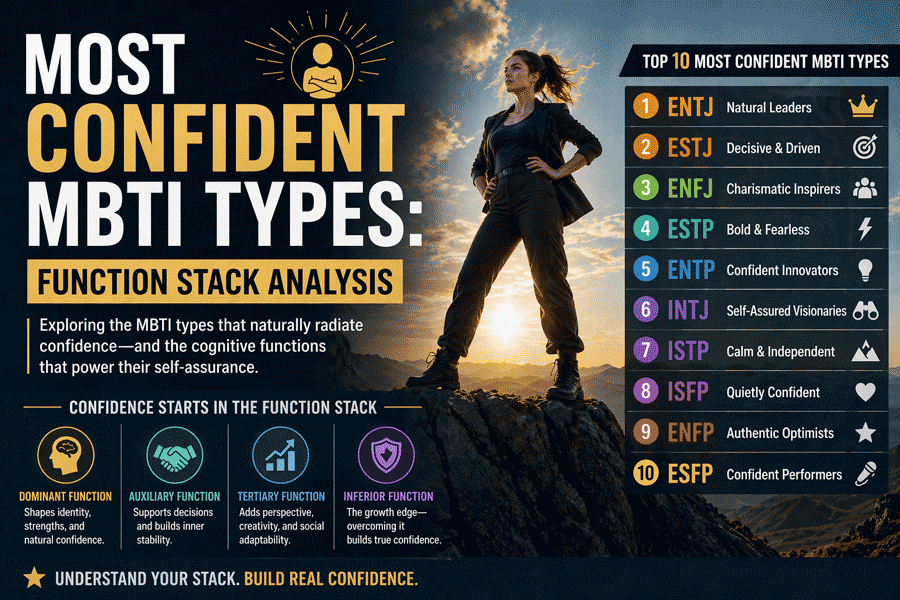
When exploring personality frameworks, a common question arises regarding which profiles exhibit the highest levels of self-assurance. While many lists circulate online claiming to identify the most confident mbti types, true confidence is not merely a trait of specific four-letter codes. It is a dynamic outcome of how an individual utilizes their cognitive function stack. Understanding this distinction is crucial for anyone seeking genuine personal development rather than superficial labeling.
MBTI, or the Myers-Briggs Type Indicator, is a tool designed to help individuals understand their psychological preferences in how they perceive the world and make decisions. It is useful for career planning, improving communication, and self-awareness. However, deeper application of the concept of the most confident mbti types must return to cognitive functions. Confidence stems from the effective use of one's dominant and auxiliary functions, not from the letters themselves. This article moves beyond stereotypes to analyze the mechanisms of confidence through a Jungian lens.
Understanding the Mechanism: Jungian Roots and Functions
To accurately discuss confidence within the MBTI framework, we must first establish the theoretical foundation. The MBTI is based on Carl Jung's theory of psychological types. Jung proposed that people have innate preferences for how they direct their energy, take in information, make decisions, and organize their lives. These preferences form the four dichotomies: Extraversion (E) vs. Introversion (I), Sensing (S) vs. Intuition (N), Thinking (T) vs. Feeling (F), and Judging (J) vs. Perceiving (P).
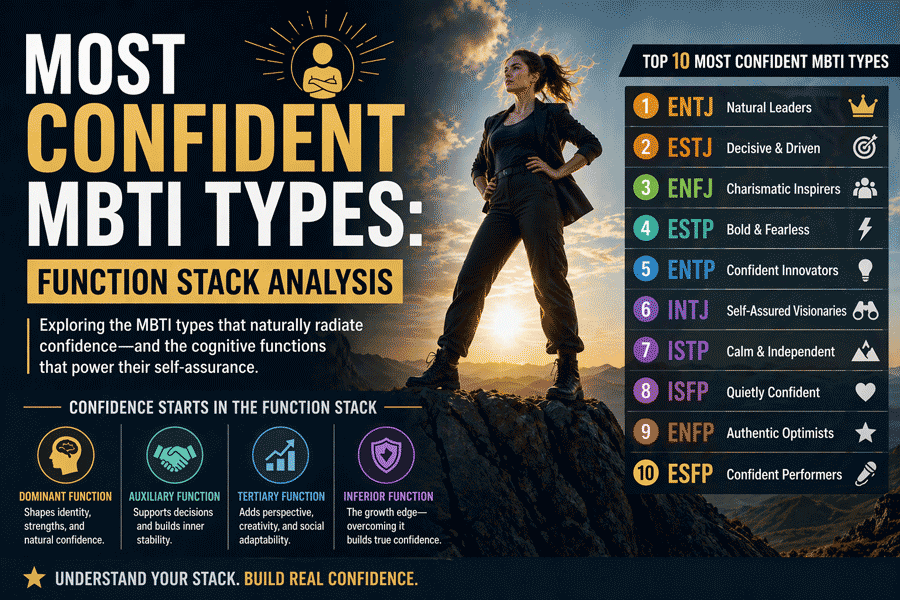
However, the four letters are merely a shorthand for a more complex system known as the cognitive function stack. Each of the 16 types operates using a hierarchy of four primary functions: Dominant, Auxiliary, Tertiary, and Inferior. These functions are the engine of personality. For example, an ENTJ leads with Extraverted Thinking (Te), while an INFP leads with Introverted Feeling (Fi). Confidence is often most visible when a person is operating from their Dominant function, as this is their natural strength.
Why does letter-based typing alone often cause mistypes? Because two types can share the same letters but operate differently. More importantly, behavior can be misleading. An introvert may appear confident in a social setting due to developed social skills, but internally they may be draining energy rapidly. Conversely, an extravert might seem quiet in a reflective environment but feel energized by the internal processing. Relying solely on observable behavior without understanding the underlying cognitive processes leads to inaccurate conclusions about who is truly confident.
Validating your type requires self-observation beyond test results. You must examine your decision patterns. When under stress, do you become overly critical (Thinking grip) or overly emotional (Feeling grip)? What motivates you? Is it logical consistency or personal values? How do you react to new information? Do you seek concrete details or abstract possibilities? Long-term feedback from others is also vital. Friends and family often notice patterns in your behavior that you might miss. By combining self-reflection with external feedback, you can move closer to an accurate type confirmation, which is the first step in understanding your unique confidence profile.
While we often look to public figures for examples, it is important to use cautious wording. For instance, Steve Jobs is widely believed to be an ENTJ, showcasing strong Te confidence, while Frida Kahlo is often typed as an ISFP, demonstrating Fi confidence through artistic expression. These examples illustrate how different functions manifest confidence, but they should not be treated as definitive facts.
Identifying the Most Confident MBTI Types
When searching for the most confident mbti types, we often look to the Extraverted Thinking (Te) and Extraverted Feeling (Fe) users because their confidence is outwardly visible. Types like ENTJ, ESTJ, ENFJ, and ESFJ often project authority and social assurance. Their dominant or auxiliary functions are oriented toward the external world, making their decision-making and interpersonal interactions appear decisive and self-assured.
However, introverted types possess a different kind of confidence. An INTJ or ISTP, leading with Introverted Intuition (Ni) or Introverted Thinking (Ti), may exhibit a quiet, unshakable confidence in their internal frameworks. They may not speak as much, but when they do, their certainty is high. Similarly, INFPs and ISFPs demonstrate confidence through authenticity and adherence to their internal values, which can be incredibly resilient in the face of external pressure.
Therefore, ranking types by confidence is inherently flawed. Instead, we should analyze which functions are being expressed. A healthy Te user will be confidently organized and decisive. A healthy Ti user will be confidently analytical and precise. A healthy Fe user will be confidently harmonious and engaging. A healthy Fi user will be confidently authentic and principled. The perception of confidence depends on the context. In a corporate boardroom, Te confidence is prized. In an artistic community, Fi confidence may be more valued.
Furthermore, confidence fluctuates based on development. A young ESTJ may appear arrogant due to undeveloped Introverted Intuition (Ni), while a mature ESTJ will show confident wisdom. A young INFP may appear insecure due to inferior Te, but a mature INFP will confidently execute their visions. Thus, the label of most confident mbti types is less about the type itself and more about the level of cognitive maturity within that type.
Practical Framework 1: Cognitive Function Development
To build genuine confidence, readers should focus on developing their cognitive functions rather than trying to act like a different type. This framework applies to anyone seeking personal growth, regardless of their specific type. It relates directly to the function stack dynamics, specifically strengthening the Dominant and Auxiliary functions while managing the Tertiary and Inferior.
When it applies: This framework is best used during periods of stability when you are not in acute stress. It is suitable for long-term career planning and skill acquisition.
Which type or function dynamics it relates to: All types benefit, but specifically, it helps Dominant function users avoid burnout and Inferior function users avoid insecurity. For example, an INFJ (Ni-Fe) should focus on trusting their insights (Ni) while developing practical execution (Se).
Practical action steps:
- Identify your Dominant Function: Spend time analyzing what activities make you feel most energized and competent. If you love organizing systems, it might be Te. If you love understanding underlying truths, it might be Ti.
- Strengthen the Auxiliary: If you are an Introvert, your Auxiliary is Extraverted. Practice engaging with the external world. If you are an Extravert, your Auxiliary is Introverted. Practice reflection and deep focus.
- Monitor the Tertiary: Use this function for play and relaxation, not for critical decision-making. Overusing the tertiary can lead to immaturity.
- Respect the Inferior: Acknowledge this function as a source of stress but also growth. Do not force it when tired.
Benefits and limitations: The benefit is sustainable growth and reduced imposter syndrome. The limitation is that it requires patience; function development takes years, not weeks. Readers can judge whether it fits them by checking if they feel more energized after practicing these steps. If you feel drained, you may be forcing a non-preferred function.
Practical Framework 2: Stress Management and Personal Growth
Confidence is often lost during times of stress. This framework focuses on recognizing stress responses known as "loops" and "grips." It applies when you feel uncharacteristically negative, stuck, or reactive. It relates to the interaction between the Dominant and Inferior functions.
When it applies: Use this during high-pressure situations, conflict, or when feeling overwhelmed. It is crucial for emotional regulation and maintaining performance.
Which type or function dynamics it relates to: This is vital for all types but especially for those who struggle with burnout. For instance, an ISTJ (Si-Te) under stress might fall into a Ni loop, becoming pessimistic about the future, or a Fe grip, becoming overly emotional.
Practical action steps:
- Recognize the Grip: Identify if you are behaving like your inferior type. Are you usually logical but suddenly explosive? That is a Thinking type in a Feeling grip.
- Engage the Auxiliary: To exit a grip, rely on your auxiliary function. If you are an Introvert, go talk to someone. If you are an Extravert, take time alone to process.
- Physical Grounding: Inferior functions are often linked to physical stress. Exercise, sleep, and nutrition can help regulate the inferior function.
- Reframe the Narrative: Understand that the stress reaction is a signal, not a failure. It indicates a need for balance.
Benefits and limitations: The benefit is rapid recovery from stress and maintained confidence during crises. The limitation is that it requires high self-awareness to catch the grip early. Readers can judge fit by observing if their stress duration shortens after applying these techniques.
Universal Growth Principles
Regardless of your specific type, certain principles apply to cultivating confidence through the MBTI lens. First, identify the dominant function first. Everything else flows from this core. If you do not know what drives you, you cannot build confidence upon it. Second, distinguish preference from skill. You may be skilled at something you do not prefer. Confidence comes from leveraging preferences, not just skills.
Third, develop the inferior function gradually. Do not try to become an expert in your weakness overnight. Small doses of inferior function activity build resilience. Fourth, explain loop and grip patterns where relevant. Understanding that your negative behavior is a temporary state caused by stress, not a permanent character flaw, preserves confidence during hard times.
Finally, growth means flexibility, not identity attachment. Do not use your type as an excuse. Saying "I am an INTP so I am bad at emotions" limits growth. Instead, say "I am an INTP, so I need to work harder on emotional intelligence." True confidence is the ability to adapt while staying true to your core nature.
8 Common Mistakes to Avoid
To ensure accurate self-understanding and genuine confidence, avoid these common pitfalls associated with MBTI typing.
1. Don't treat the four letters as a horoscope.
Explanation: Believing your type dictates your fate removes agency.
Alternative Mindset: Treat MBTI as a map of preferences, not a destiny.
2. Don't assume Extraverts are always more confident.
Explanation: Social volume does not equal internal certainty.
Alternative Mindset: Recognize that Introverted confidence is often deeper and more stable.
3. Don't ignore the cognitive functions.
Explanation: Letters are surface-level; functions are the engine.
Alternative Mindset: Study Te, Ti, Fe, Fi, Se, Si, Ne, Ni to understand behavior.
4. Don't type others without their consent.
Explanation: Armchair typing damages relationships and creates bias.
Alternative Mindset: Use MBTI to understand yourself first, then empathize with others.
5. Don't use type to justify bad behavior.
Explanation: Saying "I'm just being honest" (Ti) when being hurtful is misuse.
Alternative Mindset: Use your type strengths to communicate better, not to excuse rudeness.
6. Don't rely on a single test result.
Explanation: Tests measure mood and self-perception, which fluctuate.
Alternative Mindset: Use tests as a starting point, then validate through study and reflection.
7. Don't stereotype career paths.
Explanation: Any type can succeed in any field with the right strategies.
Alternative Mindset: Use type to find work styles that energize you, not to limit job titles.
8. Don't stop learning after typing.
Explanation: Typing is the beginning of the journey, not the end.
Alternative Mindset: Commit to ongoing study of psychology and function development.
Ongoing Learning and Resources
The field of personality psychology is evolving. Readers are encouraged to keep following new research and higher-quality MBTI and Jungian resources. Credible organizations such as the Myers & Briggs Foundation and the Center for Applications of Psychological Type (CAPT) provide foundational information. Jungian educational resources also offer depth beyond commercial test sites.
Engage with debates and newer interpretations. The community discussion around cognitive functions is rich and nuanced. Ways to identify reliable information include checking author credentials, looking for citations of Jung or Myers-Briggs original works, and avoiding content that promises quick fixes or absolute truths. Avoid low-quality summaries that reduce complex human beings to memes. By committing to ongoing learning, you ensure that your understanding of the most confident mbti types remains grounded in theory and practical reality.
Frequently Asked Questions
1. What is the best entry point for a beginner?
Start by reading about the four dichotomies, but quickly move to cognitive functions. Understanding functions prevents the stereotypes that often confuse beginners.
2. How can I confirm my type without tests?
Observe your energy levels. What drains you? What energizes you? Look at your stress reactions. These are more reliable indicators than multiple-choice questions.
3. How does MBTI help with relationship communication? It highlights differences in information processing. Knowing your partner prefers Sensing over Intuition, for example, helps you tailor how you explain ideas to them.
4. How do I learn cognitive functions efficiently? Focus on one function at a time. Try to identify Te behavior in the wild, then Ti. Compare them. Practical observation is faster than theoretical memorization.
5. Can my personality type change? Your core preferences are generally stable throughout life. However, your behavior and maturity change. You may look different on the outside as you develop, but your internal engine remains the same.
Conclusion
In conclusion, searching for the most confident mbti types is less about finding a ranking and more about understanding the mechanics of self-assurance. Confidence is not the exclusive domain of Extraverts or Thinkers. It is available to every type through the conscious development of their cognitive function stack. By returning to Jungian roots, avoiding common pitfalls, and committing to lifelong growth, you can build a confidence that is authentic to who you are. Use MBTI as a tool for understanding preferences, not a label that defines the whole person. Your journey toward confidence is unique, and your type is simply the compass that helps you navigate it.