
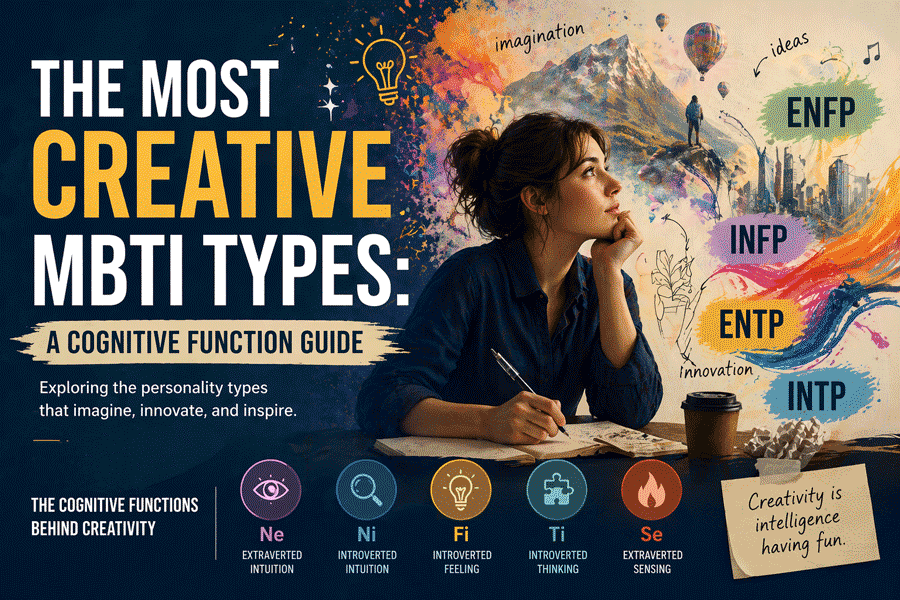
When discussing the most creative mbti types, the immediate conclusion is that creativity is not the exclusive property of specific four-letter codes, but rather the result of specific cognitive function dynamics. While stereotypes often point to INFPs or ENFPs as the sole architects of imagination, a deeper analysis reveals that every type possesses unique creative potential depending on how they engage with their dominant and auxiliary functions. True creative expression emerges when individuals understand their cognitive machinery rather than relying on surface-level personality labels. This article moves beyond simplistic typing to explore how Jungian cognitive functions drive innovation, problem-solving, and artistic expression across all sixteen types.
Understanding the MBTI (Myers-Briggs Type Indicator) begins with recognizing it as a tool for understanding preferences, not a definitive label that caps potential. It helps individuals identify how they perceive information and make decisions. However, to accurately identify the most creative mbti types, one must return to the underlying cognitive functions. This guide is designed for English-speaking readers interested in MBTI who seek depth beyond stereotypes, including those exploring cognitive functions, compatibility, career fit, and personal growth. Whether you are trying to understand your own type more accurately or looking for practical guidance on enhancing your creative output, this analysis provides the framework needed to move from static typing to dynamic development.
Framework and Mechanism: The Jungian Roots of Creativity
To understand why certain types are perceived as more creative, we must examine the Jungian roots of the MBTI system. Carl Jung proposed that human consciousness operates through specific mental processes, which Katharine Briggs and Isabel Myers later codified into the four dichotomies: Extraversion/Introversion, Sensing/Intuition, Thinking/Feeling, and Judging/Perceiving. However, the four letters are merely shorthand for the actual engine of personality: the cognitive function stack.
The Four Dichotomies and Their Relationship to the 16 Types
The dichotomies describe preferences in energy direction, information gathering, decision making, and lifestyle structure. While useful for initial sorting, they often obscure the nuance required to understand creativity. For instance, two Intuitive types may approach creativity differently depending on whether they are Introverted or Extraverted. The 16 types are combinations of these preferences, but the real magic lies in the hierarchy of functions each type uses. A type like ENTP shares the same functions as an INTJ but in a different order, leading to vastly different creative outputs. Recognizing this distinction is crucial for anyone searching for the most creative mbti types because it shifts the focus from “who you are” to “how you process.”
Cognitive Function Stack: Dominant, Auxiliary, Tertiary, Inferior
Every type operates using a stack of four functions. The dominant function is the primary lens through which an individual views the world. The auxiliary function supports the dominant, providing balance. The tertiary and inferior functions are less developed but offer significant growth opportunities. Creativity often stems from the interplay between the dominant perceiving function (how you take in information) and the dominant judging function (how you organize it).
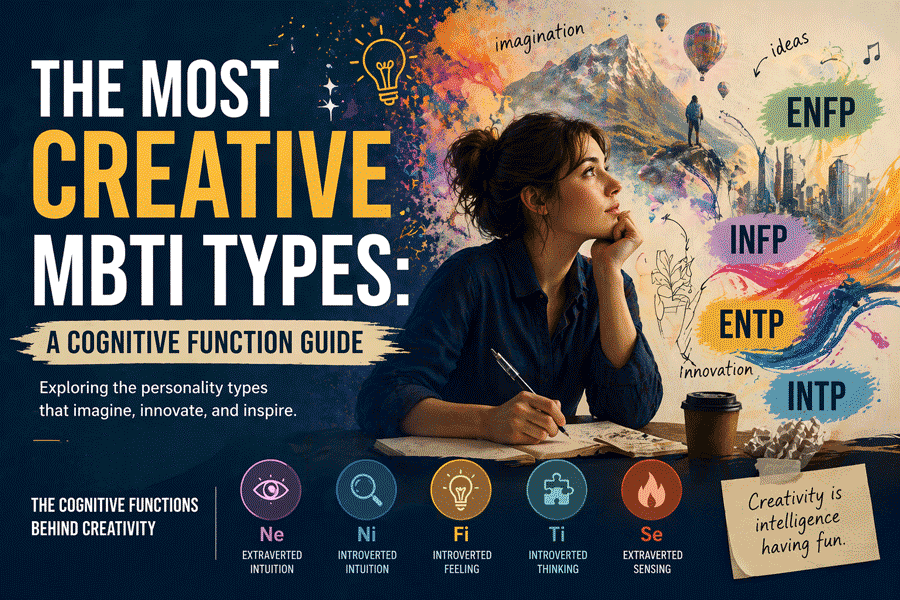
For example, types with dominant Extraverted Intuition (Ne) like ENFPs and ENTPs are often cited among the most creative mbti types because Ne generates endless possibilities and connections. Conversely, types with dominant Introverted Intuition (Ni) like INFJs and INTJs exhibit creativity through synthesis and long-term vision. Sensing types, often overlooked in creative discussions, utilize Extraverted Sensing (Se) for real-time artistic expression or Introverted Sensing (Si) for refining and preserving traditional forms. Understanding this stack explains why creativity manifests differently across the spectrum.
Why Letter-Based Typing Alone Often Causes Mistypes
Relying solely on the four letters can lead to significant mistypes, especially regarding creativity. A person might test as an INFP due to a desire to be seen as artistic, yet their decision-making patterns align more closely with Thinking functions. Letter-based typing ignores the nuance of function development. An individual might have strong creative skills but type as a Thinker because they value logical consistency in their art. Without analyzing cognitive functions, one might miss the true source of their creative strength. This is why validating type through self-observation is critical.
Validating Type Through Self-Observation and Patterns
To confirm your type without relying solely on tests, observe your decision patterns, stress reactions, and motivation. Ask yourself: Do I generate ideas rapidly and struggle to finish (Ne), or do I converge on one vision and protect it (Ni)? When stressed, do I become overly critical (Ti grip) or emotionally volatile (Fe grip)? Long-term feedback from others is also valuable. Colleagues might describe you as innovative even if you identify as a Sensor, suggesting strong intuitive development. By tracking these patterns over time, you can identify your true function stack, which is the only reliable way to determine where you fit among the most creative mbti types.
Regarding public figures, it is important to use cautious wording. For instance, Walt Disney is often typed as an ENFP due to his visionary storytelling, while Steve Jobs is widely believed to be an INTJ due to his focus on singular product perfection. These examples illustrate how different functions drive different creative outcomes, but they should not be treated as definitive facts. Use them as illustrative anchors for understanding function dynamics rather than rigid classifications.
Application Guidance: Practical Frameworks for Creative Growth
Understanding your type is only the first step. To leverage this knowledge, you need practical frameworks. Below are two detailed frameworks designed to help you apply MBTI theory to enhance creativity, communication, and career satisfaction.
Framework 1: Cognitive Function Development for Creative Output
When it applies: This framework is ideal for individuals who feel stuck in their creative pursuits or feel their type stereotype limits them. It relates to all types but is particularly useful for those looking to expand their creative toolkit beyond their dominant function.
Which type or function dynamics it relates to: This applies to the development of the auxiliary and tertiary functions. For example, an ISTJ (Si-Te) might struggle with brainstorming (Ne) but can develop it to enhance problem-solving. An ENFP (Ne-Fi) might struggle with execution (Te) but can develop it to bring ideas to life.
Practical Action Steps:
- Identify your blind spot: If you are an Intuitive type, practice grounding ideas in physical reality (Se/Si). If you are a Sensing type, practice abstract brainstorming (Ne/Ni).
- Schedule function-specific tasks: Dedicate time specifically for divergent thinking (Ne) or convergent planning (Te).
- Collaborate with opposite types: Work with someone whose dominant function is your inferior. An INTJ working with an ESFP can learn to appreciate real-time adaptability.
- Reflect on output: After completing a project, analyze which functions were used. Did you rely too much on logic and ignore emotional resonance?
Benefits and Limitations: The benefit is a more rounded creative skill set. You become less reliant on natural strengths and more adaptable. The limitation is that developing weaker functions requires significant energy and can feel unnatural initially. It may slow down initial output as you learn new processes.
How readers can judge whether it fits them: If you feel your creative work is one-dimensional or you frequently encounter bottlenecks specific to your type’s weaknesses, this framework fits. If you are already balanced, focus on mastering your dominant function instead.
Framework 2: Stress Management and Personal Growth
When it applies: This framework is crucial during periods of high pressure, burnout, or creative block. It relates to the “grip” stress response where the inferior function takes over negatively.
Which type or function dynamics it relates to: This relates to the inferior function. For Thinking types, stress may manifest as emotional outbursts (Inferior Fe/Fi). For Feeling types, stress may manifest as cold hyper-logic (Inferior Ti/Te). For Intuitives, stress may manifest as hyper-focus on sensory details (Inferior Se/Si).
Practical Action Steps:
- Recognize grip symptoms: Learn the specific stress signals of your type. An INFJ might become overly critical of sensory details when stressed.
- Engage the inferior function healthily: Instead of suppressing it, engage it in low-stakes ways. A Thinking type might journal about emotions rather than making decisions based on them.
- Return to the dominant function: Reconnect with your core strength to stabilize. An ENTP should return to brainstorming rather than forcing rigid structure when stressed.
- Set boundaries: Protect your energy reserves. Creative work requires cognitive bandwidth that stress depletes.
Benefits and Limitations: The benefit is increased resilience and sustained creative output over time. You avoid burnout cycles. The limitation is that it requires high self-awareness, which takes time to develop. It does not solve external stressors but changes your reaction to them.
How readers can judge whether it fits them: If you notice your personality seems to “flip” under stress or you experience uncharacteristic behavior during deadlines, this framework is essential. It helps maintain consistency in your creative identity.
Growth Section: Universal Principles for Personality Development
Regardless of where you fall among the most creative mbti types, certain universal principles govern personality growth. These principles ensure that you use MBTI as a ladder for development rather than a cage for identity.
Identify the Dominant Function First
Growth begins with mastery of the dominant function. Before trying to fix weaknesses, maximize your natural strengths. If you are a dominant Perceiver, allow yourself ample exploration time before forcing closure. If you are a dominant Judger, create structures that enable rather than restrict flow. Confidence in your dominant function provides the stability needed to explore weaker areas.
Distinguish Preference from Skill
A critical distinction in MBTI theory is between preference and skill. You may prefer Thinking but be highly skilled at Feeling, or vice versa. Do not confuse what comes naturally with what you are good at. Creativity is a skill that can be learned by any type, even if the process feels different. An ISTJ can be a brilliant writer, but their process will involve more structure and research than an ENFP’s free-flowing draft.
Develop the Inferior Function Gradually
The inferior function is the gateway to wholeness, but it must be approached gently. Aggressive development can lead to stress. Engage the inferior function in play rather than work. For example, a Thinking type should explore art for enjoyment, not for performance. Over time, this integration leads to a more versatile creative capacity.
Explain Loop and Grip Patterns
Under stress, types may fall into “loops” where they bypass the auxiliary function. An INTJ might loop between Ni and Ti, becoming paranoid and overly analytical without checking reality (Te). Recognizing these patterns allows you to interrupt them. Engage the auxiliary function to break the loop. For the INTJ, this means taking action in the external world (Te) rather than spiraling internally.
Growth Means Flexibility, Not Identity Attachment
Ultimately, growth means flexibility. Do not attach your identity so rigidly to your type that you refuse to adapt. Saying “I am an INFP, so I cannot do details” is a misuse of the tool. The goal of understanding the most creative mbti types is to expand your range, not limit it. True maturity in personality theory is the ability to access all functions when the situation demands it, regardless of preference.
Mistakes and Pitfalls: 8 Clear “Don’t Do This” Points
To ensure you use MBTI effectively, avoid these common pitfalls. Each point includes a better alternative mindset to guide your journey.
- Don’t equate type with skill level. Being an Intuitive type does not automatically make you a better innovator than a Sensing type. Alternative: Focus on developing the skill regardless of type preference.
- Don’t ignore the inferior function. Neglecting your weakest area limits your growth potential. Alternative: View the inferior function as a source of hidden strength and balance.
- Don’t use type as an excuse for behavior. Saying “I’m late because I’m a Perceiver” avoids responsibility. Alternative: Acknowledge the preference but manage the behavior through systems.
- Don’t rely solely on online tests. Tests measure self-perception, which can be inaccurate. Alternative: Use tests as a starting point, then validate through study and observation.
- Don’t stereotype career paths. Assuming only certain types can be artists or engineers limits opportunity. Alternative: Choose careers based on values and interests, using type to optimize work style.
- Don’t ignore stress responses. Dismissing grip states as “not you” prevents healing. Alternative: Recognize stress responses as signals to adjust your environment.
- Don’t treat type as static identity. You are not frozen in your type description. Alternative: View type as a baseline for development that evolves with maturity.
- Don’t dismiss other types’ creativity. Believing only Ne users are creative creates bias. Alternative: Appreciate the diverse forms of creativity each function stack offers.
Ongoing Learning: Resources and Credibility
The field of personality psychology is evolving. To maintain accuracy and depth, readers should commit to ongoing learning. This ensures you remain updated on new research and higher-quality interpretations.
Follow credible organizations such as the Myers & Briggs Foundation and the Center for Applications of Psychological Type (CAPT). These organizations provide research-based updates and ethical guidelines for using the instrument. Additionally, explore Jungian educational resources that delve into the original theories behind the MBTI. Understanding the historical context helps differentiate between popularized internet myths and grounded theory.
Be wary of low-quality summaries on social media. Memes and short-form content often exaggerate stereotypes for engagement. Look for long-form articles, books, and courses that discuss cognitive functions in depth. Engage with debates and newer interpretations, such as the Beebe Model or function axis theory, to broaden your understanding. When judging information quality, check for citations, author credentials, and whether the content acknowledges the limitations of MBTI. Reliable information will emphasize that MBTI is a tool for understanding preferences, not a scientifically uncontested definition of human worth.
By committing to continuous learning, you ensure that your understanding of the most creative mbti types remains nuanced and applicable. This protects you from stagnation and keeps your personal growth journey dynamic and informed.
Frequently Asked Questions (FAQ)
1. What is the best entry point for beginners interested in MBTI?
Start by learning the four dichotomies, but quickly move to cognitive functions. Read introductory books from credible sources like the Myers & Briggs Foundation. Avoid taking too many online tests initially; instead, observe your own behavior in different contexts. Focus on understanding how you make decisions and gather information rather than just which letter you prefer.
2. How can I confirm my type without relying on tests?
Validate your type through self-observation of decision patterns and stress reactions. Compare your internal experience with detailed function descriptions rather than superficial type summaries. Seek feedback from trusted friends or colleagues who know you well. Consider working with a certified MBTI practitioner who can guide you through the verification process objectively.
3. How does MBTI help with relationship communication?
MBTI highlights differences in communication styles. For example, Thinking types may prioritize logic while Feeling types prioritize harmony. Understanding these differences reduces conflict. It allows partners to translate their needs effectively. However, use this to foster empathy, not to justify incompatible behavior. Communication patterns improve when both parties understand each other’s cognitive preferences.
4. What is the most efficient way to learn cognitive functions?
Study one function at a time. Start with your suspected dominant function and observe it in daily life. Then study its opposite. Use journals to track when you use specific functions. Join discussion groups where members analyze real-life scenarios through the lens of functions. Practical application is more effective than rote memorization of definitions.
5. Can my personality type change over time?
Your core preferences generally remain stable, but your expression of them evolves. As you develop your functions, you may appear different to others. You might become more balanced, using weaker functions more effectively. This is not a change in type but a maturation of personality. Growth means flexibility and expanded capability, not necessarily a shift in your fundamental four-letter code.