
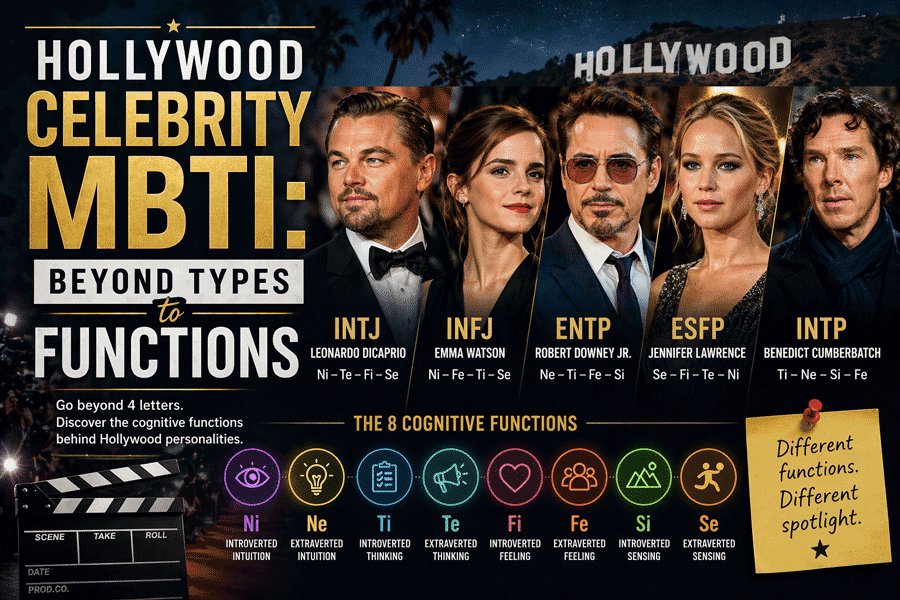
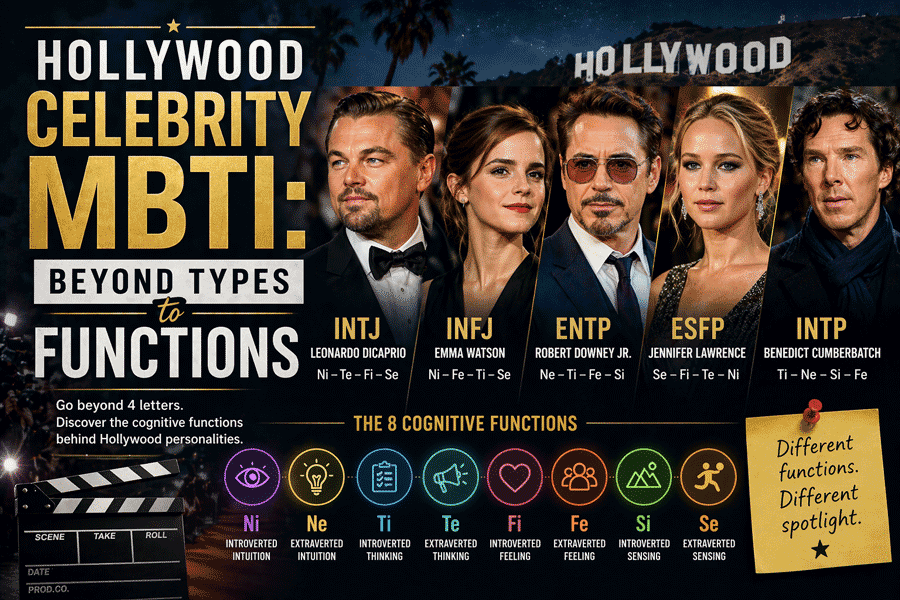
When searching for hollywood celebrity mbti types, most readers hope to find a quick list of four-letter codes assigned to famous actors and directors. However, relying solely on these labels often leads to superficial understanding and frequent mistyping. The true value of personality theory lies not in categorizing stars, but in using their public personas as case studies to understand your own cognitive processes. To apply this knowledge effectively, you must move beyond the letters and return to the underlying cognitive functions. This article provides a deep dive into the mechanisms of type, practical frameworks for growth, and the pitfalls to avoid when exploring personality psychology.
The Myers-Briggs Type Indicator (MBTI) is a tool designed to help individuals understand their preferences in how they perceive the world and make decisions. It is useful for career planning, improving communication, and fostering self-awareness. However, its deeper application requires a shift in focus. Instead of asking “What type is this celebrity?” ask “What cognitive functions are displayed here, and how do they compare to my own?” This shift transforms a trivia question into a tool for personal development.
The Mechanism Behind the Types
To understand why simple letter codes are insufficient, we must examine the theoretical roots of the system. The MBTI is based on Carl Jung’s theory of psychological types. Jung proposed that people have innate preferences for how they direct their energy, take in information, make decisions, and organize their lives. These preferences combine to form the familiar four-letter types, but the engine driving these types is the cognitive function stack.
Jungian Roots and the Four Dichotomies
The four dichotomies—Extraversion vs. Introversion, Sensing vs. Intuition, Thinking vs. Feeling, and Judging vs. Perceiving—describe the orientation of your psyche. Extraversion and Introversion determine where you focus your attention. Sensing and Intuition describe how you gather information. Thinking and Feeling explain how you make decisions. Judging and Perceiving indicate how you approach the outside world. While helpful, these dichotomies are binary simplifications of a dynamic system. Two people with the same four letters can operate very differently if their function development varies.
The Cognitive Function Stack
Every type has a stack of four functions that operate in a specific order: dominant, auxiliary, tertiary, and inferior. The dominant function is your core strength, the lens through which you view the world most naturally. The auxiliary function supports the dominant, providing balance. The tertiary function is less developed but offers relief and creativity. The inferior function is your weakest link, often emerging under stress.
For example, an INTJ leads with Introverted Intuition (Ni), supported by Extraverted Thinking (Te). An ENTJ also uses Ni and Te but leads with Te. This subtle shift changes their entire demeanor. An INTJ may appear more reserved and strategic, while an ENTJ appears more commanding and action-oriented. Recognizing these nuances is crucial when analyzing public figures. A celebrity might display strong Te behaviors due to their career demands, even if their dominant function is different.
Why Letter-Based Typing Causes Mistypes
Typing based on letters alone often fails because behavior is contextual. A famous actor might appear extraverted on stage but require significant solitude to recharge, indicating Introversion. They might make logical decisions in business but prioritize values in personal relationships. Without understanding the function stack, observers often mistype celebrities based on their public mask rather than their internal motivation. This is why deeper application of hollywood celebrity mbti data must return to cognitive functions. You must look for patterns in decision-making, stress reactions, and energy sources rather than surface-level traits.
Validating Type Through Observation
To validate a type, whether for yourself or a public figure, observe decision patterns. Does the person prioritize efficiency and logic (Thinking) or harmony and values (Feeling)? How do they handle new information? Do they look for concrete details (Sensing) or underlying patterns (Intuition)? Self-observation is key. Track your energy levels after social interactions. Notice what drains you versus what energizes you. Long-term feedback from trusted others can also reveal blind spots. If everyone says you are stubborn during stress, it might indicate a grip reaction in your inferior function. Tests are a starting point, but lived experience is the confirmation.
Practical Frameworks for Application
Understanding your type is only useful if you can apply it. Below are two practical frameworks to help you use personality theory for tangible improvement in your life and relationships.
Framework 1: Cognitive Function Development
This framework focuses on strengthening your function stack to achieve greater psychological balance. It applies to anyone seeking personal growth, regardless of their specific type.
When it applies: Use this when you feel stuck in repetitive patterns, experience chronic stress, or want to expand your skill set without burning out.
Related Dynamics: This relates to the dominant and auxiliary functions. The goal is to use your strengths efficiently while developing your weaker functions to support them.
Practical Action Steps:
- Identify your dominant function: Spend one week tracking moments where you feel most “in flow.” Note what mental process you were using. Was it analyzing data (Ti/Te), connecting with people (Fe/Fi), planning ahead (Ni/Si), or exploring possibilities (Ne/Se)?
- Support with the auxiliary: If you are a dominant Thinker, consciously practice considering values in decisions. If you are a dominant Feeler, practice objective analysis.
- Engage the tertiary: Use your tertiary function for leisure. If it is Extraverted Intuition, engage in brainstorming hobbies. If it is Introverted Sensing, enjoy nostalgic activities.
- Respect the inferior: Do not force your inferior function. Instead, create environments where it is supported. If your inferior is Feeling, ensure you have emotional support systems.
Benefits and Limitations: The benefit is increased resilience and reduced internal conflict. The limitation is that developing lower functions takes time and energy. You cannot become equally proficient in all functions; the goal is competence, not mastery.
How to Judge Fit: If you feel more energized and less defensive after trying these steps, the framework fits. If you feel exhausted by forcing a specific behavior, you may be overusing a weaker function.
Framework 2: Relationship and Communication Guidance
This framework uses type dynamics to improve interactions with colleagues, partners, and family members. It is particularly useful for resolving conflicts.
When it applies: Use this during misunderstandings, team collaborations, or when trying to explain your needs to others.
Related Dynamics: This relates to the Thinking/Feeling and Judging/Perceiving dichotomies, as well as the Extraversion/Introversion energy flow.
Practical Action Steps:
- Map communication styles: Identify if the other person prefers direct information (Thinking) or empathetic connection (Feeling). Adjust your opening statement accordingly.
- Respect processing time: Introverts often need time to think before speaking. Extraverts may think out loud. Allow space for both styles in conversations.
- Clarify decision criteria: When making joint decisions, explicitly state whether you are prioritizing logic or values. Ask the other person to do the same.
- Manage structure vs. flexibility: Judging types prefer closure and plans. Perceiving types prefer options and spontaneity. Negotiate deadlines that satisfy both needs.
Benefits and Limitations: The benefit is reduced friction and clearer expectations. The limitation is that type does not excuse poor behavior. Respect is still required regardless of type differences.
How to Judge Fit: If conflicts decrease and collaboration feels smoother, the framework is working. If you feel you are “walking on eggshells,” you may be over-accommodating rather than communicating clearly.
Pathways to Personality Growth
Growth in the context of MBTI is not about changing your type. It is about becoming a healthier version of your type. This requires understanding the lifecycle of your cognitive functions.
Identify the Dominant Function First
Your dominant function is your home base. Growth begins with honoring this preference. If you are an Introvert, honor your need for solitude. If you are a Perceiver, honor your need for flexibility. Suppressing your dominant function to fit in leads to burnout. Acceptance is the first step toward development.
Distinguish Preference from Skill
A common misconception is that preference equals skill. You may prefer Thinking but be skilled at Feeling due to upbringing or job requirements. Do not confuse what comes naturally with what you are good at. Growth involves building skills in non-preferred areas while maintaining your natural energy source.
Develop the Inferior Function Gradually
The inferior function is often the source of mid-life growth. As you mature, you naturally integrate this function. For example, a dominant Thinker may become more empathetic over time. This should be a gradual process. Pushing too hard too soon can trigger stress responses. Approach inferior development through low-stakes activities like hobbies or volunteer work.
Explain Loop and Grip Patterns
Under stress, types may fall into “loops” or “grips.” A loop occurs when you bypass your auxiliary function and oscillate between your dominant and tertiary. For example, an INTJ might loop between Ni and Ti, becoming overly theoretical and isolated. A grip occurs when the inferior function takes over. An ENTJ in a grip might become overly emotional or sensitive to criticism. Recognizing these states allows you to step back and re-engage your auxiliary function to regain balance.
Growth Means Flexibility, Not Identity Attachment
Ultimately, personality growth means increasing your flexibility. You should be able to access different functions when the situation demands it, without losing your core identity. Do not attach your ego to your type. You are not “an INTJ”; you are a person who prefers INTJ patterns. This distinction allows you to change behaviors without feeling like you are betraying yourself.
Common Pitfalls to Avoid
When exploring personality theory, especially through the lens of hollywood celebrity mbti, there are several common mistakes that hinder accurate understanding. Avoiding these pitfalls will lead to more reliable insights.
1. Don’t Rely on Tests Alone
Explanation: Online tests often measure behavior rather than preference. They can be influenced by your current mood or job role.
Alternative Mindset: Use tests as a hypothesis generator. Validate results through self-reflection and study of cognitive functions.
2. Don’t Stereotype Celebrities
Explanation: Public personas are curated. An actor playing a villain does not mean they are a Thinking type. An activist does not automatically mean Feeling type.
Alternative Mindset: Analyze interviews and behind-the-scenes behavior for clues about energy sources and decision-making processes.
3. Don’t Confuse Skills with Preferences
Explanation: You can learn to be organized (Judging) even if you prefer flexibility (Perceiving). Competence does not equal type.
Alternative Mindset: Ask yourself what feels effortless versus what requires effort. Preference is about energy, not ability.
4. Don’t Ignore the Inferior Function
Explanation: Ignoring your weakest function leads to blind spots and stress reactions.
Alternative Mindset: Acknowledge your inferior function as a source of growth potential rather than a weakness to hide.
5. Don’t Use Type as an Excuse
Explanation: Saying “I’m a Perceiver, so I’m late” avoids responsibility. Type explains tendencies, not obligations.
Alternative Mindset: Use type to understand your challenges, then create systems to manage them responsibly.
6. Don’t Assume Compatibility is Fixed
Explanation: Certain type pairings are not destined to fail. Relationship success depends on effort and communication, not just letters.
Alternative Mindset: Focus on understanding differences and negotiating needs rather than checking type compatibility charts.
7. Don’t Ignore Context
Explanation: People behave differently at work than at home. A CEO might display strong Te at work but be Fi-dominant at home.
Alternative Mindset: Observe behavior across multiple contexts before drawing conclusions about type.
8. Don’t Treat Type as Static Identity
Explanation: While core preferences remain stable, expression changes with age and experience. You are not frozen in your type description.
Alternative Mindset: View type as a map for development, not a label that defines your entire existence.
Continuing Your MBTI Journey
Personality psychology is a evolving field. To maintain accuracy and depth in your understanding, continue following credible resources. New research often refines our understanding of Jungian theory. Look for higher-quality MBTI and Jungian resources that focus on functions rather than just dichotomies. Credible organizations such as the Myers & Briggs Foundation and the Center for Applications of Psychological Type (CAPT) provide reliable information. Engage with debates and newer interpretations, but always evaluate the evidence. Learn to identify reliable information by checking if the source cites theoretical foundations or relies on anecdotal evidence. Avoid low-quality summaries that reduce complex psychology to memes or horoscopes. By staying informed, you ensure that your use of personality theory remains a tool for empowerment rather than limitation.
Frequently Asked Questions
1. Where should a beginner start with MBTI?
Begin by learning the four dichotomies and taking a reputable test to get a baseline. However, immediately move to studying cognitive functions. Read books that explain the function stack, as this provides the depth needed to understand why you behave the way you do. Do not stop at the four-letter code.
2. How can I confirm my type without tests?
Focus on energy dynamics. Notice what drains you and what energizes you over the long term. Observe your stress reactions. If you become overly critical, you might be in a Thinking loop. If you become overly emotional, you might be in a Feeling grip. Compare these patterns to function descriptions rather than type summaries.
3. How does type affect relationship communication?
Type influences how you express care and resolve conflict. Thinkers may offer solutions, while Feelers offer empathy. Understanding this difference prevents misinterpreting intent. Communicate your needs explicitly. Tell your partner how you prefer to receive support rather than expecting them to guess based on your type.
4. What is the most efficient way to learn cognitive functions?
Study one function at a time. Start with your suspected dominant function. Look for examples in daily life. Join discussion forums where people analyze specific functions rather than just types. Practice identifying functions in others by listening to their language and observing their priorities.
5. Can my personality type change over time?
Core preferences are generally stable throughout adulthood. However, your expression of these preferences can change. You may develop better control over your inferior function or adapt your behavior to suit your environment. This is growth, not a change in type. If you feel your type has changed, re-evaluate whether you understood your initial type correctly.