
Introduction: Beyond the Four Letters
Understanding human behavior is a complex endeavor, and few frameworks have captured the public imagination quite like the Myers-Briggs Type Indicator. However, true insight goes far beyond a simple four-letter code. When exploring mbti personality types compatibility, it is crucial to recognize that type is a starting point, not a destination. This guide provides a comprehensive walkthrough for individuals seeking to understand their cognitive machinery, navigate interpersonal dynamics, and foster personal growth. Whether you are looking to improve workplace collaboration or deepen romantic bonds, the key lies in returning to the cognitive functions that underpin the theory.
Many people take a test once and label themselves forever. This static view limits potential. Based on existing observations and research from the Myers & Briggs Foundation, type dynamics are fluid. The goal of this article is to equip you with the tools to verify your type through self-observation, understand how different functions interact, and apply this knowledge practically. We will avoid rigid stereotyping and instead focus on the nuanced interplay of preferences that define human interaction.
Theoretical Framework and Core Mechanisms
To truly grasp compatibility, one must understand the engine driving the vehicle. The MBTI is rooted in Carl Jung's theory of psychological types. While the four dichotomies (Extraversion/Introversion, Sensing/Intuition, Thinking/Feeling, Judging/Perceiving) are the most visible layer, the cognitive function stack is the core mechanism.
The Four Dimensions and 16 Types
The surface level of MBTI divides people into 16 distinct types. However, these letters are merely indicators of deeper preferences. For instance, an 'F' preference does not mean a person lacks logic; it means they prioritize values and harmony when making decisions. Understanding this distinction is vital for compatibility. Two 'Thinkers' might clash if one uses Extraverted Thinking (Te) to organize the external world while the other uses Introverted Thinking (Ti) to seek internal logical consistency.
Cognitive Function Stack
Every type operates using a stack of four primary functions: Dominant, Auxiliary, Tertiary, and Inferior. This hierarchy dictates how a person processes information and makes decisions.
- Dominant Function: The hero archetype. It is the natural strength used most comfortably. For an INFJ, this is Introverted Intuition (Ni).
- Auxiliary Function: The supportive parent. It balances the dominant function. For an INFJ, this is Extraverted Feeling (Fe).
- Tertiary Function: The eternal child. It is less developed but offers relief and creativity. For an INFJ, this is Introverted Thinking (Ti).
- Inferior Function: The anima/animus. It is the weakness that often emerges under stress. For an INFJ, this is Extraverted Sensing (Se).
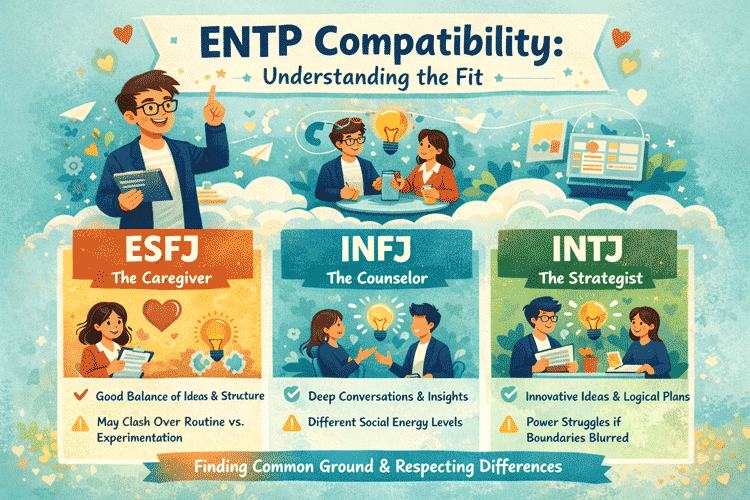
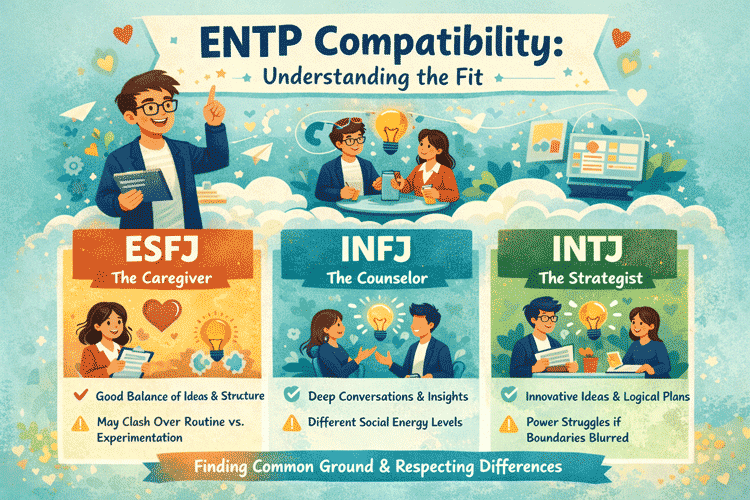
Compatibility often hinges on how these stacks interact. A relationship between an ENTP (Ne-Ti-Fe-Si) and an INTJ (Ni-Te-Fi-Se) can be stimulating because their functions mirror each other, yet challenges arise when stress triggers their inferior functions.
Verifying Your Type Without Tests
Tests are snapshots, not diagnoses. To accurately identify your type, engage in deep self-reflection. Ask yourself: "When I am tired, do I seek solitude (Introversion) or stimulation (Extraversion)?" "Do I trust concrete data (Sensing) or patterns and possibilities (Intuition)?" Seek feedback from trusted peers who know you well. Often, others see our blind spots more clearly than we do. Celebrities are often cited to help illustrate types, but use caution. For example, Albert Einstein is commonly believed to be an INTP due to his theoretical focus, while Oprah Winfrey is frequently categorized as an ENFJ due to her empathetic leadership. These are generalizations based on public persona, not clinical assessments.
Compatibility in Career, Love, and Friendship
Context matters. A type pairing that works brilliantly in a brainstorming session might struggle in a crisis management scenario. Here we break down compatibility across three major life domains.
Workplace Dynamics
In professional settings, compatibility is about complementary skills. Te users (ENTJ, ESTJ, INTJ, ISTJ) excel at execution and structure. They may find Ne users (ENFP, ENTP, INFP, INTP) too scattered, while Ne users may find Te users too rigid. However, this tension is productive. A project manager (Te) needs a creative strategist (Ne) to innovate. Conflict arises not from type difference, but from a lack of appreciation for different cognitive contributions. Research suggests that diverse teams outperform homogeneous ones when psychological safety is established.
Intimate Relationships
Romantic compatibility is often misunderstood as "opposites attract." While opposites can provide balance, shared values are crucial. Fe users (ENFJ, ESFJ, INFJ, ISFJ) prioritize group harmony and may feel unappreciated by Ti users (ISTP, INTP, ESTP, ENTP) who prioritize truth over tact. Conversely, Ti users may feel smothered by Fe users' emotional demands. Successful couples learn to translate their languages. An ISFJ might show love through acts of service (Si-Fe), while an ENTP might show love through intellectual debate and novelty (Ne-Ti). Recognizing these love languages through the lens of cognitive functions prevents misinterpretation.
Friendship and Social Circles
Friendships often thrive on shared interests (Sensing) or shared visions (Intuition). S-types may bond over activities like sports or cooking, while N-types may bond over abstract concepts and future plans. However, cross-type friendships are invaluable for growth. An ESFP can teach an INTJ to live in the moment, while an INTJ can help an ESFP plan for long-term stability. The challenge lies in patience. Understanding that a friend's seemingly irrational behavior is actually a function of their cognitive stack fosters empathy.
Development Schemes and Actionable Advice
Knowing your type is useless without application. Here are two structured schemes for personal development based on MBTI dynamics.
Scheme 1: Cognitive Function Strengthening
This scheme focuses on balancing your function stack. It is best suited for individuals feeling stuck or overly reliant on their dominant function.
- Objective: Develop the Auxiliary and Tertiary functions to create a more rounded personality.
- Action: If you are a dominant Thinker (T), schedule time for value-based reflection (F). If you are a dominant Judger (J), practice open-ended exploration without a plan (P).
- Scenario: An INTJ (Ni-Te) might struggle with interpersonal connection. They should consciously practice Fe behaviors, such as asking colleagues about their weekend without expecting a productivity outcome.
- Measurement: Track stress levels. Overuse of the dominant function often leads to burnout. Balanced function use correlates with sustained energy.
Scheme 2: Interpersonal Adaptation
This scheme is designed for leaders, partners, or anyone navigating complex social structures.
- Objective: Improve communication efficiency by adapting to the recipient's type preferences.
- Action: When communicating with an S-type, provide concrete details and step-by-step instructions. When communicating with an N-type, focus on the big picture and the "why."
- Scenario: A manager pitching a new idea to an ISTJ should highlight risk mitigation and past precedents. Pitching the same idea to an ENFP should highlight potential impact and innovation.
- Measurement: Monitor feedback loops. Are misunderstandings decreasing? Is collaboration friction reduced?
Functional Cognition and Growth Mindset
Growth in the context of MBTI is not about changing your type; it is about expanding your capacity within your type. The universal principle is to honor the Dominant function while integrating the Inferior function.
Prioritize the Dominant Function
Your dominant function is your superpower. Suppressing it leads to dissatisfaction. An ENFP needs novelty; an ISTJ needs order. Ensure your life structure allows your dominant function to shine. If an INTP is forced into a highly rigid, repetitive administrative role without room for analysis, they will likely experience chronic stress.
Integrate the Inferior Function
The inferior function is the source of growth and also the source of the "grip" stress response. When an INFJ is overwhelmed, they may overindulge in Se behaviors (binge eating, excessive shopping). Recognizing this pattern is the first step. Healthy integration means engaging the inferior function in small, controlled doses. For an INFJ, this could mean mindful walking or engaging in a sport, allowing them to connect with the physical world without being overwhelmed by it.
Lifelong Evolution
Type dynamics shift over the lifespan. Younger individuals often rely heavily on their top two functions. Mid-life often brings a confrontation with the tertiary and inferior functions. This is natural. Embrace the discomfort of developing weaker muscles. It is the only path to wholeness.
8 Common Mistakes to Avoid
Misapplication of MBTI can lead to prejudice and self-limitation. Here are eight critical pitfalls to avoid.
- Labeling and Stereotyping: Do not assume you know someone's capabilities based on their type. An INTJ can be emotional; an ESFP can be strategic.
- Self-Set Limits: Never say "I can't do this because I'm an X-type." Type explains preference, not ability.
- Forcing Judgments on Others: Do not diagnose friends or colleagues. Let them self-identify.
- Ignoring Context: Behavior changes based on environment. A quiet person at work might be loud at home.
- Over-reliance on Tests: Online tests vary in quality. Use them as hints, not verdicts.
- Using Type as an Excuse: "I'm late because I'm a P-type" is unacceptable. Responsibility transcends preference.
- Assuming Compatibility is Fixed: Relationships require work regardless of type matching. No pairing is automatically perfect.
- Neglecting Cognitive Functions: Focusing only on letters misses the mechanical reality of how the mind works.
Keeping Updated and Resources
The field of personality psychology is evolving. While MBTI remains popular, it is essential to stay informed about new research and authoritative resources.
Tracking New Research
Psychometric science advances. Keep an eye on publications from the Myers & Briggs Foundation. Be aware of the Big Five (OCEAN) model, which is often used in academic psychology alongside MBTI. Understanding how MBTI correlates with Big Five traits can provide a more robust view of personality.
Authoritative Resources
Seek out books by certified practitioners. Look for materials that emphasize type development rather than just type description. Avoid pop-psychology content that reduces types to memes. Quality resources will discuss the shadow functions and type dynamics in depth.
Community Engagement
Engage with communities that focus on growth. Discussion forums can be helpful, but verify information. Anecdotal evidence is common in online spaces. Cross-reference claims with established theory.
Frequently Asked Questions
1. I am new to MBTI. Where should I start?
Begin by learning the four dichotomies, but quickly move to cognitive functions. Read introductory materials from the Myers & Briggs Foundation. Take a reputable test as a baseline, but treat the result as a hypothesis to test against your own life experience.
2. How can I confirm my type if I test differently each time?
Test results fluctuate due to mood and context. Focus on cognitive functions. Study the descriptions of Ni vs. Ne, or Te vs. Ti. Which process feels more natural? Which feels effortful? Ask close friends how they perceive your decision-making process.
3. Can incompatible types have successful relationships?
Yes. Compatibility is not about being the same; it is about understanding differences. An INTJ and an ESFP can have a thriving relationship if they respect each other's needs for solitude versus socialization. Communication and mutual respect outweigh type matching.
4. How do I learn efficiently using my type?
S-types may prefer hands-on practice and concrete examples. N-types may prefer theoretical frameworks and conceptual models. T-types might want to understand the logic behind the material, while F-types might engage better if the material relates to human impact. Tailor your study method to your preferences.
5. How do I distinguish between credible and false MBTI information?
Credible information acknowledges nuance and avoids absolute statements. It cites established theory (Jung, Myers, Briggs) and avoids claiming one type is "better" than another. Be wary of content that uses type to justify bad behavior or discriminate against certain groups.
Conclusion
MBTI is a powerful lens for self-discovery and understanding others, but it is not a crystal ball. By focusing on mbti personality types compatibility through the lens of cognitive functions, you move beyond superficial labels. Remember that type is a starting point. The real work lies in developing your functions, navigating relationships with empathy, and continuously growing. Use this guide as a map, but walk the path yourself. Your personality is dynamic, and your potential is unlimited.