
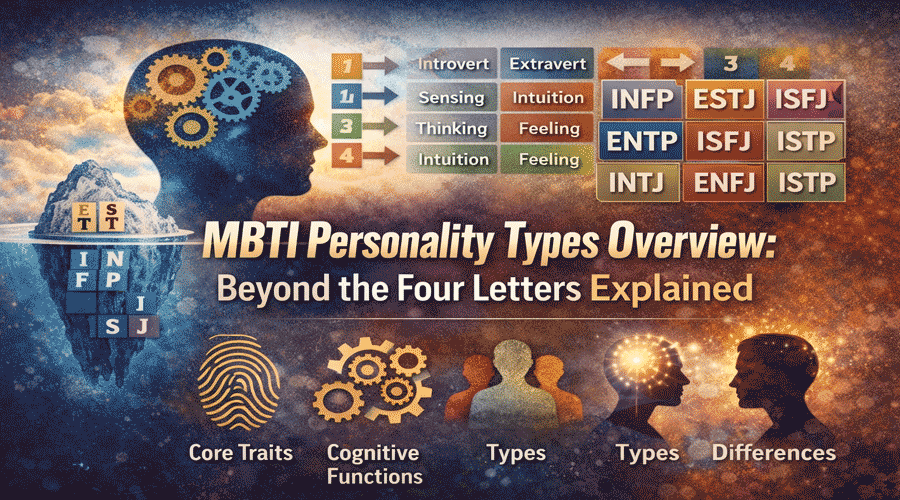
MBTI Personality Types Overview: Beyond the Four Letters Explained
If you are looking for an MBTI personality types overview, the most important thing to understand is that the four-letter code is only the starting point. MBTI helps describe how people prefer to take in information, make decisions, and interact with the world, but a deeper understanding comes from looking at cognitive functions, behavior patterns, and personal development over time.
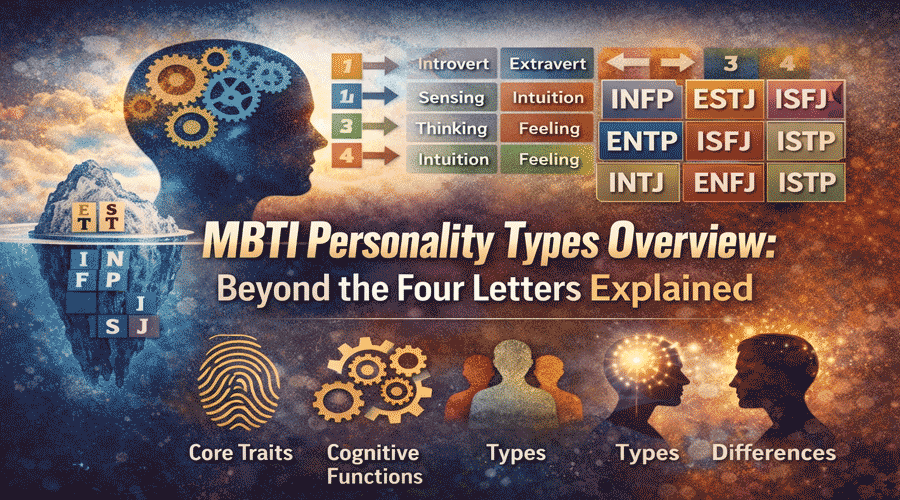
At a basic level, MBTI organizes personality into 16 types built from four preference pairs: Introversion vs. Extraversion, Sensing vs. Intuition, Thinking vs. Feeling, and Judging vs. Perceiving. However, many people stop at the letters and miss the deeper structure behind them. That is why this guide goes beyond the code itself to explain what MBTI types really mean, how cognitive functions shape behavior, and how to use personality insights in real life.
This article offers a practical MBTI personality types overview for beginners and experienced readers alike. You will learn what the four letters mean, why mistypes happen, how cognitive functions work, and how MBTI can support growth in work, relationships, and self-awareness.
What Is an MBTI Personality Types Overview?
An MBTI personality types overview is a broad explanation of how the Myers-Briggs Type Indicator organizes personality preferences into 16 distinct types. The model was developed from Carl Jung’s ideas about psychological preferences and later expanded by Katharine Cook Briggs and Isabel Briggs Myers.
MBTI does not measure intelligence, mental health, or character. Instead, it is designed to describe how people typically prefer to:
- focus their energy
- gather information
- make decisions
- approach structure and planning
This is why MBTI is often used for self-reflection, communication, team development, and personal growth. Still, the model is most useful when treated as a framework for understanding preferences rather than a rigid label.
What Do the Four MBTI Letters Mean?
Each MBTI type is built from four letter pairs:
- Extraversion (E) vs. Introversion (I): where a person tends to direct energy and attention
- Sensing (S) vs. Intuition (N): how a person prefers to take in information
- Thinking (T) vs. Feeling (F): how a person tends to make decisions
- Judging (J) vs. Perceiving (P): how a person approaches structure, planning, and the external world
These letters offer a useful summary, but they can also be misleading when taken too literally. For example, Introversion does not automatically mean shyness, and Extraversion does not always mean being loud or highly social. Likewise, Thinking does not mean emotionless, and Feeling does not mean irrational.
That is why a strong MBTI personality types overview should not stop with letter descriptions alone.
Why MBTI Goes Beyond the Four Letters
The biggest limitation of letter-based typing is that it focuses on surface-level categories rather than the mental processes that may drive them. Two people can share similar behaviors while using different internal decision-making patterns. Likewise, people can behave differently across contexts such as work, stress, family life, or leadership roles.
This is one reason mistypes are common. Many online tests measure habits or behaviors in the moment rather than long-term psychological preferences. Someone working in a highly structured role may score as more Judging or Sensing even if their natural preferences are different. Social expectations can also influence results, especially around Thinking, Feeling, or Extraversion.
To move beyond shallow typing, it helps to understand cognitive functions.
Cognitive Functions in MBTI
In MBTI theory, cognitive functions are used to describe the mental processes behind the four-letter type. These functions include:
- Sensing
- Intuition
- Thinking
- Feeling
Each function can be expressed in an introverted or extraverted way, creating eight total function attitudes:
- Introverted Sensing (Si)
- Extraverted Sensing (Se)
- Introverted Intuition (Ni)
- Extraverted Intuition (Ne)
- Introverted Thinking (Ti)
- Extraverted Thinking (Te)
- Introverted Feeling (Fi)
- Extraverted Feeling (Fe)
Each of the 16 personality types is commonly described as having a function stack made up of four main functions:
- dominant
- auxiliary
- tertiary
- inferior
For example, an INTJ is often described as using:
- Dominant Introverted Intuition (Ni)
- Auxiliary Extraverted Thinking (Te)
- Tertiary Introverted Feeling (Fi)
- Inferior Extraverted Sensing (Se)
An INTP, by contrast, is commonly described as using:
- Dominant Introverted Thinking (Ti)
- Auxiliary Extraverted Intuition (Ne)
- Tertiary Introverted Sensing (Si)
- Inferior Extraverted Feeling (Fe)
Although both types are introverted intuitive thinkers in broad terms, their internal processing styles differ in meaningful ways. This deeper level of analysis is what makes a more useful MBTI personality types overview.
Why People Mistype Themselves
Mistyping happens for several common reasons:
- people answer based on current stress rather than natural preference
- work or family roles shape outward behavior
- many tests rely on stereotypes instead of function patterns
- users confuse skills with preferences
- cultural expectations affect how people see themselves
For example, someone may appear highly organized and decisive at work but still prefer open-ended exploration internally. Another person may be very caring and empathetic but still make decisions primarily through logical analysis.
A more accurate way to identify type is to examine:
- long-term motivation
- decision-making style
- stress responses
- what energizes vs. drains you
- which patterns stay stable across different life settings
MBTI Personality Types Overview of Real-Life Applications
A useful MBTI personality types overview should help people apply the framework in daily life, not just memorize theory.
1. Career and Work Style
MBTI can help explain why certain work environments feel energizing while others feel draining.
For example:
- people who prefer Extraverted Thinking may enjoy structure, efficiency, and measurable outcomes
- people who prefer Introverted Thinking may enjoy systems analysis and conceptual precision
- people who prefer Extraverted Feeling may thrive in collaborative and interpersonal settings
- people who prefer Introverted Feeling may prefer autonomy and value-driven work
This does not mean any type can do only one kind of job. Instead, it suggests that people often perform best when at least part of their work aligns with their preferred ways of thinking and processing information.
2. Relationships and Communication
MBTI can also improve communication by giving people a vocabulary for different preferences.
Common communication gaps include:
- Thinkers offering solutions when Feelers want empathy first
- Intuitives speaking in abstractions when Sensors want specifics
- Judging types wanting closure while Perceiving types want more flexibility
Understanding these patterns can reduce conflict and help people adapt their communication style more effectively.
3. Personal Growth
The best use of MBTI is often self-development. Rather than treating type as a fixed identity, many people use it to identify:
- natural strengths
- recurring blind spots
- stress triggers
- growth areas outside their comfort zone
In this way, MBTI becomes less about labeling and more about building self-awareness.
How to Use MBTI for Growth Without Boxing Yourself In
One of the most helpful lessons from any MBTI personality types overview is that type should support growth, not limit it.
Here are a few healthy principles:
- Strengthen your natural preferences. Your dominant patterns often point to areas of ease, confidence, and long-term potential.
- Develop weaker areas gradually. Growth often comes from building skill in less preferred functions without forcing dramatic personality change.
- Separate preference from ability. A Thinking preference does not automatically mean strong logic, and a Feeling preference does not automatically mean emotional maturity.
- Watch for stress patterns. People often rely on less balanced behaviors when overwhelmed, tired, or burned out.
- Avoid identity attachment. MBTI is a framework, not a box.
Common Misconceptions About MBTI
Many readers approach MBTI with inaccurate assumptions. Here are some of the most common:
MBTI is not a horoscope
MBTI is a preference model, not a prediction tool. It does not determine your fate, success, or compatibility.
MBTI does not explain everything about personality
It describes one framework for psychological preferences, but it does not replace broader personality research or individual life experience.
Tests are not always accurate
Online assessments can be useful starting points, but they are not final proof of type.
Type does not excuse unhealthy behavior
Being a Perceiving type does not justify chronic disorganization, and being a Thinking type does not excuse harsh communication.
Healthy people of any type can build strong relationships
Compatibility depends far more on maturity, communication, and respect than on type labels alone.
MBTI and Cognitive Functions vs. Other Personality Models
It is also useful to place MBTI in context. MBTI is widely used for coaching, self-reflection, and team conversations, but it is not the only personality framework. Models such as the Big Five are more commonly used in academic personality psychology research.
That does not make MBTI useless. It simply means readers should use it with appropriate expectations. MBTI can be a valuable personal development tool, especially when paired with nuance, self-observation, and critical thinking.
How Beginners Should Start Learning MBTI
If you are new to MBTI, start in this order:
- Learn the four basic preference pairs
- Read descriptions of the 16 personality types
- Study cognitive functions one by one
- Compare similar types rather than relying on stereotypes
- Observe your own decisions, energy patterns, and stress responses over time
This approach gives you a much stronger foundation than taking repeated online quizzes alone.
Final Thoughts on MBTI Personality Types Overview
A complete MBTI personality types overview should do more than define the four letters. It should explain how the 16 types are structured, why cognitive functions matter, how mistypes happen, and how the framework can be used thoughtfully in real life.
The most valuable takeaway is simple: MBTI works best as a tool for reflection, communication, and growth. When used carefully, it can help people understand themselves and others with more clarity. When used rigidly, it can become another stereotype system. The difference lies in whether you treat your type as a starting point for exploration or a fixed label that defines you.